What does an electronics design engineer do?
An electronics design engineer is responsible for designing electronic materials and equipment to support various industrial operations and marketing processes. Electronics design engineers develop layouts according to business requirements and clients' specifications, including the budget limitations and timeframes. They also create reports of cost estimates and project feasibility, performing multiple diagnostic tests to identify inconsistencies and modifications before the final output deliverable. An electronics design engineer must have excellent mechanical and analytical skills, especially in handling design documentation and performing quality control procedures.
Electronics design engineer responsibilities
Here are examples of responsibilities from real electronics design engineer resumes:
- Lead prototyping and production effort.
- Achieve winning contract extension by successfully designing and demonstrating personal identification electronics microprocessor-base design with RF module.
- Coordinate with senior electrical engineers and achieve hands-on experience on coal fire plant power generation and power transformers, circuit breakers.
- Design personal identification RF module, researching battery options and components to reduce cost.
- Design as internet base analog data acquisition device to automatically collect pipe to soil potentials in pipeline cathodic protection systems.
- Design the FEU PWA and its logic implementation in VHDL.
- Aid in development and debugging of LabView applications for various projects.
- Mentore other team members on VHDL design methods and best practices.
- Perform reliability testing for IEEC, UL and CE standards / approvals.
- Used LabView to create a simulation for a hydraulic servo-actuator load control system.
- Work on design and build of tempest (EMI radiation proof) certify lab.
- Perform ESD, EMI, steady state and transient electrical tests on product prototypes.
- Design DSP hardware for a digital effects processor, a guitar tuner and a mixer.
- Travele extensively to various DoD test ranges for on-site testing support and acceptance testing for customers.
- Work on sustaining activities such as test time reduction, yield improvement, and RMA debug.
Electronics design engineer skills and personality traits
We calculated that 8% of Electronics Design Engineers are proficient in Analog, Power Electronics, and PCB. They’re also known for soft skills such as Initiative, Math skills, and Speaking skills.
We break down the percentage of Electronics Design Engineers that have these skills listed on their resume here:
- Analog, 8%
Designed as internet based analog data acquisition device to automatically collect pipe to soil potentials in pipeline cathodic protection systems.
- Power Electronics, 7%
Validated two power electronics technologies to help system architecture team define electric drive architecture using cost effective and robust power electronics.
- PCB, 6%
Generated and maintained PCB rules for various types of boards (surface, high temp, down-hole, etc.).
- C++, 5%
Produce advertising commercial billboards controlled by a microprocessor (C++ programming heavily involved).
- RF, 4%
Achieved winning contract extension by successfully designing and demonstrating personal identification electronics microprocessor-based design with RF module.
- CAD, 4%
Supported manufacturing with procedural documentation and CAD drawings.
Most electronics design engineers use their skills in "analog," "power electronics," and "pcb" to do their jobs. You can find more detail on essential electronics design engineer responsibilities here:
Initiative. One of the key soft skills for an electronics design engineer to have is initiative. You can see how this relates to what electronics design engineers do because "electrical and electronics engineers must apply their knowledge to new tasks in every project they undertake." Additionally, an electronics design engineer resume shows how electronics design engineers use initiative: "contract position that developed and maintained machine electrical systems to support the different forest products, and variable margin improvement initiatives. "
Math skills. Another soft skill that's essential for fulfilling electronics design engineer duties is math skills. The role rewards competence in this skill because "electrical and electronics engineers must use the principles of calculus and other advanced math in order to analyze, design, and troubleshoot equipment." According to an electronics design engineer resume, here's how electronics design engineers can utilize math skills in their job responsibilities: "performed matlab mathematical modeling of control servos, pspice circuit simulation, protel schematic capture and pcb layout. "
Speaking skills. This is an important skill for electronics design engineers to perform their duties. For an example of how electronics design engineer responsibilities depend on this skill, consider that "electrical and electronics engineers work closely with other engineers and technicians." This excerpt from a resume also shows how vital it is to everyday roles and responsibilities of an electronics design engineer: "presented designs at all design reviews including pdr to orion program and nasa customer".
Writing skills. For certain electronics design engineer responsibilities to be completed, the job requires competence in "writing skills." The day-to-day duties of an electronics design engineer rely on this skill, as "electrical and electronics engineers develop technical publications related to equipment they develop, including maintenance manuals, operation manuals, parts lists, product proposals, and design methods documents." For example, this snippet was taken directly from a resume about how this skill applies to what electronics design engineers do: "performed tasks like writing ecns, preparing material bills and designing engineered layouts using autocad. "
The three companies that hire the most electronics design engineers are:
- Regal Beloit15 electronics design engineers jobs
- Draper15 electronics design engineers jobs
- Lockheed Martin8 electronics design engineers jobs
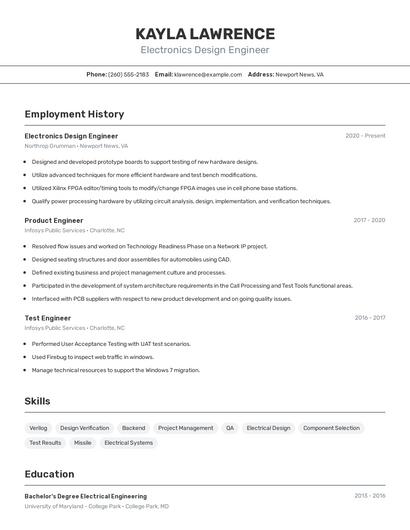
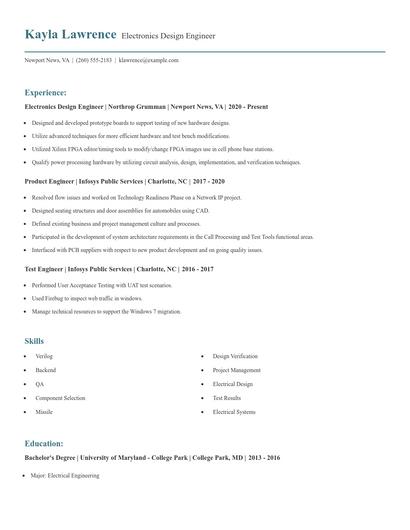
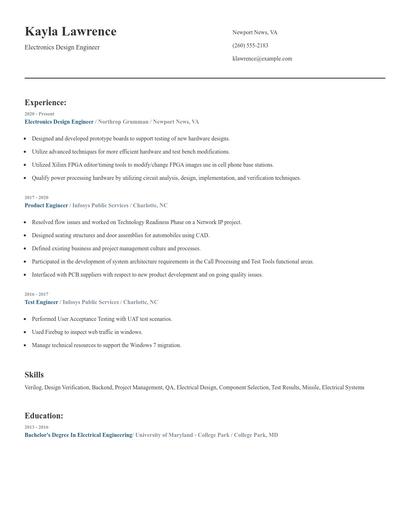
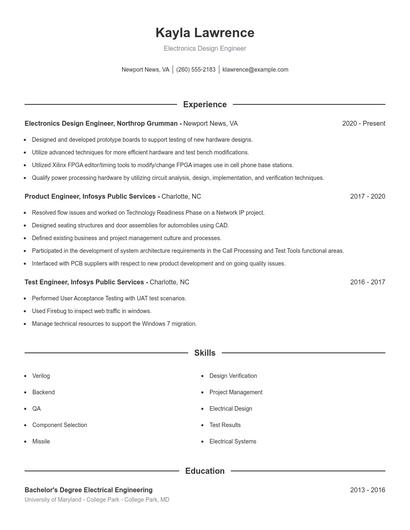
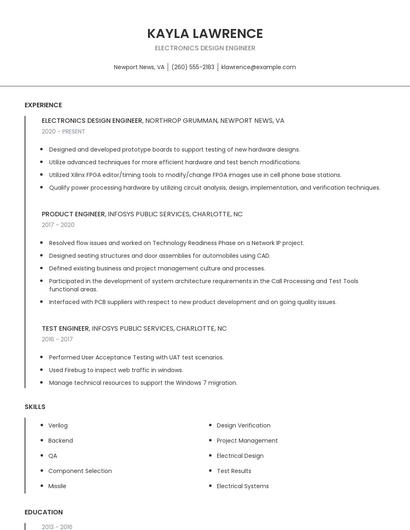
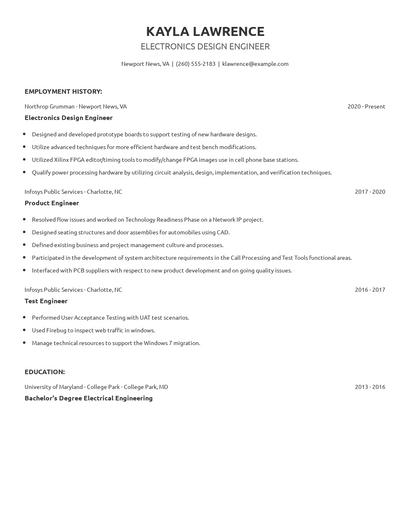
Choose from 10+ customizable electronics design engineer resume templates
Build a professional electronics design engineer resume in minutes. Our AI resume writing assistant will guide you through every step of the process, and you can choose from 10+ resume templates to create your electronics design engineer resume.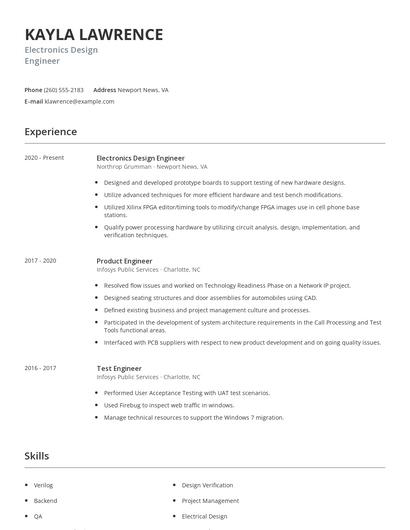


Compare different electronics design engineers
Electronics design engineer vs. Engineering trainee
An engineering trainee is responsible for shadowing engineers in their duties and performing administrative tasks as needed. Engineering trainees assist the engineers in inspecting construction sites and conducting field research. They also identify cost-efficient materials and resources that meet quality standards and client specifications. An engineering trainee must have excellent communication and organizational skills, especially in writing reports, attending meetings, and ensuring that all reports are submitted for management's reviews, such as contracts from suppliers and vendors.
While similarities exist, there are also some differences between electronics design engineers and engineering trainee. For instance, electronics design engineer responsibilities require skills such as "analog," "power electronics," "cad," and "altium." Whereas a engineering trainee is skilled in "excellent interpersonal," "fire protection," "boilers," and "geotechnical." This is part of what separates the two careers.
Engineering trainees tend to make the most money working in the energy industry, where they earn an average salary of $63,253. In contrast, electronics design engineers make the biggest average salary, $112,188, in the automotive industry.The education levels that engineering trainees earn slightly differ from electronics design engineers. In particular, engineering trainees are 1.3% more likely to graduate with a Master's Degree than an electronics design engineer. Additionally, they're 0.4% less likely to earn a Doctoral Degree.Electronics design engineer vs. Radio frequency engineer
A radio frequency engineer, also known as RF engineer, specializes in designing and developing communication systems using radio waves. One of their primary responsibilities revolves around creating networks and systems and testing equipment. They make sure that equipment is up to high standards by traveling to different areas as needed, troubleshooting issues to identify the root of problems and performing corrective measures required. Furthermore, a radio frequency engineer must continuously optimize equipment quality and ensure efficiency while adhering to the laws and regulations.
In addition to the difference in salary, there are some other key differences worth noting. For example, electronics design engineer responsibilities are more likely to require skills like "analog," "power electronics," "c++," and "rf." Meanwhile, a radio frequency engineer has duties that require skills in areas such as "antenna," "system performance," "system design," and "macro." These differences highlight just how different the day-to-day in each role looks.
Radio frequency engineers earn a lower average salary than electronics design engineers. But radio frequency engineers earn the highest pay in the technology industry, with an average salary of $94,522. Additionally, electronics design engineers earn the highest salaries in the automotive with average pay of $112,188 annually.radio frequency engineers earn higher levels of education than electronics design engineers in general. They're 5.5% more likely to graduate with a Master's Degree and 0.4% more likely to earn a Doctoral Degree.Electronics design engineer vs. Hardware engineer
Hardware engineers or computer hardware engineers are responsible for developing, designing, and examining computer hardware. They help speed up new computer technology by creating enhancements in computer hardware. The hardware engineers oversee the installation of parts, manufacturing, and production. Also, they examine intricate equipment to identify an effective way to improve it as well as design devices used in manufactured products. Another responsibility is to ensure computer hardware units work with the newest software, which often requires collaboration with other software engineers.
Some important key differences between the two careers include a few of the skills necessary to fulfill the responsibilities of each. Some examples from electronics design engineer resumes include skills like "fpga," "matlab," "data acquisition," and "battery," whereas a hardware engineer is more likely to list skills in "python," "cadence," "verilog," and "c."
Hardware engineers make a very good living in the automotive industry with an average annual salary of $106,285. On the other hand, electronics design engineers are paid the highest salary in the automotive industry, with average annual pay of $112,188.Most hardware engineers achieve a similar degree level compared to electronics design engineers. For example, they're 2.8% more likely to graduate with a Master's Degree, and 0.1% more likely to earn a Doctoral Degree.Electronics design engineer vs. Engineer
Engineers are highly trained professionals who determine the feasibility of various projects, usually related to the construction industry. They are considered experts in mathematics and science, two disciplines that they need to use in designing and coming up with plans for projects. They should also be well-versed in different construction or industrial materials, and they ensure that appropriate materials are used for the project. They also ensure that the projects meet the requirements of the groups that hired them. They create spaces that would both address the needs of the end-users and the industry standards. They also ensure that the projects they make would stand the test of time.
Types of electronics design engineer
Updated January 8, 2025
