What does an electronics tester do?
Electronics tester responsibilities
Here are examples of responsibilities from real electronics tester resumes:
- Assemble RF antennas using circuit boards, dipoles, and soldering irons.
- Experience in SMT automate and manual techniques.
- Test and troubleshot PC board per ICP-A-600C.
- Mark PC boards with grade and acceptance-rejection status.
- Test and troubleshot assemblies and or final systems.
- Test cell phone software, run and maintain test plans.
- Perform functional and RF testing on complete units to ensure proper functionality.
- Test and troubleshoot prototypes base on engineering design for military uses age.
- Organize daily schedule for assign T1 circuit migrations into remote test units.
- Test and confirm new circuits , 256k and T1 circuits for businesses.
- Set up data, diagnose and troubleshoot different problems before being ship to customer.
- Test performance and troubleshot issues of electromechanical assemblies and analysis system.
- Check ESN then scan into computer.
- Contract trough Adecco a staffing agency.
Electronics tester skills and personality traits
We calculated that 13% of Electronics Testers are proficient in Test Results, Level Troubleshooting, and Manual Tests. They’re also known for soft skills such as Dexterity, Math skills, and Mechanical skills.
We break down the percentage of Electronics Testers that have these skills listed on their resume here:
- Test Results, 13%
Documented test results in the computer tracking system and maintained logs to generate daily reports of production.
- Level Troubleshooting, 11%
Provide first level troubleshooting support in order to resolve minor to moderately complex assembly line problems.
- Manual Tests, 10%
Load units into test fixture and make necessary connections to perform manual test as well as computerized test.
- Transducers, 10%
Operated assembly equipment associated with the manufacture of ultrasound transducers.
- Surface Mount, 7%
Repair circuit cards using soldering techniques for through-hole and surface mount components.
- Test Procedures, 7%
Followed Functional Test procedures to verify proper function en every electronic unit.
Common skills that an electronics tester uses to do their job include "test results," "level troubleshooting," and "manual tests." You can find details on the most important electronics tester responsibilities below.
Math skills. Another soft skill that's essential for fulfilling electronics tester duties is math skills. The role rewards competence in this skill because "knowledge of basic math is important for measuring, calibrating, and calculating specifications in quality control testing." According to an electronics tester resume, here's how electronics testers can utilize math skills in their job responsibilities: "applied basic mathematical skills to solve technical problems. "
Mechanical skills. This is an important skill for electronics testers to perform their duties. For an example of how electronics tester responsibilities depend on this skill, consider that "quality control inspectors use tools and machinery when testing products." This excerpt from a resume also shows how vital it is to everyday roles and responsibilities of an electronics tester: "performed mechanical assembly from sub-assembly level (pc-board) and final assembly level (full device) from production line. ".
Physical strength. For certain electronics tester responsibilities to be completed, the job requires competence in "physical strength." The day-to-day duties of an electronics tester rely on this skill, as "quality control inspectors may be required to lift or maneuver heavy production materials or finished products." For example, this snippet was taken directly from a resume about how this skill applies to what electronics testers do: "analyze and determine the physical and operational state of a variety of pre-owned electronic products. "
Technical skills. A commonly-found skill in electronics tester job descriptions, "technical skills" is essential to what electronics testers do. Electronics tester responsibilities rely on this skill because "to ensure that products and parts meet quality standards, inspectors must understand the relevant blueprints, technical documents, and manuals." You can also see how electronics tester duties rely on technical skills in this resume example: "followed schematics, assembly drawings and technical prints in assembly process. "
The three companies that hire the most electronics testers are:
- Lockheed Martin3 electronics testers jobs
- Microchip Technology2 electronics testers jobs
- Elwood Staffing2 electronics testers jobs
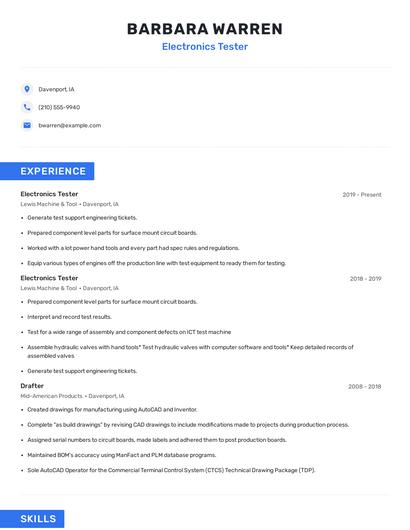
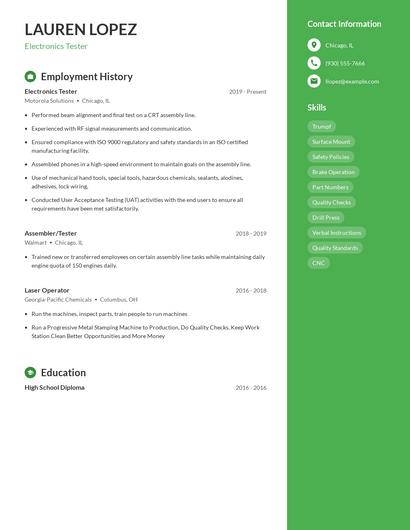
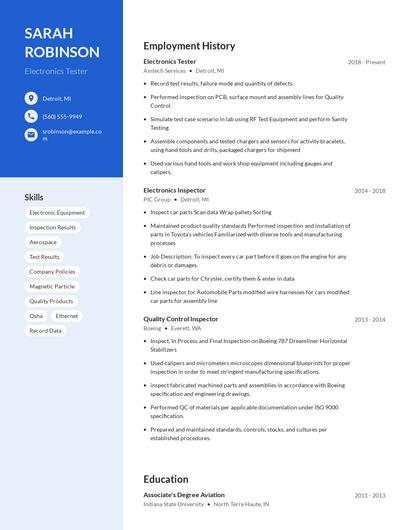
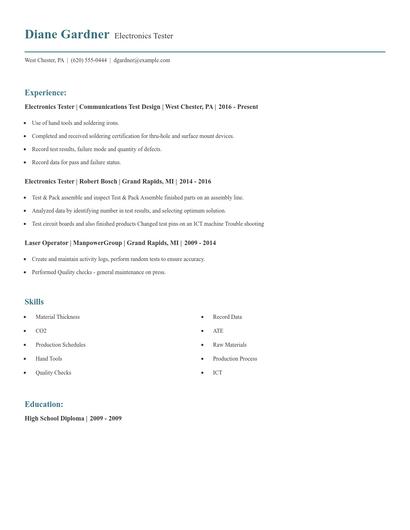
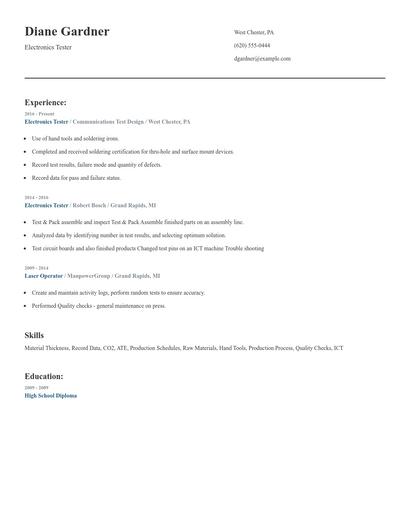
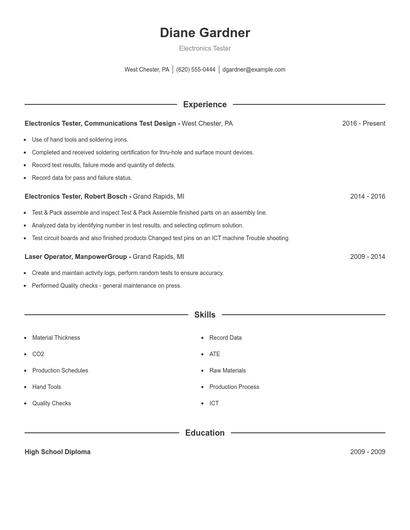
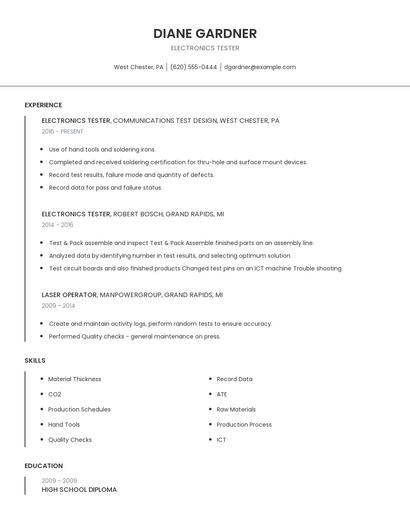
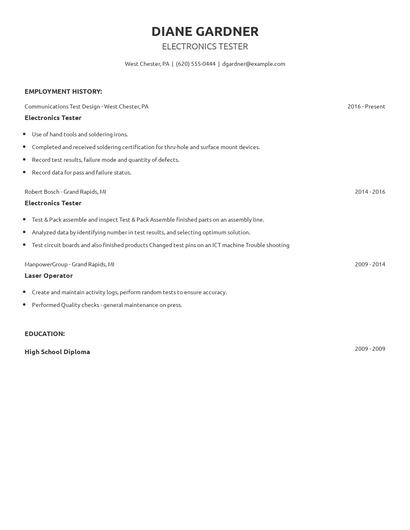
Choose from 10+ customizable electronics tester resume templates
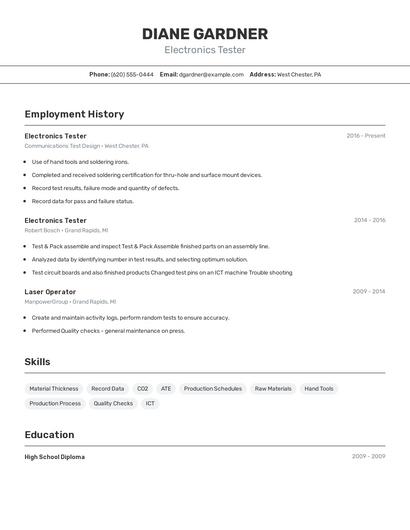
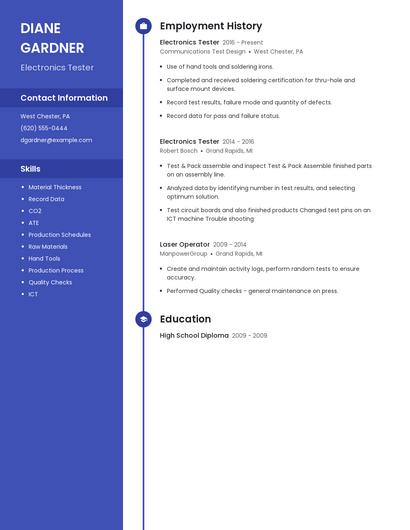
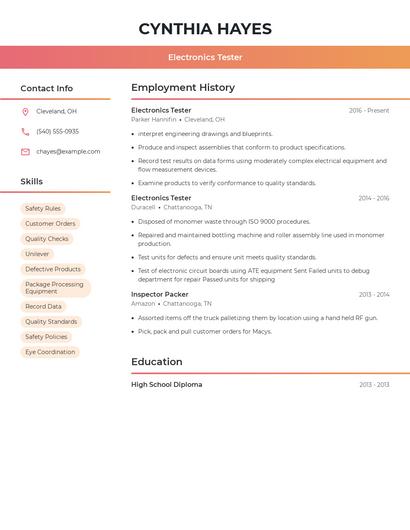
Build a professional electronics tester resume in minutes. Our AI resume writing assistant will guide you through every step of the process, and you can choose from 10+ resume templates to create your electronics tester resume.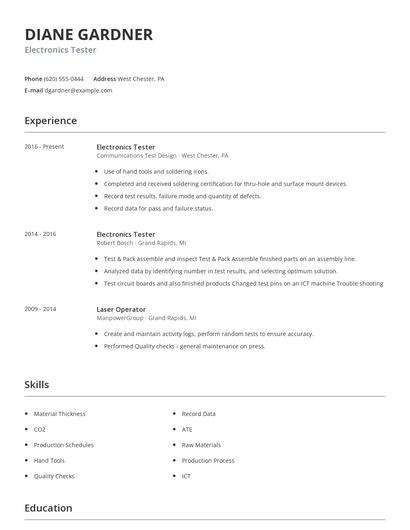
Compare different electronics testers
Electronics tester vs. Operations inspector
Receiving associates are responsible for receiving, unloading, and stocking merchandise in stockrooms. They check the quality and quantity of each product before stocking them. It is also their job to keep a record of incoming merchandise in the store's computer system. Other tasks include verifying documents and reports against the unloaded merchandise and updating sales reports regularly and accurately. Additionally, they maintain and manage stockroom records, inventories, and reports ensuring that everything is in order and systematic.
There are some key differences in the responsibilities of each position. For example, electronics tester responsibilities require skills like "test results," "level troubleshooting," "manual tests," and "transducers." Meanwhile a typical operations inspector has skills in areas such as "safety procedures," "gmp," "inspection equipment," and "cmm." This difference in skills reveals the differences in what each career does.
Operations inspectors really shine in the technology industry with an average salary of $32,111. Comparatively, electronics testers tend to make the most money in the telecommunication industry with an average salary of $36,856.The education levels that operations inspectors earn slightly differ from electronics testers. In particular, operations inspectors are 1.1% less likely to graduate with a Master's Degree than an electronics tester. Additionally, they're 0.2% less likely to earn a Doctoral Degree.Electronics tester vs. Receiving inspector
Quality Assurance Auditors are employees who ensure the adherence of other employees to company processes and guidelines. They are expected to be experts on quality assurance processes and procedures. They also have in-depth knowledge of the expected outcomes of such processes to ensure that the company only provides quality products and services. Quality assurance auditors are also familiar with regulatory laws and policies of governing bodies that oversee companies in their particular industry. They ensure that their companies are compliant and may conduct random quality checks every now and then.
Each career also uses different skills, according to real electronics tester resumes. While electronics tester responsibilities can utilize skills like "test results," "level troubleshooting," "manual tests," and "transducers," receiving inspectors use skills like "calipers," "micrometers," "aerospace," and "gd."
On average, receiving inspectors earn a higher salary than electronics testers. Some industries support higher salaries in each profession. Interestingly enough, receiving inspectors earn the most pay in the health care industry with an average salary of $46,575. Whereas electronics testers have higher pay in the telecommunication industry, with an average salary of $36,856.In general, receiving inspectors achieve similar levels of education than electronics testers. They're 0.6% less likely to obtain a Master's Degree while being 0.2% less likely to earn a Doctoral Degree.Electronics tester vs. Quality assurance inspector
A certified welding inspector is primarily in charge of inspecting welding works, ensuring its' strength and quality. Their responsibilities also entail checking safety equipment and materials, understanding project requirements, testing welds to ensure it functions according to its purpose, and evaluating the daily operations of welders to ensure that they adhere to the safety standards and regulations while operating various tools and equipment. Moreover, a certified welding inspector also helps welders by developing welding techniques to optimize operations, teaching the correct welding practices, and maintaining the cleanliness of work areas.
The required skills of the two careers differ considerably. For example, electronics testers are more likely to have skills like "level troubleshooting," "manual tests," "transducers," and "surface mount." But a quality assurance inspector is more likely to have skills like "calipers," "micrometers," "corrective action," and "safety standards."
Quality assurance inspectors make a very good living in the government industry with an average annual salary of $48,138. On the other hand, electronics testers are paid the highest salary in the telecommunication industry, with average annual pay of $36,856.quality assurance inspectors typically earn similar educational levels compared to electronics testers. Specifically, they're 0.4% more likely to graduate with a Master's Degree, and 0.2% more likely to earn a Doctoral Degree.Electronics tester vs. Certified welding inspector
Even though a few skill sets overlap between electronics testers and certified welding inspectors, there are some differences that are important to note. For one, an electronics tester might have more use for skills like "test results," "level troubleshooting," "manual tests," and "transducers." Meanwhile, some responsibilities of certified welding inspectors require skills like "cwi," "pt," "structural steel," and "ndt. "
Certified welding inspectors reach similar levels of education compared to electronics testers, in general. The difference is that they're 0.4% more likely to earn a Master's Degree, and 0.3% more likely to graduate with a Doctoral Degree.Types of electronics tester
Updated January 8, 2025
