What does an engineering scientist do?
An engineering scientist is responsible for designing new technological systems through the evaluation of scientific methods and innovative solutions. Engineering scientists analyze technical parts and components, researching the current engineering trends to meet public demands and interests. They record their observations and discoveries, run multiple diagnostic tests on the outputs to ensure its efficiency and optimal performance to support industrial operations. An engineering scientist also works closely within a group of engineering and designs team to implement procedures that would support findings from its conceptualization to final deliverables.
Engineering scientist responsibilities
Here are examples of responsibilities from real engineering scientist resumes:
- Manage sample inventory via in-house laboratory information management system (LIMS) and implement additional systems for sample and chemical organization.
- Work as a team member building PowerPoint presentations.
- Determine socket port connections using Linux tools and research TCP errors.
- Support design and prototyping of a small, portable numerical control drill tool.
- Deliver on time software models on UNIX / Linux base systems for simulation applications.
- Conduct system level specifications flow down to the sensor level for various DOD and NASA programs.
- Provide system administration, technical, and programming support for DoD image processing computer lab and projects.
- Develop, refine and validate test plans, budget, and schedule prior to performing RF measurements.
- Collaborate with ISO group to establish, update and outline departmental process procedures as required by ISO certification.
- Perform extensive online and book cetacean research, and, prepare PowerPoint slides displaying cetacean information for regions with naval exercises.
- Perform RF susceptibility and leakage testing.
- Research individual target profiling to better eliminate false positives.
- Review functional requirements for specialize HVAC systems on architectural designs.
- Optimize Java applications for robustness, reliability and reduce JVM memory footprint.
- Perform on-site visits to ascertain the validity of physical configuration relating to electrical, structural and HVAC requirements.
Engineering scientist skills and personality traits
We calculated that 11% of Engineering Scientists are proficient in C++, Python, and Data Analysis. They’re also known for soft skills such as Business skills, Problem-solving skills, and Analytical skills.
We break down the percentage of Engineering Scientists that have these skills listed on their resume here:
- C++, 11%
Performed C++ software development as needed during project development.
- Python, 11%
Create lift-off animations of launch vehicles such as ARES I (CLV) using Blender and Python.
- Data Analysis, 9%
Incorporated test equipment software changes that reduced test uncertainty, reduced field-use time and enhanced data analysis capability.
- DOD, 6%
Coordinated with NSA and DoD agencies for certification, approval and fielding of the box.
- Project Management, 4%
Provided project management oversight of a finite element analysis and optimization program for 747 aircraft assembly.
- RF, 4%
Performed RF susceptibility and leakage testing.
Common skills that an engineering scientist uses to do their job include "c++," "python," and "data analysis." You can find details on the most important engineering scientist responsibilities below.
Business skills. To carry out their duties, the most important skill for an engineering scientist to have is business skills. Their role and responsibilities require that "meeting federal standards in aerospace engineering requires business knowledge, including commercial law." Engineering scientists often use business skills in their day-to-day job, as shown by this real resume: "launch vehicle / remote sensing system concept definition - developed business case, customers, suppliers for vehicle. "
Problem-solving skills. Another soft skill that's essential for fulfilling engineering scientist duties is problem-solving skills. The role rewards competence in this skill because "aerospace engineers upgrade designs and troubleshoot problems to improve aircraft, such as for increased fuel efficiency or safety." According to an engineering scientist resume, here's how engineering scientists can utilize problem-solving skills in their job responsibilities: "developed c++ ffmpeg plugin for demonstrating super-resolution on mpeg video clips by converting sd video to hd video in real-time. "
Analytical skills. This is an important skill for engineering scientists to perform their duties. For an example of how engineering scientist responsibilities depend on this skill, consider that "aerospace engineers must be able to evaluate project design elements and propose improvements, if necessary." This excerpt from a resume also shows how vital it is to everyday roles and responsibilities of an engineering scientist: "presented results for discussion and produced a boeing document, which includes an analysis report and a test report. ".
Math skills. A commonly-found skill in engineering scientist job descriptions, "math skills" is essential to what engineering scientists do. Engineering scientist responsibilities rely on this skill because "aerospace engineers use calculus, trigonometry, and other math in their analysis, design, and troubleshooting work." You can also see how engineering scientist duties rely on math skills in this resume example: "research on mathematical alogrithms to predict rf coupling between wire harnesses used in aircraft manufacturing. "
The three companies that hire the most engineering scientists are:
- L3Harris28 engineering scientists jobs
- Amazon22 engineering scientists jobs
- The Aerospace Corporation15 engineering scientists jobs
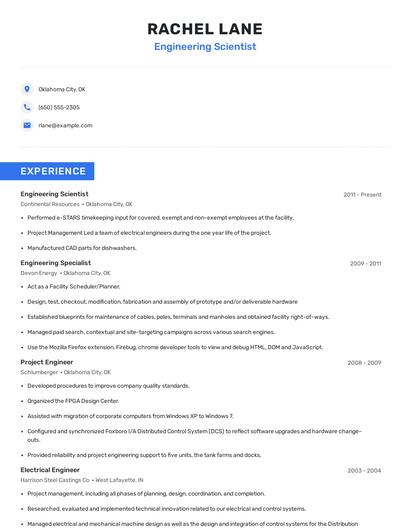
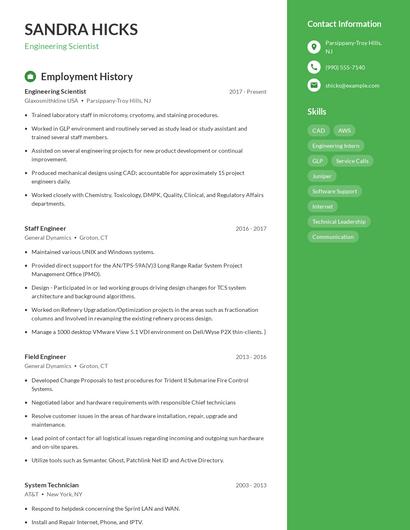
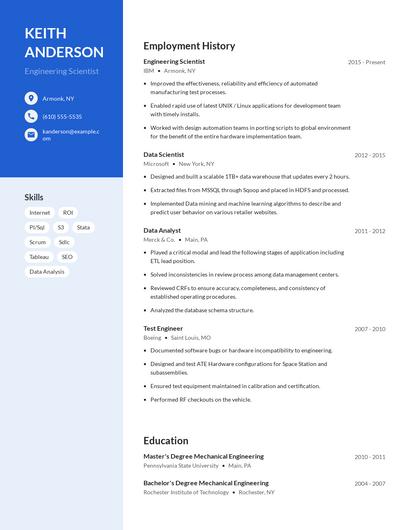
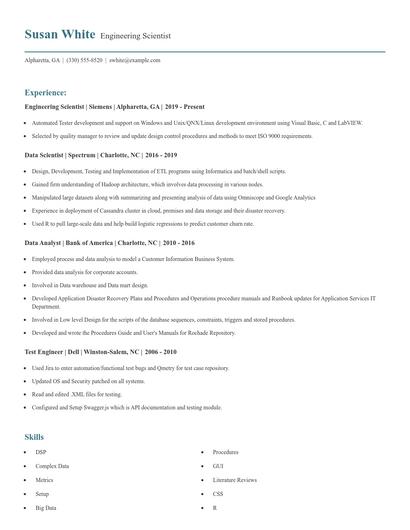
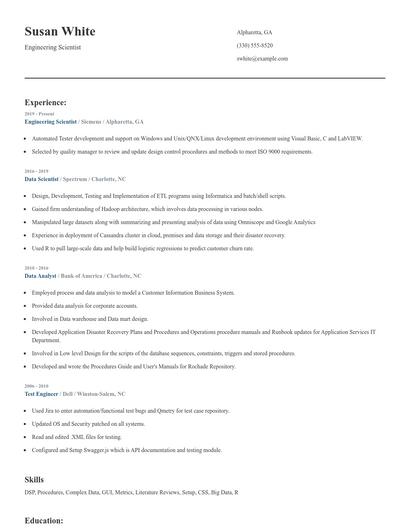
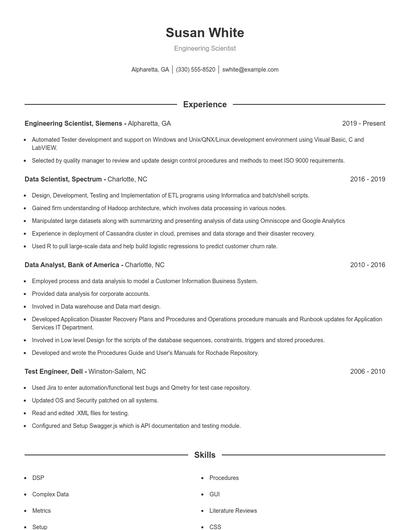
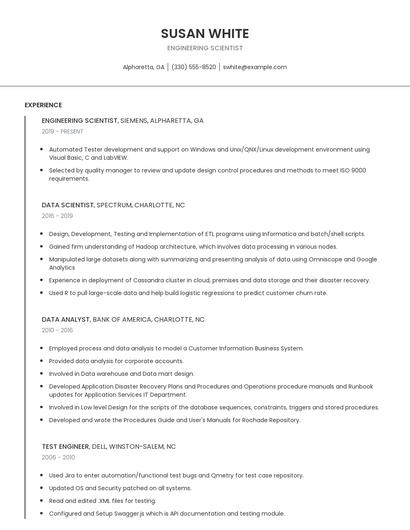
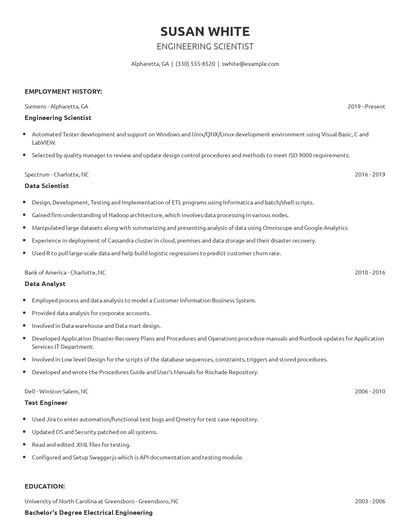
Choose from 10+ customizable engineering scientist resume templates
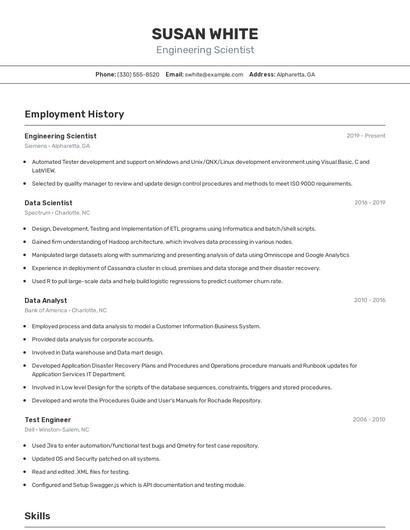
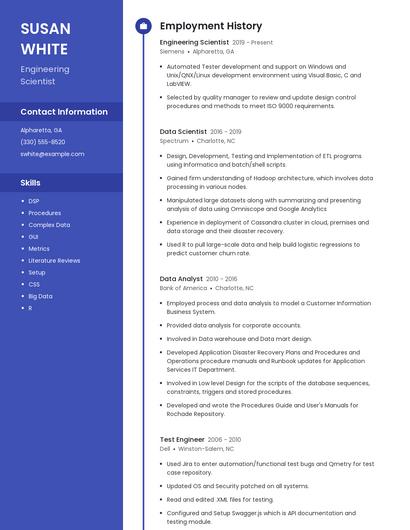
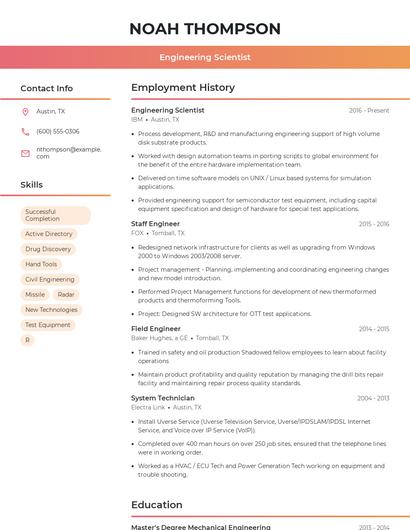
Build a professional engineering scientist resume in minutes. Our AI resume writing assistant will guide you through every step of the process, and you can choose from 10+ resume templates to create your engineering scientist resume.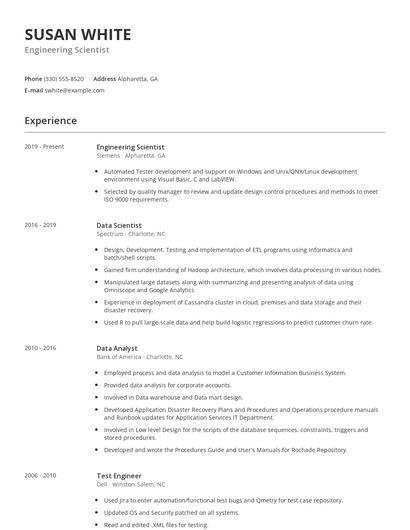
Compare different engineering scientists
Engineering scientist vs. Stress analyst
A stress analyst is a type of aerospace engineer; they design, construct, and test aircraft. They may also work on missiles or spacecraft. They primarily study design requirements for the overall strength of a craft. They analyze the stress data of structural components and prepare mathematical models of issues.
While similarities exist, there are also some differences between engineering scientists and stress analyst. For instance, engineering scientist responsibilities require skills such as "c++," "python," "data analysis," and "dod." Whereas a stress analyst is skilled in "abaqus," "airframe," "structural integrity," and "ansys." This is part of what separates the two careers.
Stress analysts really shine in the manufacturing industry with an average salary of $87,231. Comparatively, engineering scientists tend to make the most money in the automotive industry with an average salary of $95,339.stress analysts tend to reach higher levels of education than engineering scientists. In fact, stress analysts are 6.0% more likely to graduate with a Master's Degree and 2.7% less likely to have a Doctoral Degree.Engineering scientist vs. Senior structural designer
A senior structural designer designs structures such as bridges, dams, parks, or telecommunication structures. They create designs, document them, and analyze structural functionality. Frequently, they must attend meetings and seminars to distribute designs to junior structural designers. They also perform peer reviews and write reports.
While some skills are similar in these professions, other skills aren't so similar. For example, resumes show us that engineering scientist responsibilities requires skills like "c++," "python," "data analysis," and "dod." But a senior structural designer might use other skills in their typical duties, such as, "revit," "structural design," "navisworks," and "bim."
Senior structural designers may earn a higher salary than engineering scientists, but senior structural designers earn the most pay in the utilities industry with an average salary of $101,786. On the other hand, engineering scientists receive higher pay in the automotive industry, where they earn an average salary of $95,339.In general, senior structural designers achieve lower levels of education than engineering scientists. They're 13.6% less likely to obtain a Master's Degree while being 2.7% less likely to earn a Doctoral Degree.Engineering scientist vs. Structural analysis engineer
A Structural Analysis Engineer is responsible for evaluating the construction processes of establishments and other industrial properties and ensuring adherence to high-quality standards. Structural Analysis Engineers assess the materials and equipment used for the operations to confirm compliance with the budget limitations and timetables. They also check the structures and foundations of the construction and recommend techniques to enhance the element integrity. A Structural Analysis Engineer designs construction plans, conduct cost and statistical analysis, and coordinates with the clients for progress updates and any adjustments.
The required skills of the two careers differ considerably. For example, engineering scientists are more likely to have skills like "c++," "dod," "project management," and "rf." But a structural analysis engineer is more likely to have skills like "structural analysis," "analysis tools," "structural integrity," and "finite element analysis."
Structural analysis engineers earn the best pay in the transportation industry, where they command an average salary of $97,631. Engineering scientists earn the highest pay from the automotive industry, with an average salary of $95,339.When it comes to education, structural analysis engineers tend to earn higher degree levels compared to engineering scientists. In fact, they're 6.9% more likely to earn a Master's Degree, and 3.7% more likely to graduate with a Doctoral Degree.Engineering scientist vs. Avionics systems engineer
Avionics systems engineers conduct research development problems associated with aviation, essentially instrument landing systems and other safety instruments for aircraft vehicles. They are a subspecialty of the field of aerospace engineering. They also inspect, adjust, test, and repair electronic components of aircraft flight-control systems, navigation, and communication and compile maintenance and overhaul records of the work they do. Avionics systems engineer also adjusts frequencies of the communications apparatus when performing periodic checks on those frequency settings.
Types of engineering scientist
Updated January 8, 2025
