What does a facilities/engineering manager do?
Facilities Engineering Managers are responsible for supervising the maintenance and implementation of infrastructures for an organization's facility, such as heating, air conditioning, ventilation, lighting, and roofing. Their duties include establishing facility standards and design specifications, analyze infrastructure deficiencies, execute preventative plans, and ensure facilities design comply with governmental regulations. They are responsible for assuring the quality of processes and materials, coordinating facility construction, and preparing a senior management report. Facilities Engineering Managers also participate in the mentorship and training sessions of junior staff.
Facilities/engineering manager responsibilities
Here are examples of responsibilities from real facilities/engineering manager resumes:
- Coordinate FDA inspections and lead Cal-FDA audit resulting in export license issuance for clinical trials.
- Manage building maintenance for continuous operation, including repairs, preventive actions and ensuring FDA compliance.
- Manage outside vendors involve with electrical, HVAC, gas, mechanical/pneumatic/fire system renovations.
- Manage QA for research orient development efforts and for high visibility, production focuse development efforts tie to revenue generation.
- Develop PLC programs for machine control.
- Read PLC code for troubleshooting system problems.
- Perform all building maintenance (plumbing, electrical, carpentry, masonry, etc . )
- Create and enforce a safety program in compliance with OSHA regulations and insurance company's recommendations.
- Evaluate and implement changes and additions to equipment and processes to support strict company and OSHA safety guidelines.
- Monitor the maintenance of entire building (includes plumbing, electrical, air conditioning, and heating).
- Develop maintenance and reliability programs and install CMMS.
- Work primarily with capital plant improvements, maintenance performance improvements, including CMMS implementation and multiple EHS initiatives.
- Administer complex capital improvement projects including clean room retrofits, laboratory compress air and nitrogen systems, HVAC improvements.
- Restore CNC machine, implement autonomous maintenance procedures for the operators and preventive maintenance activities to eliminate micro stoppages.
- Perform DFMEA, FMEA, APQP and overseen quality controls.
Facilities/engineering manager skills and personality traits
We calculated that 8% of Facilities/Engineering Managers are proficient in HVAC, Project Management, and Continuous Improvement. They’re also known for soft skills such as Organizational skills, Math skills, and Analytical skills.
We break down the percentage of Facilities/Engineering Managers that have these skills listed on their resume here:
- HVAC, 8%
Administered complex capital improvement projects including clean room retrofits, laboratory compressed air and nitrogen systems, HVAC improvements.
- Project Management, 7%
Handled total project management including cost/schedule scope/quality control/permitting/documentation.
- Continuous Improvement, 5%
Direct and manage all maintenance activities including: maintenance employee development, scheduling, continuous improvement, individual and departmental goals.
- Facilities Engineering, 5%
Direct supervision of site manufacturing and facilities engineering, site facilities maintenance and product equipment design engineering.
- OSHA, 5%
Coordinated with O&M / NASA Safety QC personnel, to assure compliance with DFRC and OSHA requirements.
- CMMS, 5%
Developed maintenance and reliability programs and installed CMMS.
"hvac," "project management," and "continuous improvement" are among the most common skills that facilities/engineering managers use at work. You can find even more facilities/engineering manager responsibilities below, including:
Organizational skills. One of the key soft skills for a facilities/engineering manager to have is organizational skills. You can see how this relates to what facilities/engineering managers do because "architectural and engineering managers keep track of many workers, schedules, and budgets simultaneously." Additionally, a facilities/engineering manager resume shows how facilities/engineering managers use organizational skills: "developed organizational skills in problem-solving, process improvement, and engineering. "
Math skills. Another soft skill that's essential for fulfilling facilities/engineering manager duties is math skills. The role rewards competence in this skill because "architectural and engineering managers use calculus and other mathematics to develop new products and processes." According to a facilities/engineering manager resume, here's how facilities/engineering managers can utilize math skills in their job responsibilities: "performed quantitative analysis of key process indicators to identify opportunities for process improvement. "
Analytical skills. facilities/engineering managers are also known for analytical skills, which are critical to their duties. You can see how this skill relates to facilities/engineering manager responsibilities, because "architectural and engineering managers evaluate information to solve problems." A facilities/engineering manager resume example shows how analytical skills is used in the workplace: "support parking, food service, and leasing business groups with budget analysis and business process improvements. "
Communication skills. facilities/engineering manager responsibilities often require "communication skills." The duties that rely on this skill are shown by the fact that "architectural and engineering managers must effectively convey information and expectations related to projects." This resume example shows what facilities/engineering managers do with communication skills on a typical day: "revised and maintained emergency action plan, preventative maintenance scheduling and formulated plans for internal communications. "
Leadership skills. Another skill commonly found on facilities/engineering manager job descriptions is "leadership skills." It can come up quite often in facilities/engineering manager duties, since "architectural and engineering managers lead teams, which requires an ability to organize, direct, and motivate others." Here's an example from a resume of how this skill fits into day-to-day facilities/engineering manager responsibilities: "coordinated with corporate validation, production and inventory management leadership teams in support of ensuring the new site's fda compliance. "
The three companies that hire the most facilities/engineering managers are:
- M.C. Dean21 facilities/engineering managers jobs
- Clean Harbors4 facilities/engineering managers jobs
- L3Harris3 facilities/engineering managers jobs
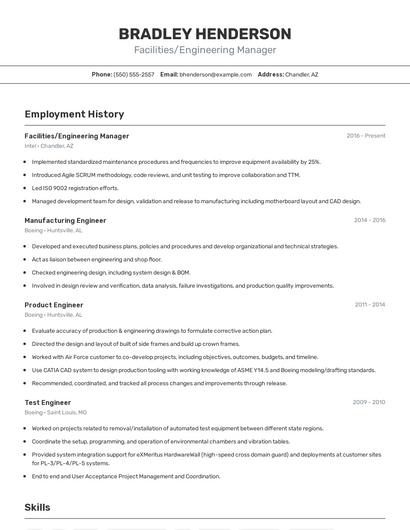
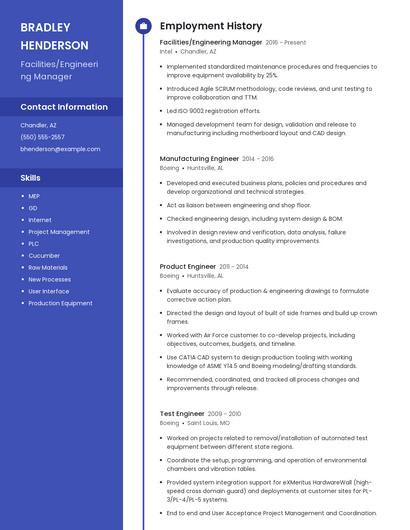
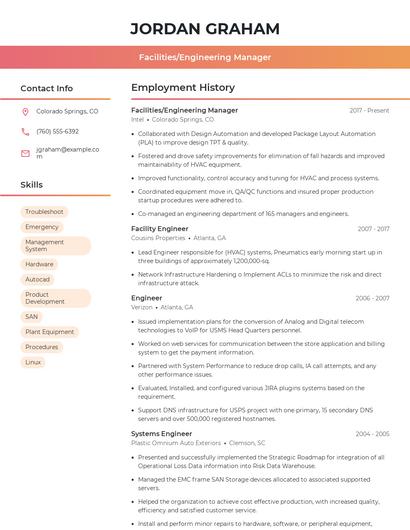
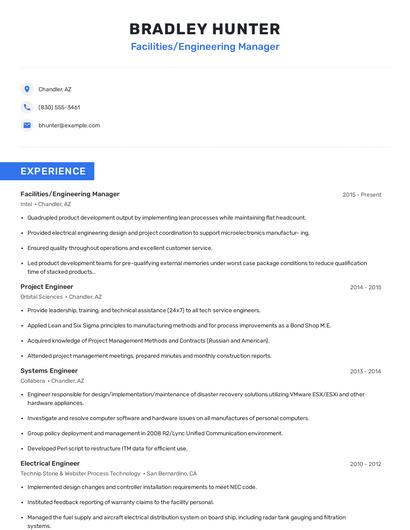
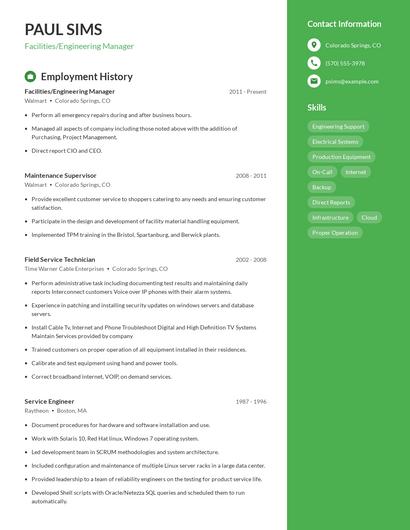
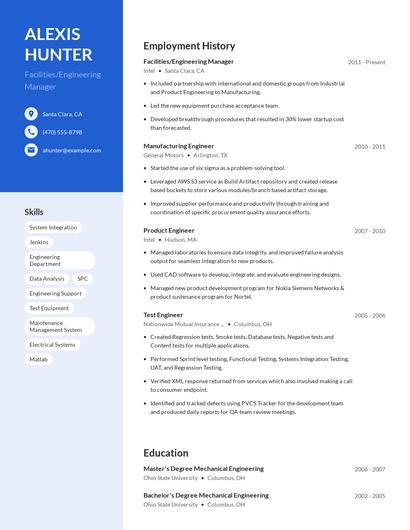
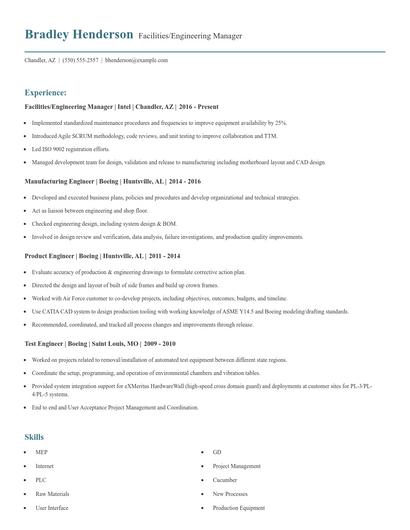
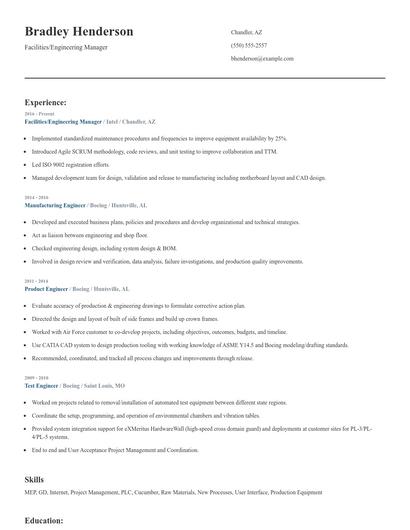
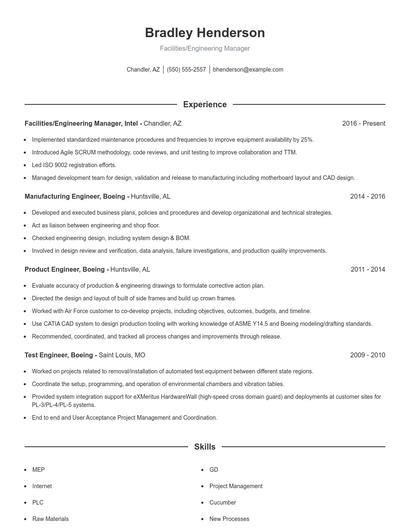
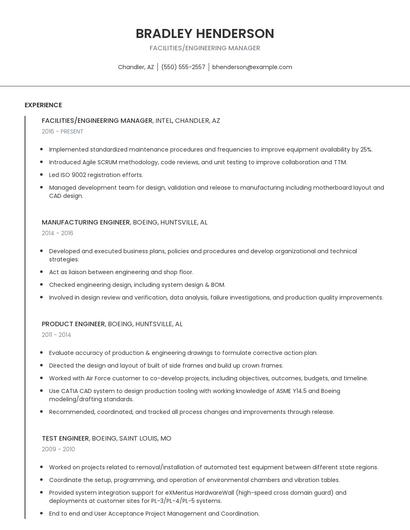
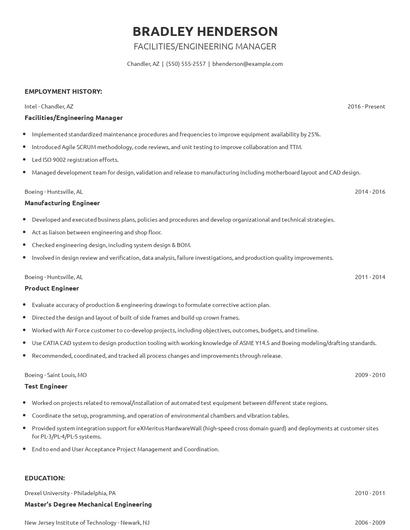
Choose from 10+ customizable facilities/engineering manager resume templates
Build a professional facilities/engineering manager resume in minutes. Our AI resume writing assistant will guide you through every step of the process, and you can choose from 10+ resume templates to create your facilities/engineering manager resume.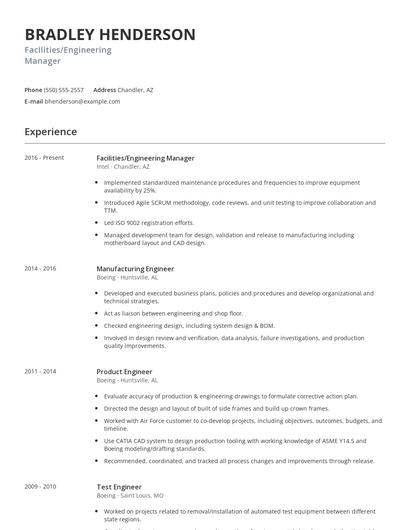
Compare different facilities/engineering managers
Facilities/engineering manager vs. Research and development director
A research and development director spearheads and oversees the research and development initiatives and projects in a company. It is their duty to set goals and guidelines, establish timelines and budgets, direct and manage different departments, liaise with internal and external parties, gather and analyze data to implement solutions against problem areas, and utilize expertise in developing strategies to optimize company operations. Moreover, as a director, it is essential to lead and encourage the workforce to reach goals, all while promoting the company's policies and regulations, creating new ones as needed.
There are some key differences in the responsibilities of each position. For example, facilities/engineering manager responsibilities require skills like "hvac," "continuous improvement," "facilities engineering," and "osha." Meanwhile a typical research and development director has skills in areas such as "product development," "oversight," "business development," and "strategic direction." This difference in skills reveals the differences in what each career does.
Research and development directors earn the highest salaries when working in the finance industry, with an average yearly salary of $167,250. On the other hand, facilities/engineering managers are paid more in the pharmaceutical industry with an average salary of $115,559.research and development directors tend to reach higher levels of education than facilities/engineering managers. In fact, research and development directors are 10.2% more likely to graduate with a Master's Degree and 11.7% more likely to have a Doctoral Degree.Facilities/engineering manager vs. Director of facilities
The director of facilities is responsible for monitoring the facilities' operations, including the inspection of tools, equipment, and machinery, scheduling routine maintenance, and managing resource budgets. Directors of facilities also maintain the safety and security of the facilities, immediately reporting potential risks to avoid hazards within the premises. They facilitate training and programs for the employees to mitigate risks, negotiate with contractors, and coordinate with the management for any facility remodeling and renovation. A director of the facility must have excellent communication and leadership skills, especially for managing staff's performance and needs.
In addition to the difference in salary, there are some other key differences worth noting. For example, facilities/engineering manager responsibilities are more likely to require skills like "continuous improvement," "facilities engineering," "capital projects," and "maintenance management system." Meanwhile, a director of facilities has duties that require skills in areas such as "customer service," "life safety," "patients," and "oversight." These differences highlight just how different the day-to-day in each role looks.
Directors of facilities may earn a lower salary than facilities/engineering managers, but directors of facilities earn the most pay in the media industry with an average salary of $87,213. On the other hand, facilities/engineering managers receive higher pay in the pharmaceutical industry, where they earn an average salary of $115,559.Average education levels between the two professions vary. Directors of facilities tend to reach higher levels of education than facilities/engineering managers. In fact, they're 5.0% more likely to graduate with a Master's Degree and 11.7% more likely to earn a Doctoral Degree.What technology do you think will become more important and prevalent for facilities/engineering managers in the next 3-5 years?
Irene Thomas Johnson
Executive Director, Solutions Development
Facilities/engineering manager vs. Research and development manager
A research and development manager is responsible for supervising project development procedures to support business operations and identify business opportunities that would pave the way for more revenue resources and profits. Research and development managers monitor the production plans from the conceptualization to the final outputs, inspecting inconsistencies and flaws in every phase and revising strategies as needed to achieve the required specifications and requirements. They delegate tasks to the staff, oversee progress, and conduct research and development programs to maximize productivity and team efforts.
The required skills of the two careers differ considerably. For example, facilities/engineering managers are more likely to have skills like "hvac," "continuous improvement," "facilities engineering," and "osha." But a research and development manager is more likely to have skills like "customer service," "patients," "product development," and "c++."
Research and development managers earn the best pay in the professional industry, where they command an average salary of $143,083. Facilities/engineering managers earn the highest pay from the pharmaceutical industry, with an average salary of $115,559.When it comes to education, research and development managers tend to earn higher degree levels compared to facilities/engineering managers. In fact, they're 9.8% more likely to earn a Master's Degree, and 6.6% more likely to graduate with a Doctoral Degree.Facilities/engineering manager vs. Director, facilities & operations
Directors of facilities operations plan, organize and maintain the operations of an organization's infrastructure systems and facilities. They hire, evaluate, train, discipline, and recommend staff dismissal. These professionals develop, recommend and administer processes, procedures, and policies that support building maintenance operations and grounds maintenance operations. Besides monitoring and overseeing the external contractors' work to ensure the project runs smoothly, these professionals also collect and analyze several complex information and data, such as utility usage and utility costs.
Types of facilities/engineering manager
Updated January 8, 2025
