Explore jobs
Find specific jobs
Explore careers
Explore professions
Best companies
Explore companies
Job outlook for family services coordinators in the United States
Family services coordinator job growth summary. After extensive research, interviews, and analysis, Zippia's data science team found that:
The projected family services coordinator job growth rate is 12% from 2018-2028.
About 52,400 new jobs for family services coordinators are projected over the next decade.
Family services coordinator salaries have increased 13% for family services coordinators in the last 5 years.
There are over 41,367 family services coordinators currently employed in the United States.
There are 112,789 active family services coordinator job openings in the US.
The average family services coordinator salary is $42,856.
Are family services coordinator jobs in demand?
Family services coordinator job and salary trends over time
Family services coordinator jobs over time
Family services coordinator job growth rate over time
| Year | # of jobs | % of population |
|---|---|---|
| 2021 | 41,367 | 0.01% |
| 2020 | 40,329 | 0.01% |
| 2019 | 40,412 | 0.01% |
| 2018 | 39,407 | 0.01% |
| 2017 | 37,940 | 0.01% |
Average family services coordinator salary over time
Family services coordinator salary by year
| Year | Avg. salary | Hourly rate | % Change |
|---|---|---|---|
| 2026 | $42,856 | $20.60 | +2.6% |
| 2025 | $41,783 | $20.09 | +3.9% |
| 2024 | $40,222 | $19.34 | +1.9% |
| 2023 | $39,471 | $18.98 | +4.1% |
| 2022 | $37,910 | $18.23 | +3.2% |
Family services coordinator jobs by state
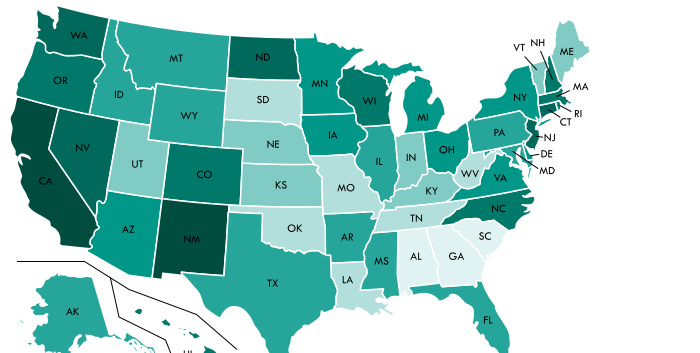
Most common states for family services coordinators
| Rank | State | Population | # of jobs | Employment/ 1000ppl |
|---|---|---|---|---|
| 1 | District of Columbia | 693,972 | 341 | 49% |
| 2 | Kansas | 2,913,123 | 874 | 30% |
| 3 | North Dakota | 755,393 | 229 | 30% |
| 4 | Delaware | 961,939 | 275 | 29% |
| 5 | Massachusetts | 6,859,819 | 1,866 | 27% |
| 6 | Minnesota | 5,576,606 | 1,519 | 27% |
| 7 | South Dakota | 869,666 | 231 | 27% |
| 8 | Alaska | 739,795 | 202 | 27% |
| 9 | Arkansas | 3,004,279 | 783 | 26% |
| 10 | New Mexico | 2,088,070 | 544 | 26% |
| 11 | Iowa | 3,145,711 | 781 | 25% |
| 12 | Vermont | 623,657 | 147 | 24% |
| 13 | Idaho | 1,716,943 | 399 | 23% |
| 14 | New Hampshire | 1,342,795 | 291 | 22% |
| 15 | Washington | 7,405,743 | 1,454 | 20% |
| 16 | Maryland | 6,052,177 | 1,219 | 20% |
| 17 | Nebraska | 1,920,076 | 379 | 20% |
| 18 | Maine | 1,335,907 | 269 | 20% |
| 19 | Oregon | 4,142,776 | 804 | 19% |
| 20 | Rhode Island | 1,059,639 | 204 | 19% |
Most common cities for family services coordinators
| Rank | City | # of jobs | Employment/ 1000ppl | Avg. salary |
|---|---|---|---|---|
| 1 | Hollister | 1 | 3% | $53,205 |
| 2 | Centennial | 1 | 1% | $46,678 |
| 3 | Framingham | 1 | 1% | $46,075 |
| 4 | Anchorage | 1 | 0% | $40,444 |
| 5 | Atlanta | 1 | 0% | $31,081 |
| 6 | Los Angeles | 1 | 0% | $52,047 |
| 7 | San Francisco | 1 | 0% | $53,244 |
Family Services Coordinator job outlook: Expert opinions
Our panel of family services coordinator experts
Texas Southern University

Saint Xavier University
Seattle University

University of Nebraska at Kearney

North Dakota State University

Seattle University

East Tennessee State University

Hartwick College
American University

Frostburg State University
Nancy Shepherd PhD., CFCS
Assistant ProfessorTexas Southern University
Human Development, Family Studies, And Related Services
What general advice would you give to a Family Services Coordinator?
Nancy Shepherd PhD., CFCS: Students should seek strong mentors in the field that will advise them and be able to write reference letters as they progress in the program. These mentors could be faculty, staff, a board member or a boss at work. Volunteer work and service learning in the field looks great on a resume. More importantly it will allow a student to build experience in their area of interest while attending school. It can set individuals apart from others when they are hired and allows someone to ask for more money. Additionally, work experience in the summer, or an internship will build skills and experience to achieve success.
What Family Services Coordinator skills would you recommend for someone trying to advance their career?
Nancy Shepherd PhD., CFCS: In general, employers stress the need for individuals that are good communicators, both verbally and in writing. Specifically in the field, the positions are varied in skill requirements. Good listening and empathy skills are important when dealing with families and young children. Business owners and workers will benefit from soft skills such as critical thinking, problem solving, teamwork, work ethic, professional attitude, and organization.
What will help Family Services Coordinators increase their earning potential?
Nancy Shepherd PhD., CFCS: The family is the center of careers in Human Development. Whether working with young children, the elderly, youth or the entire family, a graduate will want to focus on improving the lives of individuals, families and communities through their chosen position. With this in mind, building on education and applying it in a career will require a continued focus on being open to learning new skills. Finding mentors in the field to seek out with questions will be helpful. A career in Human Development can be very rewarding.
Laura Laskowski-Ferrell
Assistant Professorial Lecturer and Program CoordinatorSaint Xavier University
Education Department
What skills will help Family Services Coordinators earn the most?
Laura Laskowski-Ferrell: -Experience leading professional development
-Experience with schedule development
-Teacher Evaluator Training
-Advising Experience
What soft skills should all Family Services Coordinators possess?
Laura Laskowski-Ferrell: -Timely Communication
-Program Organization
-Visionary Leadership
-Team Player
Dr. Rashmi Chordiya Ph.D.
Assistant ProfessorSeattle University
Institute of Public Service
What soft skills should all Family Services Coordinators possess?
Dr. Rashmi Chordiya Ph.D.: Empathy, cultural intelligence, emotional intelligence, self-awareness, ability to practice calm and loving-kindness with clients.
What skills will help Family Services Coordinators earn the most?
Dr. Rashmi Chordiya Ph.D.: Skills to work with client groups of diverse backgrounds, having a deep understanding and practice of trauma-informed social work, and adaptive leadership skills to adapt to the needs of diverse clients and evolving social and organizational contexts.
Dr. Tami James Moore
Professor of Family ScienceUniversity of Nebraska at Kearney
Department of Counseling, School Psychology & Family Science. College of Education
What skills stand out on Family Services Coordinator resumes?
Dr. Tami James Moore: Academic programs for career preparation are usually housed in Family and Consumer Science or Family Science Departments of U.S. universities. Earning a degree within those programs is a key to career success. Two important certifications that set these professionals above other graduates are the CFLE (Certified Family Life Education by the National Council on Family Relations) and the CFP (Certified Financial Planning). Work experience in family case management (internships and simulated experiences) is also another important career development piece.
What soft skills should all Family Services Coordinators possess?
Dr. Tami James Moore: Problem-solving is one of the most important soft skills in this profession. Clients are usually facing some financial problems before they seek help, so the professional will need to be able to analyze the client's current situation, explore the causes of the situation, and come up with possible solutions. Relational/interpersonal skills, especially empathy and a nonjudgmental attitude, often determine the success or failure of family case management. Professionals must avoid imposing their own perception of needs and their own values onto their client's situations. This is very difficult for new professionals, but with education and guidance, that can be overcome. The ability to be a team player is also essential to success. Individuals and families will accept and implement suggested strategies much more quickly and consistently if they feel that the professional has their best interest at the center of suggested plans.
What hard/technical skills are most important for Family Services Coordinators?
Dr. Tami James Moore: An understanding of family dynamics is equally important to a full understanding of family functioning within the economic system. Information and fact-finding skills are essential (use of internet and professional websites to find data needed for planning and existing services for families to utilize in their efforts to successfully navigate financial matters, time management, and resource allocation.
What skills will help Family Services Coordinators earn the most?
Dr. Tami James Moore: If money is truly the most important motivator to an individual, serving families is probably not the field they should consider. Entry-level jobs will pay less than those that students graduating from a strictly business-based program will probably face. The potential for earnings over time is quite good, however, for graduates in this field. Employment opportunities are strong in both private and public institutions. Governmental management positions (programs created and delivered to address family poverty, housing, and food security) have a high earning potential.
Joel Hektner Ph.D.
Professor and Department HeadNorth Dakota State University
Human Development and Family Science
What hard/technical skills are most important for Family Services Coordinators?
Joel Hektner Ph.D.: Solid knowledge of developmental milestones for children, issues faced by aging adults, and common family relationship challenges.
What skills stand out on Family Services Coordinator resumes?
Joel Hektner Ph.D.: The ability to work with people of all ages and from all backgrounds. The knowledge of how to facilitate the well-being of children, families, and older adults. Being identified as a Certified Family Life Educator (CFLE).
What soft skills should all Family Services Coordinators possess?
Joel Hektner Ph.D.: Interpersonal skills, communication, ability to work collaboratively. Respect for individual and cultural differences.
What skills will help Family Services Coordinators earn the most?
Joel Hektner Ph.D.: The ability to adapt your skills to the context you are in.
Theresa Earenfight Ph.D.
Professor of History, Director, Women, Gender, and Sexuality Studies ProgramSeattle University
History Department
Will there be an enduring impact of the coronavirus pandemic on Family Services Coordinators?
Theresa Earenfight Ph.D.: As a historian of the European Middle Ages, I'm struck by how students this past year have acquired something scarce: historical empathy. The past can seem so remote, so very different from our lived experiences today, and this can make history seem irrelevant. But this fall, I was teaching a section on the bubonic plague, which historians of medicine now know was a global pandemic, not just an epidemic in Europe. Usually, students are fascinated by the gruesome medical details, but not this group.
They did not need or want to look death in the eyes. They wanted to know how did people react? How did they get back to normal? When we ticked off the list of reactions--fear, distrust of science (such as it was in 1348), xenophobia, scapegoating, economic collapse, hoarding supplies, turn to religion, gallows humor about worms crawling about corpses--they got it. When we talked about the aftermath--eat, drink, be merry, and protest the inequality--they got it. That is historical empathy, and I'm sad that this was how it had to be learned, but it will give them broader compassion that can encompass people alive today.
Will there be an enduring impact of the coronavirus pandemic on Family Services Coordinators?
Dr. Frederick Gordon Ph.D.: Graduate students will need to refocus on the changing institutional role, being both remote and in-person, and impacting agency goals and performance.
What type of skills will young Family Services Coordinators need?
Dr. Frederick Gordon Ph.D.: Budgeting skills are essential, as well as apparent, logical written ability.
Namita Sugandhi Ph.D.
Assistant Professor of AnthropologyHartwick College
Anthropology Department
What technology do you think will become more important and prevalent for Family Services Coordinators in the next 3-5 years?
Namita Sugandhi Ph.D.: Documentation and public engagement will remain crucial parts of Anthropological work, and technology that allows us to record, analyze, and share data will continue to be necessary. Over the next several years, it will be essential to find new and innovative ways of connecting virtually to audiences' broader network. This will require the ability to think out-of-the-box and adapt to unique circumstances and new technologies. Technologies that allow people to build relationships across space will continue to transform how we experience social life. Those who are new to the job market will have to master these new virtual strategies of communication and self-promotion and need to understand and navigate the impact of this pandemic on the non-virtual world.
How do you envision technology impacting Family Services Coordinators in the next 5 years?
Dr. Adelaide Kelly-Massoud: Well, every teacher and teacher candidate was thrust into distance learning. Misguided attempts to foster understanding often leaned our adult distant learning pedagogy. Teachers, and those who prepare teachers, found their job to research, define, design, and implement meaningful teaching and learning using a virtual platform. Words such as synchronous and asynchronous are now a part of our everyday vernacular. But there is a much more optimistic change on the horizon that we can thank coronavirus for.
Communication and collaboration have been forced to change. Parents and Teachers are more connected and have been put in a position to leverage technology to build networks of support and consistent dialog. I urge teachers to leverage this in their future as we work to reopening schools; we should learn from this experience to leverage technology to keep us connected.
Will there be an enduring impact of the coronavirus pandemic on Family Services Coordinators?
Dr. Adelaide Kelly-Massoud: How could there not be? The coronavirus era's teacher candidates are leveraged to be the most influential teachers in our nation's history. I believe this to be true. Children, across the country and world, have been exposed to social isolation, a disruption in learning, political, and social unrest. Now, more than ever, students, ALL students, need teachers who can create the therapeutic learning environments that will allow students to thrive once again. Access and inequity have long plagued our academic system and led to significant and horrifying achievement gaps. The coronavirus forced that outside education to see the disparities play out on their television screens and social media feeds. As the quarantine lifestyle became the new norm, the divide grew. Those who could, and were willing to pay, could maintain face-to-face instruction, while others struggle to get access to technology.
Students whose academic career is driven by the goal setting and progress monitoring, often used in special education, were sent home for parents and teachers struggling to find a way to make things work. Enduring impacts on our graduates aren't all negative. I think teacher candidates that worked through the coronavirus and pursued a degree and have both a level of commitment and a clear image of teaching demands. I believe they saw first-hand how bad things can be and how vital their role is. I am optimistic that a silver lining to a terrible year is that teacher candidates persevered for their future students and that this quality is now deeply ingrained in their craft.
Jamelyn Tobery-Nystrom
Coordinator of M.Ed. Special EducationFrostburg State University
Educational Professions
What type of skills will young Family Services Coordinators need?
Jamelyn Tobery-Nystrom: Special education needs are wide and varying, depending on position and state/jurisdiction needs. In general, knowledge and experience in the Autism Spectrum is a high need area. Knowledge and skills in behavioral/mental health are also in demand. Indeed, due to the COVID-19 pandemic, the ability to adapt instruction online is a new skill area for special education teachers.