What does a flight engineer do?
A Flight Engineer monitors and controls various aircraft systems, such as airplanes and helicopters. They ensure that all components of the plane are in proper working order, as well as diagnose and rectify problems that may arise.
Flight engineer responsibilities
Here are examples of responsibilities from real flight engineer resumes:
- Manage and execute all aircraft grind servicing as well as security for USAF assets abroad.
- Lead several Russian inspectors during a highly-visible reentry vehicle inspection on-site inspection - commend for superb leadership
- Perform operational checks on helicopter systems and subsystems to isolate and facilitate troubleshooting of malfunctions.
- Modify airframe for customer options.
- Work are performed in compliance with applicable U.S. Government and DoD regulations, guidance, policies and procedures.
- Develop flight dynamics math models in FORTRAN for the simulators of FAA approve business class aircraft using flight test data.
- Develop and deliver advance instruction for highly classify special access program in line with all U.S. policy and USAF requirements.
- Develop and maintain training syllabus.
- Ensure continuity to prescribe formal training school syllabus standards.
- Provide analysis to pilots on local FAA and international flight requirements.
- Use specialize installation tooling and inspection jigs to verify assembly standards.
- Supervise and develop weapon and tactics procedures for combat and non-combat operations.
- Implement deployment readiness procedures that enable rapid employment of multiple helicopter crews and equipment.
- Research technical orders and assist in design, and conduct tests to determine suitability of simulator performance.
- Coordinate maintenance repair actions and perform necessary unschedule repairs in order to ensure readiness of combat aircraft.
Flight engineer skills and personality traits
We calculated that 10% of Flight Engineers are proficient in FAA, Flight Operations, and Simulator. They’re also known for soft skills such as Communication skills, Quick reaction time, and Problem-solving skills.
We break down the percentage of Flight Engineers that have these skills listed on their resume here:
- FAA, 10%
Provided analysis to pilots on local FAA and international flight requirements.
- Flight Operations, 9%
Coordinated with maintenance engineering, flight operations and ground staff to ensure passenger safety and on-time operations.
- Simulator, 8%
Administered numerous simulator and aircraft flight evaluations ensuring crew member compliance with all regulations and procedures regarding the KC10A aircraft.
- DOD, 7%
Worked as a UH-60 helicopter repair man while performing aerial medical evacuations throughout Germany for both, DOD and US personnel.
- Combat, 5%
Trained newly assigned Flight Engineers with the skills necessary to transport cargo/passengers in aerial delivery missions worldwide into combat and non-combat environments
- Technical Problems, 5%
Perform technical flight engineer functions, resolve technical problems encountered by operating units.
"faa," "flight operations," and "simulator" are among the most common skills that flight engineers use at work. You can find even more flight engineer responsibilities below, including:
Communication skills. To carry out their duties, the most important skill for a flight engineer to have is communication skills. Their role and responsibilities require that "pilots must speak clearly when conveying information to air traffic controllers and other crew members." Flight engineers often use communication skills in their day-to-day job, as shown by this real resume: "utilized standard operating procedures, effective crew resource management, communication and procedures specified in the company operation manual. "
Quick reaction time. Many flight engineer duties rely on quick reaction time. "pilots must respond quickly, and with good judgment, to any impending danger.," so a flight engineer will need this skill often in their role. This resume example is just one of many ways flight engineer responsibilities rely on quick reaction time: "maintained a ch47d helicopter to be ready for any mission at all times. "
Problem-solving skills. Another skill that relates to the job responsibilities of flight engineers is problem-solving skills. This skill is critical to many everyday flight engineer duties, as "pilots must be able to identify complex problems and figure out appropriate solutions." This example from a resume shows how this skill is used: "computed aircraft performance data; skilled in troubleshooting and resolution of all aircraft malfunctions while grounded as well as in flight. "
The three companies that hire the most flight engineers are:
- L3Harris42 flight engineers jobs
- SAIC6 flight engineers jobs
- Leidos4 flight engineers jobs
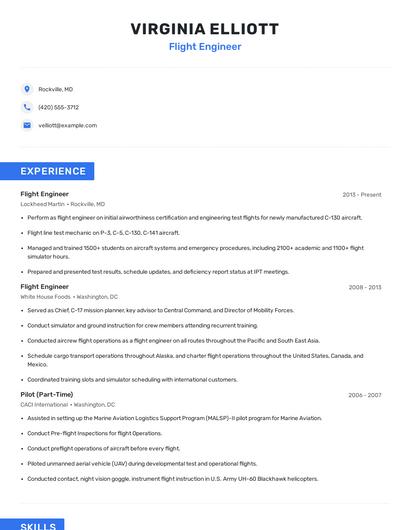
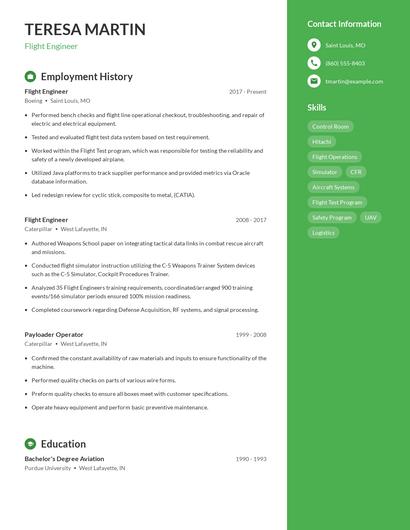
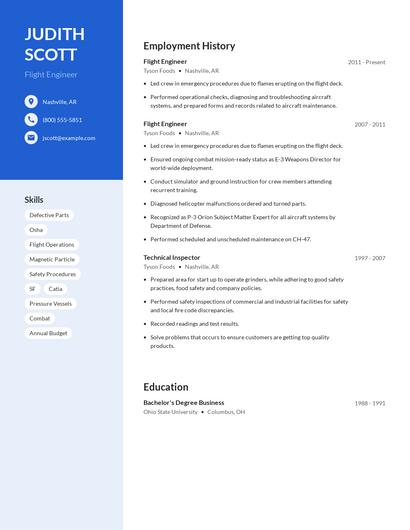
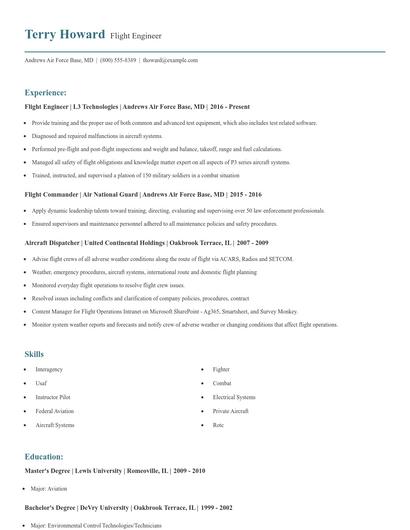
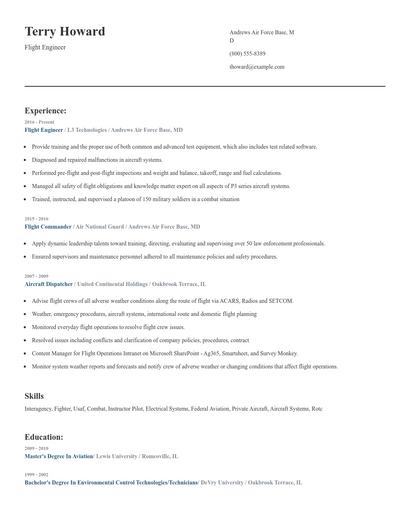
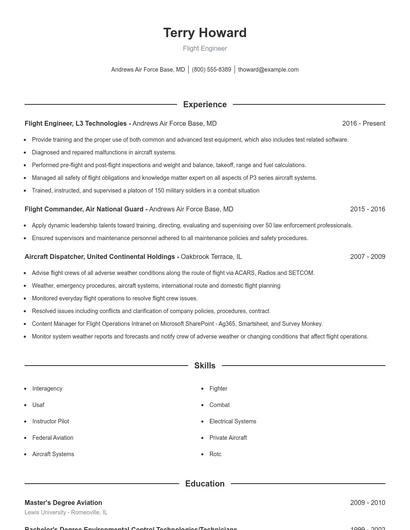
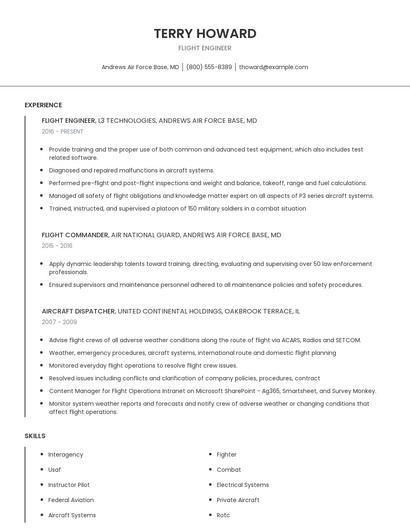
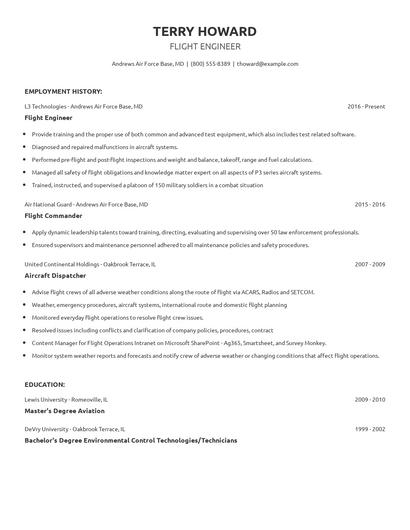
Choose from 10+ customizable flight engineer resume templates
Build a professional flight engineer resume in minutes. Our AI resume writing assistant will guide you through every step of the process, and you can choose from 10+ resume templates to create your flight engineer resume.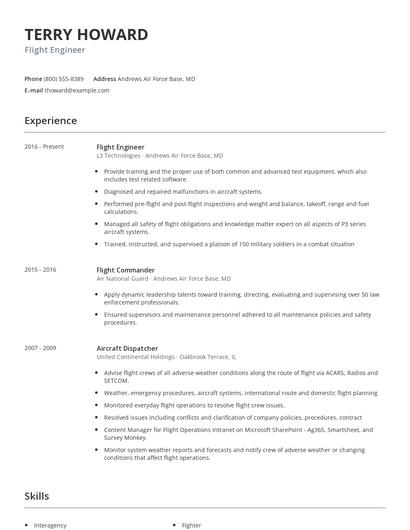
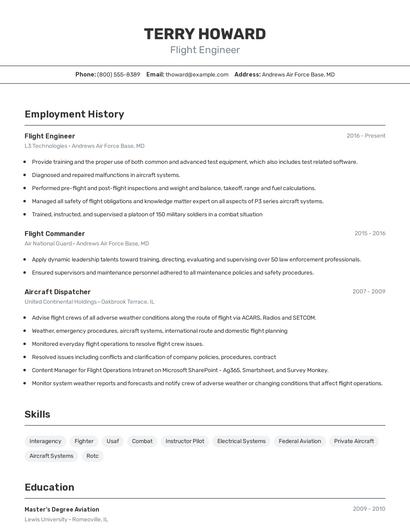
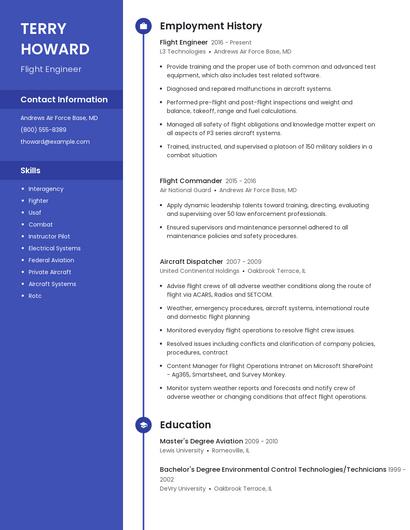
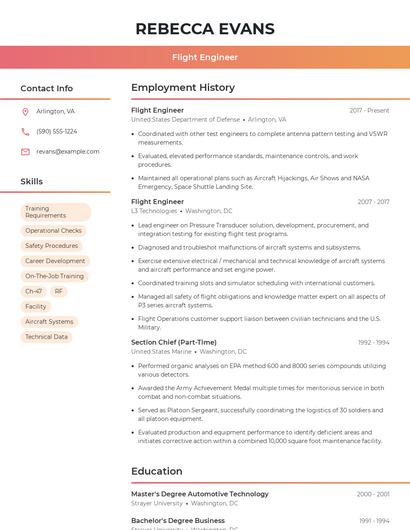
Compare different flight engineers
Flight engineer vs. Air force pilot
Primarily, an Air Force pilot flies aircraft such as bombers, transport planes, unmanned aerial vehicles, and tankers in the U.S. The pilots command their crews to complete training, combat, and other missions. They serve as military aviators who are trained to engage in air-to-ground and air-to-air combat. It is important that they master aviation skills, train, and lead flight crews, and perform flight operations. When not flying, they lead and manage the aircraft maintenance department crew.
While similarities exist, there are also some differences between flight engineers and air force pilot. For instance, flight engineer responsibilities require skills such as "simulator," "technical problems," "helicopter," and "corrective action." Whereas a air force pilot is skilled in "safety procedures," "aircraft systems," "afb," and "instructor pilot." This is part of what separates the two careers.
The education levels that air force pilots earn slightly differ from flight engineers. In particular, air force pilots are 1.3% more likely to graduate with a Master's Degree than a flight engineer. Additionally, they're 0.6% less likely to earn a Doctoral Degree.Flight engineer vs. Airline transport pilot
While some skills are similar in these professions, other skills aren't so similar. For example, resumes show us that flight engineer responsibilities requires skills like "simulator," "dod," "combat," and "technical problems." But an airline transport pilot might use other skills in their typical duties, such as, "new safety," "pic," "atp," and "federal aviation."
Airline transport pilots earn similar levels of education than flight engineers in general. They're 1.3% more likely to graduate with a Master's Degree and 0.6% more likely to earn a Doctoral Degree.Flight engineer vs. Airline captain
Some important key differences between the two careers include a few of the skills necessary to fulfill the responsibilities of each. Some examples from flight engineer resumes include skills like "faa," "simulator," "dod," and "combat," whereas an airline captain is more likely to list skills in "passenger aircraft," "federal aviation administration," "pic," and "federal regulations. "
Airline captains typically earn similar educational levels compared to flight engineers. Specifically, they're 4.7% more likely to graduate with a Master's Degree, and 1.7% more likely to earn a Doctoral Degree.Flight engineer vs. Regional airline pilot
Types of flight engineer
Updated January 8, 2025
