What does a food processor do?
A food processing job involves various tasks to ensure the highest quality of food and ingredients during food preparations in a facility. Food safety processors or food processing workers prepare and preserve various food items, such as canned, baked, frozen, dried, and pasteurized products, and manage their inventory. Aside from working in food production, the food processors also monitor the machinery during cooking and mixing of the ingredients to ensure compliance with the product quality standards. Depending on their specific tasks, these processors must follow strict health, safety food guidelines, and government regulations.
Food processor responsibilities
Here are examples of responsibilities from real food processor resumes:
- Manage and instruct workers in the art of food preparation as culinary team leader.
- Take orders and run cash register.
- Pull pallets of meals into work area using pallet jacks.
- Handle and process numerous types of livestock in strict accordance to USDA guidelines.
- Inspect incoming pallets of package food items for damages and defects prior to distribution to airport vendors.
- Bag groceries, load into cart, and help customers carry and load purchase groceries outside to their vehicles.
- Check and bag groceries, work the produce department, stock shelves, receive shipments, maintain store cleanliness.
- Maintain work area clean and sanitize to meet health and safety food laws on a daily basis to pass USDA inspections.
- Involve in all aspects of a local small business, from assembling gourmet grill sandwiches to preparing meals and serving customers.
- Follow HIPAA regulations to maintain confidentiality of patient information.
- Perform inventory and material management functions with computer and RF scanner.
- Review accounts closely for processing following appropriate FHA loan requirements and guidelines.
- Maintain confidentiality of all company and patient information in accordance with HIPAA regulations.
- Research foreclosure issues and then communicate with attorneys and management to resolve individual account problems, resulting in timely resolution.
- Work directly with mortgage lenders and foreclosure attorneys to negotiate timely and cost effective repayment plans or modifications for delinquent loans.
Food processor skills and personality traits
We calculated that 23% of Food Processors are proficient in Food Safety, Assembly Line, and GMP. They’re also known for soft skills such as Dexterity, Listening skills, and Physical strength.
We break down the percentage of Food Processors that have these skills listed on their resume here:
- Food Safety, 23%
Follow strict food safety guidelines.-Assist with monthly inventory as needed.
- Assembly Line, 12%
Schedule varied$8.55-$10.50Here I worked as manufacturer and food processor on an assembly line.
- GMP, 10%
Adhere to safe work practices, follow GMP s, maintain sanitary conditions and ensure that product quality is maintained.
- Food Preparation, 7%
Set up sites for catering, packaged food, and cleaned food preparation area.
- Food Processing Equipment, 6%
Wash, trim and cut fruits and vegetables, using sharp knives and various industrial food processing equipment.
- Pallet Jack, 6%
Operate forklift, electric pallet jack and other transportation devices to stock, load and unload.
Most food processors use their skills in "food safety," "assembly line," and "gmp" to do their jobs. You can find more detail on essential food processor responsibilities here:
The three companies that hire the most food processors are:
- Cargill15 food processors jobs
- Express Employment Indy South5 food processors jobs
- Adecco4 food processors jobs
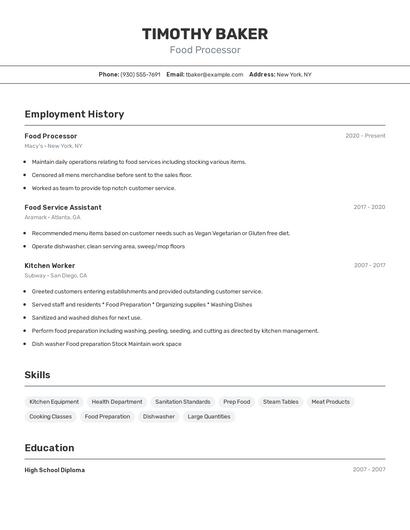
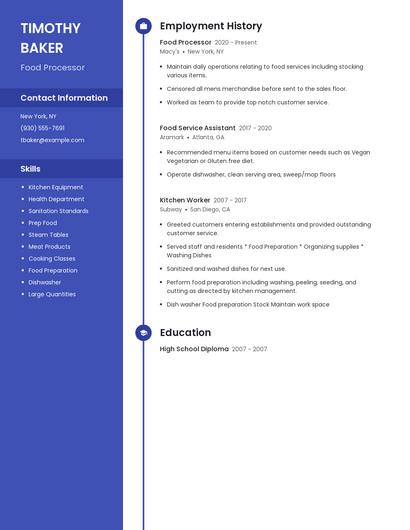
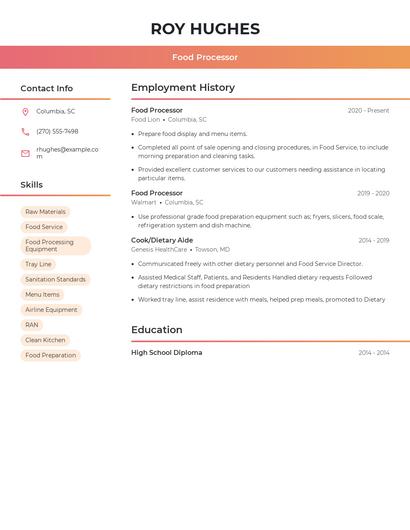
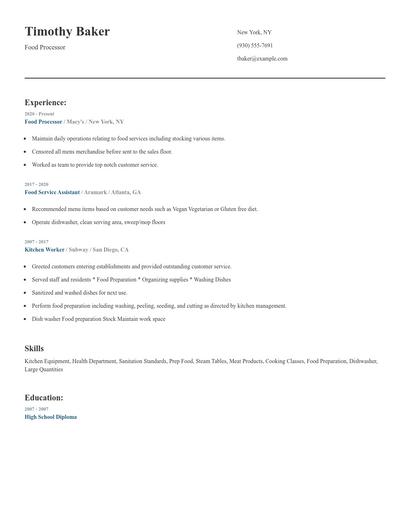
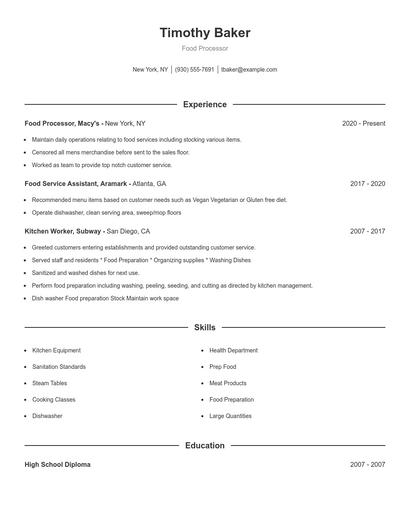
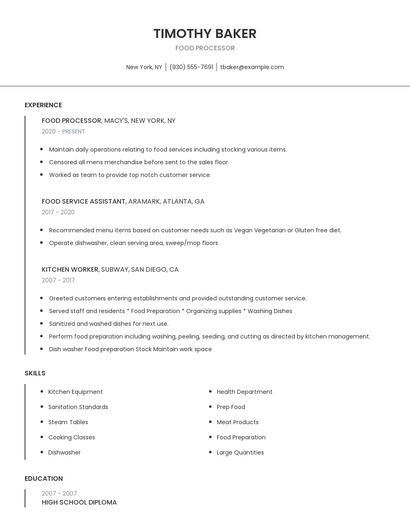
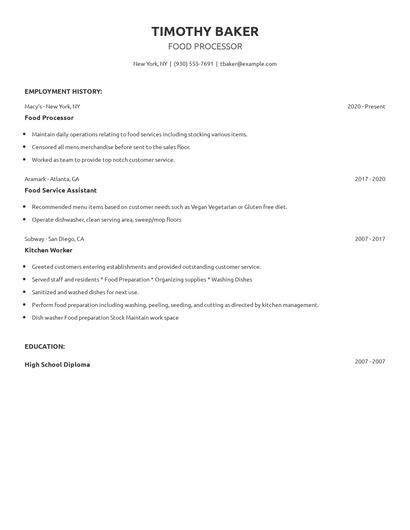
Choose from 10+ customizable food processor resume templates
Build a professional food processor resume in minutes. Our AI resume writing assistant will guide you through every step of the process, and you can choose from 10+ resume templates to create your food processor resume.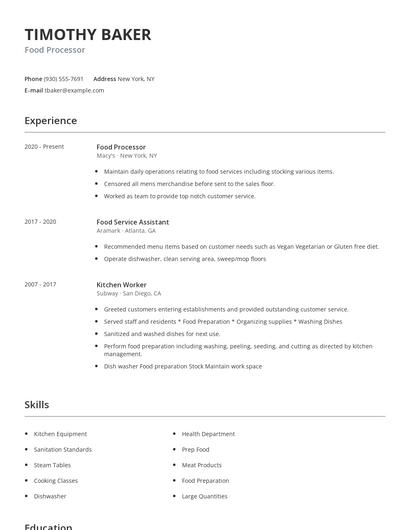
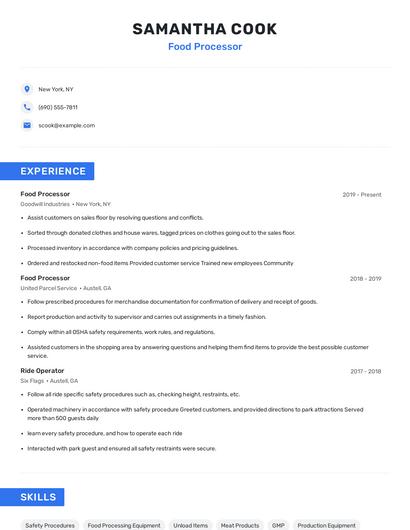
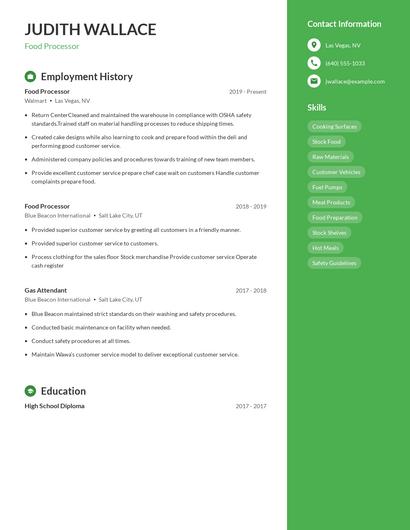
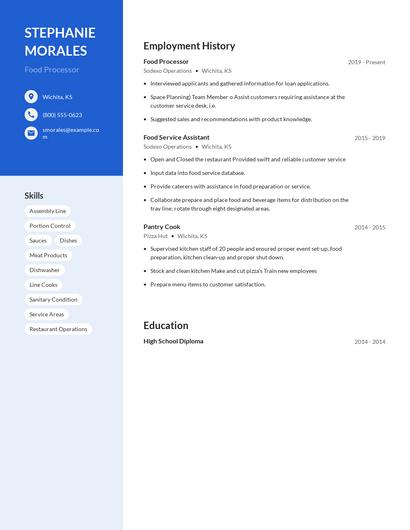
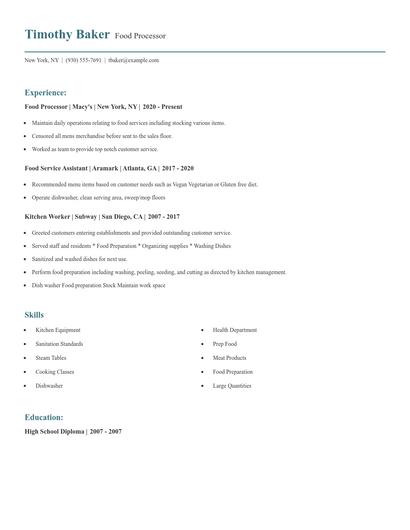
Compare different food processors
Food processor vs. Kitchen staff
The kitchen staff consists of preparation workers who execute several routine tasks as directed by chefs, food service managers, and cooks. These works should have the ability to follow cooking instructions and deliver well-prepared meals. Their responsibilities include the cleanup of dishes, cooking equipment, and the working stations. They also take charge of food safety regulations, storing and sorting of ingredients, and preparing foodstuff.
These skill sets are where the common ground ends though. The responsibilities of a food processor are more likely to require skills like "food safety," "assembly line," "gmp," and "food processing equipment." On the other hand, a job as a kitchen staff requires skills like "food handling," "cleanliness," "sanitation standards," and "quality food." As you can see, what employees do in each career varies considerably.
Kitchen staff earn the highest salaries when working in the education industry, with an average yearly salary of $30,914. On the other hand, food processors are paid more in the finance industry with an average salary of $37,607.kitchen staff tend to reach similar levels of education than food processors. In fact, kitchen staff are 0.5% less likely to graduate with a Master's Degree and 0.1% less likely to have a Doctoral Degree.Food processor vs. Kitchen helper
Kitchen helpers perform various kitchen tasks in restaurants, schools, nursing homes, and hospitals. Their duties and responsibilities include assisting cooks in the preparation of meal ingredients, helping other staff with unloading food items from delivery trucks, and washing and drying the utensils, dishes, and cookware. Kitchen helpers are also responsible for removing and replacing garbage bags and storing ingredients and food supplies in compliance with food safety standards. The requirements for this position may include a high school diploma, a license in food handling, and knowledge of food safety standards.
Each career also uses different skills, according to real food processor resumes. While food processor responsibilities can utilize skills like "food safety," "assembly line," "gmp," and "food processing equipment," kitchen helpers use skills like "food handling," "food service," "wash dishes," and "cleanliness."
Kitchen helpers earn a lower average salary than food processors. But kitchen helpers earn the highest pay in the retail industry, with an average salary of $27,239. Additionally, food processors earn the highest salaries in the finance with average pay of $37,607 annually.kitchen helpers earn similar levels of education than food processors in general. They're 0.7% less likely to graduate with a Master's Degree and 0.1% less likely to earn a Doctoral Degree.Food processor vs. Bakery clerk
A bakery clerk is an employee who is responsible for running the bakery department of supermarkets, boutique bakeries, or baking facilities. Bakery clerks are usually tasked to manage the bakery's cash register, bagging baked goods and then taking customers' payments. They ensure that the display cases inside the bakery are fully stocked with fresh bread and other baked goods. They also assist bakers with baking tasks such as measuring ingredients, mixing dough, or pouring batter.
There are many key differences between these two careers, including some of the skills required to perform responsibilities within each role. For example, a food processor is likely to be skilled in "assembly line," "gmp," "food processing equipment," and "pallet jack," while a typical bakery clerk is skilled in "basic math," "bakery products," "cleanliness," and "math."
Bakery clerks make a very good living in the retail industry with an average annual salary of $30,395. On the other hand, food processors are paid the highest salary in the finance industry, with average annual pay of $37,607.Most bakery clerks achieve a similar degree level compared to food processors. For example, they're 0.4% less likely to graduate with a Master's Degree, and 0.1% less likely to earn a Doctoral Degree.Food processor vs. Kitchen aide
Types of food processor
Updated January 8, 2025
