What does a foundry worker do?
Foundry worker responsibilities
Here are examples of responsibilities from real foundry worker resumes:
- Work numerous foundry production jobs involving physical labor, hand tools, and remote control devices.
- Grinded and run quality test on parts.
- Work around a foundry operation run a strip-out machine
- Perform other miscellaneous foundry and general labor operations.
- Help develop acontrol atmosphere brazing oven for a new cupro braze radiator
- Work for a company name Grainger through Adecco assisting with a security detail during the pope's visit to Philadelphia.
Foundry worker skills and personality traits
We calculated that 35% of Foundry Workers are proficient in Sand Molds, Aluminum Castings, and Arc Welding. They’re also known for soft skills such as Computer skills, Dexterity, and Physical strength.
We break down the percentage of Foundry Workers that have these skills listed on their resume here:
- Sand Molds, 35%
Poured molten pig iron and scrap iron at 3400 degrees into sand molds with a hand held ladle.
- Aluminum Castings, 9%
Produced aluminum castings by permanent-mold process* Mastered safety and quality control techniques
- Arc Welding, 7%
Included hands on experience with shearing, punching, arc welding/gouging, grinding, polishing, and cutting.
- Safety Guidelines, 6%
Worked as a foundry worker pouring hot metal into castings operated the furnace and followed safety guidelines.
- Bobcat, 5%
Licensed hi-lo driver and Bobcat operator * Conducted daily inventory of melting department and ordered according to inventory.
- RAN, 5%
Sandblast Operator Maintain and ran a high pressure sandblast machine to blast insulating chemicals on the inside and outside of castings.
"sand molds," "aluminum castings," and "arc welding" are among the most common skills that foundry workers use at work. You can find even more foundry worker responsibilities below, including:
Computer skills. The most essential soft skill for a foundry worker to carry out their responsibilities is computer skills. This skill is important for the role because "metal and plastic machine workers must be able to use programmable devices, computers, and robots on the factory floor." Additionally, a foundry worker resume shows how their duties depend on computer skills: "documented and managed the inventory control system in the computer placed in the warehouse using scanners and bar code readers. "
Physical strength. Another skill that relates to the job responsibilities of foundry workers is physical strength. This skill is critical to many everyday foundry worker duties, as "metal and plastic machine workers must be able to secure and tighten heavy fixtures into place." This example from a resume shows how this skill is used: "perform tasks involving physical labor at heavy construction projects, dry wall, and finishing. "
The three companies that hire the most foundry workers are:
- Workbox Staffing6 foundry workers jobs
- NOV3 foundry workers jobs
- Eaton2 foundry workers jobs
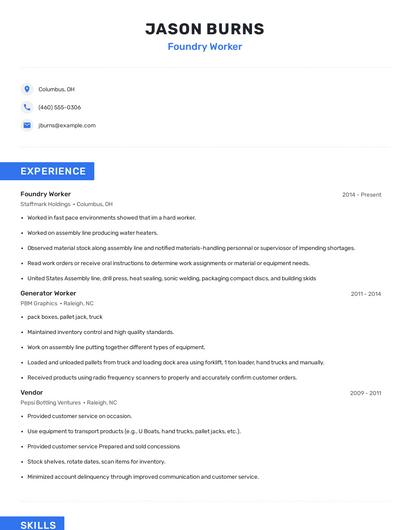
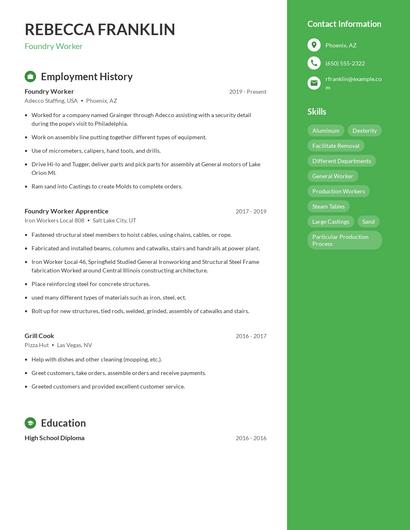
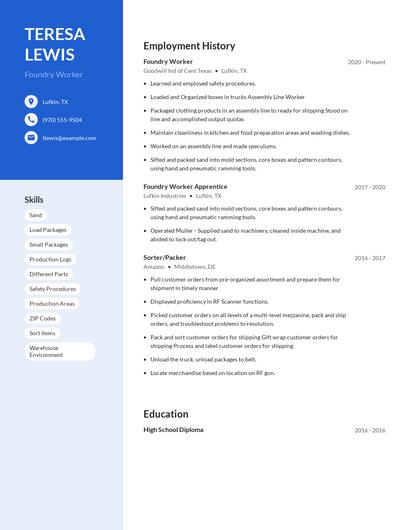
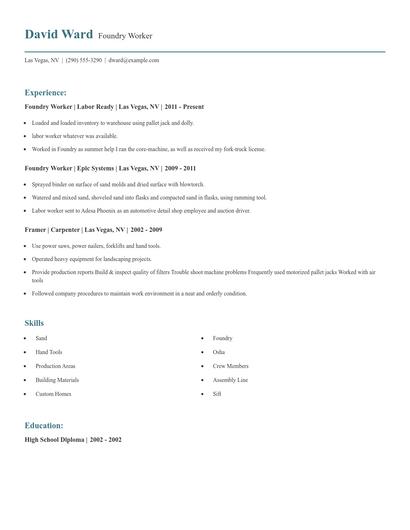
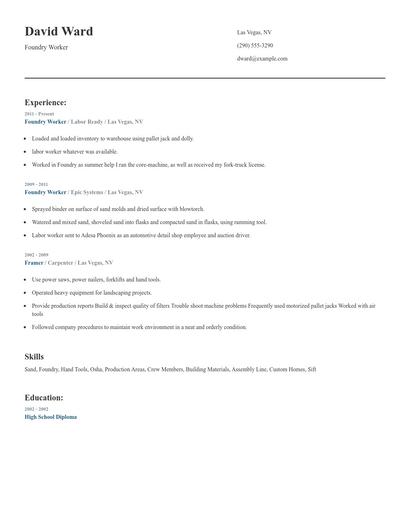
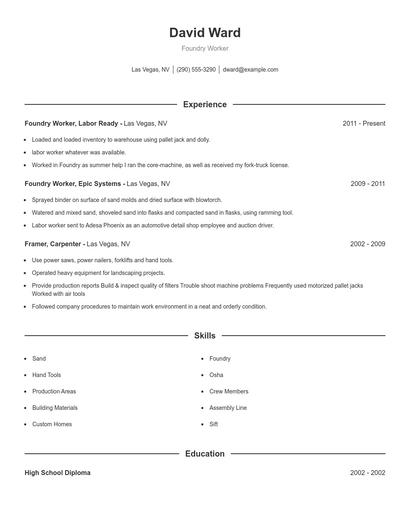
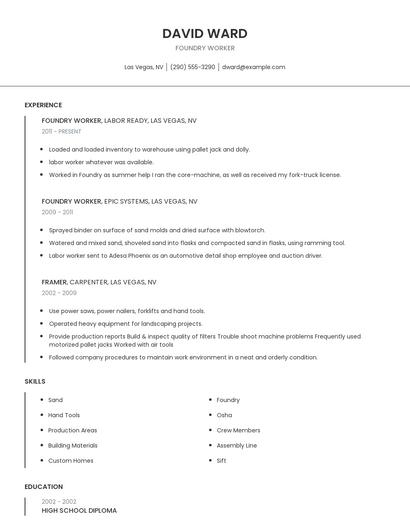
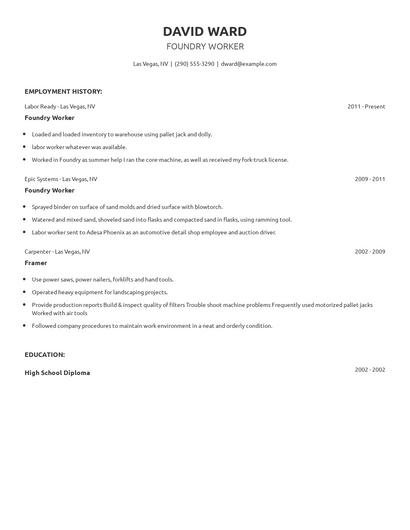
Choose from 10+ customizable foundry worker resume templates
Build a professional foundry worker resume in minutes. Our AI resume writing assistant will guide you through every step of the process, and you can choose from 10+ resume templates to create your foundry worker resume.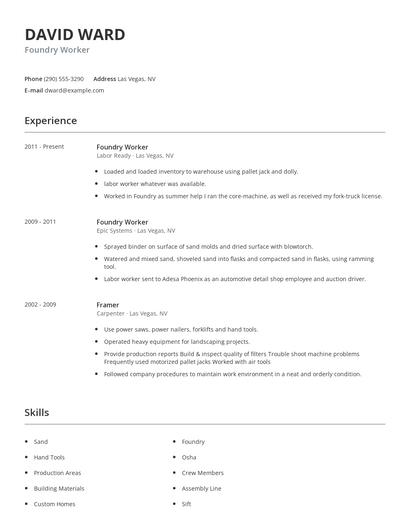
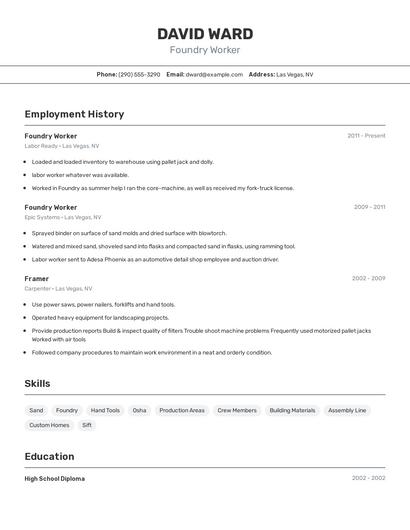
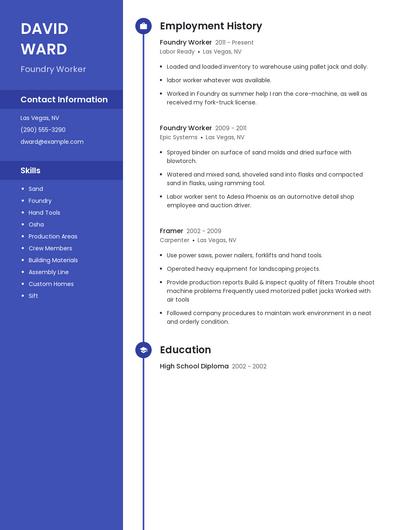
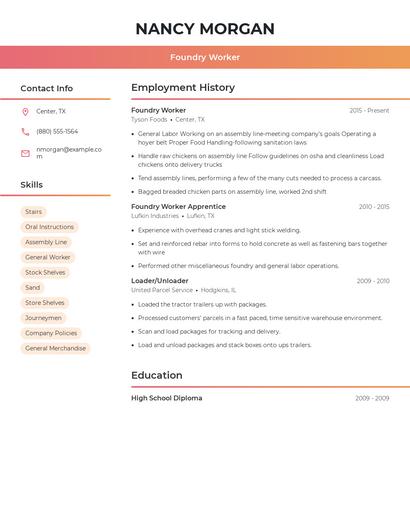
Compare different foundry workers
Foundry worker vs. Manufacturing associate
Manufacturing associates typically have varied duties and responsibilities. These include preparing materials and equipment for production, operating manufacturing equipment such as washers, and maintaining material inventory. In addition, they are responsible for inspecting purchased equipment, parts, and components, and participating in process investigations. They also review and execute documents related to manufacturing and determine any problems in the manufacturing process. To become a successful manufacturing associate, you should have skills in good manufacturing practice (GMP) compliance, aseptic processing, and biotechnology.
These skill sets are where the common ground ends though. The responsibilities of a foundry worker are more likely to require skills like "sand molds," "aluminum castings," "arc welding," and "bobcat." On the other hand, a job as a manufacturing associate requires skills like "basic math," "cell culture," "math," and "production equipment." As you can see, what employees do in each career varies considerably.
Manufacturing associates earn the highest salaries when working in the automotive industry, with an average yearly salary of $37,567. On the other hand, foundry workers are paid more in the technology industry with an average salary of $44,875.manufacturing associates tend to reach similar levels of education than foundry workers. In fact, manufacturing associates are 2.0% more likely to graduate with a Master's Degree and 0.2% more likely to have a Doctoral Degree.Foundry worker vs. Freelance production assistant
A freelance production assistant performs support tasks for television and film production crews during production stages. Their responsibilities typically include disseminating materials to various crew members, gathering props, coordinating with caterers and other contractors, preparing and cleaning sets, and running errands as needed. There are also instances where they may process documents, travel to various locations, and assist performers. Moreover, a freelance production assistant must maintain an active communication line with the entire production team to maintain a smooth and efficient workflow.
While some skills are similar in these professions, other skills aren't so similar. For example, resumes show us that foundry worker responsibilities requires skills like "sand molds," "aluminum castings," "arc welding," and "safety guidelines." But a freelance production assistant might use other skills in their typical duties, such as, "network programming," "music videos," "video production," and "adobe photoshop."
Average education levels between the two professions vary. Freelance production assistants tend to reach similar levels of education than foundry workers. In fact, they're 2.5% more likely to graduate with a Master's Degree and 0.2% more likely to earn a Doctoral Degree.Foundry worker vs. Production assistant
Production assistants are employees in show business, working behind the scenes. They work in film, television, or even theatre sets primarily to provide support. They usually work directly under directors or producers. Production assistants are responsible for ensuring that the day will run smoothly, be it for a television or film shoot or a performance at the theatre. They should be familiar with all the scenes, ensure that the cast and crew are ready, and cue them when it is their time to go on. They should also be able to anticipate needs that may arise and should be able to quickly mitigate any challenges. Production assistants should be flexible and have quick decision-making skills.
Some important key differences between the two careers include a few of the skills necessary to fulfill the responsibilities of each. Some examples from foundry worker resumes include skills like "sand molds," "aluminum castings," "arc welding," and "safety guidelines," whereas a production assistant is more likely to list skills in "video production," "teleprompter," "audio board," and "purchase orders. "
Production assistants earn the best pay in the manufacturing industry, where they command an average salary of $33,794. Foundry workers earn the highest pay from the technology industry, with an average salary of $44,875.Most production assistants achieve a similar degree level compared to foundry workers. For example, they're 2.3% more likely to graduate with a Master's Degree, and 0.2% more likely to earn a Doctoral Degree.Foundry worker vs. Production specialist
Production specialists are responsible for planning and managing the production activities of a company based on job orders. They provide support to the operations department and collaborate with supervisors to create production plans and identity workflow requirements. Other responsibilities may include managing existing workflow, organizing job training to the production team, and monitoring and reporting job status to customers. Production specialists are also expected to respond to customer concerns and inquiries, ensure the timely delivery of products, and ensure that products meet quality standards.
Types of foundry worker
Updated January 8, 2025
