
Automatically apply for jobs with Zippia
Upload your resume to get started.
Functional analyst skills for your resume and career

15 functional analyst skills for your resume and career
1. Business Process
A business process is a group of tasks that are performed by people working in a business to attain a worthy product and to present it to their customers. A business process can also be defined as performing several steps to achieve a certain goal set by a company. Business processes need to set purposeful goals and the outcome of that goal should be clear.
- Performed the role of troubleshooter, successfully identifying system inconsistencies and implementing optimum business solutions through programming and business process enhancements.
- Worked collectively with other business areas including planning and finance to ensure that manufacturing function fully integrates with other business process.
2. Lifecycle Management
- Apply Application Lifecycle Management, practices and processes to ensure quality results for project planning/deployment.
- Supported the lifecycle management of policies and processes.
3. HR
HR stands for human resources and is used to describe the set of people who work for a company or an organization. HR responsibilities revolve around updating employee records and carrying out management processes like planning, recruitment, evaluation, and selection processes. HR is a key contributor to any company or organization's growth as they are in charge of hiring the right employees, processing payrolls, conducting disciplinary actions, etc.
- Performed fit/gap and requirements analysis sessions to upgrade HR and Benefits Administration on PeopleSoft version 9.1 for a fast-paced environment.
- Configured HR Security for all HR/Benefits/Payroll Roles/User Profiles.
4. ERP
Enterprise Resource Planning (ERP) is computer software used by major corporations and organizations for conducting their management and accounting tasks efficiently. ERP systems bind different business processes with each other allowing smoother flow of data between them resulting in swift project assessment and completion.
- Suggested effective business practices to clients using ERP solution to improve overall business performance.
- Trained and led a team of 6 people through design, testing and successful implementation of SAP ERP for Discount Tire.
5. Technical Support
Technical support or tech support are the services provided by any hardware or software company to users. They help in solving the technical difficulties the customers face with their products or services. Moreover, the tech support employees maintain, manage, and repair the IT faults. They are also responsible for resolving the network problems, installing and configuring hardware and software.
- Coordinated across all organization levels comfortably with internal business customers, technical support resources, resources and external business partners.
- Provided functional and technical support to the Naval Facilities Engineering Command on various paper-less acquisitions systems.
6. Functional Specifications
- Translate business requirements for system upgrades through interviews and observations of end users; document system-level technical/functional specifications for feasibility.
- Directed client business lead counterparts in creation of functional specifications, ensuring quality of documentation for technical development.
Choose from 10+ customizable functional analyst resume templates
Build a professional functional analyst resume in minutes. Our AI resume writing assistant will guide you through every step of the process, and you can choose from 10+ resume templates to create your functional analyst resume.7. Test Scripts
Test scripts validate the quality of the software or app being tested. An effective test script has all the steps to be taken to use a software program as well as the ending result of each step.
- Produce high quality documentation, including business requirements, procedural documentation, operational and process flow documents, and test scripts.
- Provided direction in developing testing methodology and test scripts for utilization during upgrades and patch application.
8. Strong Analytical
- Have strong analytical skills, result oriented and effectiveness in problem solving.
9. Client Facing
- Project: Single sign on portal for all Client facing applications and is divided in 2 Phases.
10. Gap Analysis
- Design and development of solution architecture, mapping of business requirements into solution, gap analysis and PRICEF identification.
- Created functional and technical project management documents including gap analysis, design requirements, security and test plans.
11. User Acceptance
- Project Management and Lead experience has resulted in on time delivery and successful implementations with user acceptance of every project.
- Gathered business requirements, deliver training, coordinate user acceptance/conversion testing and provide go-live support for all new implementations.
12. CRM
CRM stands for Customer relationship management and it is a complete process through which a business or organization monitors and administers its interactions with the customers. A process in which large amounts of data are collected through marketing via a company's website, polls, surveys, and other social media applications. The basic goal of CRM is to target the right audience for their product, and then fulfill their needs, to increase the sales and revenue of the company.
- Integrated and monitored SharePoint 2010 integration with CRM 2011 for document management under different site security settings.
- Managed customer information and created reports using Microsoft dynamics CRM.
13. Payroll
Payroll is the sum of all the compensation that an organization has to pay to employees at a specified time. Payroll is managed by the finance or HR department while small business owners may handle it themselves. Payroll isn't fixed as it varies every month due to sick leaves, overtime, etc.
- Involved in defining and establishing new operational procedures to improve the day to day payroll operations and reconciliation procedures.
- Designated training resource for cross-functional training of Payroll Operations staff on Base Benefits configuration and functionality.
14. Test Cases
- Participated in required testing/validation of system enhancements and fixes, creating and/or executing the test cases including problem determination and resolution.
- Executed test cases confirming business requirements and functional designs.
15. Logistics
Logistics is a complete organization and implementation of a problem. Logistics are often considered in a complex business operation, as some works need detailed plannings. Logistics are also used in military action.
- Provide technical and administrative direction for personnel performing ammunition management and logistics automation functions in an automated logistics environment.
- Provided functional analysis and assisted in the development of acquisition requirements documentation for four Army logistics automated systems.
5 Functional Analyst resume examples
Build a professional functional analyst resume in minutes. Browse through our resume examples to identify the best way to word your resume. Then choose from 5+ resume templates to create your functional analyst resume.

What skills help Functional Analysts find jobs?
Tell us what job you are looking for, we’ll show you what skills employers want.
What functional analyst skills would you recommend for someone trying to advance their career?
Travis Grosser Ph.D.
Associate Professor of Management (@ UConn School of Business), University of Connecticut
1. Innovative and Critical Thinking: The ability to think creatively and critically to solve complex problems will be highly valued, especially in a rapidly changing business landscape.
2. Emotional Intelligence: The ability to understand and manage one's own emotions, as well as empathize with others, will be crucial for successfully navigating a workplace where change, diversity, and collaboration will continue to increase.
3. Leadership and Change Management: Skills in leading teams, managing change, and inspiring innovation will be essential as businesses navigate through transitions and transformations.
4. Digital Literacy and Technological Proficiency: As technology continues to evolve rapidly, proficiency in digital tools and platforms will be crucial. Understanding emerging technologies like artificial intelligence, blockchain/Web3, and data analytics will be increasingly valuable.
What hard/technical skills are most important for functional analysts?
Jason Caudill Ph.D.
Professor of Business, King University
List of functional analyst skills to add to your resume
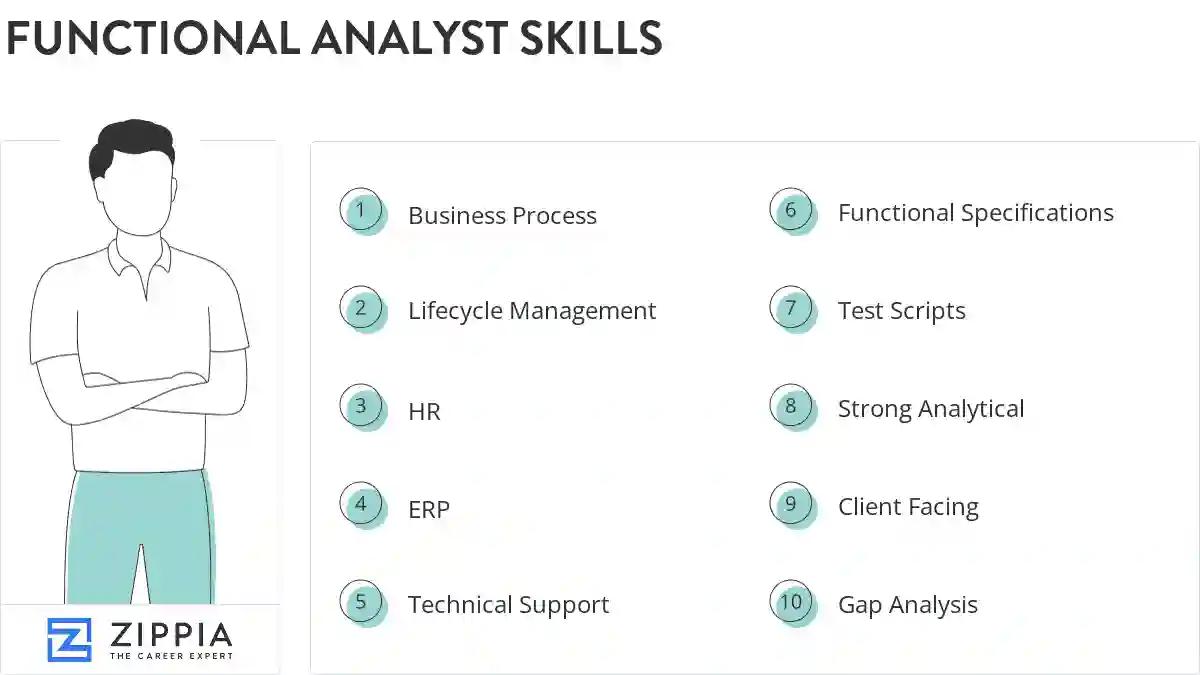
The most important skills for a functional analyst resume and required skills for a functional analyst to have include:
- Business Process
- Lifecycle Management
- HR
- ERP
- Technical Support
- Functional Specifications
- Test Scripts
- Strong Analytical
- Client Facing
- Gap Analysis
- User Acceptance
- CRM
- Payroll
- Test Cases
- Logistics
- SDLC
- SME
- Sap Functional
- BI
- DOD
- Oracle Ebs
- Visio
- Technical Specifications
- QA
- PeopleSoft
- UAT
- Fi
- Data Analysis
- MM
- Test Scenarios
- Master Data
- Gl
- Order Management
- User Training
- Fixed Assets
- System Integration
- SharePoint
- Regression
- Functional Analysis
- Emerging Technologies
- Java
- Enterprise Resource Planning
- National Security
- PL/SQL
- Help Support
- HCM
- ABAP
- SAP ECC
- EDI
- Cash Management
Updated January 8, 2025
