Explore jobs
Find specific jobs
Explore careers
Explore professions
Best companies
Explore companies
What is a geotechnical engineer and how to become one

A geotechnical engineer is a civil engineer who performs analysis and assessments on earth materials prior to construction projects. They examine soil, rocks, underground water flow, and other earth materials to determine which materials should be used in the construction. This examination also enables them to provide advice on the overall design of the structure to ensure it meets required safety and quality standards.
Geotechnical engineers work on an array of structures such as tunnels, dams, roads, railways, and bridges. They work closely with structural engineers and architects in order to efficiently execute their role. They can work in engineering firms, petroleum companies, mining companies, and construction companies. A successful geotechnical engineer should have engineering skills, project management skills, analytical skills, and communication skills.
Geotechnical engineers work full time. The role involves traveling from site to site, and so they may go beyond the 40 hours a week due to travel.
What general advice would you give to a geotechnical engineer?
Esber Andiroglu PhD, PE, LEED AP
Associate Professor of Practice, Dept. of Civil & Architectural Engineering, Director of Construction Management Programs, University of Miami
Avg. Salary $74,831
Avg. Salary $59,228
Growth rate 7%
Growth rate 0.3%
American Indian and Alaska Native 0.30%
Asian 16.99%
Black or African American 3.50%
Hispanic or Latino 10.33%
Unknown 4.56%
White 64.33%
Genderfemale 17.19%
male 82.81%
Age - 39American Indian and Alaska Native 3.00%
Asian 7.00%
Black or African American 14.00%
Hispanic or Latino 19.00%
White 57.00%
Genderfemale 47.00%
male 53.00%
Age - 39Stress level is high
7.1 - high
Complexity level is challenging
7 - challenging
Work life balance is fair
6.4 - fair
Geotechnical engineer career paths
Key steps to become a geotechnical engineer
Explore geotechnical engineer education requirements
Start to develop specific geotechnical engineer skills
Skills Percentages Geotechnical 17.27% Civil Engineering 11.11% Project Management 5.13% Autocad 4.70% GINT 4.68% Complete relevant geotechnical engineer training and internships
Accountants spend an average of 6-12 months on post-employment, on-the-job training. New geotechnical engineers learn the skills and techniques required for their job and employer during this time. The chart below shows how long it takes to gain competency as a geotechnical engineer based on U.S. Bureau of Labor Statistics data and data from real geotechnical engineer resumes.Research geotechnical engineer duties and responsibilities
- Incorporate ASCE, AISC, and IBC as well as other standards.
- Design are provided considering conservative seismic design criteria per IBC 2006 and available USGS data for Afghanistan.
- Execute FEA such as thermal, static structural, modal, harmonic response, and random vibration using ANSYS and NASTRAN.
- Prepare hydrology & hydraulic studies, review environmental assessments GIS analysis and map preparation for various studies.
Get geotechnical engineer experience
Generally, it takes 4-6 years to become a geotechnical engineer. The most common roles before becoming a geotechnical engineer include engineering internship, project engineer team lead and research assistant.Prepare your geotechnical engineer resume
When your background is strong enough, you can start writing your geotechnical engineer resume.
You can use Zippia's AI resume builder to make the resume writing process easier while also making sure that you include key information that hiring managers expect to see on a geotechnical engineer resume. You'll find resume tips and examples of skills, responsibilities, and summaries, all provided by Zippi, your career sidekick.
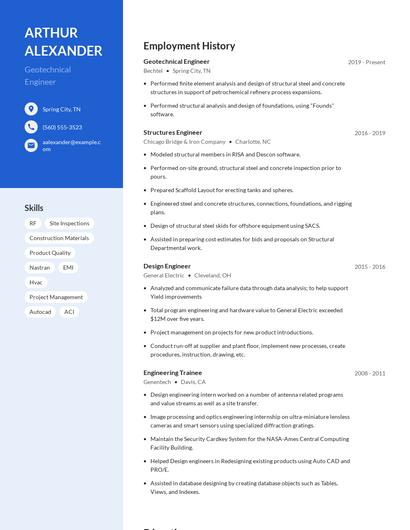
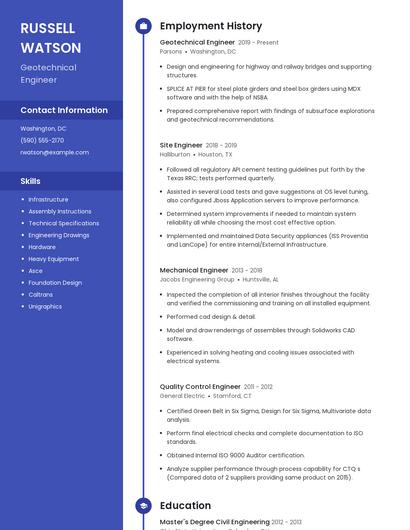
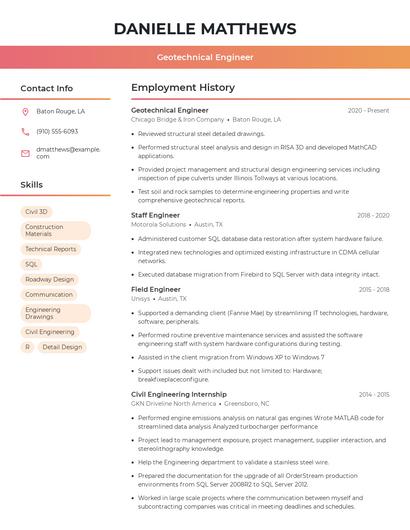
Choose from 10+ customizable geotechnical engineer resume templates
Build a professional geotechnical engineer resume in minutes. Browse through our resume examples to identify the best way to word your resume. Then choose from 10+ resume templates to create your geotechnical engineer resume.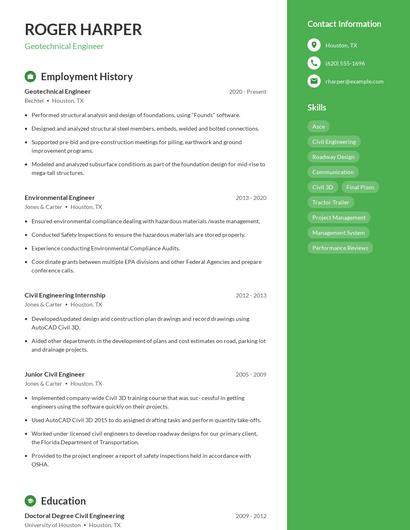

Apply for geotechnical engineer jobs
Now it's time to start searching for a geotechnical engineer job. Consider the tips below for a successful job search:
- Browse job boards for relevant postings
- Consult your professional network
- Reach out to companies you're interested in working for directly
- Watch out for job scams
How did you land your first geotechnical engineer job

Are you a geotechnical engineer?
Share your story for a free salary report.
Average geotechnical engineer salary
The average geotechnical engineer salary in the United States is $74,831 per year or $36 per hour. Geotechnical engineer salaries range between $56,000 and $99,000 per year.
What am I worth?

How do geotechnical engineers rate their job?
Geotechnical engineer reviews

Less money in this civil engineering works
I like it because of it is the basis of development
I don't like the fact that it is not well organized
The salary and the benefits that come with a job.
Possible trouble finding jobs.
Geotechnical engineer FAQs
Search for geotechnical engineer jobs
Updated January 8, 2025
