What does a gis coordinator do?
A GIS Coordinator captures, stores, manipulates, analyzes, and manages spatial and geographic data. They supervise a team of staff including programmers, cartographers, data managers, and support specialists.
Gis coordinator responsibilities
Here are examples of responsibilities from real gis coordinator resumes:
- Manage client data and perform database extraction regularly to make timely data updates.
- Project manager and system administrator for GPS pipeline data collection system.
- Act as DBA for the organization's enterprise geodatabases (ArcSDE v10.1and SQL 2008 R2).
- Used python scripting and ModelBuilder for geoprocessing and analysis on a debris flow research project.
- Collect and verify field data using different data sources including: GPS units, scan documents, and electronic drawings.
- Maintain internal departmental website using HTML.
- Standardize procedures for data entry and heads-up digitizing.
- Oversee consultations with foresters and contractors regarding timber harvest plan digitizing and harvest attribute associations.
- Update and maintain locations of utilities and infrastructure, consolidating data from municipalities and private companies into county-wide feature layers.
- Help Medicaid eligible members to secure both physical and behavioral services in the community by reviewing and preparing prior authorization requests.
- Monitor daily maintenance on the packaging equipment to ensure compliance with all applicable regulations and troubleshoot mechanical problems.
Gis coordinator skills and personality traits
We calculated that 10% of GIS Coordinators are proficient in GPS, GIS Data, and Arcgis Online. They’re also known for soft skills such as Creativity, Analytical skills, and Communication skills.
We break down the percentage of GIS Coordinators that have these skills listed on their resume here:
- GPS, 10%
Used aerial imagery, GPS, GIS, and field collected environmental data AFCEE and the U.S. Army Corp of Engineers.
- GIS Data, 9%
Developed and edited GIS data for consumption throughout organization.
- Arcgis Online, 8%
Develop and maintain all ArcGIS Online Web Applications for use by the public and city personnel.
- Python, 7%
Developed internal broker and external client Web GIS Applications utilizing Python, JavaScript API & HTML.
- Esri, 6%
Direct GIS support related activities including direct end user support, GIS education efforts in the form of ESRI authorized training.
- Database Design, 6%
Managed Fort Irwin's entire cultural resource GIS, including spatial database design and implementation.
Common skills that a gis coordinator uses to do their job include "gps," "gis data," and "arcgis online." You can find details on the most important gis coordinator responsibilities below.
Creativity. The most essential soft skill for a gis coordinator to carry out their responsibilities is creativity. This skill is important for the role because "because analysts are tasked with finding innovative solutions to computer problems, an ability to “think outside the box” is important." Additionally, a gis coordinator resume shows how their duties depend on creativity: "managed data collection and assessment procedures in updating the stormwater drainage inventory for the city of greensboro's gis. "
Analytical skills. Another soft skill that's essential for fulfilling gis coordinator duties is analytical skills. The role rewards competence in this skill because "analysts must interpret complex information from various sources and decide the best way to move forward on a project." According to a gis coordinator resume, here's how gis coordinators can utilize analytical skills in their job responsibilities: "organized meetings of cross-functional teams to coordinate gis data standardization, application requirements as well as resource planning and project implementations. "
Communication skills. This is an important skill for gis coordinators to perform their duties. For an example of how gis coordinator responsibilities depend on this skill, consider that "analysts work as a go-between with management and the it department and must explain complex issues in a way that both will understand." This excerpt from a resume also shows how vital it is to everyday roles and responsibilities of a gis coordinator: "managed system installation and configuration, prototyping, application development, gis database design, workflow integration, and technical communication. ".
The three companies that hire the most gis coordinators are:
- The Medicus Firm
49 gis coordinators jobs
- Olsson9 gis coordinators jobs
- Veolia Water Tech2 gis coordinators jobs
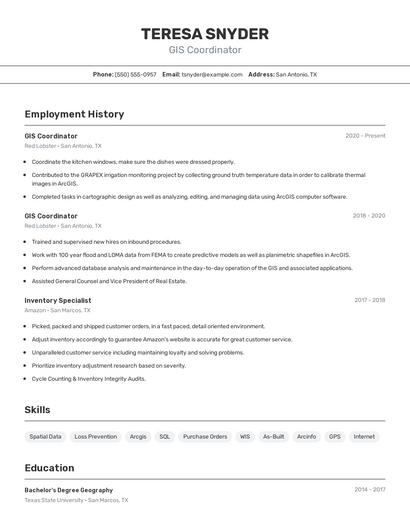
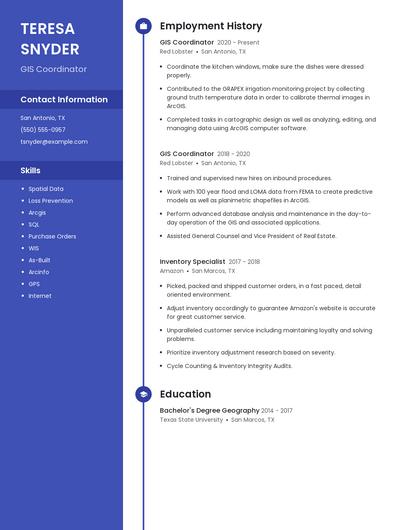
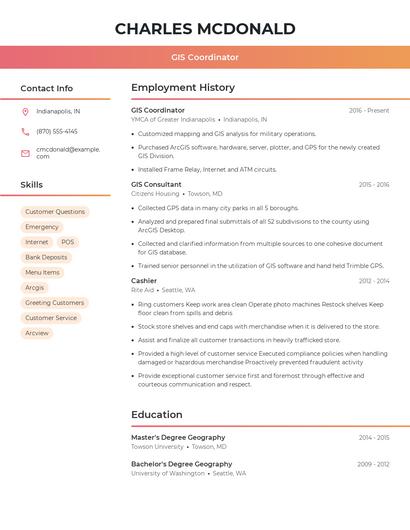
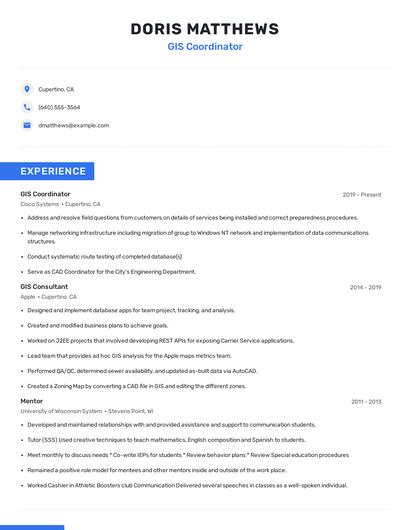
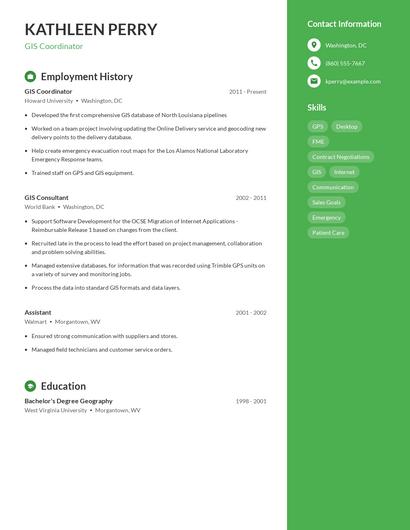
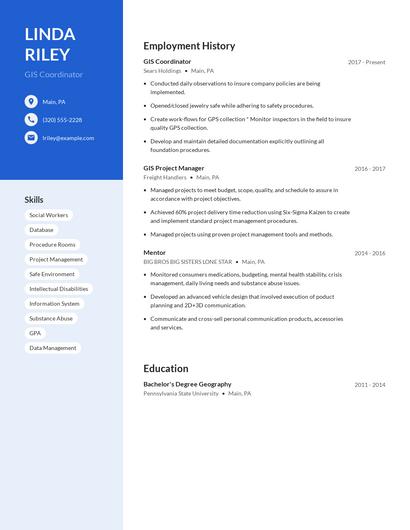
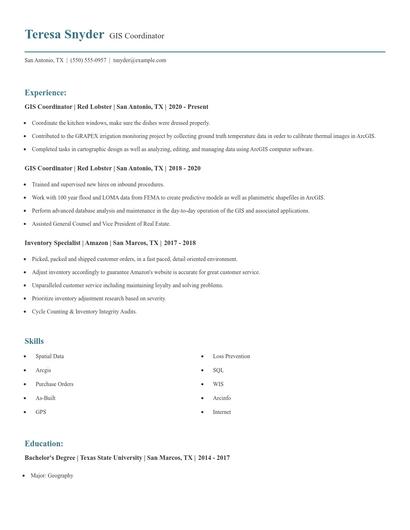
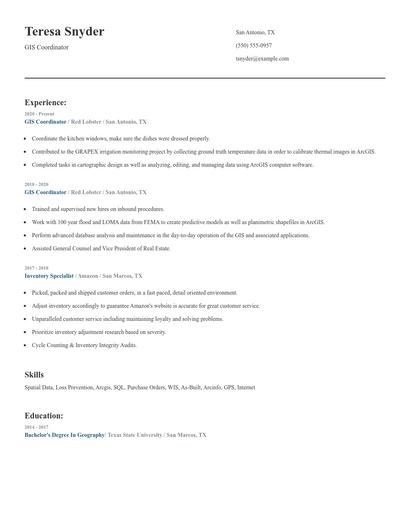
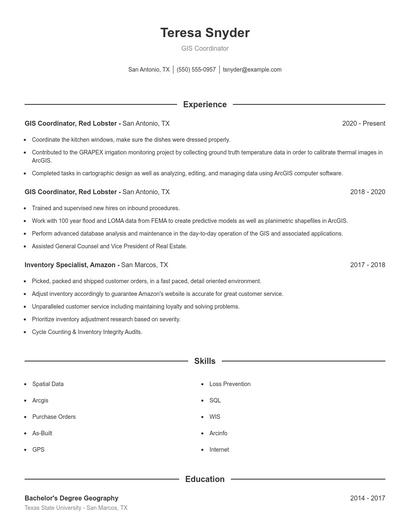
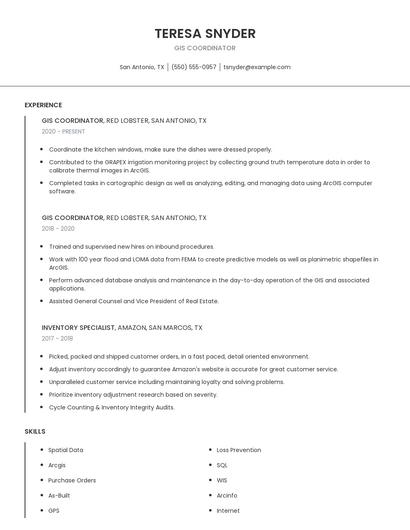
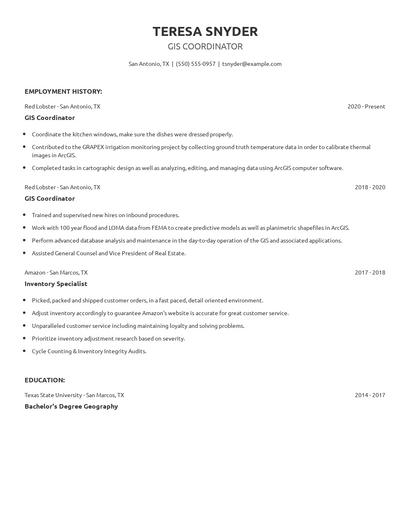
Choose from 10+ customizable gis coordinator resume templates
Build a professional gis coordinator resume in minutes. Our AI resume writing assistant will guide you through every step of the process, and you can choose from 10+ resume templates to create your gis coordinator resume.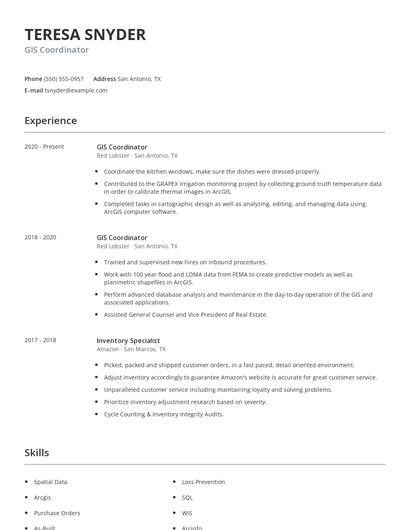
Compare different gis coordinators
Gis coordinator vs. Geospatial technician
Geospatial technicians majorly assist other geospatial analysts and project managers to build, manage, and make use of GIS databases to identify spatial relationships. Their job is to create customized maps and GIS applications or software. Furthermore, they are expected to review and interpret all GIS data, maps, and graphs. They are also expected to analyze applications of software, create data reports, and digital 3D models. Their job duties also involve updating satellite navigation systems and providing technical support to users.
While similarities exist, there are also some differences between gis coordinators and geospatial technician. For instance, gis coordinator responsibilities require skills such as "gis data," "arcgis online," "database design," and "data management." Whereas a geospatial technician is skilled in "visualization," "production tasks," "remote sensing," and "extraction." This is part of what separates the two careers.
The education levels that geospatial technicians earn slightly differ from gis coordinators. In particular, geospatial technicians are 8.7% less likely to graduate with a Master's Degree than a gis coordinator. Additionally, they're 0.5% less likely to earn a Doctoral Degree.Gis coordinator vs. Information systems technician
An information systems technician is responsible for maintaining the efficiency of various network systems' performance. Information systems technicians provide network troubleshooting, upgrading systems for optimization, maintaining the security of databases, managing the interaction of networks, and inspecting and troubleshooting system inconsistencies. Additional duties include creating network designs based on clients' specifications, configuring software and hardware applications, and creating reports on system issues and resolutions. An information systems technician must have excellent knowledge of information systems procedures, programming languages, detecting malfunctions, and making resolutions promptly.
Each career also uses different skills, according to real gis coordinator resumes. While gis coordinator responsibilities can utilize skills like "gps," "gis data," "arcgis online," and "python," information systems technicians use skills like "customer service," "troubleshoot," "phone calls," and "desk support."
Information systems technicians earn a lower average salary than gis coordinators. But information systems technicians earn the highest pay in the government industry, with an average salary of $63,116. Additionally, gis coordinators earn the highest salaries in the professional with average pay of $55,777 annually.In general, information systems technicians achieve lower levels of education than gis coordinators. They're 11.7% less likely to obtain a Master's Degree while being 0.5% less likely to earn a Doctoral Degree.What technology do you think will become more important and prevalent for gis coordinators in the next 3-5 years?
Nathan Manser Ph.D.
Lecturer of Geological and Mining Engineering, Faculty Advisor to Innovative Global Solutions Enterprise, Michigan Technological University
Gis coordinator vs. Mapping manager
A GIS (Geographic Information Systems) intern is responsible for assisting the data analyst team on project management operations, data processing procedures, and advocacy program planning. GIS interns shadow all the processes of the organization, performing administrative and clerical duties under the supervision of a direct manager. They also assist with developing strategic procedures for process improvement and product development. A GIS intern should have excellent communication and organizational skills, as well as the ability to multitask and learn tasks within strict deadlines.
Some important key differences between the two careers include a few of the skills necessary to fulfill the responsibilities of each. Some examples from gis coordinator resumes include skills like "gis data," "arcgis online," "python," and "esri," whereas a mapping manager is more likely to list skills in "gis," "auto cad," "powerpoint," and "business plan. "
Most mapping managers achieve a lower degree level compared to gis coordinators. For example, they're 10.6% less likely to graduate with a Master's Degree, and 0.5% less likely to earn a Doctoral Degree.Gis coordinator vs. Gis internship
Types of gis coordinator
Updated January 8, 2025
