What does a groundwater monitoring technician do?
A groundwater monitoring technician does a lot of environmental monitoring, such as sampling soil and water along with air monitoring. Serving in this capacity, you will be expected to work with environmental technicians to examine problems with groundwater bodies. The end result of your analysis is valuable data about water systems which will help determine portable water, waste disposal, and construction developments.
Groundwater monitoring technician responsibilities
Here are examples of responsibilities from real groundwater monitoring technician resumes:
- Manage daily RCRA inspections and mechanical, electrical, and electronic equipment preventive/corrective maintenance procedures.
- Enroll pre-trial release and probation clients into strict alcohol abstinence and GPS monitoring programs.
- Well inspections, which consist of making sure they are completed properly and getting a GPS coordinate.
- Perform operational checks and acceptance testing on monitoring equipment to include calibration and maintenance on ACAMS and DAAMS.
- Monitor epileptic patients for seizure activity.
- Interpret remote patient EKG readings accurately and efficiently.
- Contact patients and physicians regarding abnormal or life threatening events.
- Assist HAZWOPER technicians with logistical support for operations on project operations including research of facilities and vendors need for project completion.
- Excel in building PCs for deployment including imaging, ghosting, and configuration for network access.
- Integrate Microsoft SCCM with ServiceNow for pulling the entire configuration item into ServiceNow.
Groundwater monitoring technician skills and personality traits
We calculated that 30% of Groundwater Monitoring Technicians are proficient in Process Equipment, Patients, and EEG. They’re also known for soft skills such as Interpersonal skills, Analytical skills, and Communication skills.
We break down the percentage of Groundwater Monitoring Technicians that have these skills listed on their resume here:
- Process Equipment, 30%
Monitored various components of process equipment for fugitive emissions.
- Patients, 21%
Contacted patients and physicians regarding abnormal or life threatening events.
- EEG, 6%
Program Tucson, Arizona Epilepsy Monitoring Unit Technician EEG Technician, Unit Associate
- OSHA, 5%
Inspected valves, flanges, pumps, vessels and tanks according to Method-21 and OSHA regulations.
- LDAR, 5%
Perform Method 21 inspections on valves, pumps, compressors and other related components in LDAR service.
- CPR, 4%
Expanded professional knowledge base by attending various seminars and training sessions including CPR and Crisis Patient Intervention certification.
Most groundwater monitoring technicians use their skills in "process equipment," "patients," and "eeg" to do their jobs. You can find more detail on essential groundwater monitoring technician responsibilities here:
Interpersonal skills. The most essential soft skill for a groundwater monitoring technician to carry out their responsibilities is interpersonal skills. This skill is important for the role because "environmental science and protection technicians need to work well and collaborate with others, because they often work with scientists and other technicians." Additionally, a groundwater monitoring technician resume shows how their duties depend on interpersonal skills: "demonstrate positive interpersonal skills while working with patients, families, physician, co-workers, and other departments. "
Analytical skills. Another essential skill to perform groundwater monitoring technician duties is analytical skills. Groundwater monitoring technicians responsibilities require that "environmental science and protection technicians must carry out a wide range of laboratory and field tests, and their results must be accurate and precise." Groundwater monitoring technicians also use analytical skills in their role according to a real resume snippet: "conducted and documented on site observations of local conditions influencing air quality data. "
Communication skills. groundwater monitoring technicians are also known for communication skills, which are critical to their duties. You can see how this skill relates to groundwater monitoring technician responsibilities, because "environmental science and protection technicians must have good listening and writing skills, because they must follow precise directions for sample collection and communicate their results effectively in written reports." A groundwater monitoring technician resume example shows how communication skills is used in the workplace: "used excellent communication skills and a positive attitude when addressing patients from diverse populations. "
The three companies that hire the most groundwater monitoring technicians are:
- Clean Harbors12 groundwater monitoring technicians jobs
- Danbury Hospital3 groundwater monitoring technicians jobs
- Medical University of South Carolina
3 groundwater monitoring technicians jobs
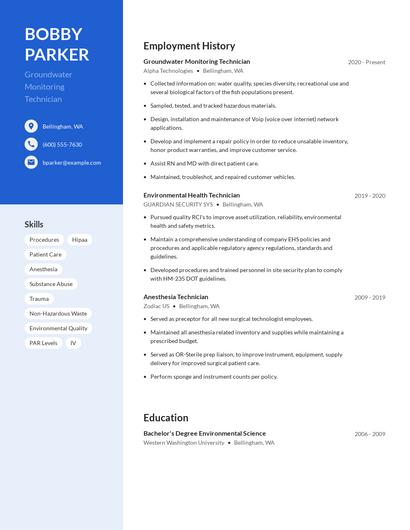
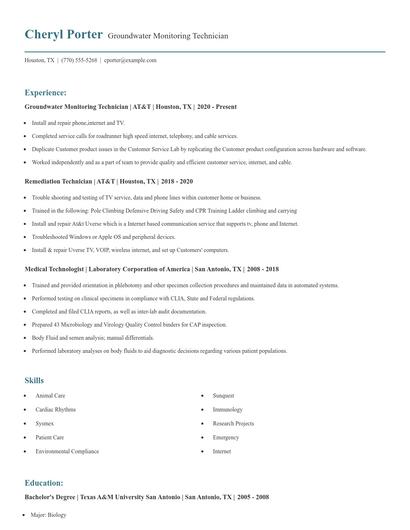
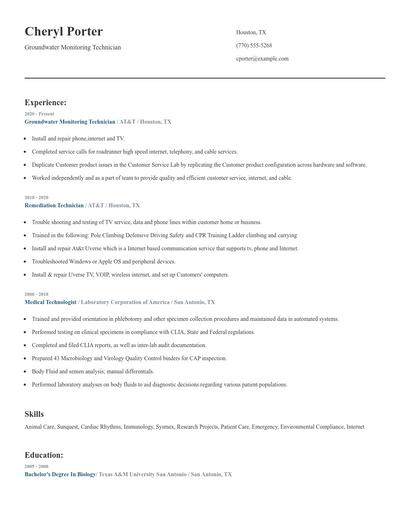
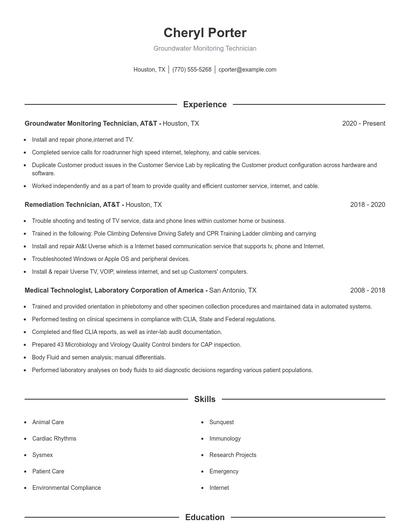
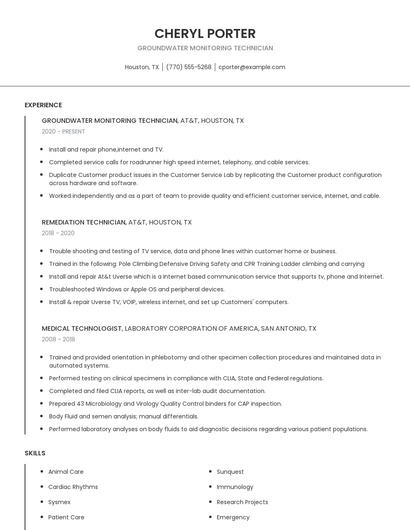
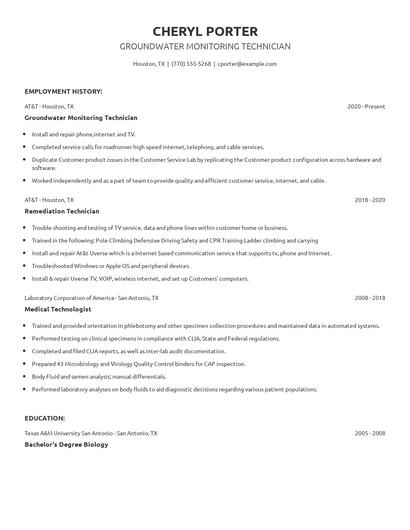
Choose from 10+ customizable groundwater monitoring technician resume templates
Build a professional groundwater monitoring technician resume in minutes. Our AI resume writing assistant will guide you through every step of the process, and you can choose from 10+ resume templates to create your groundwater monitoring technician resume.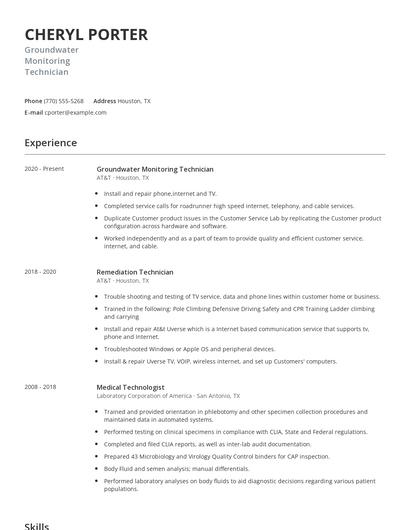


Compare different groundwater monitoring technicians
Groundwater monitoring technician vs. Environmental assistant
An environmental assistant is primarily in charge of performing daily administrative support tasks in an office. Their responsibilities include preparing and processing documentation, coordinating services and procedures, monitoring the inventory of supplies, participating in the procurement procedures, answering calls and correspondence, and maintaining records of all transactions. They may also perform managerial duties if necessary. Furthermore, as an environmental assistant, it is essential to keep an active communication line with staff, coordinating every step of the way while adhering to the company's policies and regulations.
There are some key differences in the responsibilities of each position. For example, groundwater monitoring technician responsibilities require skills like "process equipment," "eeg," "ldar," and "twic." Meanwhile a typical environmental assistant has skills in areas such as "patient rooms," "cleanliness," "patient care," and "nursing home." This difference in skills reveals the differences in what each career does.
Environmental assistants earn the highest salaries when working in the manufacturing industry, with an average yearly salary of $45,535. On the other hand, groundwater monitoring technicians are paid more in the construction industry with an average salary of $43,934.On average, environmental assistants reach similar levels of education than groundwater monitoring technicians. Environmental assistants are 0.6% less likely to earn a Master's Degree and 0.3% less likely to graduate with a Doctoral Degree.Groundwater monitoring technician vs. Laboratory analyst
A Laboratory Analyst helps conduct experiments, run laboratory tests, and analyze results. They compile and record data for the documentation needed for testing and report preparation.
Each career also uses different skills, according to real groundwater monitoring technician resumes. While groundwater monitoring technician responsibilities can utilize skills like "process equipment," "patients," "eeg," and "osha," laboratory analysts use skills like "test methods," "lab equipment," "lims," and "laboratory procedures."
Laboratory analysts earn a higher average salary than groundwater monitoring technicians. But laboratory analysts earn the highest pay in the pharmaceutical industry, with an average salary of $47,806. Additionally, groundwater monitoring technicians earn the highest salaries in the construction with average pay of $43,934 annually.In general, laboratory analysts achieve similar levels of education than groundwater monitoring technicians. They're 2.3% more likely to obtain a Master's Degree while being 0.3% less likely to earn a Doctoral Degree.Groundwater monitoring technician vs. Environmental services supervisor
Environmental services supervisors direct and administer a healthcare facility's housekeeping program to maintain sanitation and occupational health. They help departments in charge of the cleanup, sanitation, pest control, housekeeping, and laundry. These professionals should be experts in health, sanitation, and safety policies and regulations. They oversee the staff of the department and their working conditions. They inspect the ventilation, air conditioning, and heating. Also, they take charge of equipment and supplies, quality assurance and control, and prepare budgets.
The required skills of the two careers differ considerably. For example, groundwater monitoring technicians are more likely to have skills like "process equipment," "eeg," "osha," and "ldar." But a environmental services supervisor is more likely to have skills like "environmental services," "cleanliness," "customer service," and "floor care."
Environmental services supervisors earn the best pay in the hospitality industry, where they command an average salary of $43,387. Groundwater monitoring technicians earn the highest pay from the construction industry, with an average salary of $43,934.Most environmental services supervisors achieve a similar degree level compared to groundwater monitoring technicians. For example, they're 3.4% less likely to graduate with a Master's Degree, and 1.4% less likely to earn a Doctoral Degree.Groundwater monitoring technician vs. Field technician engineer
Field service technicians or engineers are engineering professionals who are dispatched to specific locations to perform several tasks such as maintenance, service repairs, and installing electrical and engineering equipment products. These engineers are required to effectively communicate with their customers about their concerns related to equipment maintenance and repair so that they address them immediately. They must travel to customer sites to conduct survey and document existing field conditions and installation accuracy. Field service engineers must also conduct training for service technicians and operators at dealer and customer locations.
Types of groundwater monitoring technician
Updated January 8, 2025
