What does a guide do?
A guide is an expert on a location's history and gives guided tours to tourists at historic sites, nature and scenic attractions, and other travel destinations. Manuals are usually residents in the area hired by visitors' bureaus and travel companies. The tour guides provide visitors relevant and exciting information about the places they visit and keep the tour safe, organized, and productive. Their primary duties include a brief meeting with the tour manager to know the tourist's interests and needs. They plan itineraries, arrange, and organize transportation between destinations. At certain times, they are in charge of collecting fees, sell souvenirs, and promote gift shops.
Guide responsibilities
Here are examples of responsibilities from real guide resumes:
- Manage kayaks, guest and guide gear and repaired/ordered as needed.
- Lead VIP guests on guide tours of the property and facilitate their involvement in special events, productions, and conventions.
- Manage payroll - specifically manage overtime.
- Provide hands on experience in stream exploration, plant identification, and survival classes.
- Wrangle horses, clean fish, and elk.
- Generate high quality reports in the form of listing, HTML, XML, RTF and PDF formats using SAS ODS.
- Update CPR and WFA certifications.
- card, and undergo survival wilderness training.
- Represent GDB at special functions and demos.
- Thread cables through derrick pulleys, using hand tools.
- Perform first responder CPR and first aid if warrant.
- Guide clients on fly out trips for salmon and trout.
- Certify wilderness first responder; emergency first aid and rescue.
- Receive extensive outreach, security and safety training, CPR certify.
- Assist in creating social media presence for the company on Facebook.
Guide skills and personality traits
We calculated that 26% of Guides are proficient in Brand Awareness, Product Knowledge, and Safety Rules. They’re also known for soft skills such as Customer-service skills, Detail oriented, and Physical stamina.
We break down the percentage of Guides that have these skills listed on their resume here:
- Brand Awareness, 26%
Execute marketing plan that drives traffic/sales/brand awareness to eatery via B2B marketing, community visibility, social media marketing.
- Product Knowledge, 12%
Demonstrate exemplary product knowledge to customers.
- Safety Rules, 12%
Monitor operations to ensure that staff members comply with administrative policies and procedures, and safety rules.
- Customer Service, 8%
Provided exceptional customer service, assisting citizens and tourist with directions in downtown Baltimore and homeless population to shelters.
- Safety Procedures, 5%
Worked closely with managers to make department-specific changes including enhanced safety procedures, improved communication processes and recognition programs.
- CPR, 5%
Obtained and held a British Canoe Union and Lifeguard CPR certification to ensure customer safety while participating in action water sports.
"brand awareness," "product knowledge," and "safety rules" are among the most common skills that guides use at work. You can find even more guide responsibilities below, including:
Customer-service skills. One of the key soft skills for a guide to have is customer-service skills. You can see how this relates to what guides do because "animal care and service workers should understand pet owners’ needs so they can provide excellent customer service." Additionally, a guide resume shows how guides use customer-service skills: "demonstrate strong guest service skills while maintaining a high regard for safety and monitoring the proper use of safety equipment. "
Detail oriented. Another essential skill to perform guide duties is detail oriented. Guides responsibilities require that "animal care and service workers are often responsible for maintaining records and monitoring changes in animals’ behavior." Guides also use detail oriented in their role according to a real resume snippet: "detail and customer service oriented. "
Physical stamina. This is an important skill for guides to perform their duties. For an example of how guide responsibilities depend on this skill, consider that "animal care and service workers must be able to kneel, crawl, and lift heavy supplies, such as bags of food." This excerpt from a resume also shows how vital it is to everyday roles and responsibilities of a guide: "certified in medication administration, cpr, and transportation of mentally and physically disabled adults. ".
Problem-solving skills. guide responsibilities often require "problem-solving skills." The duties that rely on this skill are shown by the fact that "animal trainers must be able to assess whether animals are responding to teaching methods and to identify which methods are successful." This resume example shows what guides do with problem-solving skills on a typical day: "resolved customer complaints and concerns with strong verbal and negotiation skills. "
Reliability. Another crucial skill for a guide to carry out their responsibilities is "reliability." A big part of what guides relies on this skill, since "animal care and service workers need to care for animals on schedule and in a timely manner." How this skill relates to guide duties can be seen in an example from a guide resume snippet: "demonstrated reliability and responsibility for customer service and satisfaction. "
The three companies that hire the most guides are:
- Surterra Wellness36 guides jobs
- Walmart35 guides jobs
- The Escape Game27 guides jobs
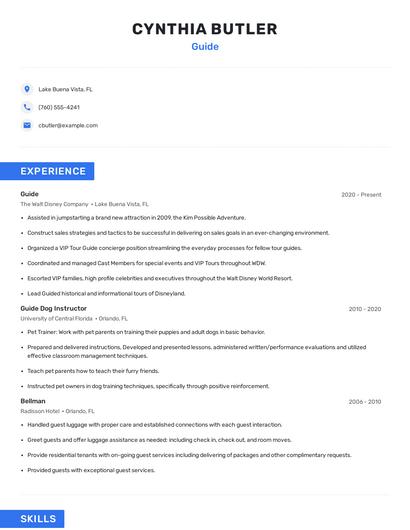
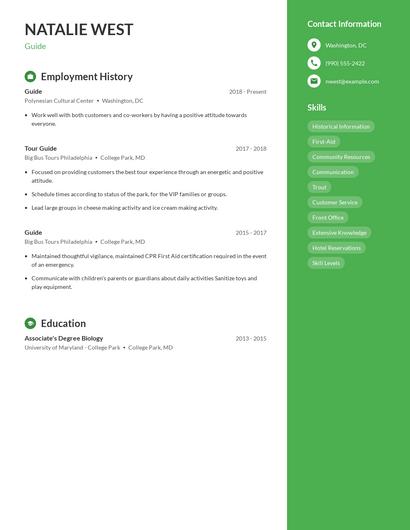
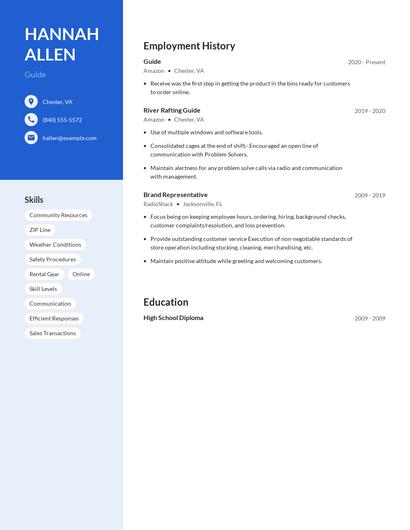
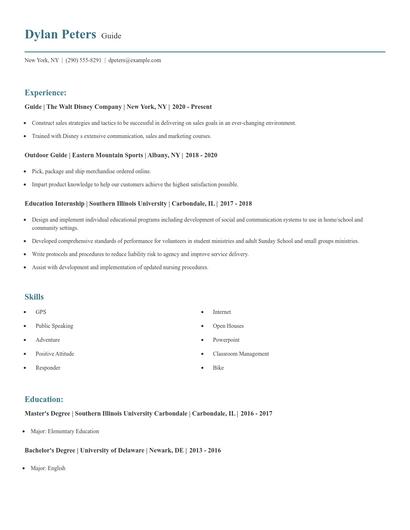
Choose from 10+ customizable guide resume templates
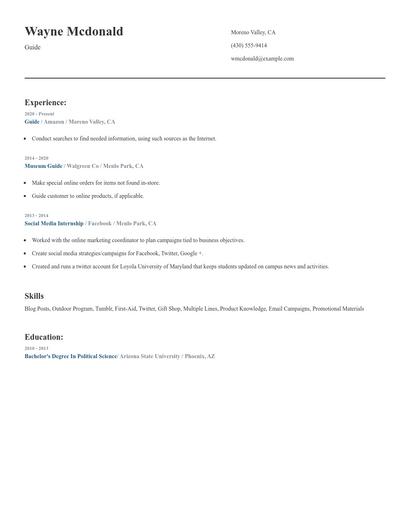
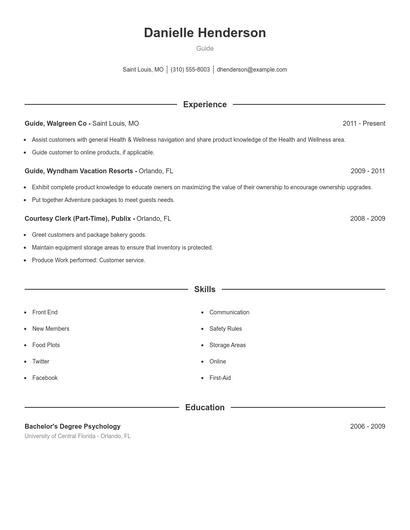
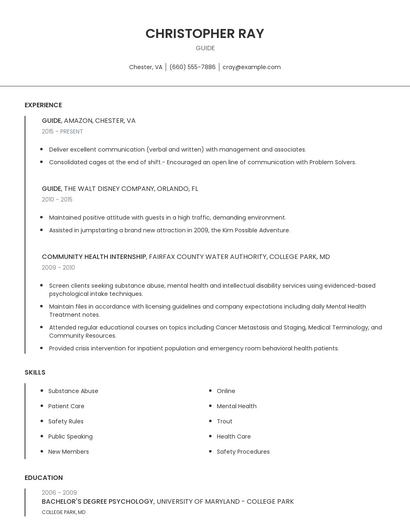
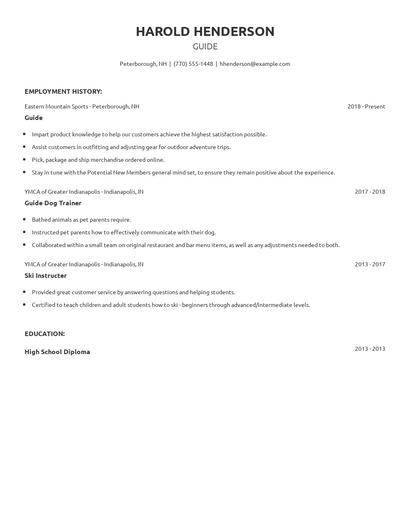
Build a professional guide resume in minutes. Our AI resume writing assistant will guide you through every step of the process, and you can choose from 10+ resume templates to create your guide resume.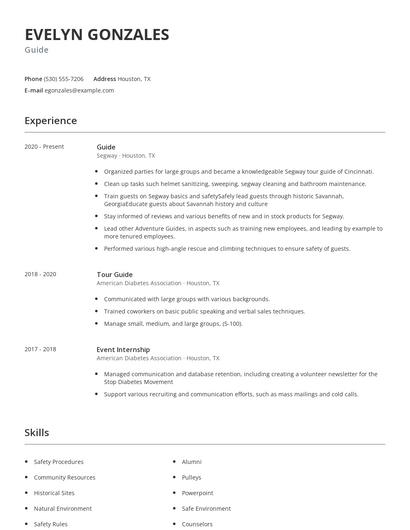
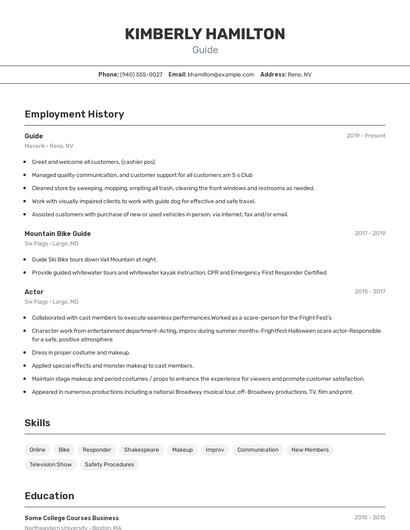
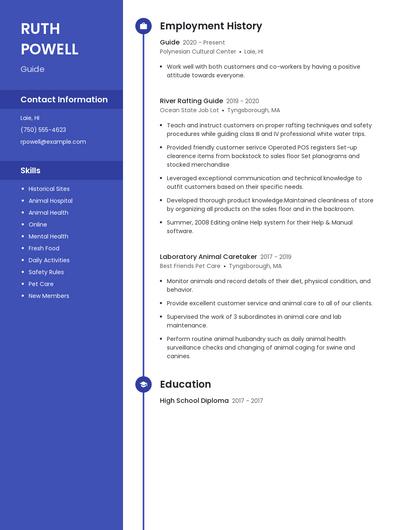
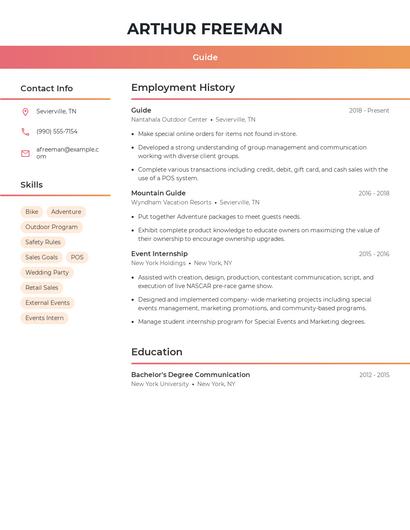
Compare different guides
Guide vs. Escort
Escort is a service provided to accompany an individual, group of people, or vehicle to provide guidance and protection or mark of honor. Military Escort services accompany deceased military personnel to show respect--a healthcare escort sometimes accompanies patients to their destination for ongoing care safely. A Security Escort, commonly called close escort duties, is performed by bodyguards to accompany individuals like VIPs, Celebrities, Sports stars, Heads of State whenever they make an appearance and travel around. A Security Escort usually has special training in evasive driving, close combat, firearms, and first aid.
These skill sets are where the common ground ends though. The responsibilities of a guide are more likely to require skills like "brand awareness," "product knowledge," "customer service," and "adventure." On the other hand, a job as an escort requires skills like "patients," "emergency situations," "safety hazards," and "law enforcement." As you can see, what employees do in each career varies considerably.
Escorts tend to make the most money working in the manufacturing industry, where they earn an average salary of $35,462. In contrast, guides make the biggest average salary, $47,406, in the technology industry.The education levels that escorts earn slightly differ from guides. In particular, escorts are 4.1% less likely to graduate with a Master's Degree than a guide. Additionally, they're 0.8% less likely to earn a Doctoral Degree.Guide vs. Escort service attendant
Each career also uses different skills, according to real guide resumes. While guide responsibilities can utilize skills like "brand awareness," "product knowledge," "safety rules," and "customer service," escort service attendants use skills like "wheelchair," "stretchers," "patients," and "escort services."
Average education levels between the two professions vary. Escort service attendants tend to reach similar levels of education than guides. In fact, they're 1.3% less likely to graduate with a Master's Degree and 0.8% less likely to earn a Doctoral Degree.Guide vs. Docent
Some important key differences between the two careers include a few of the skills necessary to fulfill the responsibilities of each. Some examples from guide resumes include skills like "brand awareness," "product knowledge," "safety rules," and "customer service," whereas a docent is more likely to list skills in "natural history," "public speaking," "aquarium," and "museum visitors. "
When it comes to education, docents tend to earn similar degree levels compared to guides. In fact, they're 2.8% more likely to earn a Master's Degree, and 0.0% more likely to graduate with a Doctoral Degree.Guide vs. Museum attendant
Types of guide
Updated January 8, 2025
