
Automatically apply for jobs with Zippia
Upload your resume to get started.
Hospital secretary skills for your resume and career
15 hospital secretary skills for your resume and career
1. Patients
- Established excellent relationships with all patients and co-workers.
- Created and maintained charts and medical records for patients in the Outpatient Treatment Program.
2. Scheduling Appointments
Scheduling appointments is the practice of finding a free slot with the person(s) you want to meet. The process of scheduling appointments involves finding mutually free time, negotiating follow-ups, sending reminders, and creating new appointments. Scheduling appointments is important to ensure that the timings of consecutive meetings do not clash with each other.
- Conducted clerical and administrative functions such as organizing paper and electronic files, generating correspondence, scheduling appointments and answering telephones.
- Provided secretarial support to department of Radiation/Oncology and physicians, including answering telephones, scheduling appointments, greeting and directing patients.
3. Surgery
- Worked six months in Workforce Development then six months in General Surgery and Trauma.
- Keep family up to date regarding their loved ones in surgery.
4. Transcription
- Demonstrated diligent organization with transcription of physician orders, maintained medical record charts, entered patient labs.
- Worked extensively with pathologists and vendor as the transcription representative for implementation of voice recognition system.
5. Dictation
- Transcribed pathology and autopsy reports from taped dictation as well as maintained departmental procedure manuals.
- Reviewed dictation for accuracy, ensuring translation was consistent with associated patient symptoms or diagnosis.
6. Administrative Functions
Administrative Functions all revolve around planning and managing business operations. Administrators engage in the planning and execution of different business objectives, implementing workplace policies, and organizing resources efficiently. Every action that is a step towards the business's goals is covered by Administrative Functions.
- Execute systems and information compliance, secure productive administrative functions within intelligence processing, and safeguard sensitive material and routing dissemination.
- Possess experience in utilizing microcomputers and computer terminals that have standard typewriter keyboards with extra function keys to accomplish administrative functions.
7. Meeting Minutes
- Prepare meeting agenda/packets, draft/facilitate publication of official Notices/ resolutions/ordinances, attend monthly meetings and prepare official meeting Minutes.
- Streamlined daily operations by preparing correspondence, transcribing meeting minutes, and managing files/records/documents.
8. Telephone Calls
Telephone calls are a communication means through which a caller is connected to the called party. The call is done through a telecommunications device called a telephone. The caller can use a landline, mobile phone, or satellite phone to make the call.
- Handle incoming telephone calls, screen calls and respond to customer inquiries and/or allocate calls to the appropriate staff member.
- Triaged telephone calls for appropriate follow-up which required use of independent judgement and discretion.
9. Statistical Reports
- Prepare statistical reports, maintain tuition files, and nursing education files for tracking certificates.
- Prepared many statistical reports related to daily production as well as performed routine clerical tasks.
10. Front Desk
- Covered front desk and reception area when needed.
- Coordinated front desk reception and manual scheduling, transcribing physician orders, medical instructions, medication information and dietary requirements.
11. Patient Appointments
- Updated Alumni database and scheduled patient appointments.
- Greeted patients warmly and professionally; answered phone and directed calls to appropriate departments; effectively arranged and scheduled patient appointments.
12. Radiology
Radiology means a division of medicine that concentrates on the use of radiant energy or any other radioactive material in the process of diagnosis and ailment treatments. It deals specifically with X-rays and radiations bearing high-energy, used in medicine and diagnosis.
- Distributed laboratory, radiology, and diagnostic test results for ready availability for nurses and physicians.
- Performed all clerical duties for physicians in Radiology Department.
13. Patient Data
- Entered patient data into computers.
- Obtained new patient data and insurance information Entered new patient information into the computer and updated existing patient data.
14. Direct Calls
Direct calls are connections established with a previous customer or client, most likely a subscriber.
- Answered telephone and/or direct calls to appropriate individual.
- Monitor telephone calls and appropriately direct calls.
15. Hippa
HIPAA, which stands for Health Insurance Portability and Accountability Act, is a United States federal statue created, enacted, and turned to law in 1996, which whose primary purposes were to modernise the healthcare systems in the United States, secure and generally enhance the management of that personal information of patients that was in the hands of healthcare facilities, such as hospitals and insurance companies, and to enable the providing of healthcare and insurance to more people.
- Transcribed patient information and entered it into medical charts and hospital database while following medical confidentiality and HIPPA regulations.
- Initiate and maintain complete and accurate patient medical records while observing patient privacy and confidentiality; HIPPA requirements.

What skills help Hospital Secretaries find jobs?
Tell us what job you are looking for, we’ll show you what skills employers want.
What hard/technical skills are most important for hospital secretarys?
Allison White
Associate Professor, Ohio University
List of hospital secretary skills to add to your resume
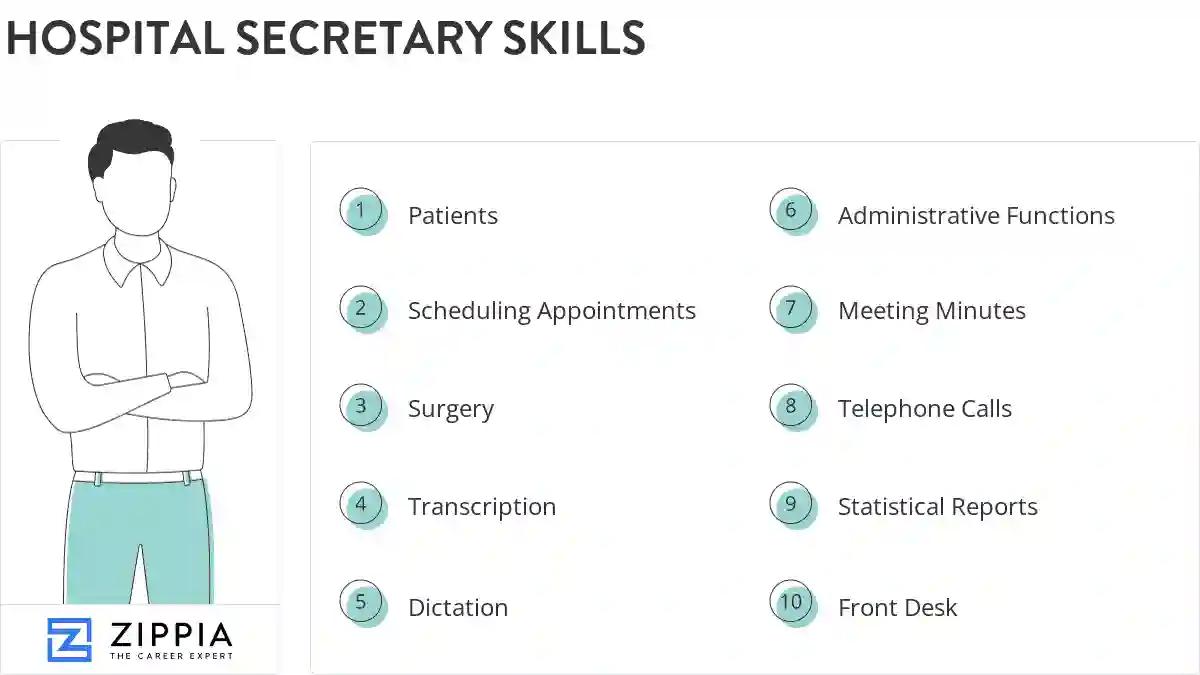
The most important skills for a hospital secretary resume and required skills for a hospital secretary to have include:
- Patients
- Scheduling Appointments
- Surgery
- Transcription
- Dictation
- Administrative Functions
- Meeting Minutes
- Telephone Calls
- Statistical Reports
- Front Desk
- Patient Appointments
- Radiology
- Patient Data
- Direct Calls
- Hippa
Updated January 8, 2025
