What does a hris analyst do?
HRIS analysts are primarily responsible for the management and supervision of human resource information systems, including databases and software, to ensure everything is running smoothly. Moreover, HRIS analysts are also responsible for coordinating with human resources staff to determine their needs, address issues and concerns to provide technical support, analyze various data to devise strategies for improvement, and conduct regular inspections for maintenance. There are also instances where they must provide training or instructional materials for staff, produce progress reports, and evaluate human resource documents.
Hris analyst responsibilities
Here are examples of responsibilities from real hris analyst resumes:
- Manage headcount data in COGNOS application.
- Manage ACA data extraction & 1095-C reporting
- Manage setup of accruals for PTO and vacation and sick time company wide.
- Manage support and upgrade of desktop PC hardware, application software and OS.
- Manage benefits programs, including plan design, pricing, system implementation, and ACA compliance.
- Create and manage various SharePoint sites that allow for data to be more efficiently capture and share.
- Perform costing analysis of ERP base solutions vs. SaaS solutions.
- Perform a high level assessment on strategic impacts of going the route of an ERP base solution vs. SaaS base solution/s.
- Provide functional and technical support, identify and troubleshoot system problems.
- Recommend improvements to HCM processes and systems that lead to enhancements.
- Configure systems and install / update / re-image OS and application software.
- Assist in RFP process and contract negotiations for HCM and bolt on vendors.
- Report various defects in user friendly format using JIRA as a defect tracking tool.
- Lead the design, development and maintenance of Lawson ERP system and all interfacing systems.
- Save hundreds of thousands of dollars by negotiating vendor software purchase contracts relate to SAN software purchasing.
Hris analyst skills and personality traits
We calculated that 6% of Hris Analysts are proficient in Process Improvement, Project Management, and Troubleshoot. They’re also known for soft skills such as Creativity, Analytical skills, and Communication skills.
We break down the percentage of Hris Analysts that have these skills listed on their resume here:
- Process Improvement, 6%
Provided phone and email support to disaster recovery team and recommended process improvements for ongoing disaster recovery efforts.
- Project Management, 6%
Participate on HRIS implementation project teams-business requirements gathering, business process review, project management testing documentation, communications.
- Troubleshoot, 5%
Compiled data, troubleshoot information security issues, and develop solutions.
- Data Integrity, 4%
Performed routine audits of HRIS data for data integrity and provided reporting necessary to meet Senior Management/SOX compliance and regulatory requirements.
- Business Processes, 4%
Provided technical business insight on business processes including: Organizational Management, Personnel Administration, Benefits Administration, and Payroll.
- Data Analysis, 4%
Participate in preparation of written reports and oral presentations summarizing data analysis results.
Most hris analysts use their skills in "process improvement," "project management," and "troubleshoot" to do their jobs. You can find more detail on essential hris analyst responsibilities here:
Creativity. The most essential soft skill for a hris analyst to carry out their responsibilities is creativity. This skill is important for the role because "because analysts are tasked with finding innovative solutions to computer problems, an ability to “think outside the box” is important." Additionally, a hris analyst resume shows how their duties depend on creativity: "coordinated inventory link implementation project at multiple facilities. "
Analytical skills. Another essential skill to perform hris analyst duties is analytical skills. Hris analysts responsibilities require that "analysts must interpret complex information from various sources and decide the best way to move forward on a project." Hris analysts also use analytical skills in their role according to a real resume snippet: "coordinated test scripts to make sure that interrelated data and processes were systematically tested. "
Communication skills. This is an important skill for hris analysts to perform their duties. For an example of how hris analyst responsibilities depend on this skill, consider that "analysts work as a go-between with management and the it department and must explain complex issues in a way that both will understand." This excerpt from a resume also shows how vital it is to everyday roles and responsibilities of a hris analyst: "created all testing scripts, communication and training materials. ".
The three companies that hire the most hris analysts are:
- Tecomet52 hris analysts jobs
- Highmark51 hris analysts jobs
- Rubrik49 hris analysts jobs
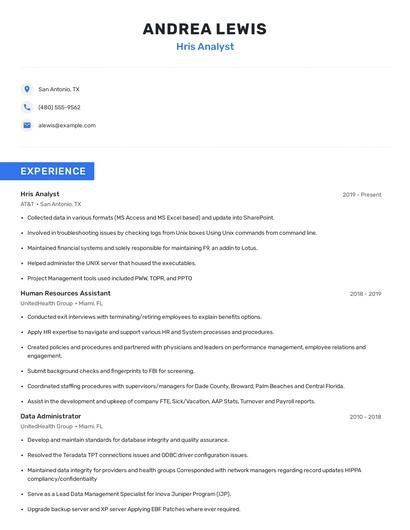
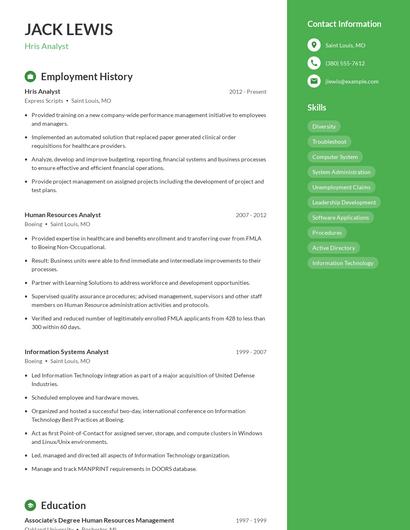
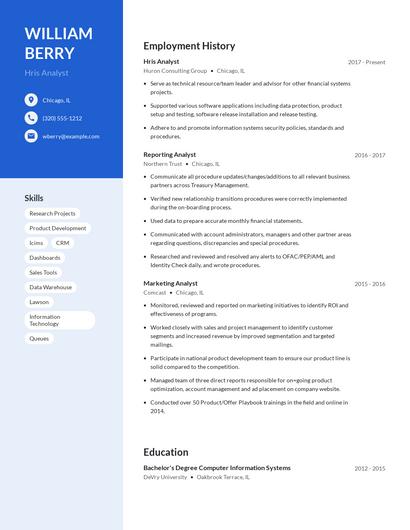
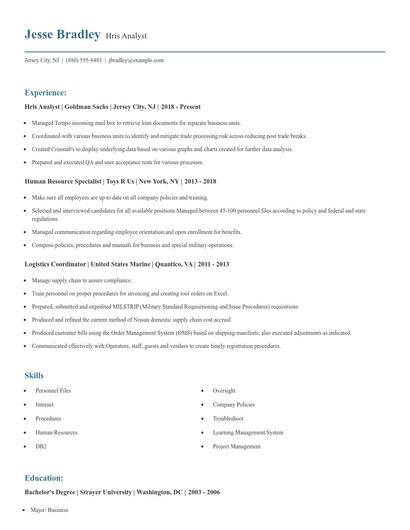
Choose from 10+ customizable hris analyst resume templates
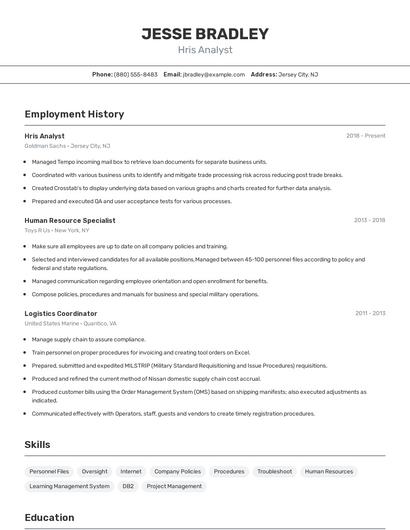
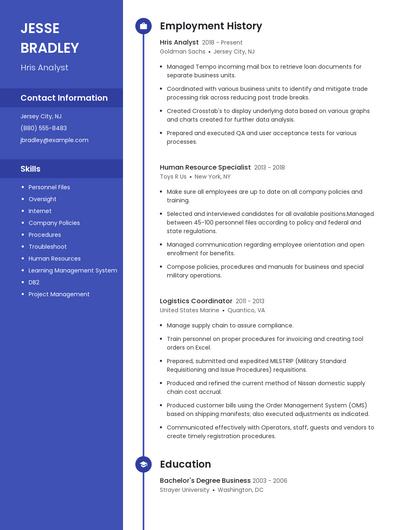
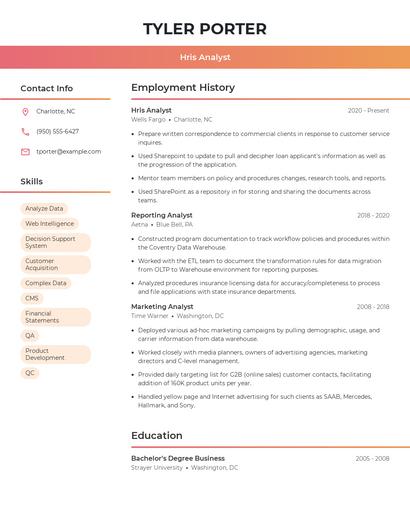
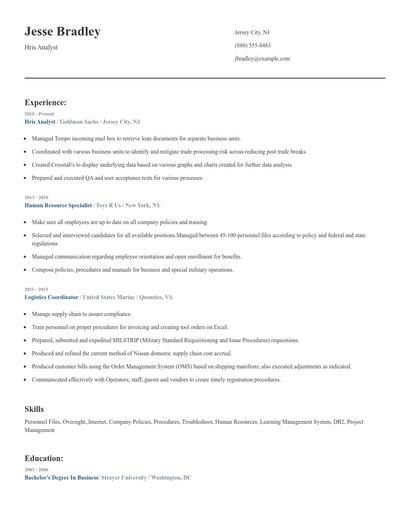
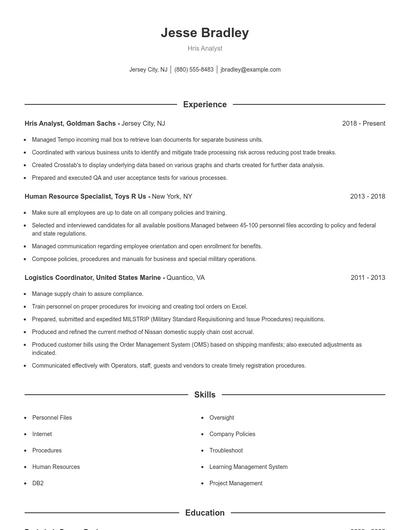
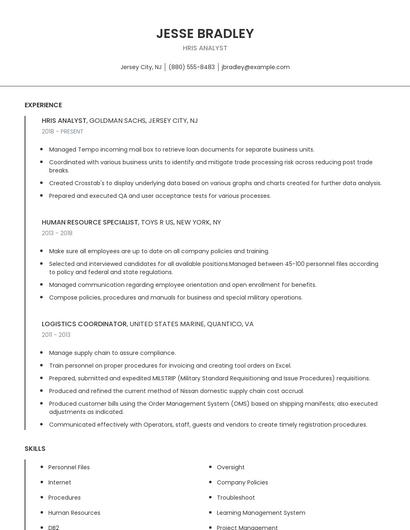
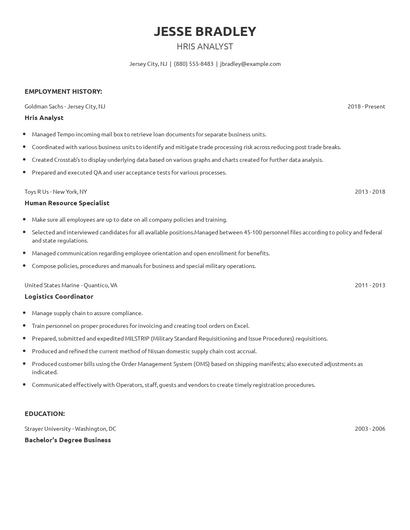
Build a professional hris analyst resume in minutes. Our AI resume writing assistant will guide you through every step of the process, and you can choose from 10+ resume templates to create your hris analyst resume.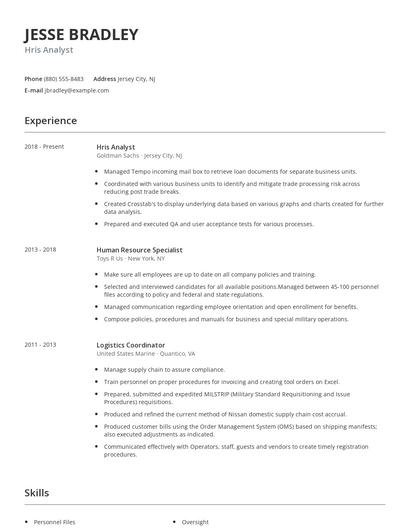
Compare different hris analysts
Hris analyst vs. Business analyst/quality analyst
A business analyst/quality analyst is responsible for evaluating business outputs and operational processes to ensure that everything adheres to the quality standards and business regulations. Business analysts/quality analysts support senior management in determining solutions to improve the company's services and provide the highest satisfaction for the customers and clients. They also conduct data and statistical analysis by assessing the market trends to identify opportunities that would generate more revenue resources and increase profitability for the business.
While similarities exist, there are also some differences between hris analysts and business analyst/quality analyst. For instance, hris analyst responsibilities require skills such as "process improvement," "project management," "troubleshoot," and "data integrity." Whereas a business analyst/quality analyst is skilled in "qa," "sql server," "microsoft visio," and "business process." This is part of what separates the two careers.
Business analysts/quality analysts really shine in the finance industry with an average salary of $94,836. Comparatively, hris analysts tend to make the most money in the retail industry with an average salary of $83,914.business analysts/quality analysts tend to reach higher levels of education than hris analysts. In fact, business analysts/quality analysts are 9.9% more likely to graduate with a Master's Degree and 0.3% more likely to have a Doctoral Degree.Hris analyst vs. Systems analyst programmer
A Systems Analyst Programmer provides technical expertise and recommendations in evaluating new IT software projects. They also indentify solutions and opportunities that can enhance the efficiency of business processes.
In addition to the difference in salary, there are some other key differences worth noting. For example, hris analyst responsibilities are more likely to require skills like "process improvement," "project management," "troubleshoot," and "data integrity." Meanwhile, a systems analyst programmer has duties that require skills in areas such as "c++," "c #," "java," and "database design." These differences highlight just how different the day-to-day in each role looks.
Systems analyst programmers may earn a higher salary than hris analysts, but systems analyst programmers earn the most pay in the finance industry with an average salary of $94,914. On the other hand, hris analysts receive higher pay in the retail industry, where they earn an average salary of $83,914.Average education levels between the two professions vary. Systems analyst programmers tend to reach similar levels of education than hris analysts. In fact, they're 2.3% less likely to graduate with a Master's Degree and 0.3% more likely to earn a Doctoral Degree.Hris analyst vs. Implementation analyst
An implementation analyst is an individual who is responsible for conducting data analysis and software testing when a company is doing a software upgrade. Implementation analysts must ensure that the company has the appropriate equipment to meet its operational needs by determining which hardware and software they should use. They provide workshops and conduct education for trainers on the functionality of the product as well as to conduct tests to ensure the proper functionality of the product. Implementation analysts must also prepare budgets for proposed equipment or tailor their recommendations to fit an established budget.
The required skills of the two careers differ considerably. For example, hris analysts are more likely to have skills like "data integrity," "system changes," "sql," and "system issues." But a implementation analyst is more likely to have skills like "client facing," "customer service," "qa," and "financial institutions."
Implementation analysts earn the highest salary when working in the technology industry, where they receive an average salary of $83,317. Comparatively, hris analysts have the highest earning potential in the retail industry, with an average salary of $83,914.Most implementation analysts achieve a similar degree level compared to hris analysts. For example, they're 2.1% less likely to graduate with a Master's Degree, and 0.2% less likely to earn a Doctoral Degree.Hris analyst vs. Technical system analyst
Technical Systems Analysts are employees who are adept in information technology (IT). They work in the IT department, where they oversee the different networks and systems that exist in the company. They manage the technical systems and ensure that these systems are working properly at all times. They generate reports related to the networks and systems. They then study and analyze these reports to identify existing problems or anticipate challenges that may come their way. These reports help them craft solutions to problems and invest in infrastructure that will address challenges.
Types of hris analyst
Updated January 8, 2025
