
Automatically apply for jobs with Zippia
Upload your resume to get started.
Information technology consultant skills for your resume and career

15 information technology consultant skills for your resume and career
1. Customer Service
Customer service is the process of offering assistance to all the current and potential customers -- answering questions, fixing problems, and providing excellent service. The main goal of customer service is to build a strong relationship with the customers so that they keep coming back for more business.
- Guaranteed high network availability to meet customer service level agreement requirements in addition to delivering support and performing necessary recovery procedures.
- Provided customer service to patrons about printing and other computing and application issues, particularly those involving Microsoft Office products.
2. Database
A database is a collection of data and information which makes it easy to view, access, and manage. Databases save a lot of time and can store huge amounts of data. Databases make sorting data easier and stores it in certain fields which narrows the searching criteria. A database usually contains tables, graphs, and columns to display data.
- Developed Line-of-Business and database applications.
- Documented and Updated existing database and information systems ER-Diagram entities and their relationships with new interface application and table data entities.
3. Project Management
- Advised management on application/infrastructure enhancements required for performance improvements using excellent project management capabilities.
- Perform project management and oversight of technical projects including information security, application development, cloud-based services, and telecommunication systems.
4. Cloud
Cloud is a server that is accessed over the internet. There are different programs and software that also run on these servers. These clouds can be accessed from anywhere in the world as they are not present in your computer storage, but have their online servers. Cloud consists of data centers all across the world.
- Recruited to manage the implementation of cloud based computing infrastructure Program Manager - Consultant - focused on architecture design and implementation.
- Specialized knowledge of hosted desktop RDC secure cloud environment solutions/hosted infrastructure, data security/compliance, and legal software applications.
5. Troubleshoot
Troubleshooting is the process of analyzing and fixing any kind of problem in a system or a machine. Troubleshooting is the detailed yet quick search in the system for the main source of an issue and solving it.
- Provide network/computer system, assessment, recommendation, installation, deployment, troubleshoot and support of various complex Information Technology infrastructures.
- Supported information technology infrastructure, databases, and troubleshoot problems via remote connection at La Petite Corporate Headquarters in Overland Park.
6. Business Processes
- Gathered business requirements, documented existing business processes and made recommendations on how to improve existing business work flows and processes.
- Implemented rules for monitoring, notification, and escalation for critical applications by analyzing business processes and unitizing operations security principles.
Choose from 10+ customizable information technology consultant resume templates
Build a professional information technology consultant resume in minutes. Our AI resume writing assistant will guide you through every step of the process, and you can choose from 10+ resume templates to create your information technology consultant resume.7. Network Infrastructure
- Maintain network infrastructure and application configuration architecture documentation.
- Analyzed and recommended solutions on existing server and network infrastructure including security, communications, software, and cabling requirements.
8. SQL Server
- Simplified and consolidated MS Access/SQL Server application to facilitate management of bids and purchasing for construction process.
- Supervised staff whose responsibilities included application development, SQL Server, and network system administration.
9. Linux
Linux is a Unix-like operating system. Just like Windows, Mac OS, and IOS, Linux is an operating system used by millions across the globe. Android itself is powered by the Linux operating system. Linux manages all the hardware resources that are associated with your computer. The software is famous because of the protection it grants from viruses, malware, and crashes. The Linux operating system is entirely free and is an open-source software meaning it can be altered by those equipped with the knowledge to code.
- Performed routine maintenance on various operating systems including Mac, Linux and Microsoft and desktop peripherals.
- Designed, implemented and supported mixed Linux and Windows environments for small business customers.
10. Technical Support
Technical support or tech support are the services provided by any hardware or software company to users. They help in solving the technical difficulties the customers face with their products or services. Moreover, the tech support employees maintain, manage, and repair the IT faults. They are also responsible for resolving the network problems, installing and configuring hardware and software.
- Cost savings realized through contractual, equipment savings and technical support to minimize downtime and maximize productivity.
- Provide on-site hardware and software technical support including installation, preventative maintenance and troubleshooting on systems.
11. PC
- Maintained inventory of PC users/computers/Printers.
- Install, maintain, and support Servers, PC systems, wireless networks and networks for several small companies and individuals.
12. Desktop Support
- Provided remote desktop support, supervised physical installation and machine configuration/certification if required along with application migration (if applicable).
- Provided on-site advanced desktop support for Windows based operating systems and Microsoft applications, including troubleshooting and repairing software/hardware malfunctions.
13. OS
In technical terms, OS stands for "Operating System". It is a software that is used to run programs on the computer. An operating system acts as a link between the user and the hardware components. Windows, macOS, iOS, Linux are examples of an operating system.
- Developed engineering practices and technical documentation for enterprise-wide XP migration of desktop/Laptop OS to Windows 7.
- Supported compatibility testing and application scripting to enable migration to new OS Platform.
14. SDLC
- Developed an interface application for CGAS data conversion to SAP conforming data accuracy using SDLC methodology.
- Prepared SDLC technical documentation and presentations for customers and senior leaders.
15. Visio
Visio or Microsoft Visio is computer software that allows users to create and draw vector graphics according to their requirements. The program is used to draw flowcharts, org charts, data flow diagrams, process flow diagrams, and modeling diagrams. Visio is also used to draw architectural designs including; building and floor plans, and 3D geographical maps.
- Created documentation and network diagrams utilizing Microsoft Project, Excel, VISIO and MS Word.
- Documented high-level processing and data models/flows via the creation and maintenance of VISIO diagrams.
5 Information Technology Consultant resume examples
Build a professional information technology consultant resume in minutes. Browse through our resume examples to identify the best way to word your resume. Then choose from 5+ resume templates to create your information technology consultant resume.

What skills help Information Technology Consultants find jobs?
Tell us what job you are looking for, we’ll show you what skills employers want.
What skills stand out on information technology consultant resumes?
Dale Musser Ph.D.
Associate Teaching Professor, University of Missouri
-Past accomplishments in delivering results while working with others
-Technical skills in target areas for job. The hottest areas right now: machine learning, large scale apps, and autonomous systems.
What soft skills should all information technology consultants possess?
Ehsan Sheybani Ph.D.
Professor, University of South Florida
What information technology consultant skills would you recommend for someone trying to advance their career?
Ranganathan Chandrasekaran
Professor and Director of Graduate Studies, University of Illinois
What type of skills will young information technology consultants need?
Peter Dordal Ph.D.
Director for Information Technology, Loyola University Chicago
IT students entering the business world will need to know how to get the maximum leverage out of business systems. In many cases, this will mean writing their own specialized queries to extract the precise business intelligence needed; general-purpose "canned" queries just won't cut it. They will need a broad understanding of what software can accomplish for the enterprise and how to deploy new software effectively; this applies to software used in the office as well as to software used in manufacturing and shipping. And they will need to understand how to lease storage and computing resources from the cloud to meet not only predictable, long-term demands but also sudden short-term business projects.
Students working in database administration and management will need to be able to manage much larger volumes of data than a few years ago. They will need to be familiar with the great variety of new databases in order to pick the best tool for the job.
Students working in network management will need to be able to ensure that everyone has the bandwidth and server access they need, as those demands expand to include extensive video, low-latency real-time connectivity, and the regular transfer of huge amounts of data.
Students in cybersecurity will need to be fully acquainted with all the recommended best practices. However, they will also have to be able to anticipate and guard against potential new vulnerabilities. "By the book" protection is no longer sufficient.
What technical skills for an information technology consultant stand out to employers?
Melody Buckner Ph.D.
Associate Vice Provost | Digital Learning and Online Initiatives, Assistant Professor of Practice, University of Arizona
What hard/technical skills are most important for information technology consultants?
Robert Rucker
Lecturer, Arizona State University
1. Need to know how to design and implement ( or contribute to) a 'principled' information base (this is a skill my students encounter routinely)
a. Designing an information system requires knowing multiple levels of analysis and synthesis
- I teach the undergrad and graduate levels of database
( I have been teaching' conceptual level modeling --- using Object role modeling ( this is a layer above ER and relational, and has been underappreciated IMO
b. relational level analysis using SQL
implementational level using T-SQL
c. NoSQL using Couchbase and SQL++ and hence the key-value mode of storage
implementation ( SQL + NoSQL seem essential in this world of federated databases !)
d. Of course, there is the underlying substrate of approaching an info task in the first place!
2. For what it's worth, I also teach big data. Again, finding (understanding) and exemplifying the principles underlying the algorithms and data development is crucial.
List of information technology consultant skills to add to your resume
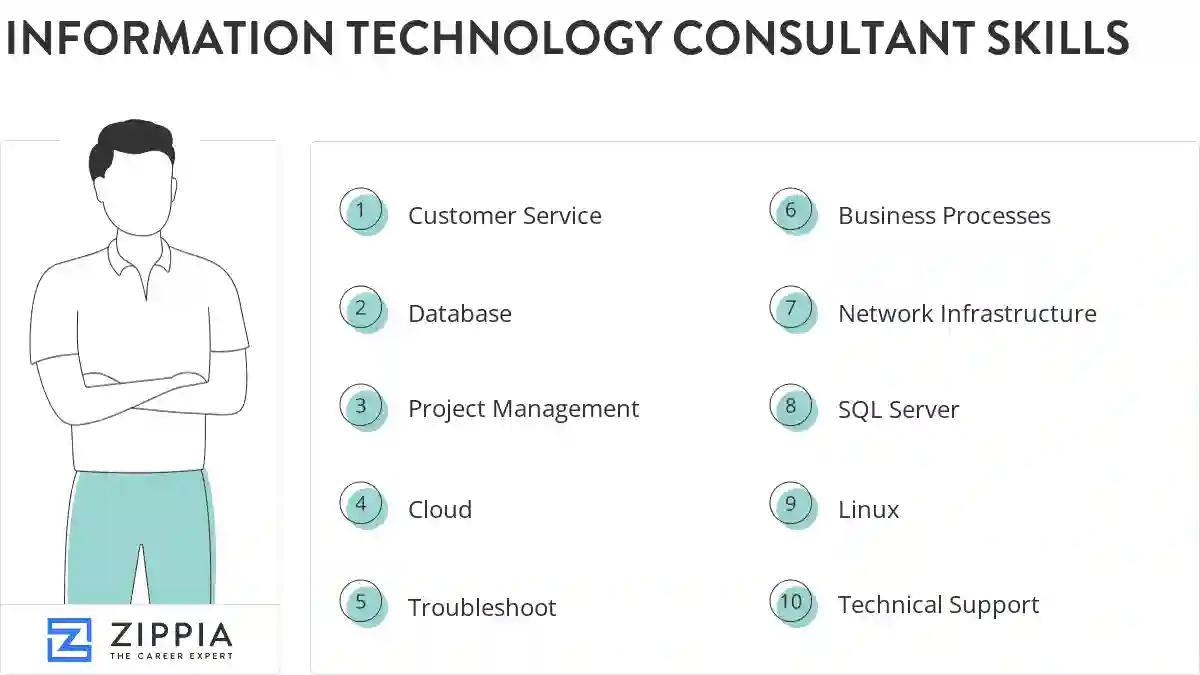
The most important skills for an information technology consultant resume and required skills for an information technology consultant to have include:
- Customer Service
- Database
- Project Management
- Cloud
- Troubleshoot
- Business Processes
- Network Infrastructure
- SQL Server
- Linux
- Technical Support
- PC
- Desktop Support
- OS
- SDLC
- Visio
- ITIL
- Enterprise Architecture
- ERP
- SharePoint
- Citrix
- Unix
- Management System
- VPN
- VMware
- Windows Server
- DNS
- SOX
- Amazon Web Services
- Disaster Recovery
- Mac
- JavaScript
- HTML
- Computer System
- Windows XP
- Technical Issues
- HIPAA
- Lan
- Oracle 11G
- QA
- VoIP
- POS
- IIS
- Backup Recovery
- TCP/IP
- Develop Understanding
- CSS
- PHP
- DHCP
Updated January 8, 2025
