What does an integration and test engineer do?
An integration and test engineer is responsible for evaluating network systems and applications, ensuring its optimal performance and stability to support business operations and achieve the highest customer satisfaction. Integration and test engineers design new networks or improve existing databases according to business requirements and client needs. They also run multiple diagnostic tests and quality checks to servers to locate malfunctions and inconsistencies and perform immediate troubleshooting and configurations. These engineers must have excellent communication and technical skills, especially on resolving server issues and creating technical solutions with cost-reduction techniques.
Integration and test engineer responsibilities
Here are examples of responsibilities from real integration and test engineer resumes:
- Utilize VMware vSphere to manage virtual machines and collect metrics for system stability and troubleshooting during test activities.
- Manage full life-cycle development and implementation of company's verification scheme for HSE critical equipment.
- Provide testing support to user acceptance (UAT) testing.
- Execute Java base TAF GUI automation test cases for long run.
- Develop test plans, test site scheduling, equipment calibration and setup, RF signal measurement and data analysis.
- Carry out UAT most of the releases.
- Create PERL templates to post-process logs & verify WCDMA/LTE call-flows.11.
- Gather and analyze air traffic data between sites using various UNIX commands.
- Identify, document, and track defects in JIRA through correction and implementation.
- Verify in UNIX environment to make sure user home directories are create with correct access
- Develop automation using Perl and deploy it for software unit testing of C2K stack.
- Access Linux back end to check log files for errors and confirm processes are running.
- Design configured and implement complete Compaq FC SAN consisting of Compaq EMA12000/HSG80 running FW revs.
- Well-Verse with different defect tracking tools like JIRA and Bugzilla, chosen to be used by Motorola.
- Integrate hardware, load and configure windows, Linux, and AIX operating systems per the test plan.
Integration and test engineer skills and personality traits
We calculated that 7% of Integration And Test Engineers are proficient in Test Equipment, Python, and Test Procedures. They’re also known for soft skills such as Creativity, Listening skills, and Math skills.
We break down the percentage of Integration And Test Engineers that have these skills listed on their resume here:
- Test Equipment, 7%
Insured proper operation, administration and modification of test equipment operating system software, test software and test equipment checkout software.
- Python, 6%
Write programs and perform regression tests for Ground Software Releases using Python.
- Test Procedures, 6%
Developed and implemented test plans, test procedures, deployment procedures, and operational procedures in a Scrum/Agile development environment.
- C++, 5%
Utilized C++ and RedHat Linux to assist developers in creating test harnesses for AOLTV and TiVo application code.
- C #, 5%
Designed/maintained automation using in-house C # automation library.
- RF, 5%
Automated and integrated RF and digital systems testing for ARC-210 UHF Transceivers, IFFT & TACAN system characteristics and RF parameters.
Common skills that an integration and test engineer uses to do their job include "test equipment," "python," and "test procedures." You can find details on the most important integration and test engineer responsibilities below.
Creativity. One of the key soft skills for an integration and test engineer to have is creativity. You can see how this relates to what integration and test engineers do because "mechanical engineers design and build complex pieces of equipment and machinery." Additionally, an integration and test engineer resume shows how integration and test engineers use creativity: "developed inventive improvements to device structure and invented new data analysis algorithms. "
Listening skills. Another soft skill that's essential for fulfilling integration and test engineer duties is listening skills. The role rewards competence in this skill because "mechanical engineers often work on projects with others, such as architects and computer scientists." According to an integration and test engineer resume, here's how integration and test engineers can utilize listening skills in their job responsibilities: "communicated with the qa manager, developers and the customer to ensure the final system delivered the expected functionality. "
Math skills. Another skill that relates to the job responsibilities of integration and test engineers is math skills. This skill is critical to many everyday integration and test engineer duties, as "mechanical engineers use the principles of calculus, statistics, and other advanced subjects in math for analysis, design, and troubleshooting in their work." This example from a resume shows how this skill is used: "developed scripts in order to obtain daily statistics report and extract kpi information pertaining to samsung 4g lte core systems. "
Mechanical skills. A big part of what integration and test engineers do relies on "mechanical skills." You can see how essential it is to integration and test engineer responsibilities because "mechanical skills allow engineers to apply basic engineering concepts and mechanical processes to the design of new devices and systems." Here's an example of how this skill is used from a resume that represents typical integration and test engineer tasks: "provide data analysis during mechanical tests for any problems and suggest actions for resolutions to problems or test failures"
Problem-solving skills. Another common skill required for integration and test engineer responsibilities is "problem-solving skills." This skill comes up in the duties of integration and test engineers all the time, as "mechanical engineers need good problem-solving skills to take scientific principles and discoveries and use them to design and build useful products." An excerpt from a real integration and test engineer resume shows how this skill is central to what an integration and test engineer does: "provided data analysis and trending while conducted "system anomaly" investigations and provided resolution. "
The three companies that hire the most integration and test engineers are:
- Lockheed Martin80 integration and test engineers jobs
- L3Harris73 integration and test engineers jobs
- Raytheon Technologies38 integration and test engineers jobs
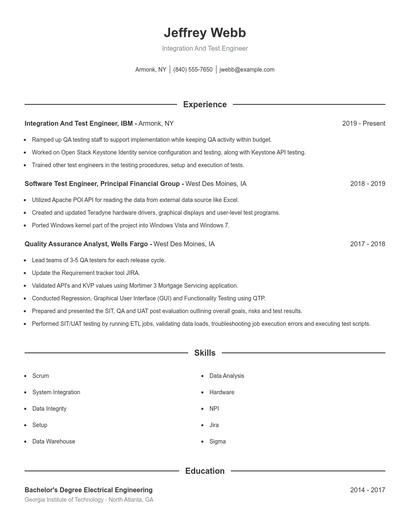
Choose from 10+ customizable integration and test engineer resume templates
Build a professional integration and test engineer resume in minutes. Our AI resume writing assistant will guide you through every step of the process, and you can choose from 10+ resume templates to create your integration and test engineer resume.




Compare different integration and test engineers
Integration and test engineer vs. Test specialist
A test specialist is responsible for evaluating and running diagnostic tests for system networks and applications to ensure stability and efficiency according to the quality standards. Test specialists analyze the system's features and write findings reports for improvement and technical resolutions. They also help system engineers in developing infrastructures and designing servers to support business operations and maximize productivity. A test specialist must have excellent communication and organizational skills, especially in identifying malfunctions and inconsistencies before the actual launch of deliverables.
While similarities exist, there are also some differences between integration and test engineers and test specialist. For instance, integration and test engineer responsibilities require skills such as "python," "c++," "c #," and "labview." Whereas a test specialist is skilled in "selenium," "client facing," "development life," and "life cycle." This is part of what separates the two careers.
Test specialists tend to reach lower levels of education than integration and test engineers. In fact, test specialists are 6.7% less likely to graduate with a Master's Degree and 0.4% more likely to have a Doctoral Degree.Integration and test engineer vs. Software engineer-consultant
A software engineer consultant develops and recommends strategies to optimize a company's software engineering operations. Their responsibilities revolve around conducting extensive research and analysis to find new opportunities, performing software evaluations and risk assessments, identifying the strengths and weaknesses of existing processes, and developing solutions against problem areas. Through the findings of their research, a software engineer consultant draws conclusions and recommendations that will help the company to reach their short and long-term goals and resolve issues or concerns.
Each career also uses different skills, according to real integration and test engineer resumes. While integration and test engineer responsibilities can utilize skills like "test equipment," "test procedures," "c #," and "rf," software engineers-consultant use skills like "architecture," "software development," "api," and "ui."
On average, software engineers-consultant earn a higher salary than integration and test engineers. Some industries support higher salaries in each profession. Interestingly enough, software engineers-consultant earn the most pay in the insurance industry with an average salary of $118,185. Whereas integration and test engineers have higher pay in the telecommunication industry, with an average salary of $99,821.software engineers-consultant earn similar levels of education than integration and test engineers in general. They're 2.7% more likely to graduate with a Master's Degree and 0.4% more likely to earn a Doctoral Degree.What technology do you think will become more important and prevalent for integration and test engineers in the next 3-5 years?
Perry Kivolowitz
Chair, Computer Science Department; Professor of Practice in Computer Science, Carthage College
Integration and test engineer vs. Staff software engineer
A Staff Software Engineer is responsible for developing, maintaining, and repairing company software for maximum efficiency and usability. They instruct and mentor their team members in software development techniques and cloud development.
There are many key differences between these two careers, including some of the skills required to perform responsibilities within each role. For example, an integration and test engineer is likely to be skilled in "test equipment," "test procedures," "system integration," and "test results," while a typical staff software engineer is skilled in "software development," "architecture," "git," and "database."
Staff software engineers earn the best pay in the retail industry, where they command an average salary of $160,201. Integration and test engineers earn the highest pay from the telecommunication industry, with an average salary of $99,821.Most staff software engineers achieve a higher degree level compared to integration and test engineers. For example, they're 9.1% more likely to graduate with a Master's Degree, and 2.2% more likely to earn a Doctoral Degree.Integration and test engineer vs. Engineer
Engineers are highly trained professionals who determine the feasibility of various projects, usually related to the construction industry. They are considered experts in mathematics and science, two disciplines that they need to use in designing and coming up with plans for projects. They should also be well-versed in different construction or industrial materials, and they ensure that appropriate materials are used for the project. They also ensure that the projects meet the requirements of the groups that hired them. They create spaces that would both address the needs of the end-users and the industry standards. They also ensure that the projects they make would stand the test of time.
Types of integration and test engineer
Updated January 8, 2025
