Explore jobs
Find specific jobs
Explore careers
Explore professions
Best companies
Explore companies
What is an interpreter and how to become one
An interpreter facilitates communication between individuals who speak different languages. They may work in legal, medical, educational, and business environments to translate spoken words and/or written documents. Interpreters must have excellent language skills and cultural knowledge, as well as strong communication and interpersonal skills. They may work in person or remotely, using technology to facilitate communication. Interpreting can be a rewarding profession that allows individuals to make a meaningful difference.
What general advice would you give to an interpreter?
Laura Polhemus Ph.D.
Advanced Assistant Professor, Bethel University
The Center for Atypical Language Interpreting offers many resources that will prepare you to work with individuals from a variety of language backgrounds. https://cssh.northeastern.edu/cali/
There are many Deaf individuals obtaining advanced degrees and working in high level positions. Knowing how to behave with the utmost professionalism in a multitude of work settings and having strong academic language skills in both American Sign Language and English are important in working with these individuals.
Avg. Salary $42,008
Avg. Salary $59,228
Growth rate 20%
Growth rate 0.3%
American Indian and Alaska Native 0.26%
Asian 17.46%
Black or African American 5.80%
Hispanic or Latino 32.80%
Unknown 4.93%
White 38.75%
Genderfemale 61.33%
male 38.67%
Age - 40American Indian and Alaska Native 3.00%
Asian 7.00%
Black or African American 14.00%
Hispanic or Latino 19.00%
White 57.00%
Genderfemale 47.00%
male 53.00%
Age - 40Stress level is manageable
7.1 - high
Complexity level is challenging
7 - challenging
Work life balance is excellent
6.4 - fair
What are the pros and cons of being an interpreter?
Pros
High demand for interpreters
Flexible work schedule
Potential for travel and international work
Competitive pay rates
Opportunity for professional development and advancement
Cons
Irregular work hours, including weekends and evenings
Limited job security and benefits for freelance interpreters
Limited opportunities for career advancement in some settings
Potential for burnout from high demand and long hours
Potential for miscommunication or misunderstandings with clients
Interpreter career paths
Key steps to become an interpreter
Explore interpreter education requirements
Start to develop specific interpreter skills
Skills Percentages Patients 23.88% Customer Service 17.66% ASL 10.38% Medical Terminology 7.67% LEP 4.95% Complete relevant interpreter training and internships
Accountants spend an average of Less than 1 month on post-employment, on-the-job training. New interpreters learn the skills and techniques required for their job and employer during this time. The chart below shows how long it takes to gain competency as an interpreter based on U.S. Bureau of Labor Statistics data and data from real interpreter resumes.Research interpreter duties and responsibilities
- Lead an international team of HUMINT collectors for the NATO mission in Bosnia where overt and covert collection protocols are observed.
- Perform administrative duties such as filling, scanning, printing and photocopying.
- Keep update information on students, families and translate school documents into Hmong.
- Serve as a media spokesperson for the ESL department on Spanish radio and television.
Prepare your interpreter resume
When your background is strong enough, you can start writing your interpreter resume.
You can use Zippia's AI resume builder to make the resume writing process easier while also making sure that you include key information that hiring managers expect to see on an interpreter resume. You'll find resume tips and examples of skills, responsibilities, and summaries, all provided by Zippi, your career sidekick.
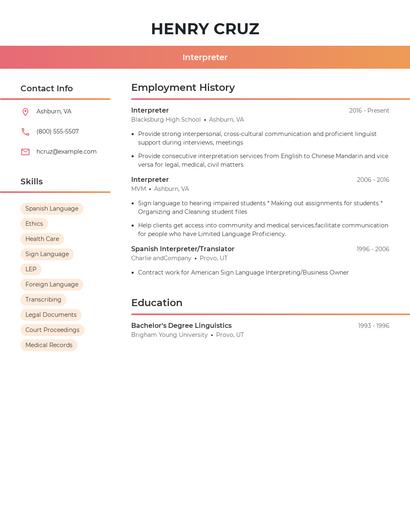
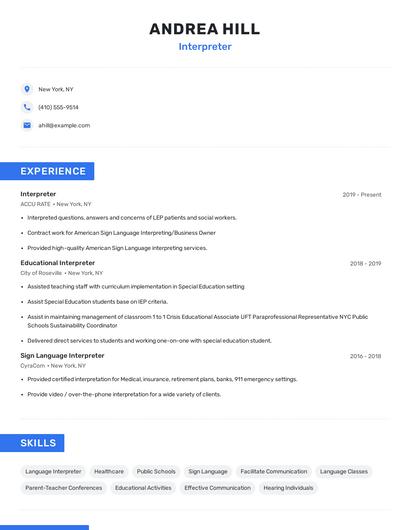
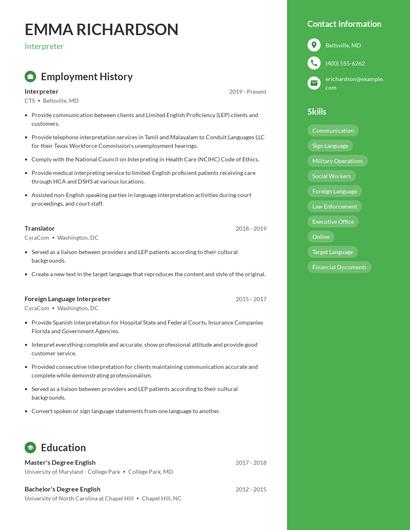
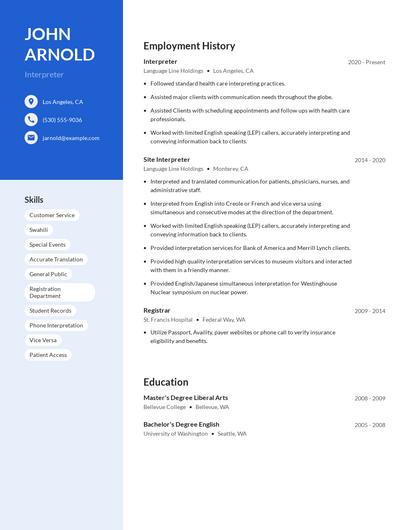
Choose from 10+ customizable interpreter resume templates
Build a professional interpreter resume in minutes. Browse through our resume examples to identify the best way to word your resume. Then choose from 10+ resume templates to create your interpreter resume.




Apply for interpreter jobs
Now it's time to start searching for an interpreter job. Consider the tips below for a successful job search:
- Browse job boards for relevant postings
- Consult your professional network
- Reach out to companies you're interested in working for directly
- Watch out for job scams
How did you land your first interpreter job

Are you an interpreter?
Share your story for a free salary report.
Average interpreter salary
The average interpreter salary in the United States is $42,008 per year or $20 per hour. Interpreter salaries range between $29,000 and $60,000 per year.
What am I worth?

How do interpreters rate their job?
Interpreter reviews

Being the mediator and the satisfaction I get from helping people communicate.
Nothing so far.
Translating Bilingual student's School work
I do not like teaching American students
interpreting student's school work
I do not like teaching bilingual classes
Interpreter FAQs
Search for interpreter jobs
Updated January 8, 2025
