What does a lan engineer do?
Lan engineer responsibilities
Here are examples of responsibilities from real lan engineer resumes:
- Manage VPN accounts using Nortel client.
- Manage enterprise level projects as a project manager using ITIL project management methodology.
- Customize, configure, troubleshoot, fix servers and workstations both remotely and onsite.
- Configure, deploy, and troubleshoot LAN infrastructure for Florida base offices and data center.
- Used DNS settings, server connections, DHCP, certificate usage, location files, ping, tracert and nslookup commands.
- Support users globally through SCCM.
- Provide technical support globally using SCCM.
- Provide on-going technical support in Nortel and Cisco VoIP environment.
- Diagnose and repair remote access issues both VPN and web base.
- Transition new clients from physical server to a VMWare infrastructure (P2V).
- Work on installing and configuring DHCP servers, maintaining and removing ghost records.
- Racked and stack new Cisco 3550 rack switches, install fiber and RJ45 cabling.
- Coordinate PC and printer breakdown & packing for physical move to new location (s).
- Initiate and administrate the server consolidation program through use of VMware ESX server and VMware VirtualCenter.
- Install financial applications on servers and publish them to the Citrix web base environment for clients.
Lan engineer skills and personality traits
We calculated that 8% of LAN Engineers are proficient in Windows Server, Disaster Recovery, and Network Infrastructure. They’re also known for soft skills such as Analytical skills, Communication skills, and Problem-solving skills.
We break down the percentage of LAN Engineers that have these skills listed on their resume here:
- Windows Server, 8%
Created, supervised and maintained Windows Server and MS Exchange Accounts for over 500 users at state agency.
- Disaster Recovery, 7%
Created and implemented disaster recovery plan.
- Network Infrastructure, 7%
Recruited to help establish and manage enterprise-wide highly available server and storage area network infrastructure.
- Computer System, 5%
Contract Completed * Installed computer systems, including peripherals and software.
- Network Support, 5%
Network support for five servers which included installing servers, print servers, training systems personnel and end-users.
- Switches, 4%
Authored and published a Master Security document for all network routers and switches, Main authentication is via RADIUS/TACAS.
Most lan engineers use their skills in "windows server," "disaster recovery," and "network infrastructure" to do their jobs. You can find more detail on essential lan engineer responsibilities here:
Analytical skills. The most essential soft skill for a lan engineer to carry out their responsibilities is analytical skills. This skill is important for the role because "administrators need to evaluate networks and systems to make sure that they perform reliably and to anticipate new requirements as customers’ needs change." Additionally, a lan engineer resume shows how their duties depend on analytical skills: "maintained, analyzed, trouble-shot, and repaired computer systems, hardware and computer peripherals. "
Communication skills. Another soft skill that's essential for fulfilling lan engineer duties is communication skills. The role rewards competence in this skill because "administrators must describe problems and their solutions to non-it workers." According to a lan engineer resume, here's how lan engineers can utilize communication skills in their job responsibilities: "implemented pc workstation to mainframe communication links for satellite offices. "
Problem-solving skills. lan engineers are also known for problem-solving skills, which are critical to their duties. You can see how this skill relates to lan engineer responsibilities, because "administrators must quickly resolve problems that arise with computer networks." A lan engineer resume example shows how problem-solving skills is used in the workplace: "analyzed lan needs and determined optimum and cost-benefit solutions for customers. "
The three companies that hire the most lan engineers are:
- DMI Technology1 lan engineers jobs
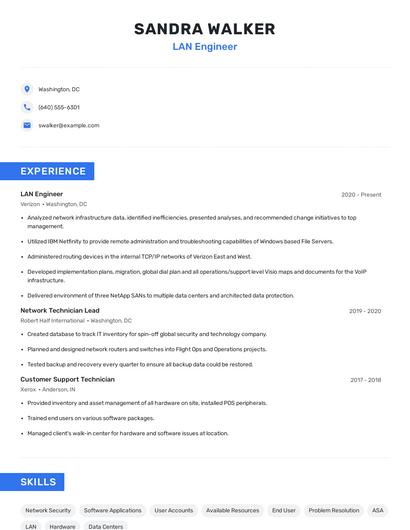
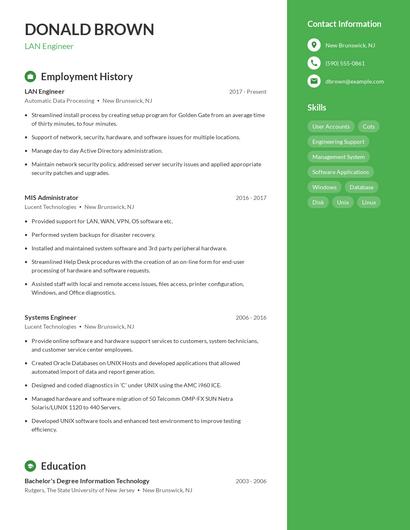
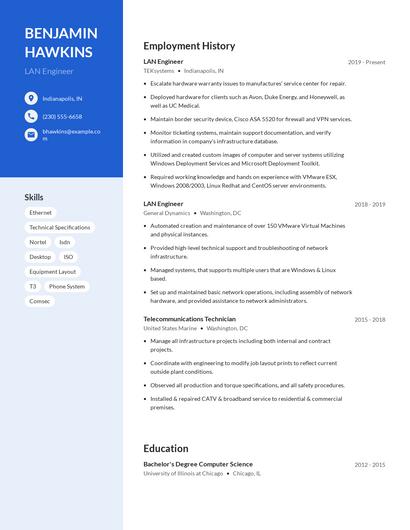
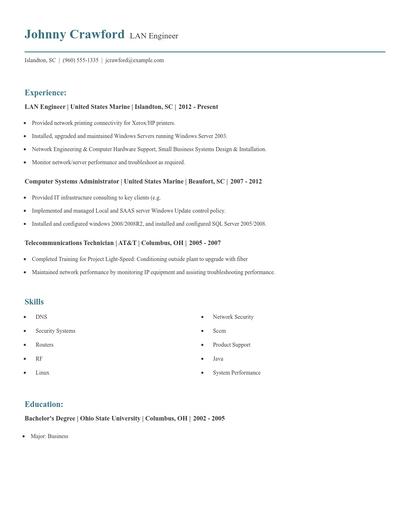
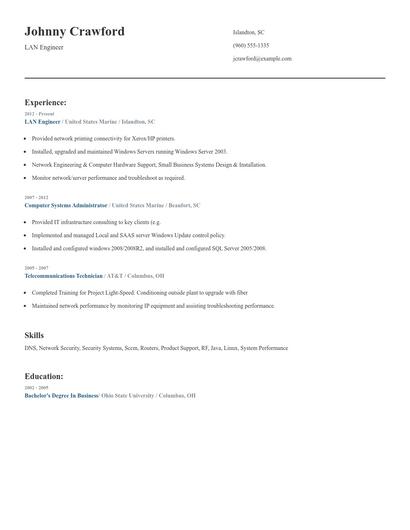
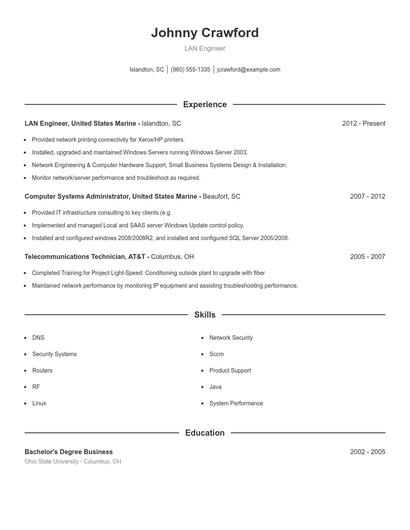
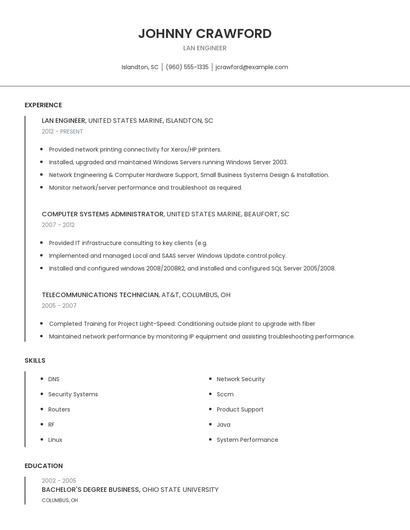
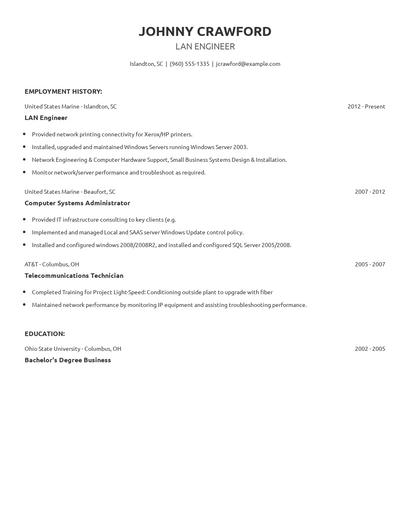
Choose from 10+ customizable lan engineer resume templates
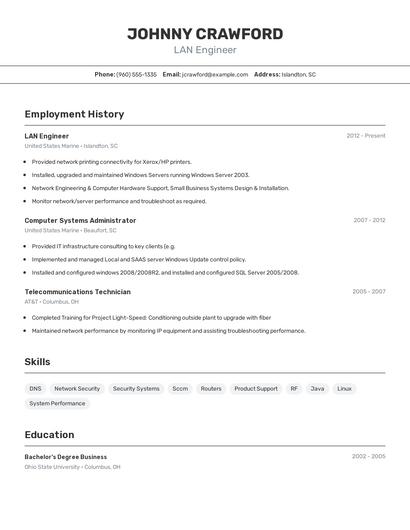
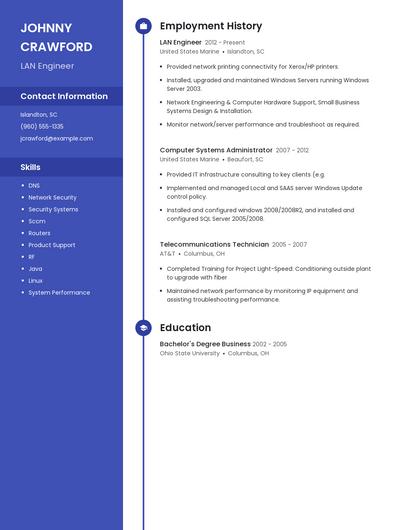
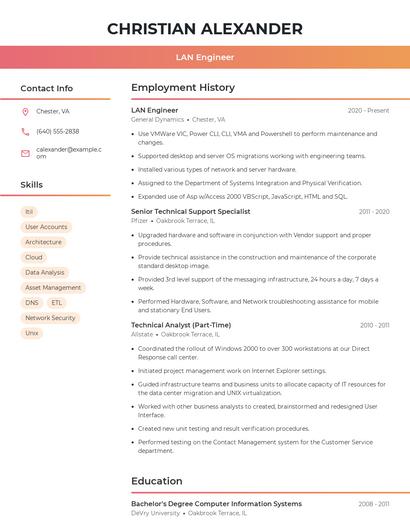
Build a professional lan engineer resume in minutes. Our AI resume writing assistant will guide you through every step of the process, and you can choose from 10+ resume templates to create your lan engineer resume.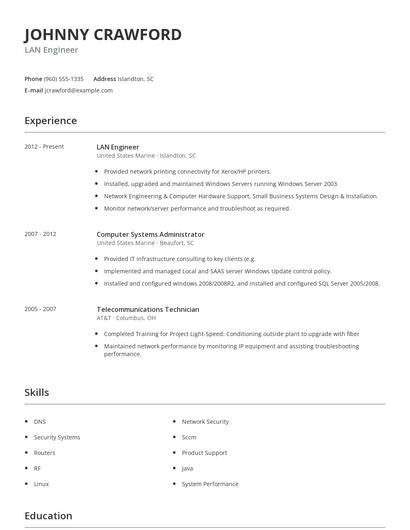
Compare different lan engineers
Lan engineer vs. Technical support senior engineer
A technical support senior engineer is primarily in charge of resolving complicated issues and concerns through calls and correspondence, ensuring efficiency and client satisfaction. Their responsibilities include coordinating with customer support staff to gather data, studying records of initial assessments, liaising with clients to identify their needs, utilizing their expertise to develop solutions, and maintaining records of all transactions. Furthermore, as a technical support senior engineer, it is essential to lead and serve as a mentor to others, all while implementing the company's policies and regulations.
These skill sets are where the common ground ends though. The responsibilities of a lan engineer are more likely to require skills like "disaster recovery," "network infrastructure," "computer system," and "network support." On the other hand, a job as a technical support senior engineer requires skills like "java," "customer service," "azure," and "customer satisfaction." As you can see, what employees do in each career varies considerably.
Technical support senior engineers earn the highest salaries when working in the telecommunication industry, with an average yearly salary of $104,548. On the other hand, lan engineers are paid more in the retail industry with an average salary of $84,195.On average, technical support senior engineers reach similar levels of education than lan engineers. Technical support senior engineers are 3.1% more likely to earn a Master's Degree and 0.1% more likely to graduate with a Doctoral Degree.Lan engineer vs. Senior infrastructure engineer
A senior infrastructure engineer specializes in designing and developing systems and infrastructures based on client preferences and industry standards. They have the duty to identify and understand the project's needs, streamline project requirements, produce drafts, create prototypes and models, and establish tests to identify potential issues and ensure the projects' quality. Additionally, a senior infrastructure engineer has the authority to make decisions, train and supervise junior engineers, establish goals and timelines, provide technical support, and implement policies and guidelines.
Each career also uses different skills, according to real lan engineer resumes. While lan engineer responsibilities can utilize skills like "computer system," "network support," "problem resolution," and "desktop support," senior infrastructure engineers use skills like "cloud," "aws," "customer service," and "azure."
On average, senior infrastructure engineers earn a higher salary than lan engineers. Some industries support higher salaries in each profession. Interestingly enough, senior infrastructure engineers earn the most pay in the hospitality industry with an average salary of $123,360. Whereas lan engineers have higher pay in the retail industry, with an average salary of $84,195.In general, senior infrastructure engineers achieve similar levels of education than lan engineers. They're 3.4% more likely to obtain a Master's Degree while being 0.1% more likely to earn a Doctoral Degree.What technology do you think will become more important and prevalent for lan engineers in the next 3-5 years?
Dr. Galen Duree
Head of the Department of Physics and Optical Engineering and Professor, Rose-Hulman Institute of Technology
Lan engineer vs. Systems integration engineer
A systems integration engineer is responsible for evaluating the efficiency and performance of the control systems to support business operations and requirements. Systems integration engineers develop technical solutions from business initiatives that would maximize a team's productivity and increase target performance. They also handle the upgrades of network infrastructure and system configuration and resolve technical failures as soon as they arise. A systems integration engineer must have excellent communication and technical skills, especially in providing recommendations to improve the network's capability and prevent downtimes.
The required skills of the two careers differ considerably. For example, lan engineers are more likely to have skills like "disaster recovery," "network infrastructure," "computer system," and "network support." But a systems integration engineer is more likely to have skills like "python," "architecture," "system integration," and "c++."
Systems integration engineers earn the best pay in the professional industry, where they command an average salary of $105,674. Lan engineers earn the highest pay from the retail industry, with an average salary of $84,195.Most systems integration engineers achieve a higher degree level compared to lan engineers. For example, they're 9.3% more likely to graduate with a Master's Degree, and 0.9% more likely to earn a Doctoral Degree.Lan engineer vs. Technical systems engineer
Technical Systems Engineers are responsible for maintaining the integrity of the infrastructure or systems network. They build, maintain, and repair all the systems and network infrastructure of the organization. They troubleshoot problems and find the best possible solution to address such problems. They also ensure that those problems will be resolved and would never be encountered again. Technical Systems Engineers also help out in information technology or network infrastructure projects of other departments. They provide expertise on the systems-related aspects of the project. They help guide project teams on the feasibility and the success factors of the project.
Even though a few skill sets overlap between lan engineers and technical systems engineers, there are some differences that are important to note. For one, a lan engineer might have more use for skills like "network support," "software applications," "sql," and "ospf." Meanwhile, some responsibilities of technical systems engineers require skills like "cloud," "technical support," "powershell," and "project management. "
The finance industry tends to pay the highest salaries for technical systems engineers, with average annual pay of $116,420. Comparatively, the highest lan engineer annual salary comes from the retail industry.technical systems engineers reach similar levels of education compared to lan engineers, in general. The difference is that they're 4.5% more likely to earn a Master's Degree, and 0.4% more likely to graduate with a Doctoral Degree.Types of lan engineer
Updated January 8, 2025
