What does a lead quality control analyst do?
Lead quality control analyst responsibilities
Here are examples of responsibilities from real lead quality control analyst resumes:
- Work and manage implementation of regulatory requirements for lab, including: EPA, ASTM, and NELAC.
- Experience with validation of Tecan ELISA plate washer.
- Experience with validation and qualification of ELISA plate reader.
- Conform to GMP and cGMP in an FDA/OSHA regulate industry.
- Develop, validate and train QC analysts to run HPLC systems.
- Work closely with project leaders in developing and implementing stability protocols following current ICH and FDA guidelines.
- Conduct QC monitoring and provide statistical process control of a complex technological process and evaluate final product compliance to industry standards.
- Formulate and test DNA fluorescence sequencing kits, ensuring sequencing meet specifications when run on protein separating instruments.
Lead quality control analyst skills and personality traits
We calculated that 19% of Lead Quality Control Analysts are proficient in GMP, Test Results, and Analytical Methods. They’re also known for soft skills such as Detail oriented, Math skills, and Analytical skills.
We break down the percentage of Lead Quality Control Analysts that have these skills listed on their resume here:
- GMP, 19%
Participated in laboratory investigations and identified sources of Non-Conformance with GMP Methods and protocols.
- Test Results, 15%
Approved the test results of new and /or existing systems, enhancements and patches to ensure proper operations.
- Analytical Methods, 11%
Executed validation protocols, which include: Instrument Performance Qualification and Analytical Method Transfer for Finished Products and Raw Material.
- SME, 9%
Experienced independent contributor and Subject Matter Expert (SME) for the Quality Control Factor VIII potency assay.
- HPLC, 7%
Develop, validate and trained QC analysts to run HPLC systems.
- Stability Samples, 4%
Implemented a visual scheduling tool for testing of routine finished product and stability samples.
"gmp," "test results," and "analytical methods" are among the most common skills that lead quality control analysts use at work. You can find even more lead quality control analyst responsibilities below, including:
Detail oriented. The most essential soft skill for a lead quality control analyst to carry out their responsibilities is detail oriented. This skill is important for the role because "industrial engineering technologists and technicians must record precisely what they measure and observe." Additionally, a lead quality control analyst resume shows how their duties depend on detail oriented: "analyze test results and draft reports detailing findings. "
Math skills. Another soft skill that's essential for fulfilling lead quality control analyst duties is math skills. The role rewards competence in this skill because "industrial engineering technologists and technicians use mathematics and statistical techniques to analyze data collected from studies." According to a lead quality control analyst resume, here's how lead quality control analysts can utilize math skills in their job responsibilities: "perform qualitative and quantitative analysis for product quality assurance. "
Analytical skills. Another skill that relates to the job responsibilities of lead quality control analysts is analytical skills. This skill is critical to many everyday lead quality control analyst duties, as "industrial engineering technologists and technicians assess changes in conditions, operations, and the environment to help industrial engineers figure out how systems should work." This example from a resume shows how this skill is used: "achieved employee spotlight award for developing procedures to maintain consistent and accurate quality reviews through the groups performing quality analysis. "
Communication skills. lead quality control analyst responsibilities often require "communication skills." The duties that rely on this skill are shown by the fact that "industrial engineering technologists and technicians must listen carefully to instructions from engineers and must clearly articulate problems to their supervisors." This resume example shows what lead quality control analysts do with communication skills on a typical day: "maintained close communication and interaction with qc management and staff to ensure on-time testing of samples. "
The three companies that hire the most lead quality control analysts are:
- BNY Mellon7 lead quality control analysts jobs
- Navy Federal Credit Union3 lead quality control analysts jobs
- Danaher1 lead quality control analysts jobs
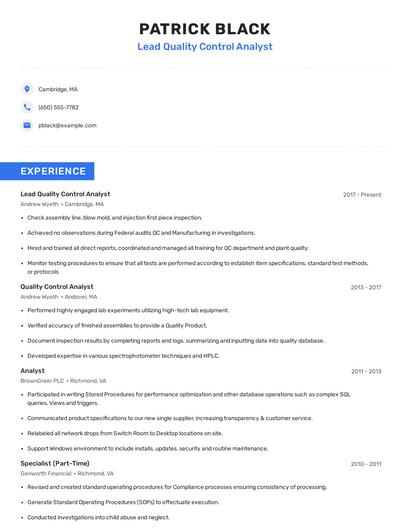
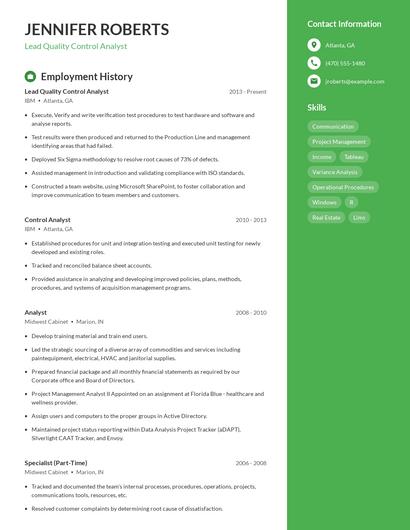
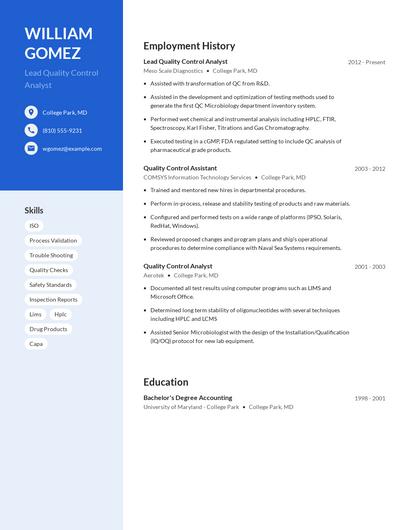
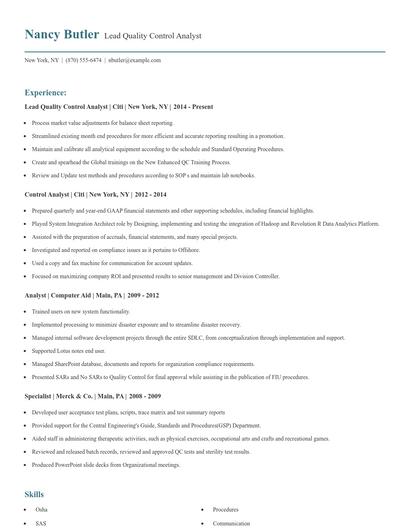
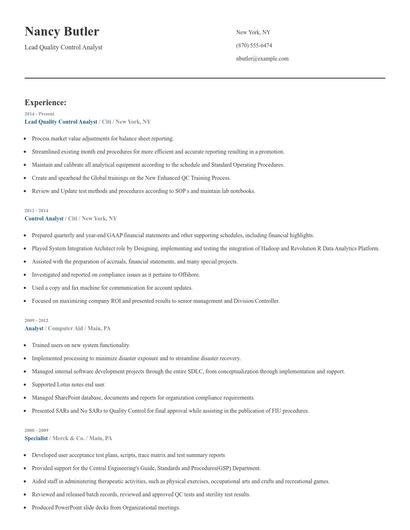
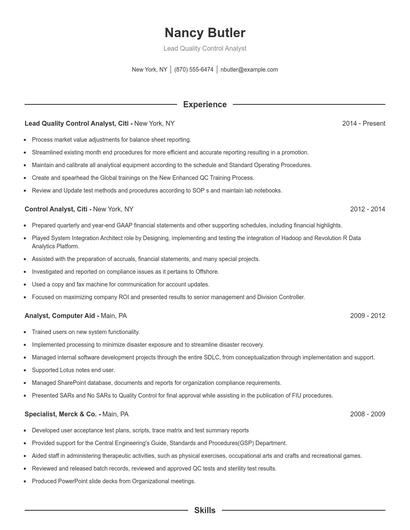
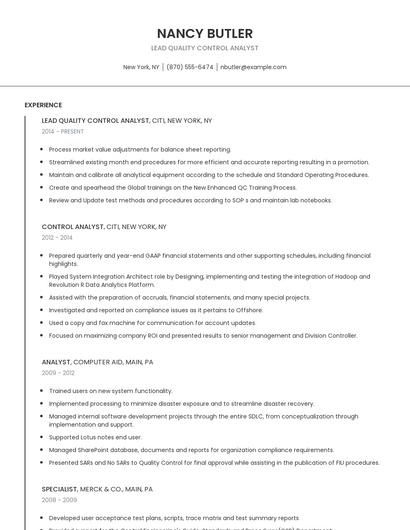
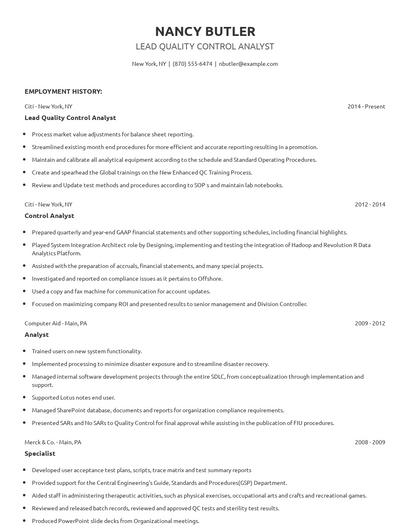
Choose from 10+ customizable lead quality control analyst resume templates
Build a professional lead quality control analyst resume in minutes. Our AI resume writing assistant will guide you through every step of the process, and you can choose from 10+ resume templates to create your lead quality control analyst resume.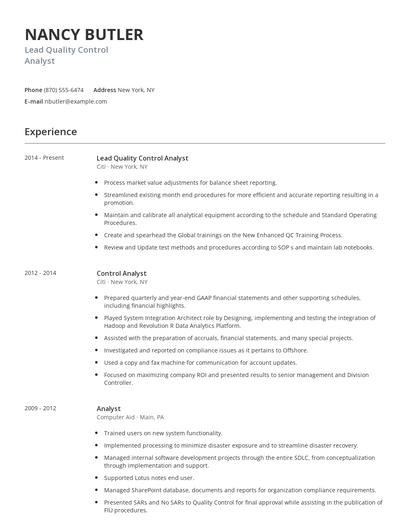
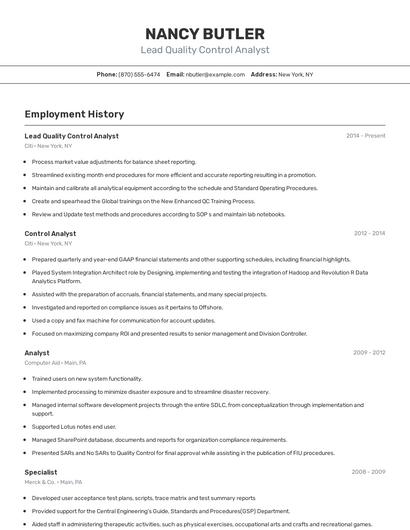
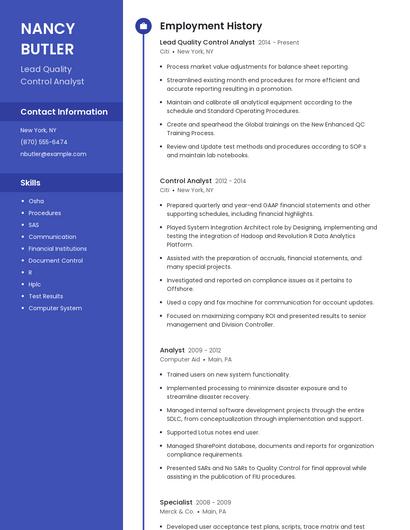
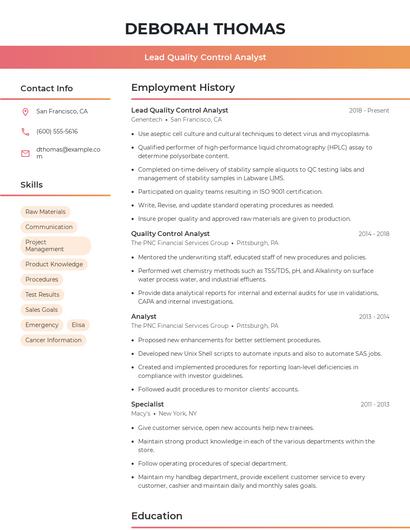
Compare different lead quality control analysts
Lead quality control analyst vs. Analyst
Analysts are employees or individual contributors with a vast experience in a particular field that help the organization address challenges. They help the organization improve processes, policies, and other operations protocol by studying the current processes in place and determining the effectiveness of those processes. They also research industry trends and data to make sound inferences and recommendations on what the company should do to improve their numbers. Analysts recommend business solutions and often help the organization roll out these solutions. They ensure that the proposed action plans are effective and produce the desired results.
These skill sets are where the common ground ends though. The responsibilities of a lead quality control analyst are more likely to require skills like "gmp," "test results," "analytical methods," and "hplc." On the other hand, a job as an analyst requires skills like "customer service," "troubleshoot," "data analysis," and "management system." As you can see, what employees do in each career varies considerably.
Analysts earn the highest salaries when working in the technology industry, with an average yearly salary of $79,330. On the other hand, lead quality control analysts are paid more in the technology industry with an average salary of $82,883.On average, analysts reach similar levels of education than lead quality control analysts. Analysts are 1.6% less likely to earn a Master's Degree and 1.3% more likely to graduate with a Doctoral Degree.Lead quality control analyst vs. Quality assurance scientist
In a manufacturing setting, a quality assurance scientist specializes in utilizing scientific procedures in ensuring that products adhere to a company's quality standards and policies. Their responsibilities include developing quality control procedures, conducting experiments and analysis, identifying areas needing improvement, implementing solutions in problem areas, and maintaining detailed records of results. Furthermore, as a quality assurance scientist, it is essential to keep an active communication line with the quality assurance team, coordinating every step of the way for an efficient and safe workflow.
While some skills are similar in these professions, other skills aren't so similar. For example, resumes show us that lead quality control analyst responsibilities requires skills like "stability samples," "laboratory equipment," "test cases," and "sql server." But a quality assurance scientist might use other skills in their typical duties, such as, "data analysis," "microbiology," "test methods," and "lab equipment."
Quality assurance scientists earn a lower average salary than lead quality control analysts. But quality assurance scientists earn the highest pay in the manufacturing industry, with an average salary of $72,744. Additionally, lead quality control analysts earn the highest salaries in the technology with average pay of $82,883 annually.Average education levels between the two professions vary. Quality assurance scientists tend to reach similar levels of education than lead quality control analysts. In fact, they're 0.4% more likely to graduate with a Master's Degree and 1.3% more likely to earn a Doctoral Degree.Lead quality control analyst vs. Quality associate
A quality associate is responsible for ensuring that a new product meets standards for usage and operating. You will perform various tasks that include assisting in identifying quality problems and improving operational processes, writing, disseminating, and maintaining quality documentation and manuals, and verifying logs and databases to monitor and flag quality issues and improvements. In addition, you are responsible for supporting document control and quality audits, reviewing reports and validation protocols, and investigating and diagnosing quality complaints.
There are many key differences between these two careers, including some of the skills required to perform responsibilities within each role. For example, a lead quality control analyst is likely to be skilled in "gmp," "test results," "analytical methods," and "stability samples," while a typical quality associate is skilled in "patients," "qa," "quality system," and "quality specifications."
Quality associates earn the highest salary when working in the health care industry, where they receive an average salary of $48,676. Comparatively, lead quality control analysts have the highest earning potential in the technology industry, with an average salary of $82,883.When it comes to education, quality associates tend to earn lower degree levels compared to lead quality control analysts. In fact, they're 5.7% less likely to earn a Master's Degree, and 1.3% less likely to graduate with a Doctoral Degree.Lead quality control analyst vs. Quality assurance associate
A quality assurance associate's role is to oversee the production operations in a manufacturing plant or a similar setting, ensuring quality standards throughout the entire process. Most of the time, a quality assurance associate must perform workforce assessments, provide training to new employees, produce or approve documentation and progress reports, and collaborate with colleagues to ensure that everything is running smoothly and complies with the company's policies and regulations. Furthermore, there are instances when one must address issues and concerns, providing them with the necessary corrective measures.
Types of lead quality control analyst
Updated January 8, 2025
