What does a line producer do?
A line producer is responsible for managing the production crew, ensuring that the production schedules are finished timely, and assisting the creative team. Line producers handle the budget and allocate resources accurately, following production guidelines and safety regulations. They also supervise press releases, interview schedules, and promotions to various media platforms while organizing the filming process. A line producer must have excellent communication and organizational skills, especially in interacting with the public and production management.
Line producer responsibilities
Here are examples of responsibilities from real line producer resumes:
- Manage most aspects of post-production, work with editors, and follow projects through QC to final delivery.
- Manage brand YouTube strategy and programming efforts for on-air series, digital initiatives, marketing campaigns and sponsor commitments.
- Facilitate and manage CNN weekend editorial team of freelance editorial producers.
- Supervise crew before, during, and after principal photography.
- Produce new media projects, including streaming audio/video and DVD authoring.
- Add content and video clips in a fun, professional and appropriate manner.
- Edit major league baseball game clips (air on NBC affiliates nightly news nationwide . )
- Oversee various production sizes from demo reels to large scale DVD games and BD-J titles.
- Enhance a celebrity interview by enhancing a poor quality audio clip from YouTube while an interview are in progress.
- Coordinate workflow between photography teams, talent, and on-set staff on set to ensure that content meet or exceed expectations.
- Compose and edit scripts for television newscasts, entertainment television programing including fiction and non-fiction productions.
- Coordinate all logistical elements and aspects for guest's appearances within CNN bureaus, local affiliates as well as off-site locations.
- Direct the documentation of military grind and aerial combat operations.
Line producer skills and personality traits
We calculated that 21% of Line Producers are proficient in Line-Producer, Control Room, and Cross-Selling. They’re also known for soft skills such as Communication skills, Creativity, and Leadership skills.
We break down the percentage of Line Producers that have these skills listed on their resume here:
- Line-Producer, 21%
Anchor, Reporter, Line-Producer: Suncoast Business Journal, WEDU-TV 3, Tampa.
- Control Room, 18%
Guide talent, writers, associate producers and the technical team in the control room.
- Cross-Selling, 17%
Developed a book of business increasing sales through cold-calling, cross-selling and networking.
- Develop Story Ideas, 5%
Coordinated with team to develop story ideas and offer innovative suggestions for story coverage.
- News Stories, 3%
Mastered covering breaking news stories from around the world.
- Reality, 3%
FOX Reality Series - Trading Spouses
"line-producer," "control room," and "cross-selling" are among the most common skills that line producers use at work. You can find even more line producer responsibilities below, including:
Communication skills. To carry out their duties, the most important skill for a line producer to have is communication skills. Their role and responsibilities require that "producers and directors must convey information and ideas clearly in order to coordinate many people to finish a production on time and within budget." Line producers often use communication skills in their day-to-day job, as shown by this real resume: "orchestrate all aspects of video production for commercial clients, as well as, employee communications. "
Creativity. Another soft skill that's essential for fulfilling line producer duties is creativity. The role rewards competence in this skill because "because a script may be interpreted in different ways, directors must decide on their approach and on how to represent the script’s ideas for the production." According to a line producer resume, here's how line producers can utilize creativity in their job responsibilities: "partnered with directors and advertising creatives to bring their concepts for television commercials to life. "
Leadership skills. This is an important skill for line producers to perform their duties. For an example of how line producer responsibilities depend on this skill, consider that "directors instruct actors and help them portray their characters in a believable manner." This excerpt from a resume also shows how vital it is to everyday roles and responsibilities of a line producer: "assigned crew roles for production and post-production and operated cameras during shoots leadership experience".
The three companies that hire the most line producers are:
- Paramount23 line producers jobs
- IBC Bank7 line producers jobs
- Woodruff Sawyer5 line producers jobs
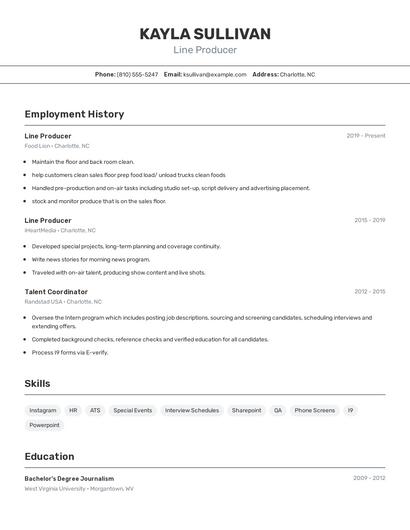
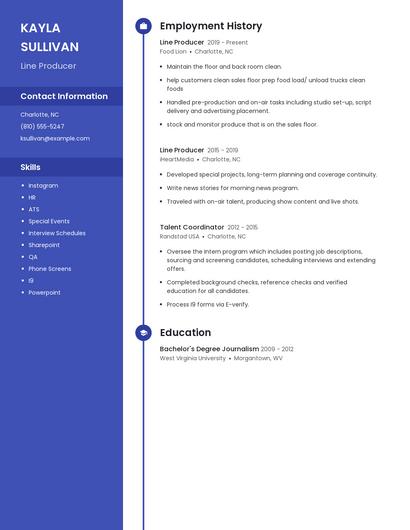
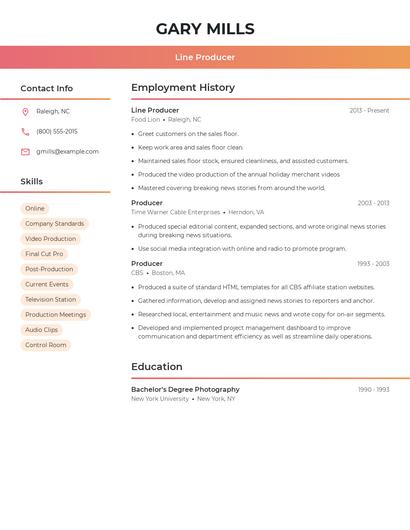
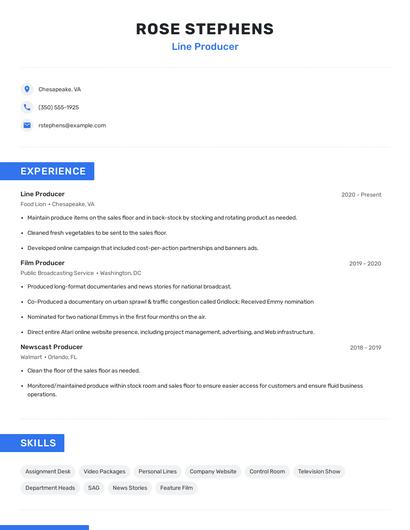
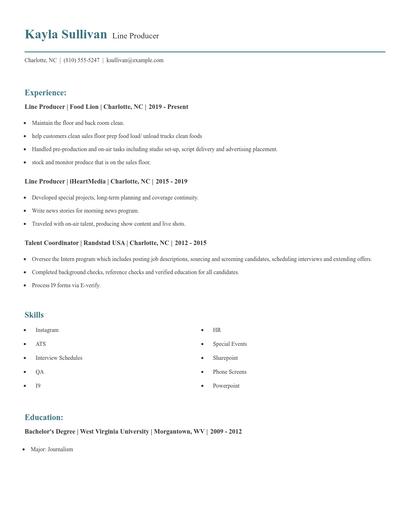
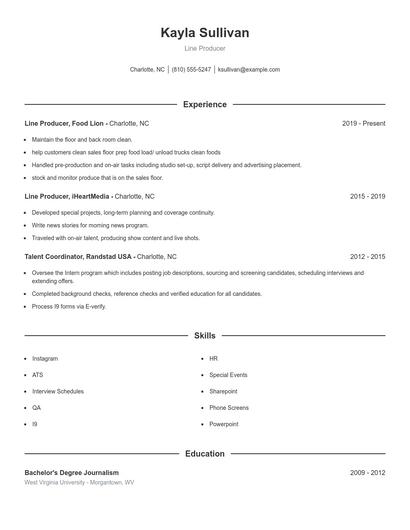
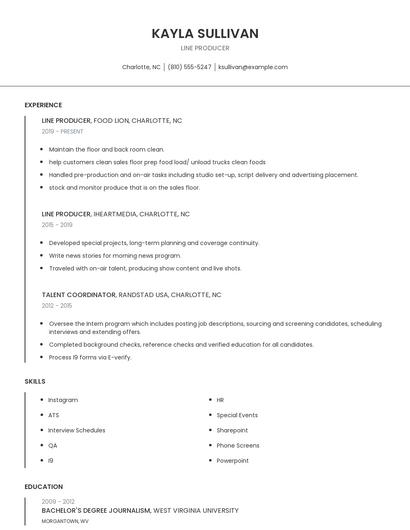
Choose from 10+ customizable line producer resume templates
Build a professional line producer resume in minutes. Our AI resume writing assistant will guide you through every step of the process, and you can choose from 10+ resume templates to create your line producer resume.




Compare different line producers
Line producer vs. Camera operator
A camera operator is responsible for operating various technical equipment to support technical operations, such as media productions and live events. Camera operators must have extensive knowledge of different camera features to select the appropriate device and manage the production's overall visual presentation. They also deliver the perfect footage on different angles for easy editing techniques alongside the technical crews and director's supervision. A camera operator should be communicative, as well as having excellent time-management and multi-tasking skills to adhere to the demands of production and schedules.
There are some key differences in the responsibilities of each position. For example, line producer responsibilities require skills like "line-producer," "cross-selling," "develop story ideas," and "news stories." Meanwhile a typical camera operator has skills in areas such as "camera equipment," "camera operation," "audio equipment," and "cctv." This difference in skills reveals the differences in what each career does.
Camera operators earn the highest salaries when working in the education industry, with an average yearly salary of $44,733. On the other hand, line producers are paid more in the insurance industry with an average salary of $51,867.camera operators tend to reach lower levels of education than line producers. In fact, camera operators are 5.8% less likely to graduate with a Master's Degree and 0.1% less likely to have a Doctoral Degree.Line producer vs. Photo editor
Photo Editors are employees in the creatives or marketing department of the company. They handle photos used by the company for its marketing collaterals, social media posts, or publishing. They also ensure that the photos are in line with the company's brand and image. Photo Editors may add items or elements to make the photo more eye-catching.
Each career also uses different skills, according to real line producer resumes. While line producer responsibilities can utilize skills like "line-producer," "control room," "cross-selling," and "develop story ideas," photo editors use skills like "adobe photoshop," "stock photography," "photo shoots," and "instagram."
Photo editors may earn a higher salary than line producers, but photo editors earn the most pay in the professional industry with an average salary of $68,080. On the other hand, line producers receive higher pay in the insurance industry, where they earn an average salary of $51,867.Average education levels between the two professions vary. Photo editors tend to reach similar levels of education than line producers. In fact, they're 4.2% less likely to graduate with a Master's Degree and 0.1% less likely to earn a Doctoral Degree.What technology do you think will become more important and prevalent for line producers in the next 3-5 years?
Johnathan Paul
Adjunct Professor, University of North Texas
Line producer vs. Freelance video editor
A freelance video editor offers video editing services to individuals and businesses. Most freelance video editors manage their own time and work at their preferred places, some even working from home. Among their responsibilities include meeting with clients to identify their needs and preferences, negotiating contracts, gathering and editing clips, and completing projects within deadlines. There are also instances when they must shoot videos in adherence to the contract's terms. Moreover, a freelance video editor must establish positive relationships with clients to develop a strong client base.
The required skills of the two careers differ considerably. For example, line producers are more likely to have skills like "line-producer," "control room," "cross-selling," and "develop story ideas." But a freelance video editor is more likely to have skills like "training videos," "video content," "motion graphics," and "adobe premiere pro."
Freelance video editors typically earn similar educational levels compared to line producers. Specifically, they're 3.4% less likely to graduate with a Master's Degree, and 0.0% less likely to earn a Doctoral Degree.Line producer vs. Photographer, editor
A Photographer, Editor selects, edits, and positions photos in print and web publications. They work for newspapers, magazines, websites, or other publications.
Types of line producer
Updated January 8, 2025
