
Automatically apply for jobs with Zippia
Upload your resume to get started.
Logistics operations manager skills for your resume and career

15 logistics operations manager skills for your resume and career
1. Supply Chain
A supply chain is a network or a sequence by which finished products of a company are distributed to retailers and then supplied to the end-users. The distribution of products and services from the production line to the final buyers is carried out in a series of steps including; manufacturing, transportation, and their distribution. The whole supply chain consists of different entities including; manufacturers, transportation, warehouses, suppliers, and retailers. The entities ensure that the products retain their originality while also minimizing the cost of delivery.
- Spearheaded reorganization of supply chain operations and implemented new standards and continuous improvements to refine inventory management and supply chain operations.
- Provide status updates to the business pertaining to supply chain and business unit performance including a forward view of expected results/opportunities
2. Logistics Operations
- Obtained MBA during tenure in this role, effectively balancing degree attainment initiative with successful leadership of on-site logistics operation.
- Directed an organization responsible for providing staff guidance and leadership; programs directly involving the USMC world-wide logistics operations mission.
3. Operational Procedures
The operational procedure means the prescriptive documents that describe processes involving several partners. The involved techniques get utilized in defining the related work.
- Monitor ministry policies and developed new operational procedures as needed for ministry in order to increase efficiency.
- Work with Staff Managers to coordinate mission training in order to reduce cost and more efficient operational procedures.
4. Customer Service
Customer service is the process of offering assistance to all the current and potential customers -- answering questions, fixing problems, and providing excellent service. The main goal of customer service is to build a strong relationship with the customers so that they keep coming back for more business.
- Developed 2 organizational departments to manage the fueling business comprised of Logistics, Customer Service, Billing and Validations.
- Developed business growth plans including transportation, logistics, production, customer service, repair and warehousing operations.
5. Process Improvement
- Facilitate the strategic planning, process improvement and technical documentation of all logistical execution, standard operating procedures and compliance.
- Review and implement appropriate procedures and process improvements to ensure the delivery of effective and efficient services.
6. Continuous Improvement
Continuous improvement is an ongoing process of improvement of products, services, and processes with the help of innovative ideas. It is an organized approach that helps an organization to find its weaknesses and improve them.
- Developed strategy for continuous improvement and managed business relationships with 3rd party distribution home delivery carriers.
- Manage Inventory control and Warehouse operations with lean manufacturing and continuous improvements mind set.
Choose from 10+ customizable logistics operations manager resume templates
Build a professional logistics operations manager resume in minutes. Our AI resume writing assistant will guide you through every step of the process, and you can choose from 10+ resume templates to create your logistics operations manager resume.7. Direct Reports
- Directed comprehensive logistical presence encompassing materials/equipment, facilities, budgets and personnel, supervising more than 150 direct and indirect reports.
- Developed direct reports and designed career path development programs resulting in their promotion to greater positions within the organization.
8. Logistics Support
- Assure availability of logistics support information required to coordinate/develop materiel-fielding plans/releases.
- Performed logistics support analysis to influence source selection and/or design towards the most effective, supportable, organizational readiness.
9. ISO
- Completed ISO 9001 Quality Management System Internal Auditor Certification.
- Passed and monitored all company required audits such as TSA audit, Operational audits, and inner office ISO audits.
10. Inventory Control
- Manage logistics operation for international trading company, including imports, exports, inventory control, warehousing and order fulfillment activities.
- Delivered supply technical guidance, recommendations for corrective actions, and customer responses as intermediary between Project Teams and Inventory Control Points
11. Warehouse Management
- Project engineering management - Distribution Center and Warehouse Management Systems design, special analyses and capital justification.
- Warehouse management and distribution quality management of medication, medical supplies, and narcotics.
12. Management System
A management system is a set of policies, processes, and procedures taken by an organization or a business to ensure it can fulfill its tasks and achieve its objectives. A management system makes sure that the company excels financially and improves the user experience. The management system also takes care of the worker's and employees' needs and manages their workload and oversees their performance. Apart from interior matters of the company, a management system also deals with exterior matters like legislations, tax matters, and law issues.
- Inventory management; Designed and updated the company's inventory management system and policy respectively within 9 months of employment.
- Utilized the latest technologies including automated inventory management systems, computerized forecasting, and scheduling / routing software.
13. Sigma
In Greek alphabets, sigma is the 18th letter that means "to sum up". In statistics, the lower case symbol of sigma is the unit of measurement for standard deviation which is used to assess the variability in a given set of data. While the upper case symbol is for summation notation means to add up all the given numbers in the data set.
- Spearheaded a complete overhaul of base logistics process, introducing Six Sigma and statistical process control methods to supply operations.
- Led and completed two (2) Six Sigma projects resulting in $1.8 million dollars in annualized cost savings.
14. Warehouse Operations
Warehouse operations include all those actions associated with the goods, from the point of receiving them to safely storing them in the warehouse. From attaching barcodes on packages to coordinating with teams, all fall under the category of warehouse operations.
- Interacted with customers and Store Managers as well as managed warehouse operations and established a professional & industrious warehouse environment.
- Coordinated inventory planning and managed warehouse operations, including quality control and compliance with regulations, NAFTA certificates, etc.
15. Inventory Management
- Supervised staff personnel in the areas of supply management, property accountability, inventory management, fleet management and equipment management.
- Warehouse and inventory management for 4 warehouses located domestic and international for both new and refurbished IC units.
5 Logistics Operations Manager resume examples
Build a professional logistics operations manager resume in minutes. Browse through our resume examples to identify the best way to word your resume. Then choose from 5+ resume templates to create your logistics operations manager resume.

What skills help Logistics Operations Managers find jobs?
Tell us what job you are looking for, we’ll show you what skills employers want.
What skills stand out on logistics operations manager resumes?
Dr. Timothy Edwards
Professor, Interim Director, University of Arkansas at Little Rock
What logistics operations manager skills would you recommend for someone trying to advance their career?
Nina Woodard
Senior Career Development Specialist, Belmont University
What type of skills will young logistics operations managers need?
Daniel Stanton
CEO, Mr. Supply Chain
What technical skills for a logistics operations manager stand out to employers?
Kerem Cakirer Ph.D.
Senior Lecturer, Indiana University Bloomington
What soft skills should all logistics operations managers possess?
Steven Bauer
Visiting Professor of Marketing, Pepperdine University, Seaver College
What hard/technical skills are most important for logistics operations managers?
Bruce Heiman Ph.D.
Professor of International Business, San Francisco State University
-Some experience and skills with coding in any language (at the moment, Python or C++ are preferred, though Ruby on Rails is also good)
-Deep spreadsheet skills (pivot tables and macros, as examples).
-Relational database skills, including programming (e.g., MySQL)
-Data mining
-AI/Machine Learning experience
List of logistics operations manager skills to add to your resume
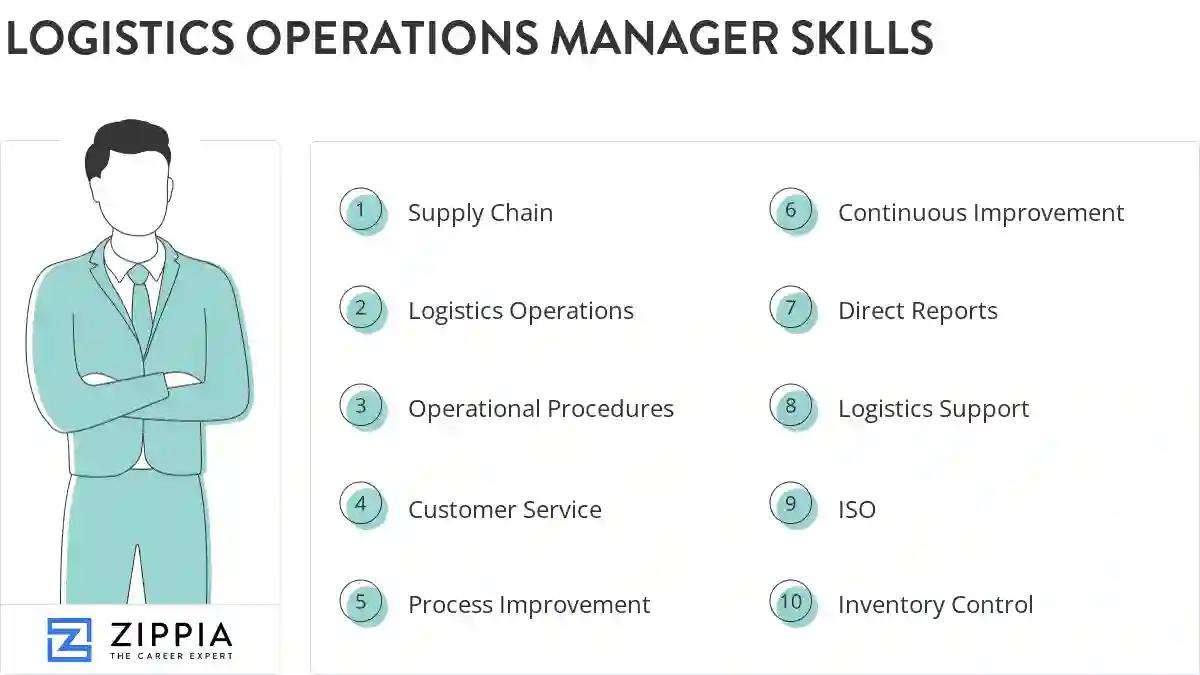
The most important skills for a logistics operations manager resume and required skills for a logistics operations manager to have include:
- Supply Chain
- Logistics Operations
- Operational Procedures
- Customer Service
- Process Improvement
- Continuous Improvement
- Direct Reports
- Logistics Support
- ISO
- Inventory Control
- Warehouse Management
- Management System
- Sigma
- Warehouse Operations
- Inventory Management
- KPIs
- On-Time Delivery
- Performance Metrics
- Transportation Operations
- TMS
- WMS
- Property Accountability
- Cost Reduction
- Cost Savings
- Chain Management
- LTL
- ERP
- Third-Party Logistics
- DOD
- Human Resources
- Outbound Shipments
- Corrective Action
- Hazmat
- Forwarders
- EDI
- Sortation
- Customer Orders
- Inventory Accuracy
- Manage Cross
- Logistics Systems
- Freight Forwarders
- Distribution Centers
- Hazardous Materials
- International Shipments
- FDA
- Cycle Counts
- Order Fulfillment
- Distribution Operations
- Logistics Activities
- RF
Updated January 8, 2025
