What does a mainframe programmer do?
Mainframe programmer responsibilities
Here are examples of responsibilities from real mainframe programmer resumes:
- Train the local programming staff in JCL and in revise COBOL coding to take advantage of the expanded mainframe processing capacity.
- Code SQL statements to generate reports and check the optimization of SQL queries using SPUFI.
- Create new programs using COBOL CICS VSAM to generate the adjudication process of claims whenever the user approves the policy.
- Access creation in RACF and ACF2 systems and train the team.
- Have expert level knowledge in using ENDEVOR.
- Experience with VTAM and TCP/IP definitions and problem diagnosis.
- Review, recode, and reinstal usermods using SMP/E.
- Unload existing data from VSAM file into a flat file.
- Provide prelimanary testing of BMC's suite of monitoring tools.
- Work with Java team in converting mainframe modules in Java language.
- Work writing SQL for data corrections and code program enhancements for claims.
- Create new Java code to handle information exchange between front-end and existing back-end systems.
- Design, code and test many SAS programs for reports and creating conversion files.
- Work in COOLGEN tool to generate the COBOL programs & deploy in UNIX environment.
- Analyze defective code and develop a debugging scheme that would work best for this situation.
Mainframe programmer skills and personality traits
We calculated that 11% of Mainframe Programmers are proficient in JCL, DB2, and MQ. They’re also known for soft skills such as Detail oriented, Troubleshooting skills, and Analytical skills.
We break down the percentage of Mainframe Programmers that have these skills listed on their resume here:
- JCL, 11%
Trained the local programming staff in JCL and in revised COBOL coding to take advantage of the expanded mainframe processing capacity.
- DB2, 11%
Worked with DB2 Database Administrators to design and implement new DB2 Tables to support various migration projects in the Broker area.
- MQ, 8%
Participated in development and programming of MQ Communication System.
- CICS, 7%
Analyzed business requirements and technical specification documents to develop CICS VT.
- SQL, 7%
Coded SQL statements to generate reports and check the optimization of SQL queries using SPUFI.
- VSAM, 4%
Participated in the design and implementation of conversion of DDA system file from ISAM to VSAM KSDS (assembler code).
"jcl," "db2," and "mq" are among the most common skills that mainframe programmers use at work. You can find even more mainframe programmer responsibilities below, including:
Detail oriented. The most essential soft skill for a mainframe programmer to carry out their responsibilities is detail oriented. This skill is important for the role because "computer programmers must closely examine the code they write because a small mistake can affect the entire computer program." Additionally, a mainframe programmer resume shows how their duties depend on detail oriented: "prepare visio flow diagrams, detailing data/job/programs flow, with input and output specifications. "
Troubleshooting skills. Another essential skill to perform mainframe programmer duties is troubleshooting skills. Mainframe programmers responsibilities require that "an important part of a programmer’s job is to check the code for errors and fix any they find." Mainframe programmers also use troubleshooting skills in their role according to a real resume snippet: "managed all aspects of mainframe cobol, jcl code writing, testing, troubleshooting and transfer to mainframe production. "
Analytical skills. This is an important skill for mainframe programmers to perform their duties. For an example of how mainframe programmer responsibilities depend on this skill, consider that "computer programmers must understand complex instructions in order to create computer code." This excerpt from a resume also shows how vital it is to everyday roles and responsibilities of a mainframe programmer: "used file-aid and qmf to validate data. ".
The three companies that hire the most mainframe programmers are:
- Bank of America2 mainframe programmers jobs
- Conduent2 mainframe programmers jobs
- Parker Hannifin2 mainframe programmers jobs
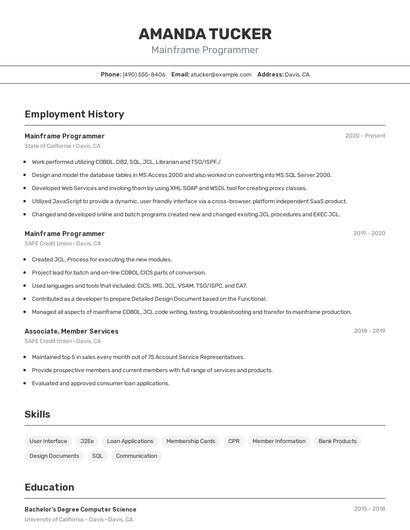
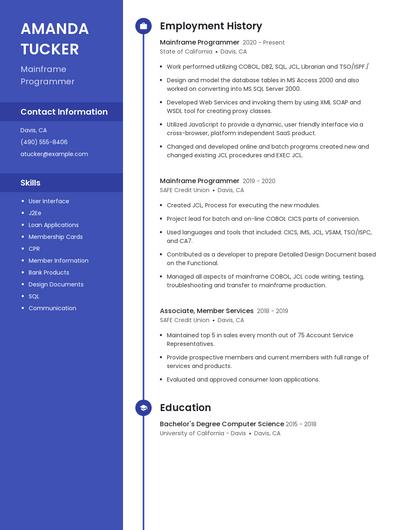
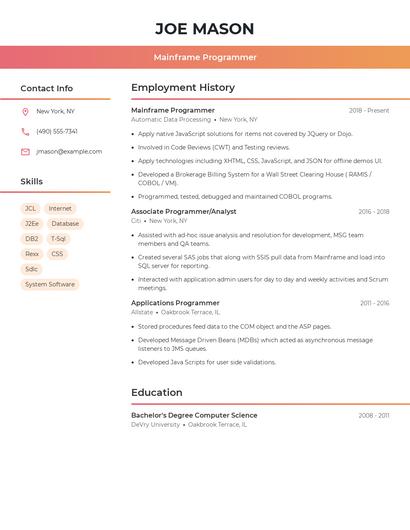
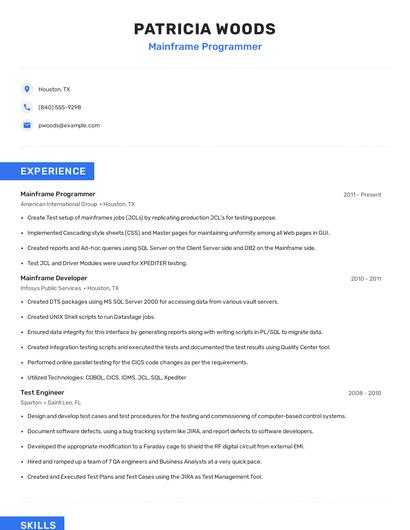
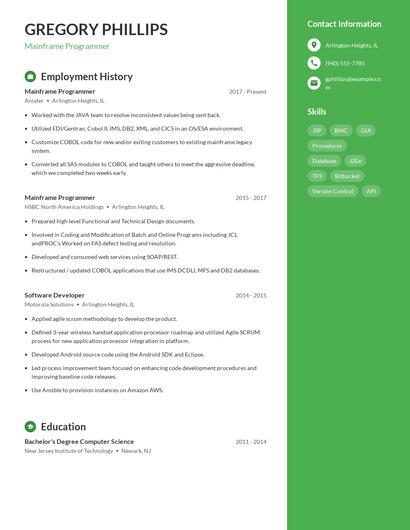
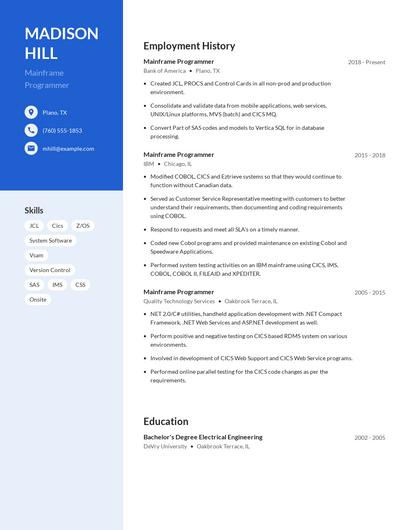
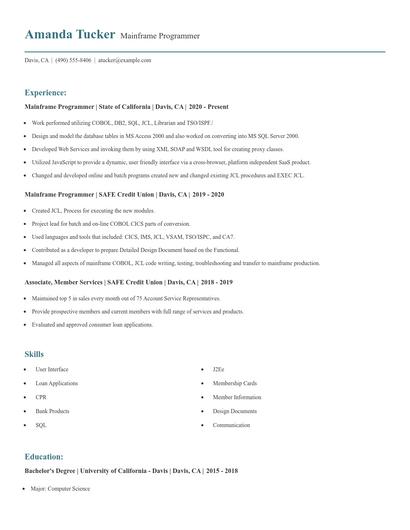
Choose from 10+ customizable mainframe programmer resume templates
Build a professional mainframe programmer resume in minutes. Our AI resume writing assistant will guide you through every step of the process, and you can choose from 10+ resume templates to create your mainframe programmer resume.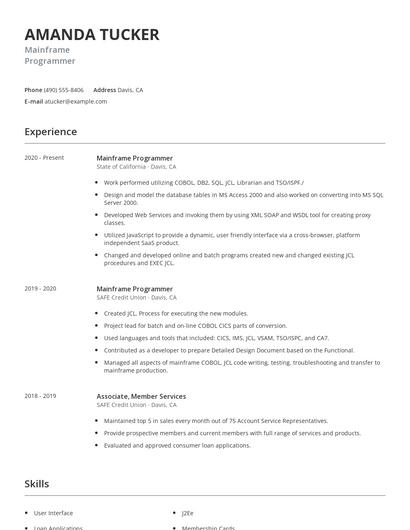
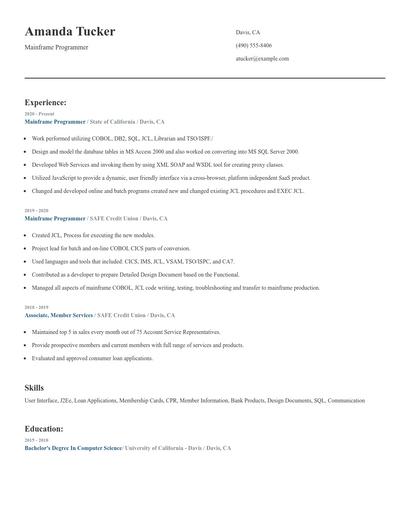
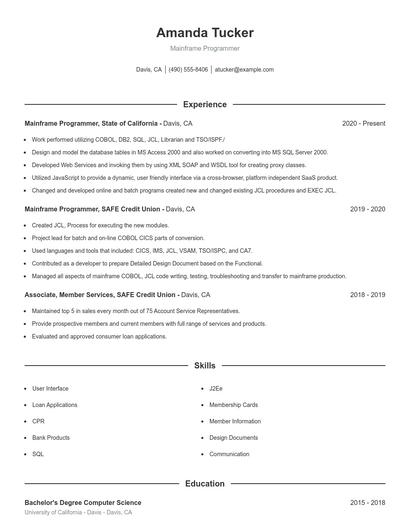
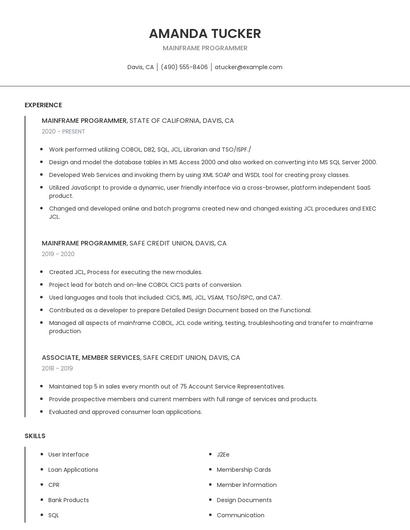
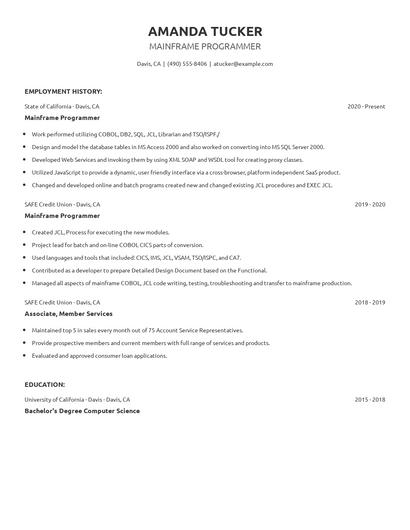
Compare different mainframe programmers
Mainframe programmer vs. Sap/abap developer
An SAP/ABAP developer is responsible for designing and creating software programs and applications through the SAP and ABAP programming codes. They conduct multiple diagnostic tests for newly-created and existing applications to ensure adherence to quality standards and requirements. They also provide technical resolution to end-users for their system issues and upgrade infrastructure to prevent the reoccurrence of downtimes and system failures. An SAP/ABAP developer must have excellent communication and technical skills, especially in evaluating features for smooth navigation and operations.
There are some key differences in the responsibilities of each position. For example, mainframe programmer responsibilities require skills like "jcl," "db2," "mq," and "cics." Meanwhile a typical sap/abap developer has skills in areas such as "sap abap," "sap hana," "pi," and "mm." This difference in skills reveals the differences in what each career does.
Sap/abap developers really shine in the manufacturing industry with an average salary of $110,167. Comparatively, mainframe programmers tend to make the most money in the finance industry with an average salary of $89,759.sap/abap developers tend to reach higher levels of education than mainframe programmers. In fact, sap/abap developers are 7.1% more likely to graduate with a Master's Degree and 0.7% less likely to have a Doctoral Degree.Mainframe programmer vs. Program development internship
A Program Development Intern helps to improve the quality of education in schools and other academic institutions. They work in order to gain work experience and satisfy the requirements for a qualification.
In addition to the difference in salary, there are some other key differences worth noting. For example, mainframe programmer responsibilities are more likely to require skills like "jcl," "db2," "mq," and "cics." Meanwhile, a program development internship has duties that require skills in areas such as "customer service," "professional development," "html css," and "customer satisfaction." These differences highlight just how different the day-to-day in each role looks.
Program development interns earn a lower average salary than mainframe programmers. But program development interns earn the highest pay in the finance industry, with an average salary of $40,028. Additionally, mainframe programmers earn the highest salaries in the finance with average pay of $89,759 annually.In general, program development interns achieve similar levels of education than mainframe programmers. They're 0.4% more likely to obtain a Master's Degree while being 0.7% less likely to earn a Doctoral Degree.What technology do you think will become more important and prevalent for mainframe programmers in the next 3-5 years?
Frank McCown Ph.D.
Associate Professor, Harding University
Mainframe programmer vs. Programmer/analyst lead
A software developer is mostly responsible for the development, implementation, and design of new or modified software products or current business projects. They typically work within the IT department of a company and will be involved in coordinating with the business analysts and development managers to guarantee software projects meet standard requirements. They do complex tasks from testing to evaluating new program design, modification of existing programs, and subsequently developing these modifications. In addition, deploying software tools, maintaining and upgrading existing systems are also part of their responsibilities.
The required skills of the two careers differ considerably. For example, mainframe programmers are more likely to have skills like "sql," "ftp," "tcp ip," and "test data." But a programmer/analyst lead is more likely to have skills like "c++," "c #," "project management," and "sql server."
Programmer/analyst leads make a very good living in the retail industry with an average annual salary of $110,090. On the other hand, mainframe programmers are paid the highest salary in the finance industry, with average annual pay of $89,759.programmer/analyst leads typically earn similar educational levels compared to mainframe programmers. Specifically, they're 2.0% less likely to graduate with a Master's Degree, and 0.1% less likely to earn a Doctoral Degree.Mainframe programmer vs. Program developer
Even though a few skill sets overlap between mainframe programmers and program developers, there are some differences that are important to note. For one, a mainframe programmer might have more use for skills like "jcl," "mq," "cics," and "sql." Meanwhile, some responsibilities of program developers require skills like "development programs," "community outreach," "project management," and "professional development. "
In general, program developers hold higher degree levels compared to mainframe programmers. Program developers are 5.8% more likely to earn their Master's Degree and 2.3% more likely to graduate with a Doctoral Degree.Types of mainframe programmer
Updated January 8, 2025
