
Automatically apply for jobs with Zippia
Upload your resume to get started.
Managing owner skills for your resume and career

15 managing owner skills for your resume and career
1. Lifecycle Management
- Established Data Lifecycle Management processes.
2. Customer Service
Customer service is the process of offering assistance to all the current and potential customers -- answering questions, fixing problems, and providing excellent service. The main goal of customer service is to build a strong relationship with the customers so that they keep coming back for more business.
- Conducted Customer Service/Publicity/Skin Care operator.
- Managed daily business operations including marketing, customer service, scheduling, contract negotiation and management, personnel management and payroll.
3. Management Process
- Established and managed capacity management processes for all customer- facing services, including email, web, news, and DNS.
- Author of Corporate Release Policy and procedures, which provides checks and balances to the Change and Configuration Management processes.
4. ITIL
- Facilitated quarterly ITIL training for all levels of IT from Executives to staff level.
- Designed, implemented and managed processes based on ITIL best practices, standards and related support tools across the organization.
5. Payroll
Payroll is the sum of all the compensation that an organization has to pay to employees at a specified time. Payroll is managed by the finance or HR department while small business owners may handle it themselves. Payroll isn't fixed as it varies every month due to sick leaves, overtime, etc.
- Controlled and monitored all inventory levels, merchandise, payroll and operational procedures.
- Created quarterly operations budgets, managed company finances and payroll.
6. Financial Statements
A financial statement is a report of an individual or a company that includes all the information about the declared assets, the use of money, income, and also the contribution of shareholders over a certain period.
- Maintain company budgets, manage working capital, prepare annual financial statements, and perform property maintenance and renovations.
- Performed all accounting functions including Accounts Receivable, Accounts Payable, budgets and financial statements.
7. Property Management
Property management is the regular oversight of commercial, residential, or industrial real estate by a third-party contractor. Property management includes the day-to-day care of the property, fixing minor and major issues, and monitoring the security of the property.
- Provided necessary tasks done in a timely and professional level of quality to higher standards than local property management abilities.
- Developed and marketed property management business to oversee vacation rental homes that catered to the Disney World vacation market.
8. Real Estate
Real estate is land that has buildings on it. This kind of property consists of permanent improvements either natural or man-made, which include, houses, fences, bridges, water trees, and minerals. There are 4 types of real estate namely; residential real estate, commercial real estate, industrial real estate, and vacant land.
- Prepared and negotiated various contracts and leases necessary to effectuate commercial business and residential real estate transactions.
- Practice areas included business law, employment law, and real estate law; reviewed, drafted, and negotiated contracts.
9. Business Management
Business management refers to a subject where coordination of all spheres of an organization's operations by planning comes into existence. It majorly concerns with issues about income and other factors such as the profitability of the business.
- Implemented and managed several 24/7 E-business management solutions and projects for Internet enabled companies globally.
- Execute all phases of business management, including fiscal responsibility and new business development.
10. HVAC
- Maintained plumbing, electrical, central air HVAC.
- Specialized in installation of HVAC systems in new construction, commercial refrigeration and appliance service and installation throughout South Carolina.
11. Human Resources
Human resources is a set of people in a business or a corporation that are designated to locate, interview, and recruit new employees into the company. They are also responsible to maintain the integrity of the employees and help them sort their problems out. They try to introduce and manage employee-benefit programs.
- Complete accountability for all daily operations including P&L, sales, human resources, marketing, and finance.
- Coordinate and direct all aspects of Human Resources including but not limited to interviewing, screening, hiring and training.
12. Logistics
Logistics is a complete organization and implementation of a problem. Logistics are often considered in a complex business operation, as some works need detailed plannings. Logistics are also used in military action.
- Facilitated all travel arrangements and convention center logistics.
- Managed all logistics, directly assisting clients with the full-project life-cycle from initial development to execution phases.
13. Inventory Control
- Coordinated all daily activities including implementation of new inventory control system and employee sales incentive program.
- Delegated inventory control responsibilities to my employees.
14. Business Operations
The operations that carry out the inner working of an organization are called business operations. From creating products, to marketing them, business operations play a vital role in every step.
- Founded and built a busy, family law-focused practice Managed all aspects of day-to-day business operations
- Full responsibility for the management of day-to-day business operations.
15. Business Development
Business development is the ideas or initiatives that work to make business work better. Selling, advertising, product development, supply chain management, and vendor management are only a few of the divisions involved with it. There is still a lot of networking, negotiating, forming alliances, and trying to save money. The goals set for business development guide and coordinate with all of these various operations and sectors.
- Orchestrated creation of comprehensive e-marketing and social media infrastructure accelerating new business development.
- Worked on business development for introduction into additional markets.

What skills help Managing Owners find jobs?
Tell us what job you are looking for, we’ll show you what skills employers want.
What skills stand out on managing owner resumes?
Dr. Timothy Edwards
Professor, Interim Director, University of Arkansas at Little Rock
List of managing owner skills to add to your resume
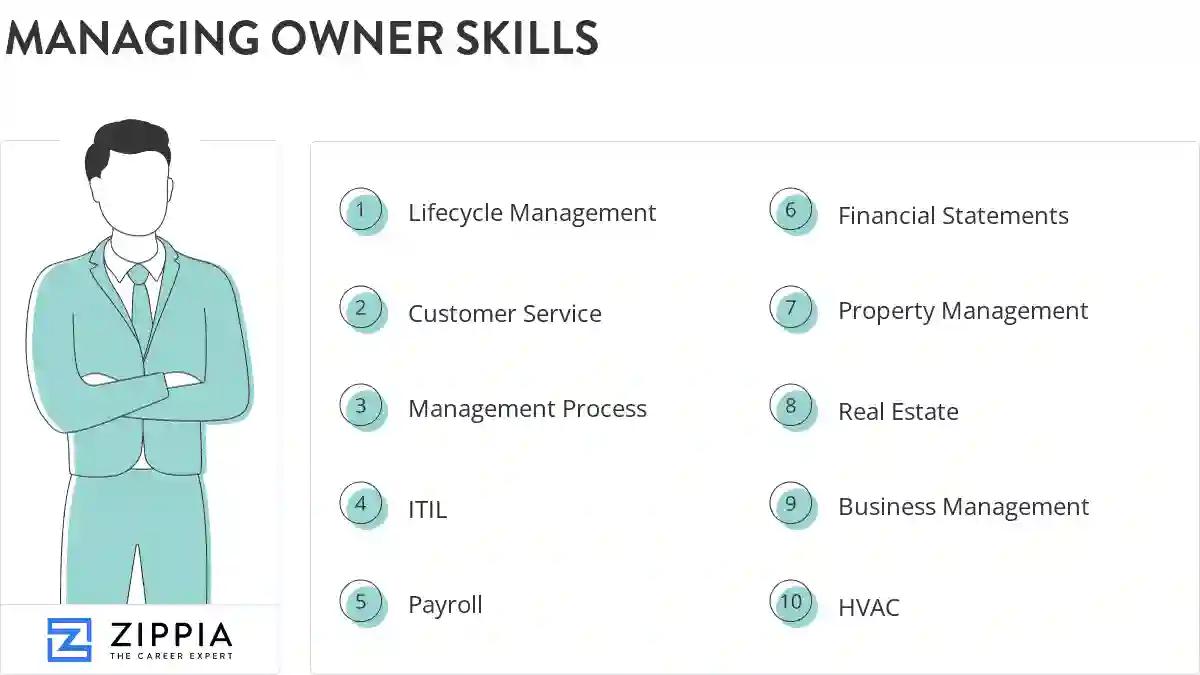
The most important skills for a managing owner resume and required skills for a managing owner to have include:
- Lifecycle Management
- Customer Service
- Management Process
- ITIL
- Payroll
- Financial Statements
- Property Management
- Real Estate
- Business Management
- HVAC
- Human Resources
- Logistics
- Inventory Control
- Business Operations
- Business Development
- Business Plan
- A/P
- Rental Properties
- Customer Relations
- Business Model
- Construction Management
- QuickBooks
- Client Relations
- Management Company
- Construction Projects
- SEO
- Market Research
- Financial Reports
- Background Checks
- LLC
- Organizational Change Management
- Evictions
- Family Law
- Property Maintenance
- Business Relationships
- Government Agencies
- Snow Removal
- Inventory Management
- Cost Control
- Trade Shows
- Bank Deposits
- Residential Properties
- Criminal Defense
- Contract Negotiations
Updated January 8, 2025
