What does a master production scheduler do?
A master production scheduler manages company processes by ensuring they are completed on time and they meet a client's expectations. They work with a master production schedule to ensure that individual commodities are produced in line with the present demands for the product. They work with manufacturing to determine the demands set for the product in terms of quantity, the time period for production, and the products that need to be procured for the manufacturing.
Master production scheduler responsibilities
Here are examples of responsibilities from real master production scheduler resumes:
- Lead efforts to achieve high level of schedule accuracy, enhance WIP, and improve reliability of deliveries.
- Lead daily production meetings with manufacturing and site logistics and facilitate many projects.
- Implement and sustain the quality system to remain compliant with ISO [] standards.
- Oversee production planner activities to ensure steady flow of WIP through plant and ultimately on time delivery of finish goods.
- Assist in the review of MRP integrity pertaining to lead times, lot sizes, BOM, and shrinkage factors.
- Determine supply/demand and capacity and load requirements into ERP system.
- Maintain ERP system by analyzing capacity data by work center/machine.
- Document many ISO procedures and maintain revisions and control documents.
- Maintain acceptable inventory accuracy levels through cycle counting, administer proper tracking and FIFO systems, prepare for quarterly inventories.
- Report KPI s for executive oversight.
- Collect data, develop reporting tools and present department KPI results to corporate executives.
- Direct process and production improvement activities in an FDA regulate work environment.
Master production scheduler skills and personality traits
We calculated that 8% of Master Production Schedulers are proficient in Master Production Schedule, Logistics, and Customer Demand. They’re also known for soft skills such as Communication skills, Customer-service skills, and Detail oriented.
We break down the percentage of Master Production Schedulers that have these skills listed on their resume here:
- Master Production Schedule, 8%
Directed all planning activities and cross-functional interactions required in the formulation and execution of the Master Production Schedule.
- Logistics, 7%
Led daily production meetings with manufacturing and site logistics and facilitated many projects.
- Customer Demand, 6%
Monitored the operation of work center schedules as necessary to maximize productivity and/or meet customer demands.
- Capacity Planning, 6%
Used SAP Capacity Planning tools, determined future production constraints, loaded level production plan, identified corrective actions; i.e.
- ERP, 6%
Determined supply/demand and capacity and loaded requirements into ERP system.
- Continuous Improvement, 4%
Communicate and collaborate with functional departments to implement continuous process improvement.
Most master production schedulers use their skills in "master production schedule," "logistics," and "customer demand" to do their jobs. You can find more detail on essential master production scheduler responsibilities here:
Communication skills. The most essential soft skill for a master production scheduler to carry out their responsibilities is communication skills. This skill is important for the role because "material recording clerks are frequently in contact with suppliers, vendors, or managers and need to convey their company’s needs effectively." Additionally, a master production scheduler resume shows how their duties depend on communication skills: "maintained close communication between the sales department and the production floor to ensure on time deliveries to customers. "
Customer-service skills. Many master production scheduler duties rely on customer-service skills. "material recording clerks may interact with customers in order to respond to problems or complaints.," so a master production scheduler will need this skill often in their role. This resume example is just one of many ways master production scheduler responsibilities rely on customer-service skills: "coordinated multiple yearly customer-production schedules and handled last-minute customer requests, changing priorities, equipment limitations and delivery dates. "
Detail oriented. master production schedulers are also known for detail oriented, which are critical to their duties. You can see how this skill relates to master production scheduler responsibilities, because "material and product inspecting clerks must pay attention to detail when checking items for defects, some of which are small and difficult to spot." A master production scheduler resume example shows how detail oriented is used in the workplace: "develop and communicate component requirement plans to support the detailed production plan and master production schedule. "
Math skills. A big part of what master production schedulers do relies on "math skills." You can see how essential it is to master production scheduler responsibilities because "material recording clerks may need to calculate shipping costs or take measurements." Here's an example of how this skill is used from a resume that represents typical master production scheduler tasks: "analyze production specifications and perform mathematical calculations to determine manufacturing process. "
The three companies that hire the most master production schedulers are:
- Allison Transmission4 master production schedulers jobs
- Lockheed Martin3 master production schedulers jobs
- Hunter Douglas3 master production schedulers jobs
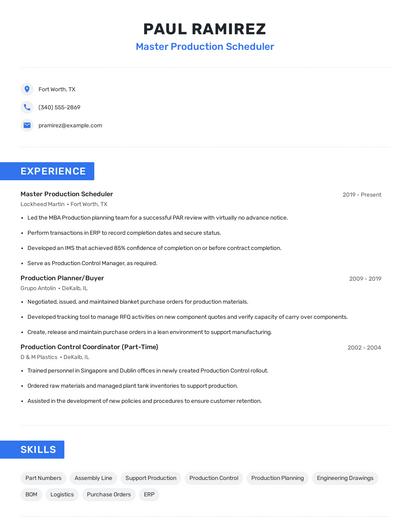
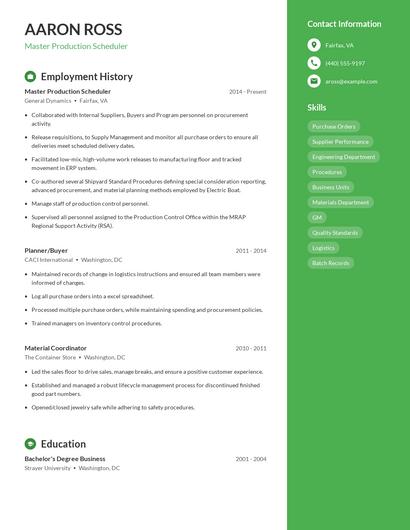
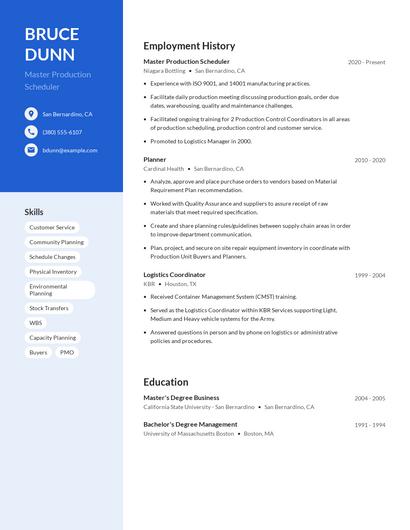
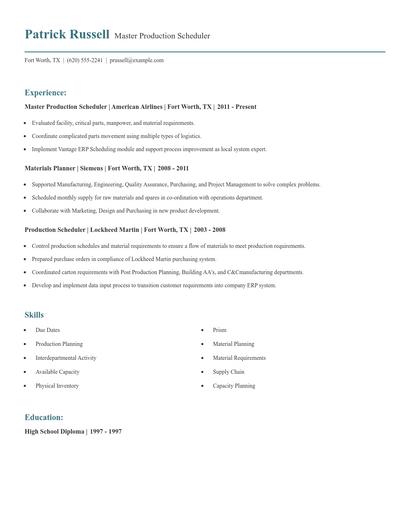
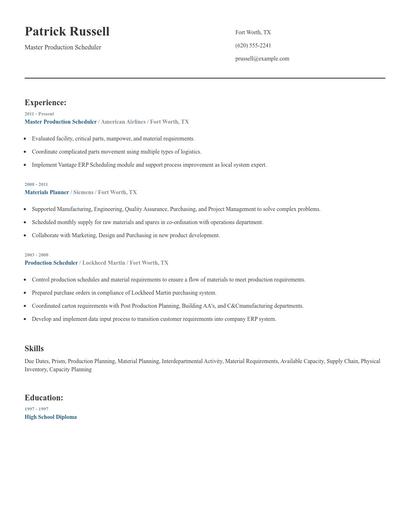
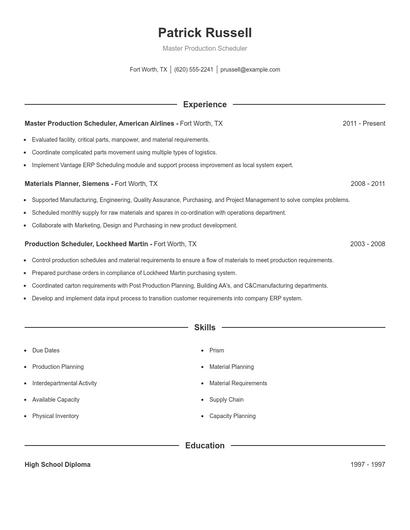
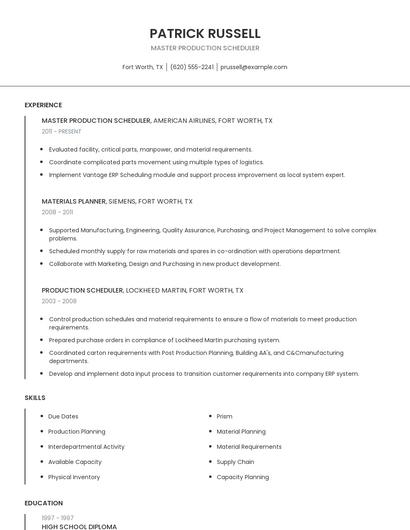
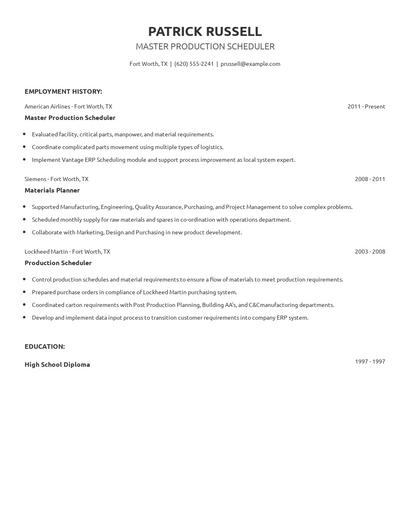
Choose from 10+ customizable master production scheduler resume templates
Build a professional master production scheduler resume in minutes. Our AI resume writing assistant will guide you through every step of the process, and you can choose from 10+ resume templates to create your master production scheduler resume.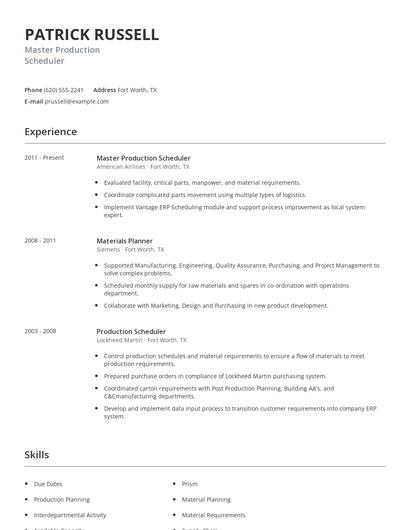
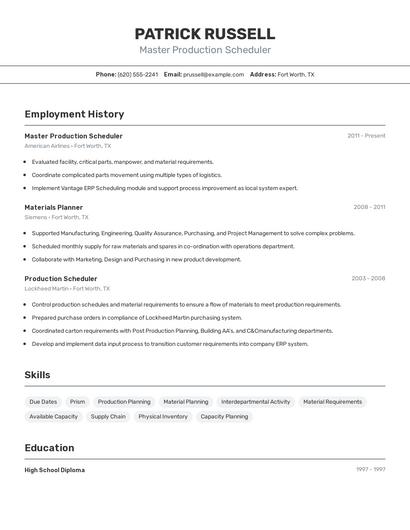
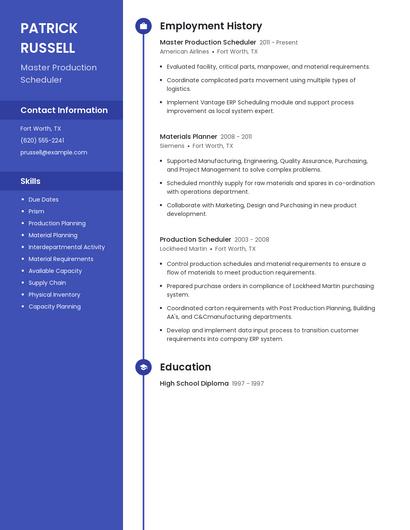
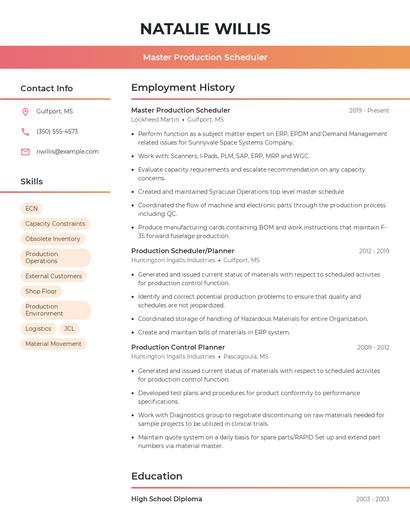
Compare different master production schedulers
Master production scheduler vs. Inventory coordinator
An inventory coordinator specializes in overseeing the supply flow of materials in a warehouse or similar setting. It is their responsibility to manage and handle the inventory, ensuring that the quantity and quality of materials align with company standards. Moreover, they are also responsible for assessing staff's performance, coordinating with different employees to ensure the accuracy of services, gathering and organizing data, maintaining records of transactions, and responding to any inquiries or concerns. As an inventory coordinator, it is essential to devise strategies for optimal performance, all while implementing the company's policies and regulations.
There are some key differences in the responsibilities of each position. For example, master production scheduler responsibilities require skills like "master production schedule," "customer demand," "capacity planning," and "continuous improvement." Meanwhile a typical inventory coordinator has skills in areas such as "customer service," "cleanliness," "sales floor," and "shipping receiving." This difference in skills reveals the differences in what each career does.
Inventory coordinators earn the highest salaries when working in the energy industry, with an average yearly salary of $40,639. On the other hand, master production schedulers are paid more in the pharmaceutical industry with an average salary of $81,956.inventory coordinators tend to reach lower levels of education than master production schedulers. In fact, inventory coordinators are 6.2% less likely to graduate with a Master's Degree and 0.2% less likely to have a Doctoral Degree.Master production scheduler vs. Planning coordinator
As planning coordinators, there are certain skills that this job requires to accomplish their responsibilities. They mostly work at the non-profits and health care facilities. Working as planning coordinators, it is expected that your communication skills are good, excellent customer service skills, and detail-oriented. Moreover, as a planning coordinator, part of their job is to focus on patient care, treatment plans, and medical records. This job is complex, and it's not limited to patient care but also managing financial statements and providing good customer service throughout.
In addition to the difference in salary, there are some other key differences worth noting. For example, master production scheduler responsibilities are more likely to require skills like "master production schedule," "customer demand," "capacity planning," and "continuous improvement." Meanwhile, a planning coordinator has duties that require skills in areas such as "patients," "insurance benefits," "customer service," and "data entry." These differences highlight just how different the day-to-day in each role looks.
Planning coordinators may earn a lower salary than master production schedulers, but planning coordinators earn the most pay in the finance industry with an average salary of $54,780. On the other hand, master production schedulers receive higher pay in the pharmaceutical industry, where they earn an average salary of $81,956.Average education levels between the two professions vary. Planning coordinators tend to reach similar levels of education than master production schedulers. In fact, they're 0.7% more likely to graduate with a Master's Degree and 0.2% more likely to earn a Doctoral Degree.Master production scheduler vs. Expeditor
The role of expeditors is to ensure the timely and efficient preparation and delivery of food. To accomplish this task, they also perform other duties, including managing inventory levels, managing supply requisition, and coordinating with subcontractors. They are also responsible for streamlining interdepartmental communication, monitoring job progress, and collaborating with project managers to collect relevant information about job status. This role requires specific skills and qualifications, including a high school diploma or an associate degree in food service, business management, and hospitality management, relevant work experience, and certifications in CCP, CPSM, or CPPB.
Some important key differences between the two careers include a few of the skills necessary to fulfill the responsibilities of each. Some examples from master production scheduler resumes include skills like "master production schedule," "customer demand," "capacity planning," and "erp," whereas an expeditor is more likely to list skills in "customer service," "cleanliness," "house training," and "team work. "
Expeditors earn the highest salary when working in the construction industry, where they receive an average salary of $46,040. Comparatively, master production schedulers have the highest earning potential in the pharmaceutical industry, with an average salary of $81,956.Most expeditors achieve a lower degree level compared to master production schedulers. For example, they're 7.2% less likely to graduate with a Master's Degree, and 0.2% less likely to earn a Doctoral Degree.Master production scheduler vs. Planning supervisor
Planning supervisors are professionals who are responsible for coordinating the health and safety aspects of project design and the initial planning. These supervisors are required to ensure that designers cooperate and comply with their duties, especially in avoiding and reducing risks. They must prepare the health and safety plan before arrangements are made for appointing a principal contractor. Planning supervisors must also provide advice to their clients about the competence and allocation of resources by designers and all contractors.
Types of master production scheduler
Updated January 8, 2025
