What does a materials scientist do?
A materials scientist is responsible for evaluating scientific properties, investigating chemical solutions and structures, and analyzing the components of natural materials. Materials scientists perform data analysis using scientific methods and operating different laboratory tools and equipment to develop entirely new scientific discoveries that would benefit various market industries for production. They also validate their findings by researching existing cases or coordinating with science experts to support their claims. A materials scientist creates a comprehensive report, including its scope and benefits for society.
Materials scientist responsibilities
Here are examples of responsibilities from real materials scientist resumes:
- Manage equipment calibration and maintenance to comply with CGMPs, FDA and OSHA
- Achieve API form stability improvement by encapsulation and subsequent analysis.
- Manage large-scale GMP manufacturing and pilot-scale trials for material development evaluations.
- Manage sample inventory via in-house laboratory information management system (LIMS) and implement additional systems for sample and chemical organization.
- Develop testing methods for characterizations of latent heat storage materials using DSC, TGA, and FTIR instruments.
- Study the film morphological properties by SEM, XRD, XRF.
- Involve in quality control of products by evaluation of mechanical properties and work with ASTM standards.
- Determine composition of solid and liquid samples using FTIR.
- Participate in several FDA audits and many internal audits.
- Perform sample preparation for TEM analysis using FIB/SEM system.
- Work includes sample preparation-BOE/HF etching, micro-cleaving etc, SEM imaging, FIB/SEM.
- Coordinate cross-functional and global studies to select optimal API for late stage development.
- Study the optical properties of several novel rare earth dope glasses for laser applications.
- Provide a welding protocol regarding welding trials perform on ASTM A1035 rebars and according to AWS D5.1 and D5.4.
- Document current operating procedures for the powder production department and the composites manufacturing cell for compliance to ISO 9001-2000 regulations.
Materials scientist skills and personality traits
We calculated that 10% of Materials Scientists are proficient in Polymer, SEM, and Materials Characterization. They’re also known for soft skills such as Interpersonal skills, Organizational skills, and Time-management skills.
We break down the percentage of Materials Scientists that have these skills listed on their resume here:
- Polymer, 10%
Formulated own project concepts and executed technology projects regarding the research and development of novel polymer fiber reinforced composites.
- SEM, 7%
Designed layout and managed 1st NSC Materials Analysis lab which included TEM, SEM, and Auger services.
- Materials Characterization, 6%
Performed self-directed failure analysis and materials characterization.
- Data Analysis, 5%
Conducted data analysis and submitted written reports.
- Technical Reports, 5%
Author of multiple U.S. patent applications and prepared technical reports
- FTIR, 4%
Determined composition of solid and liquid samples using FTIR.
"polymer," "sem," and "materials characterization" are among the most common skills that materials scientists use at work. You can find even more materials scientist responsibilities below, including:
Interpersonal skills. To carry out their duties, the most important skill for a materials scientist to have is interpersonal skills. Their role and responsibilities require that "chemists and materials scientists typically work on teams and need to be cooperative." Materials scientists often use interpersonal skills in their day-to-day job, as shown by this real resume: "team oriented professional with excellent interpersonal and communication skills. "
Organizational skills. Another soft skill that's essential for fulfilling materials scientist duties is organizational skills. The role rewards competence in this skill because "chemists and materials scientists must document processes carefully when conducting experiments, tracking outcomes, and analyzing results." According to a materials scientist resume, here's how materials scientists can utilize organizational skills in their job responsibilities: "advanced organizational objectives by collaborating with staff to develop and implement new research projects and protocols. "
Time-management skills. This is an important skill for materials scientists to perform their duties. For an example of how materials scientist responsibilities depend on this skill, consider that "chemists and materials scientists usually need to meet deadlines and must be able to prioritize tasks while maintaining quality." This excerpt from a resume also shows how vital it is to everyday roles and responsibilities of a materials scientist: "ensured timely completion of glp tk studies to meet ind submission timelines. ".
Analytical skills. materials scientist responsibilities often require "analytical skills." The duties that rely on this skill are shown by the fact that "chemists and materials scientists need to evaluate the results of experiments to ensure accuracy in their research." This resume example shows what materials scientists do with analytical skills on a typical day: "led compendia revision reviews and represented analytical lab during fda audits. "
Math skills. Another crucial skill for a materials scientist to carry out their responsibilities is "math skills." A big part of what materials scientists relies on this skill, since "chemists and materials scientists regularly use calculus, algebra, statistics, and other math for calculations." How this skill relates to materials scientist duties can be seen in an example from a materials scientist resume snippet: "perform extraction and quantitative analysis of antioxidants in commercial skin care products using hplc-uv and analyze data using chemstation. "
Problem-solving skills. While "problem-solving skills" is last on this skills list, don't underestimate its importance to materials scientist responsibilities. Much of what a materials scientist does relies on this skill, seeing as "chemists’ and materials scientists’ work involves posing questions during research and finding answers through results." Here is a resume example of how this skill is used in the everyday duties of materials scientists: "collaborated with the dod to develop new transparent armor solutions for use in new generation vehicles. "
The three companies that hire the most materials scientists are:
- Raytheon Technologies5 materials scientists jobs
- Applied Materials4 materials scientists jobs
- UES4 materials scientists jobs
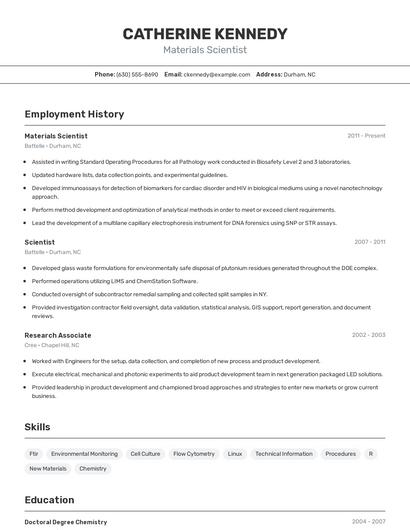
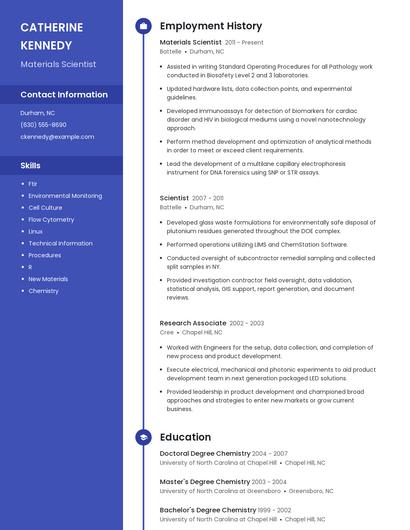
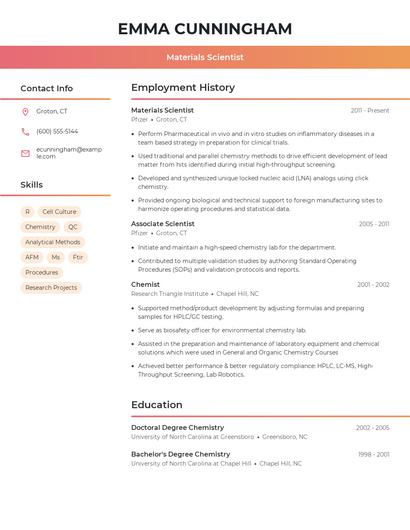
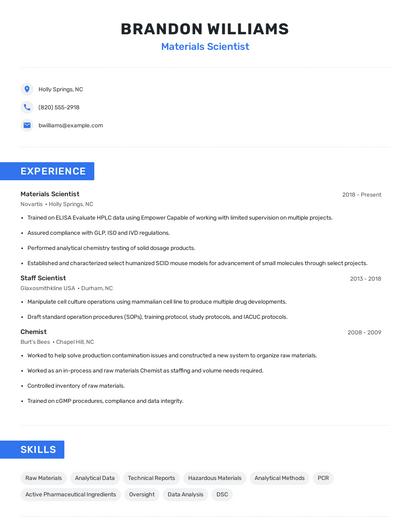
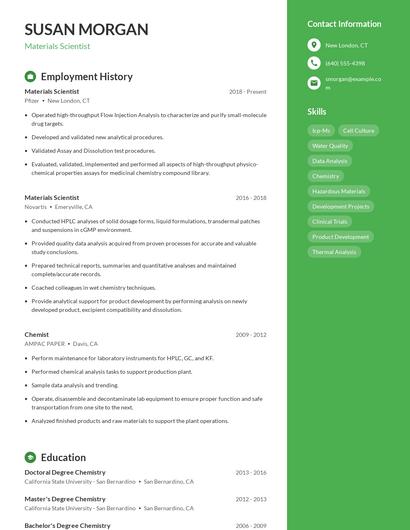
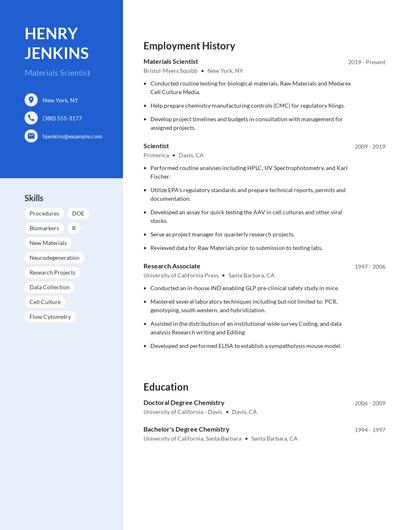
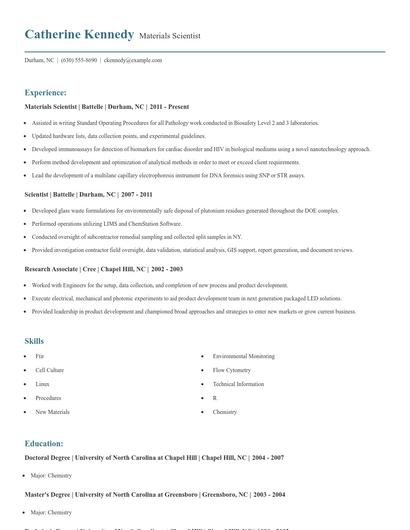
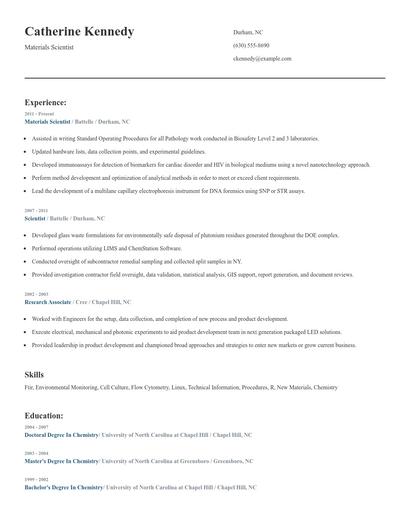
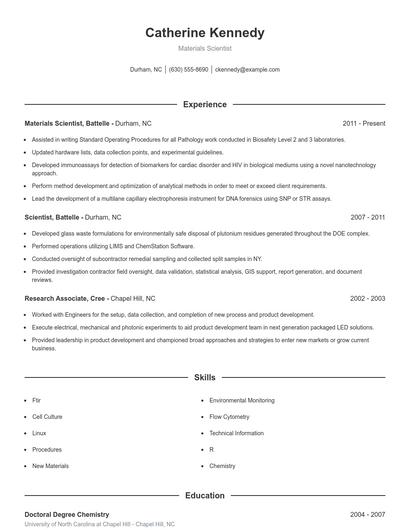
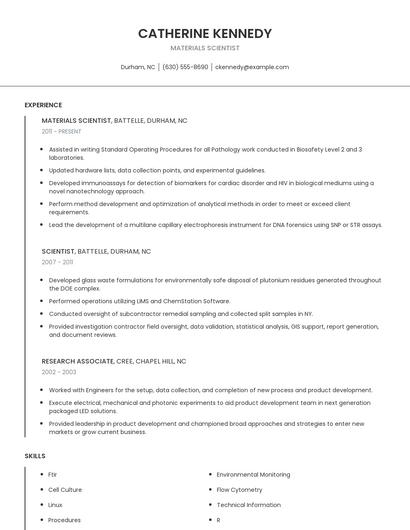
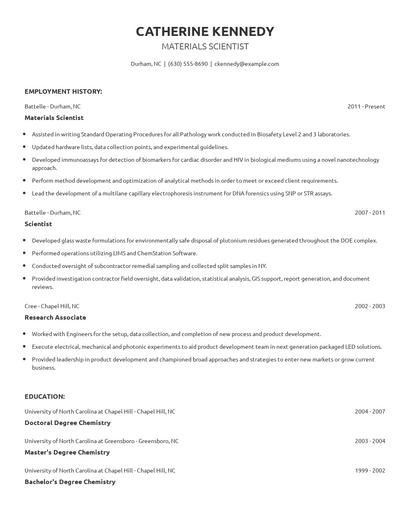
Choose from 10+ customizable materials scientist resume templates
Build a professional materials scientist resume in minutes. Our AI resume writing assistant will guide you through every step of the process, and you can choose from 10+ resume templates to create your materials scientist resume.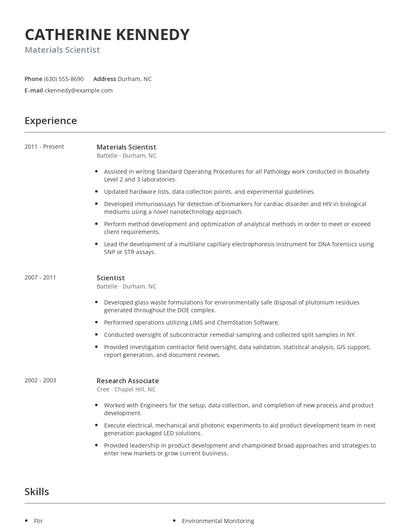
Compare different materials scientists
Materials scientist vs. Chemical technician
A chemical technician is responsible for supporting chemists and laboratory technicians in performing laboratory investigations and examining chemical components and structures. Chemical technicians ensure the stability of laboratory tools and equipment, performing proper sterilization and segregation of disposable materials, and maintaining the adequacy of inventory. They also record the research progress, including scientific methods, and write observation reports for reference. A chemical technician manages the cleanliness and orderliness of the facility to avoid potential hazards and complications during chemical operations.
These skill sets are where the common ground ends though. The responsibilities of a materials scientist are more likely to require skills like "polymer," "sem," "materials characterization," and "data analysis." On the other hand, a job as a chemical technician requires skills like "lab equipment," "safety procedures," "hazardous materials," and "osha." As you can see, what employees do in each career varies considerably.
Chemical technicians tend to make the most money working in the pharmaceutical industry, where they earn an average salary of $66,439. In contrast, materials scientists make the biggest average salary, $93,256, in the technology industry.The education levels that chemical technicians earn slightly differ from materials scientists. In particular, chemical technicians are 12.9% less likely to graduate with a Master's Degree than a materials scientist. Additionally, they're 23.4% less likely to earn a Doctoral Degree.Materials scientist vs. Research chemist
A research chemist specializes in conducting studies and experiments to develop new products. Their duties primarily focus on conducting research and assessments, gathering and analyzing chemical samples, developing ideas, conducting tests to study chemical reactions, maintaining records of all procedures, and utilizing previous studies. Their research findings can be used to create new medicines, enhance existing products, and lead to innovations. When it comes to employment, a research chemist may work for pharmaceutical companies, private laboratories, government agencies, and learning institutions.
While some skills are similar in these professions, other skills aren't so similar. For example, resumes show us that materials scientist responsibilities requires skills like "materials characterization," "characterization techniques," "additive manufacturing," and "laser." But a research chemist might use other skills in their typical duties, such as, "laboratory equipment," "method development," "analytical chemistry," and "organic synthesis."
Research chemists may earn a lower salary than materials scientists, but research chemists earn the most pay in the energy industry with an average salary of $92,565. On the other hand, materials scientists receive higher pay in the technology industry, where they earn an average salary of $93,256.Average education levels between the two professions vary. Research chemists tend to reach similar levels of education than materials scientists. In fact, they're 1.0% less likely to graduate with a Master's Degree and 23.4% less likely to earn a Doctoral Degree.What technology do you think will become more important and prevalent for materials scientists in the next 3-5 years?
Janet Gray Ph.D.
Professor and Department Chair, The College of New Jersey
Materials scientist vs. Accelerator systems director
Chemists are generally responsible for observing and investigating chemical substances to create new and safe compounds essential for practical applications. They are often grouped depending on a particular area of specialization to focus and understand the complexities of the matter. A chemist usually takes time performing research and conducting experiments to test and further improve the quality and usage of a specific chemical substance. Chemists are expected to write on their observations and findings to establish scientific results.
The required skills of the two careers differ considerably. For example, materials scientists are more likely to have skills like "polymer," "sem," "materials characterization," and "data analysis." But a accelerator systems director is more likely to have skills like "business ideas," "business model," "kpi," and "direct communication."
Accelerator systems directors typically earn higher educational levels compared to materials scientists. Specifically, they're 28.7% more likely to graduate with a Master's Degree, and 23.5% more likely to earn a Doctoral Degree.Materials scientist vs. Chemist
Types of materials scientist
Updated January 8, 2025
