What does a mechanical field engineer do?
A mechanical field engineer is an engineering professional who works on-site on a variety of projects. The responsibilities of this position are inspecting and installing equipment, conducting research, reporting project status, and resolving on-site malfunctions. They also perform administrative tasks, create reports, and ensure adherence to client specifications.
Mechanical field engineer responsibilities
Here are examples of responsibilities from real mechanical field engineer resumes:
- Coordinate and supervise mechanical and craft trades to achieve proper and timely completion of the HVAC work.
- Manage and/or participate in a variety of water and wastewater assist company principles as engineering consultants for numerous municipal clients.
- Create and maintain the project's RFI and change notice log.
- Gain experience in HVAC system and piping design engineering, schedules and purchasing.
- Design conduit layout, conduit fill, cable sizes to comply with NEC codes.
- Analyze force distributions and design rigging arrangements for complicate lifts with manual rigging and heavy lift cranes
- Install 2x31.5 MVA transformers and 33 , 11kv S.G. and other building electrical and mechanical systems and equipment.
- Prepare site query or request for information (RFI) to client or proponent regarding the problem encounter at site.
- Identify and troubleshot all possible errors in engineering and design in the field while ensuring all NEC code requirements are met.
- Provide technical capabilities for testing relays, circuit breakers, transformers, motor control equipment and relate switchgear in the field.
- Generate FMEA to analyze system reliability and propose future improvement plan to eliminate high failure risk factors.
- Authore and present technical manuals, troubleshoot guides, technical reports and presentations to provide instructional training to technicians and supervisors.
- Flatb semi trailer, air brake servicing, electrical fault troubleshooting, truck mount crane hydraulic system servicing.
- Develop and maintain engineering ISO documentation.
- Deliver the electronic packaging of analog, digital and RF components with a limit volume with stringent environmental requirements.
Mechanical field engineer skills and personality traits
We calculated that 51% of Mechanical Field Engineers are proficient in Troubleshoot, Outage, and Gas Turbines. They’re also known for soft skills such as Creativity, Listening skills, and Mechanical skills.
We break down the percentage of Mechanical Field Engineers that have these skills listed on their resume here:
- Troubleshoot, 51%
Authored and presented technical manuals, troubleshoot guides, technical reports and presentations to provide instructional training to technicians and supervisors.
- Outage, 11%
Prepared timely and accurate technical reports for customer records and reference for future outages.
- Gas Turbines, 11%
Provided technical assistance and support to customers for heavy-frame gas turbines and auxiliary equipment.
- Technical Direction, 5%
Provide technical direction to Field Engineers & craft during the fabrication and installation phases of construction.
- Technical Issues, 4%
Coordinated the resolution of mechanical technical issues on all MIA projects.
- Mechanical Systems, 3%
Scoped and executed all hydrostatic testing for critical pressure parts for all piping & mechanical systems
"troubleshoot," "outage," and "gas turbines" are among the most common skills that mechanical field engineers use at work. You can find even more mechanical field engineer responsibilities below, including:
Creativity. The most essential soft skill for a mechanical field engineer to carry out their responsibilities is creativity. This skill is important for the role because "mechanical engineers design and build complex pieces of equipment and machinery." Additionally, a mechanical field engineer resume shows how their duties depend on creativity: "generated assembly drawings using inventor and autocad, applied gd&t;, created bom using ms office. "
Listening skills. Another soft skill that's essential for fulfilling mechanical field engineer duties is listening skills. The role rewards competence in this skill because "mechanical engineers often work on projects with others, such as architects and computer scientists." According to a mechanical field engineer resume, here's how mechanical field engineers can utilize listening skills in their job responsibilities: "communicated effectively in order to check job status and provide technical support to vendors. "
Mechanical skills. This is an important skill for mechanical field engineers to perform their duties. For an example of how mechanical field engineer responsibilities depend on this skill, consider that "mechanical skills allow engineers to apply basic engineering concepts and mechanical processes to the design of new devices and systems." This excerpt from a resume also shows how vital it is to everyday roles and responsibilities of a mechanical field engineer: "developed detailed mechanical work packages for refueling outage, emergent and on-line tasks. ".
Problem-solving skills. A big part of what mechanical field engineers do relies on "problem-solving skills." You can see how essential it is to mechanical field engineer responsibilities because "mechanical engineers need good problem-solving skills to take scientific principles and discoveries and use them to design and build useful products." Here's an example of how this skill is used from a resume that represents typical mechanical field engineer tasks: "manage and provide resolutions for request for information (rfi) and field change requests (fcrs). "
Math skills. Another crucial skill for a mechanical field engineer to carry out their responsibilities is "math skills." A big part of what mechanical field engineers relies on this skill, since "mechanical engineers use the principles of calculus, statistics, and other advanced subjects in math for analysis, design, and troubleshooting in their work." How this skill relates to mechanical field engineer duties can be seen in an example from a mechanical field engineer resume snippet: "conducted quantitative analysis by creating numerical methods and algorithms for engineering problems using tools such as python and matlab. "
The three companies that hire the most mechanical field engineers are:
- Ghafari Associates11 mechanical field engineers jobs
- Amazon10 mechanical field engineers jobs
- Bechtel Corporation6 mechanical field engineers jobs
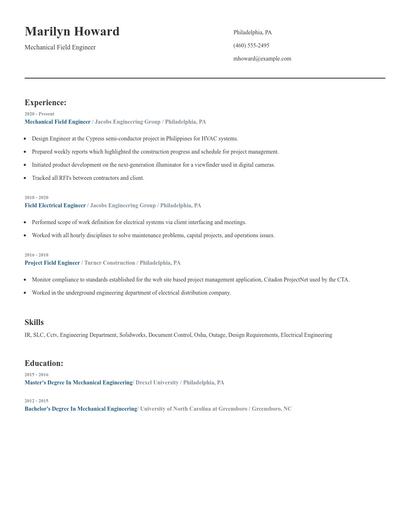
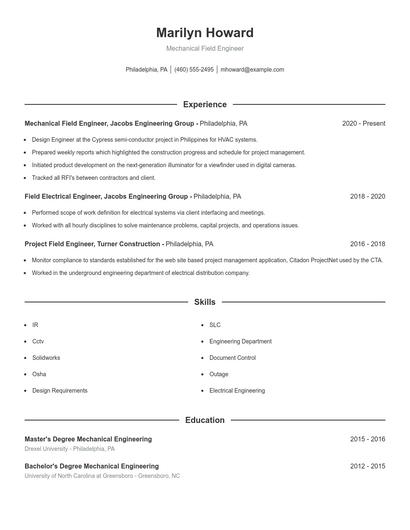
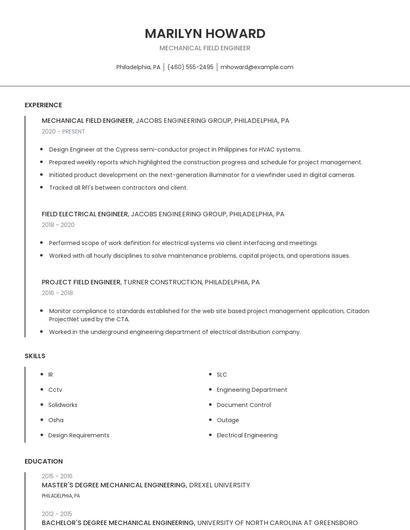
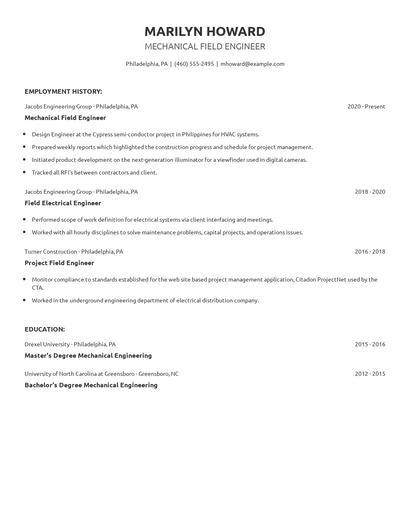
Choose from 10+ customizable mechanical field engineer resume templates
Build a professional mechanical field engineer resume in minutes. Our AI resume writing assistant will guide you through every step of the process, and you can choose from 10+ resume templates to create your mechanical field engineer resume.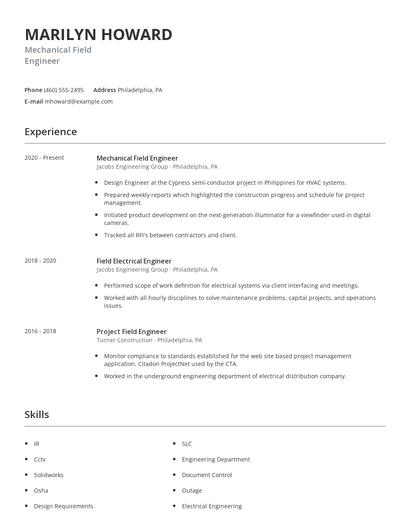
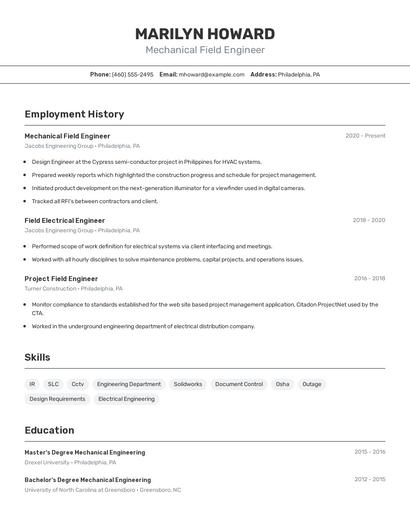
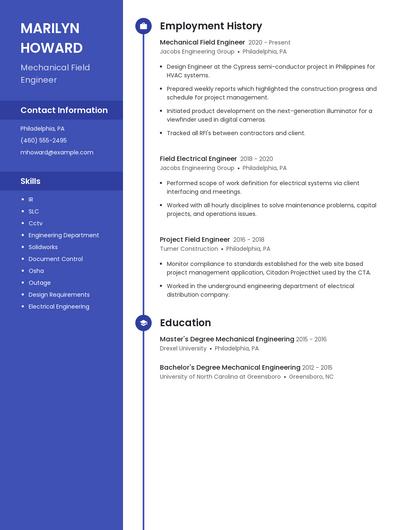
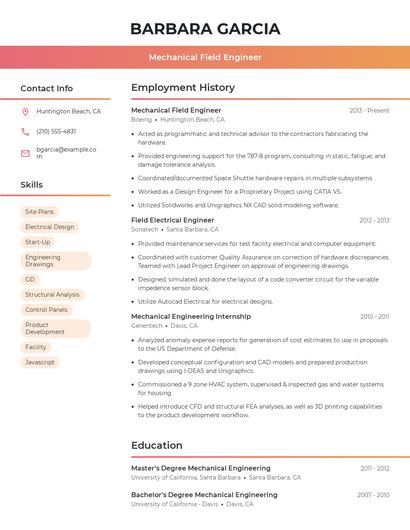
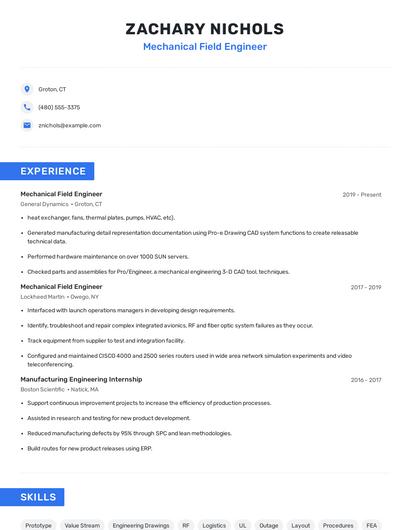
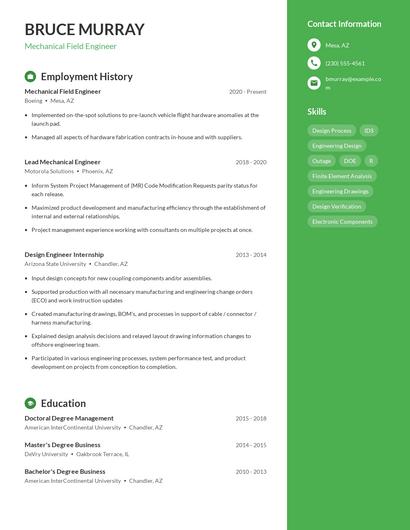
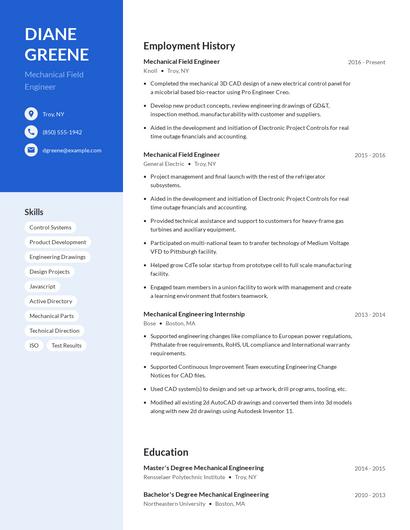
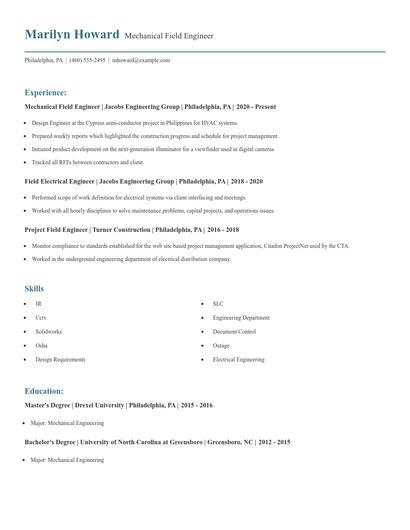
Compare different mechanical field engineers
Mechanical field engineer vs. Engineer
Engineers are highly trained professionals who determine the feasibility of various projects, usually related to the construction industry. They are considered experts in mathematics and science, two disciplines that they need to use in designing and coming up with plans for projects. They should also be well-versed in different construction or industrial materials, and they ensure that appropriate materials are used for the project. They also ensure that the projects meet the requirements of the groups that hired them. They create spaces that would both address the needs of the end-users and the industry standards. They also ensure that the projects they make would stand the test of time.
These skill sets are where the common ground ends though. The responsibilities of a mechanical field engineer are more likely to require skills like "oil gas," "outage," "gas turbines," and "technical direction." On the other hand, a job as an engineer requires skills like "python," "cloud," "c++," and "c #." As you can see, what employees do in each career varies considerably.
Engineers really shine in the automotive industry with an average salary of $97,672. Comparatively, mechanical field engineers tend to make the most money in the energy industry with an average salary of $93,423.The education levels that engineers earn slightly differ from mechanical field engineers. In particular, engineers are 8.5% more likely to graduate with a Master's Degree than a mechanical field engineer. Additionally, they're 0.5% more likely to earn a Doctoral Degree.Mechanical field engineer vs. Product engineer
A product engineer specializes in designing and developing commercial materials and services. They are primarily responsible for conducting thorough research and analysis of the latest trends and marketing conditions to come up with new ideas and products for the public. Moreover, they are also responsible for producing reports and presentations, coordinating with the development team of their company. Product engineers also reach out to vendors and suppliers for the raw materials, set regulations and standards for the product, and even conduct a rigorous and regular quality check.
While some skills are similar in these professions, other skills aren't so similar. For example, resumes show us that mechanical field engineer responsibilities requires skills like "oil gas," "outage," "technical direction," and "mechanical systems." But a product engineer might use other skills in their typical duties, such as, "product design," "project management," "c++," and "solidworks."
On average, product engineers earn a higher salary than mechanical field engineers. Some industries support higher salaries in each profession. Interestingly enough, product engineers earn the most pay in the technology industry with an average salary of $90,301. Whereas mechanical field engineers have higher pay in the energy industry, with an average salary of $93,423.Average education levels between the two professions vary. Product engineers tend to reach higher levels of education than mechanical field engineers. In fact, they're 8.6% more likely to graduate with a Master's Degree and 0.5% less likely to earn a Doctoral Degree.Mechanical field engineer vs. Equipment engineer
The duties of an equipment engineer depend on one's organization or industry of employment. Typically, their responsibilities revolve around designing and developing mechanical and electronic equipment, analyzing and improving existing systems, performing customization according to customers' preferences, installing and removing attachments, and conducting regular maintenance procedures. An equipment engineer must also address issues and complaints, providing corrective measures promptly and efficiently. Furthermore, it is essential to coordinate with team members and other specialists, inspect and test new systems, and adhere to the company's policies and regulations.
Some important key differences between the two careers include a few of the skills necessary to fulfill the responsibilities of each. Some examples from mechanical field engineer resumes include skills like "troubleshoot," "outage," "technical direction," and "technical issues," whereas an equipment engineer is more likely to list skills in "equipment performance," "semiconductor," "project management," and "preventive maintenance. "
Equipment engineers earn the best pay in the energy industry, where they command an average salary of $108,645. Mechanical field engineers earn the highest pay from the energy industry, with an average salary of $93,423.Most equipment engineers achieve a similar degree level compared to mechanical field engineers. For example, they're 4.4% more likely to graduate with a Master's Degree, and 0.5% more likely to earn a Doctoral Degree.Mechanical field engineer vs. Staff engineer
Staff engineers are responsible for designing, developing, and inspecting various products, equipment, or structures. These professionals may perform varied duties depending on their specialization that includes overseeing the design and construction of buildings, bridges, sewer systems, and other infrastructure, estimating the financial costs of construction projects, and ensuring compliance with health and safety laws and regulations. Other duties include designing and developing machinery, tools, and engines, solving design problems, and building the manufacturing equipment needed to create their products.
Types of mechanical field engineer
Updated January 8, 2025
