
Automatically apply for jobs with Zippia
Upload your resume to get started.
Mental health program manager skills for your resume and career
15 mental health program manager skills for your resume and career
2. Behavioral Health
- Direct Manager for the Behavioral Health Provider Relations Advocates servicing the state of Tennessee conducting provider relations and individual/group contracting.
- Develop goal-directed, individualized service plans for adolescents with behavioral health needs.
3. Mental Health
Mental health is the state of wellbeing in which an individual can cope with the regular stresses and tensions of life, and can work productively without having any emotional or psychological breakdown. Mental health is essential for a person of any age and helps them make the right decisions in their life.
- Administered Mental Health Program and an inter-agency Re-entry Program for HIV-positive ex-offenders, including ensuring compliance with state and federal regulations.
- Provided mental health evaluations, and administer standardized psychological testing; developed and implemented treatment plans.
4. Substance Abuse
- Improved MHRRTP program by writing policies and enhancing functioning of the homeless, PTSD, and substance abuse programs.
- Trained in HHRP which is a government DEBI for Harm Reduction of Substance Abuse and HIV.
5. Family Therapy
- Provide Family Therapy Sessions (utilizing evidence-based modalities) with parents and client.
- Provided individual and family therapy, oversaw foster licensing program, developed year long attachment training program for clinicians.
6. Rehabilitation
- Developed and maintain close liaison with local providers and drug rehabilitation facilities.
- Chair and direct interdisciplinary teams in the development and evaluation of individualized habilitation, rehabilitation and treatment plans.
Choose from 10+ customizable mental health program manager resume templates
Build a professional mental health program manager resume in minutes. Our AI resume writing assistant will guide you through every step of the process, and you can choose from 10+ resume templates to create your mental health program manager resume.7. Medicaid
- Conducted billing and coding through agency reimbursement funding through Medicaid.
- Review of Medicaid authorized service plans and therapeutic interventions.
8. Crisis Intervention
- Provided crisis intervention while caseload was being established to provide individual and group therapy.
- Provided coaching, crisis intervention with an emphasis on client safety.
9. Clinical Supervision
Clinical supervision refers to how practicing nurses get professional and moral support from their experienced colleagues. The practice aims to promote their ability to make a concrete decision that values the patient's well-being.
- Monitor overall treatment and provide therapists with clinical supervision.
- Provide clinical supervision to the Children department Therapist.
10. Service Delivery
Service delivery means, having any contact with the public administration during which customers including citizens, residents, or firms, require or give data, handle their problems and perform their duties.
- Managed customer relationship that resulted in consistently achieving outstanding customer satisfaction, based on survey data for product and service delivery.
- Developed Individualized Service Plans with clients and monitored service delivery to ensure services were delivered as described in Individual Service Plans.
11. Program Planning
Program Planning is the overall process of designing a plan to achieve a specific objective within an organization. This involves clarifying what issues need to be solved, setting expected outcomes, managing resources needed, and creating performance metrics to track progress. Planning a program requires participation and funding from various stakeholders.
- Participate in program planning, and additional services provided if necessary to children and families in relations to special needs.
- Maintain record keeping, program planning and development as well as professional development.
12. Community Resources
Community resources are a set of resources that are used in the day to day life of people which improves their lifestyle in some way. People, sites or houses, and population assistance can come under the services offered by community resources.
- Developed and promoted relations with referral and community resources and service providers.
- Maintained close liaison with legal supervision and community resources.
14. Administrative Supervision
- Performed the hiring, training and clinical and administrative supervision of staff.
- Provide direct clinical and administrative supervision to home-based and outpatient Mental Health Therapists and Master's level interns.
15. Community Agencies
Community agencies stand for the organizations operated to provide human service in the community.
- Serve as a liaison with community agencies and other groups and organizations which impact maternal child health services.
- Cultivated and maintained collaborative relationships with community agencies/organizations and volunteers to ensure positive community engagement.
5 Mental Health Program Manager resume examples
Build a professional mental health program manager resume in minutes. Browse through our resume examples to identify the best way to word your resume. Then choose from 5+ resume templates to create your mental health program manager resume.

What skills help Mental Health Program Managers find jobs?
Tell us what job you are looking for, we’ll show you what skills employers want.
What skills stand out on mental health program manager resumes?
Dianne Ciro Ph.D.
Assistant Professor, San Diego State University
What type of skills will young mental health program managers need?
Dr. Eva Moya Ph.D.
Professor, The University of Texas
Skills in research, to study social issues, with the intention of developing social policy or micro-level approaches to practice to improve people's lives, and training in relation to multiculturalism, cultural competence, cultural humility practice is vital.
Key skills include:
-Collaboration
-Critical thinking
-Ethics in evidence based-practice
-Assessment, intervention, and evaluation
-Social work competencies to inform behaviors.
-Administration and management
-Community practice
-Policy practice
What technical skills for a mental health program manager stand out to employers?
Meaghan Goodman Ph.D.
Program Director & Assistant Professor, Maryville University
-Like to think critically and problem solve,
-Are passionate about the field and demonstrate a desire to continually learn more,
-Are dedicated to serving people and helping them live their best lives,
-And those who possess strong advocacy skills!
What soft skills should all mental health program managers possess?
Todd Terry
Department Chair, Management, Davenport University
Graduates should have good critical thinking skills. They will need to be adaptive and able to analyze data to make good informed decisions.
In today's work environment, working on teams is a regular function. Therefore, employers are looking for the candidate who can professionally interact with other team members, have a positive attitude and a good work ethic.
What hard/technical skills are most important for mental health program managers?
Linda Galocy
Director and Assistant Dean, Clinical Associate Professor, Indiana University Northwest
+a health information professional to understand an entire process, such as the revenue cycle. There are many individuals involved in the process of obtaining payment for healthcare services rendered, and it is important for everyone to do their job, do it correctly, and when errors occur, work together to correct those errors.
List of mental health program manager skills to add to your resume
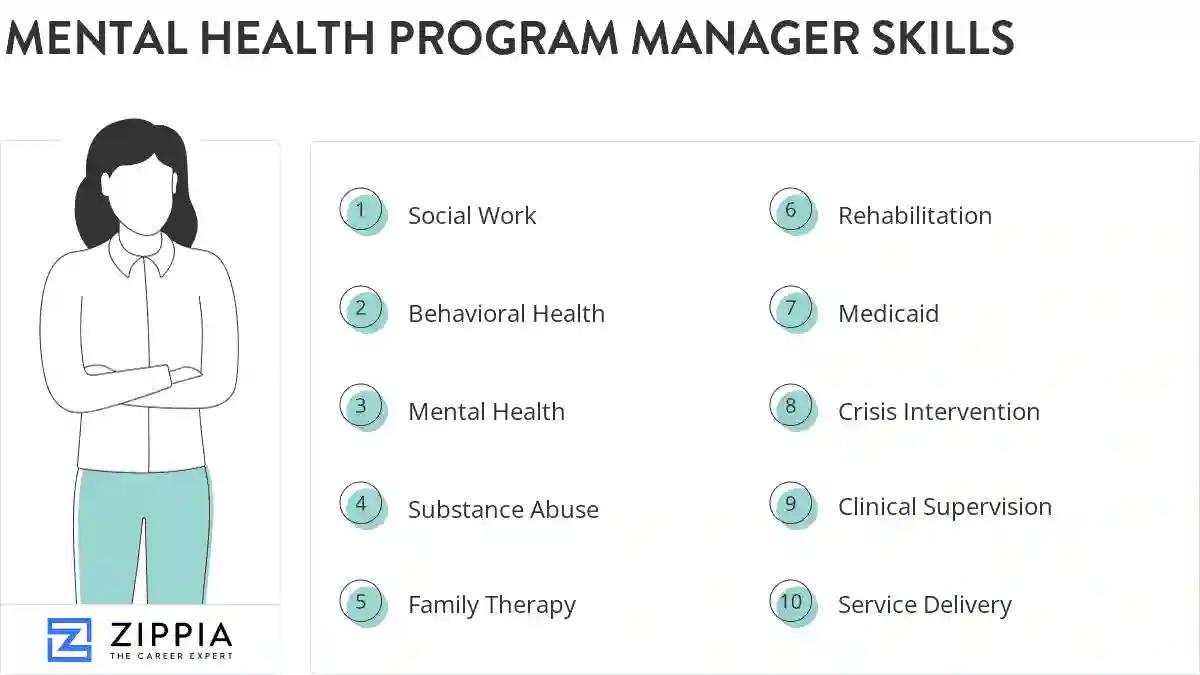
The most important skills for a mental health program manager resume and required skills for a mental health program manager to have include:
- Social Work
- Behavioral Health
- Mental Health
- Substance Abuse
- Family Therapy
- Rehabilitation
- Medicaid
- Crisis Intervention
- Clinical Supervision
- Service Delivery
- Program Planning
- Community Resources
- Social Services
- Administrative Supervision
- Community Agencies
- Child Abuse
- Program Development
- Group Therapy
- Performance Evaluations
- Clinical Services
- Technical Assistance
- Individual Therapy
- Discharge Planning
- Performance Standards
- Staff Supervision
- Mental Health Treatment
- Mental Health Issues
- Quality Service
- State Regulations
- Medi-Cal
- Administrative Oversight
- Program Budget
- Indirect Supervision
- Medication Management
- Clinical Oversight
- Mental Illness
- Crisis Situations
- CARF
- Early Intervention
- Community Organizations
- IEP
- Community Outreach
- Mental Health Professionals
- NCQA
- DMH
- Professional Development
- Direct Supervision
- Disciplinary Actions
- Federal Guidelines
Updated January 8, 2025

1. Social Work