What does a migration engineer do?
The job of a data migration engineer focuses on the definition of a data migration plan for a solution. Data migration engineers handle high-end relationships between businesses through competitive solutions to technical issues. They execute the physical set-up of workstations in the new building. It is their job to organize and ensure that the SharePoint site is sustained for migration tracking and team issue resolution. They develop migration and integration SQL code for client enforcement, upgrades, and requests.
Migration engineer responsibilities
Here are examples of responsibilities from real migration engineer resumes:
- Perform network testing, replace hubs with Cisco switches, and manage cabling contractors.
- Achieve VDI system high availability, eliminating single-points of failure to the VDI environment for internal and external VDI connectivity.
- Extract Java MSI's for use in SCCM to avoid bloat ware and taskbar installations.
- Position require troubleshooting PC networking issues involving LAN connectivity, TCP/IP, DNS, etc.
- Administer LAN, install CAT5 cabling, create user accounts, troubleshoot TCP/IP and IPX/SPX issues, and resolve connectivity problems.
- Upgrade VMware tolls and ESX host critical patches and setup baseline.
- Plane migration strategies, DR plans with SAN and NAS data.
- Verify SharePoint migration schedule are completed after each migration and keep current.
- Modify the Linux kernel to add tracing probes for Config access tool.
- Copy user data from old OS to new OS using provide scripts.
- Configure SSL, http redirection, siteminder installation, webservices on IIS.
- Organize and sustain SharePoint site to track migrations and issues resolve by team.
- Deploy the SRM project with the DR setup using the SAN array base replication.
- Work closely with the Java development group using with the JBoss to the J2EE applications.
- Create image of old systems using SCCM and perform DOD wipe on drives prior to disposal.
Migration engineer skills and personality traits
We calculated that 10% of Migration Engineers are proficient in Java, Azure, and PowerShell. They’re also known for soft skills such as Analytical skills, Communication skills, and Problem-solving skills.
We break down the percentage of Migration Engineers that have these skills listed on their resume here:
- Java, 10%
Deployed the build scripts with ANT to the Java development environment.
- Azure, 9%
Trained on Microsoft Azure platform for future private-to-public cloud migrations.
- PowerShell, 8%
Automated, where possible, server deployment using PowerShell.
- SharePoint, 6%
Deployed customized solution files in SharePoint 2010 environment.
- Linux, 5%
Supervised decommission of 646 legacy Windows & Linux virtual machines, which realized significant infrastructure / support cost savings.
- SQL Server, 4%
Designed and implemented SMSQL for 48 SQL servers.
"java," "azure," and "powershell" are among the most common skills that migration engineers use at work. You can find even more migration engineer responsibilities below, including:
Analytical skills. One of the key soft skills for a migration engineer to have is analytical skills. You can see how this relates to what migration engineers do because "administrators need to evaluate networks and systems to make sure that they perform reliably and to anticipate new requirements as customers’ needs change." Additionally, a migration engineer resume shows how migration engineers use analytical skills: "performed extensive research and successfully carried out application analysis for 18 .net and 12 java based applications. "
Communication skills. Another essential skill to perform migration engineer duties is communication skills. Migration engineers responsibilities require that "administrators must describe problems and their solutions to non-it workers." Migration engineers also use communication skills in their role according to a real resume snippet: "provide proactive technical support and problem resolution using trouble ticketing, email, and verbal communication techniques. "
Problem-solving skills. Another skill that relates to the job responsibilities of migration engineers is problem-solving skills. This skill is critical to many everyday migration engineer duties, as "administrators must quickly resolve problems that arise with computer networks." This example from a resume shows how this skill is used: "performed and managed all stages of client data migrations, and resolved migration service issues. "
The three companies that hire the most migration engineers are:
- Federal Reserve Bank7 migration engineers jobs
- Ahead USA6 migration engineers jobs
- U.S. Bank3 migration engineers jobs
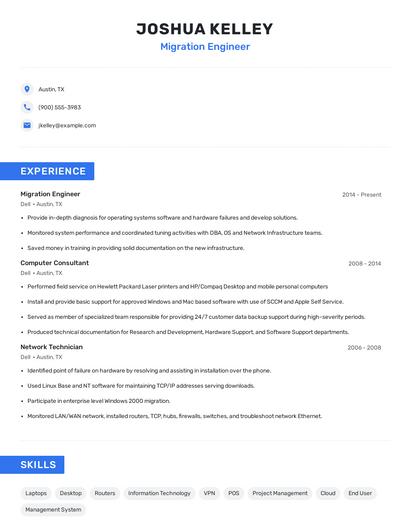
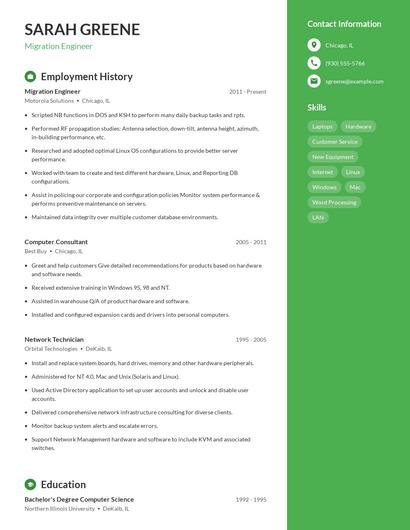
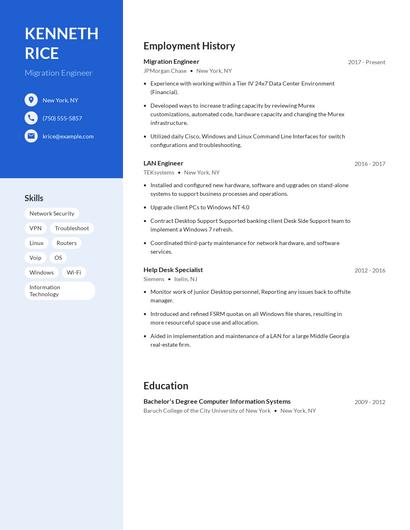
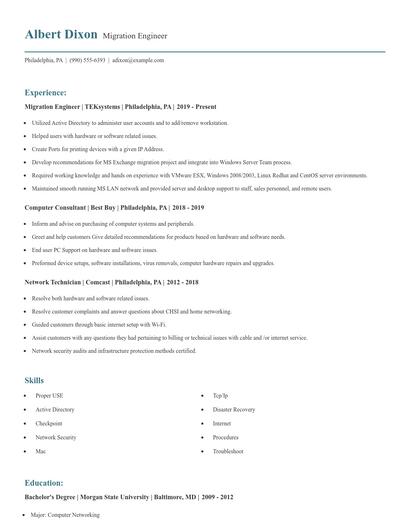
Choose from 10+ customizable migration engineer resume templates
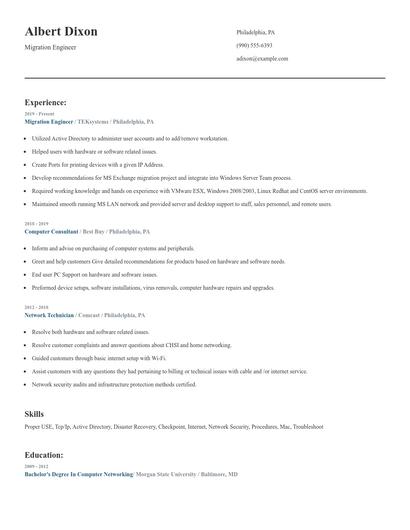
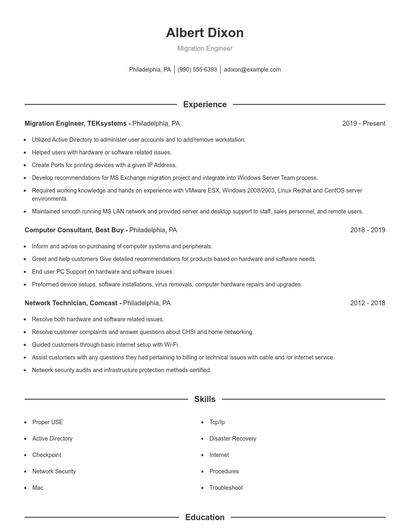
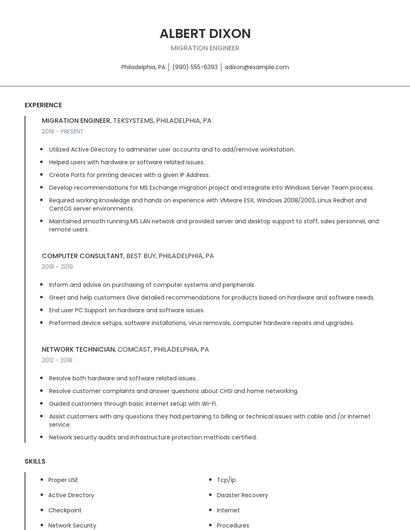
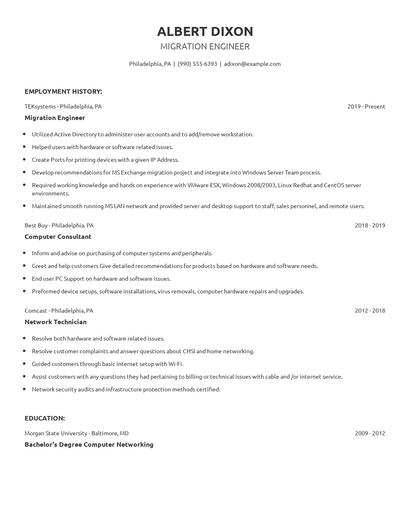
Build a professional migration engineer resume in minutes. Our AI resume writing assistant will guide you through every step of the process, and you can choose from 10+ resume templates to create your migration engineer resume.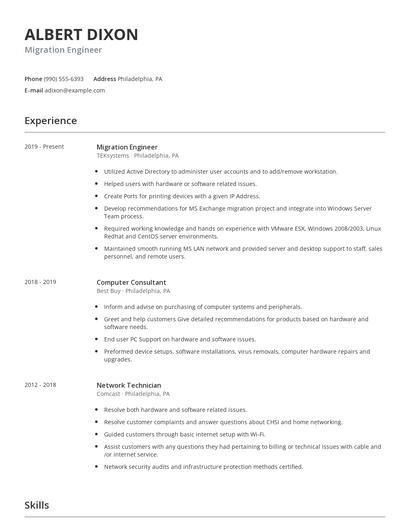
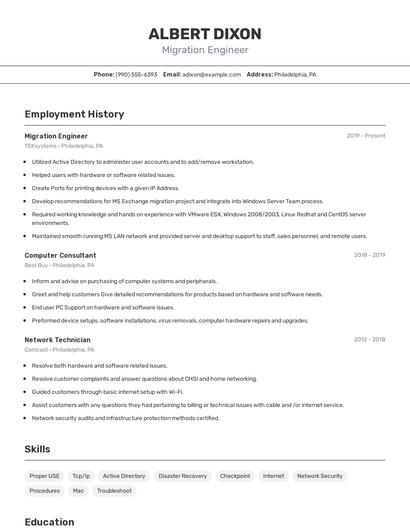
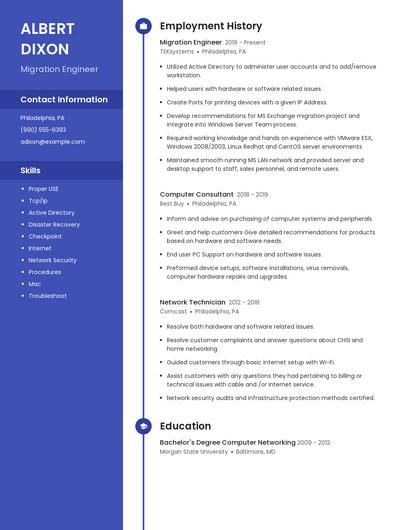
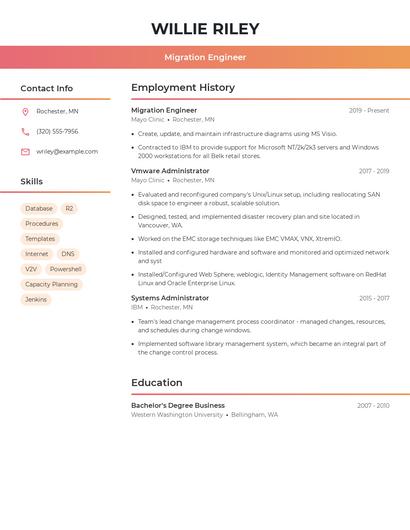
Compare different migration engineers
Migration engineer vs. Network/server administrator
A Network Administrator ensures an organizations' network is operational and up to date. They solve problems that arise within computer networks, maintaining computer networks, interacting with clients, and consulting with them to determine their system requirements.
These skill sets are where the common ground ends though. The responsibilities of a migration engineer are more likely to require skills like "java," "migration project," "data migration," and "vmware." On the other hand, a job as a network/server administrator requires skills like "customer service," "server administration," "disaster recovery," and "dhcp." As you can see, what employees do in each career varies considerably.
Network/server administrators really shine in the manufacturing industry with an average salary of $84,609. Comparatively, migration engineers tend to make the most money in the pharmaceutical industry with an average salary of $107,322.network/server administrators tend to reach similar levels of education than migration engineers. In fact, network/server administrators are 2.3% less likely to graduate with a Master's Degree and 0.1% less likely to have a Doctoral Degree.Migration engineer vs. Systems administrator
Systems administrators are employees who oversee information technology infrastructures in the office. They are skilled information technology professionals who are knowledgeable about the company's network systems and other technology-related infrastructures. They are responsible for installing, configuring, or updating network systems, software, and hardware. They also monitor the different systems and troubleshoot any issues that users may encounter. Systems administrators manage the access of users, ensure the security of the network, and address any challenges that users may have. They conduct repairs and routine maintenance to ensure that the systems in place are in the best shape.
In addition to the difference in salary, there are some other key differences worth noting. For example, migration engineer responsibilities are more likely to require skills like "migration project," "data migration," "vmware," and "migration process." Meanwhile, a systems administrator has duties that require skills in areas such as "database," "computer system," "dhcp," and "disaster recovery." These differences highlight just how different the day-to-day in each role looks.
Systems administrators may earn a lower salary than migration engineers, but systems administrators earn the most pay in the technology industry with an average salary of $86,962. On the other hand, migration engineers receive higher pay in the pharmaceutical industry, where they earn an average salary of $107,322.Average education levels between the two professions vary. Systems administrators tend to reach similar levels of education than migration engineers. In fact, they're 0.6% more likely to graduate with a Master's Degree and 0.1% more likely to earn a Doctoral Degree.Migration engineer vs. Network security engineer
A network security engineer is responsible for maintaining the safety and security of all the organization's network systems, conducting regular configuration and maintenance to avoid unauthorized access and suspicious activities that may pose risks for the company's integrity. Network security engineers manage security threats and strategize resolutions to mitigate the reoccurrence of security issues. They also develop security enhancement recommendations, update network infrastructure, and monitor system activities. A network security engineer should have excellent communication and technical skills, as well as a strong command of programming languages and system codes.
There are many key differences between these two careers, including some of the skills required to perform responsibilities within each role. For example, a migration engineer is likely to be skilled in "powershell," "sharepoint," "onedrive," and "sql server," while a typical network security engineer is skilled in "network security," "windows," "routers," and "servers."
Network security engineers earn the best pay in the retail industry, where they command an average salary of $95,160. Migration engineers earn the highest pay from the pharmaceutical industry, with an average salary of $107,322.When it comes to education, network security engineers tend to earn higher degree levels compared to migration engineers. In fact, they're 6.7% more likely to earn a Master's Degree, and 0.0% more likely to graduate with a Doctoral Degree.Migration engineer vs. Systems support engineer
Systems support engineers are information technology professionals who are responsible for building and maintaining the IT infrastructure of an organization. They are required to provide network administration and technical support to identify complex problem issues and come up with solutions to solve them. They must assist the system support engineers in accomplishing any projects they are working with. They must troubleshoot servers, personal computers, and peripheral equipment while liaising with their customers. They must also create and maintain user accounts and implement group policy management through an active directory.
Even though a few skill sets overlap between migration engineers and systems support engineers, there are some differences that are important to note. For one, a migration engineer might have more use for skills like "azure," "onedrive," "migration project," and "data migration." Meanwhile, some responsibilities of systems support engineers require skills like "database," "customer satisfaction," "system support," and "system administration. "
Systems support engineers enjoy the best pay in the finance industry, with an average salary of $92,061. For comparison, migration engineers earn the highest salary in the pharmaceutical industry.In general, systems support engineers hold similar degree levels compared to migration engineers. Systems support engineers are 2.7% more likely to earn their Master's Degree and 0.2% more likely to graduate with a Doctoral Degree.Types of migration engineer
Updated January 8, 2025
