What does a network services technician do?
A network services technician is responsible for installing and maintaining networks, ensuring efficiency and smooth workflow. Among their responsibilities include providing technical support to clients through calls and correspondence, responding to concerns and inquiries, troubleshooting problems, and producing progress reports. They may also assess the company's networks and systems to identify its strengths and weaknesses, recommending solutions against problem areas. Furthermore, they must conduct regular maintenance checks, performing repairs as needed while in adherence to the company's policies and regulations.
Network services technician responsibilities
Here are examples of responsibilities from real network services technician resumes:
- Manage the deployment of desktop, laptop computers and VOIP telephones.
- Manage client configuration of Cisco VPN concentrator and work with clients in installing and troubleshooting issues with Cisco VPN client.
- Manage firewalls, endpoint encryption and other communications and systems security devices for large scale networks across distinct complicate infrastructure.
- Configure, install, and maintain network equipment including switches, routers, and hubs.
- Install and switch operations network onto new Cisco routers in data-center.
- Assist technicians and training when installing WIMAX CPE, giving RF study coverage and commissioning equipment.
- Restart and/or modify configurations, within a UNIX shell when necessary, for WebServices and/or their associate Java processes
- Rebuild communication closets with brand new racks, switches, and patch panels (setting up all patch cords).
- Configure residential VOIP systems in compliance with existing home security systems.
- Coordinate replacement and installation of routers at customer locations, and maintain device configurations.
- Provide professional coordination of installation, maintenance, provisioning and testing of fiber optic DWDM/SONET/Metro Ethernet systems.
- Install and implementation various types of servers/computers, printers, and networking equipment effectively provide quality service and installation for customers.
- Establish and sustain collaborative relationships and open communications with clients while educating on LAN usage and issues.
Network services technician skills and personality traits
We calculated that 30% of Network Services Technicians are proficient in Customer Service, Customer Satisfaction, and NOC. They’re also known for soft skills such as Analytical skills, Communication skills, and Multitasking skills.
We break down the percentage of Network Services Technicians that have these skills listed on their resume here:
- Customer Service, 30%
Job responsibilities included daily Installation and Maintenance of telecommunication lines with objectives of meeting customer service commitments and company goals.
- Customer Satisfaction, 19%
Recognized on several occasions for Outstanding Customer satisfaction, and Resolution of Presidential Escalation, and Customer Retention.
- NOC, 13%
Facilitated and coordinated maintenance efforts through the NOC in conjunction with supervisory field personnel.
- Troubleshoot, 4%
Install, configure, and troubleshoot agency proprietary software, web based applications, database applications, and Microsoft Office applications.
- Desktop Support, 2%
Worked in a team setting to perform desktop support for more than 400 banks operating within an IBM AS400 processing environment.
- Linux, 2%
Installed LINUX web servers and used SAMBA for creating Windows Shares S.A.I.C.
Most network services technicians use their skills in "customer service," "customer satisfaction," and "noc" to do their jobs. You can find more detail on essential network services technician responsibilities here:
Analytical skills. One of the key soft skills for a network services technician to have is analytical skills. You can see how this relates to what network services technicians do because "administrators need to evaluate networks and systems to make sure that they perform reliably and to anticipate new requirements as customers’ needs change." Additionally, a network services technician resume shows how network services technicians use analytical skills: "perform installation and service to data, voice, and video equipment * identify and isolate system or network problems. "
Communication skills. Many network services technician duties rely on communication skills. "administrators must describe problems and their solutions to non-it workers.," so a network services technician will need this skill often in their role. This resume example is just one of many ways network services technician responsibilities rely on communication skills: "resolved lan, wan and telecommunication issues. "
Multitasking skills. network services technicians are also known for multitasking skills, which are critical to their duties. You can see how this skill relates to network services technician responsibilities, because "administrators may have to work on many problems and tasks at the same time." A network services technician resume example shows how multitasking skills is used in the workplace: "exhibit strong communication, critical thinking, multitasking, troubleshooting, and customer service skills"
Problem-solving skills. network services technician responsibilities often require "problem-solving skills." The duties that rely on this skill are shown by the fact that "administrators must quickly resolve problems that arise with computer networks." This resume example shows what network services technicians do with problem-solving skills on a typical day: "provide pc/networking solutions including price quoting on hardware/software installations and customer services. "
The three companies that hire the most network services technicians are:
- Amazon1 network services technicians jobs
- Saratoga Hospital1 network services technicians jobs
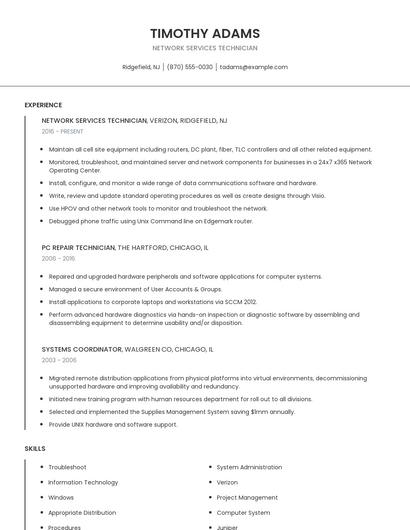
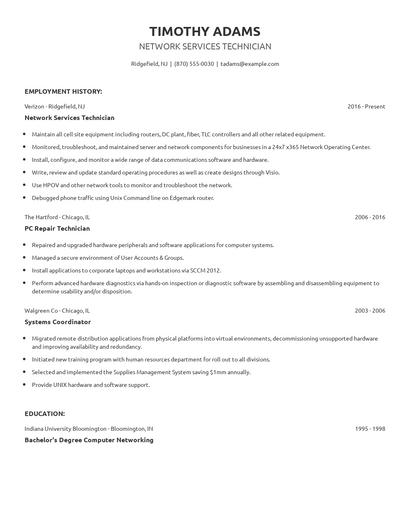
Choose from 10+ customizable network services technician resume templates
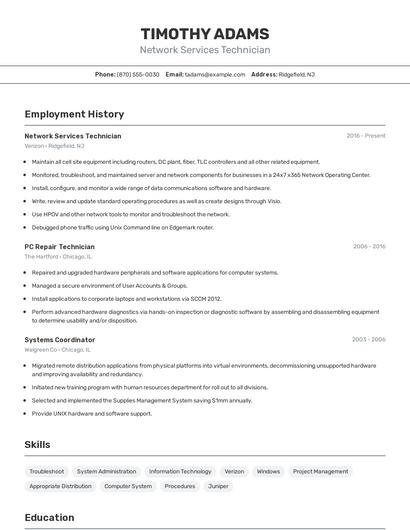
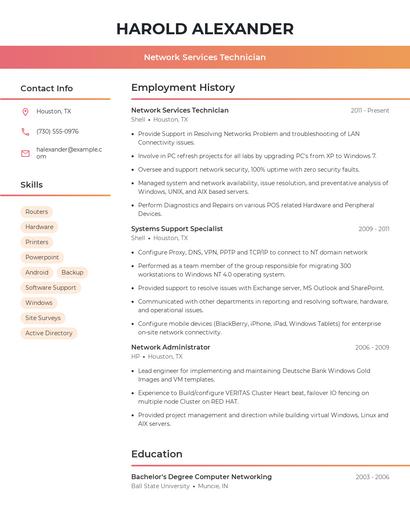
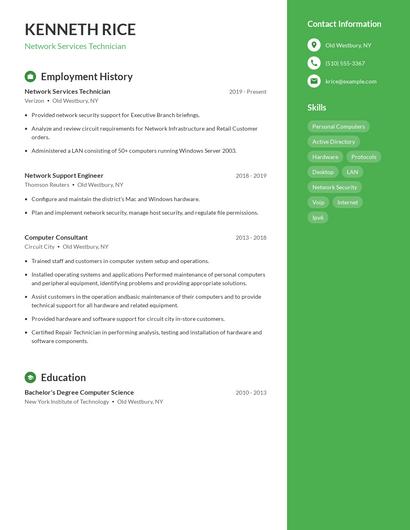
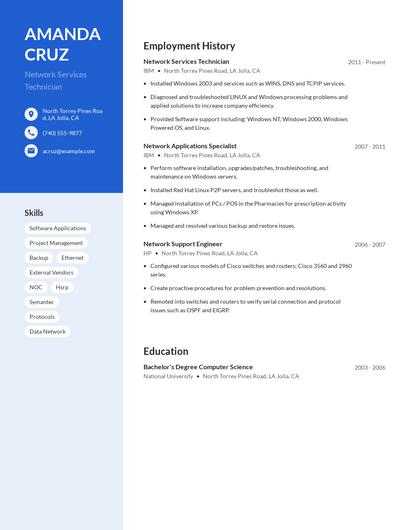
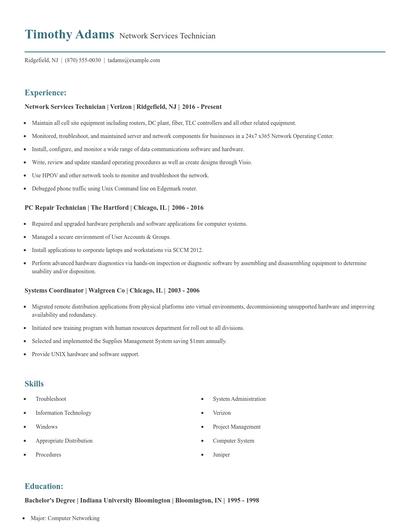
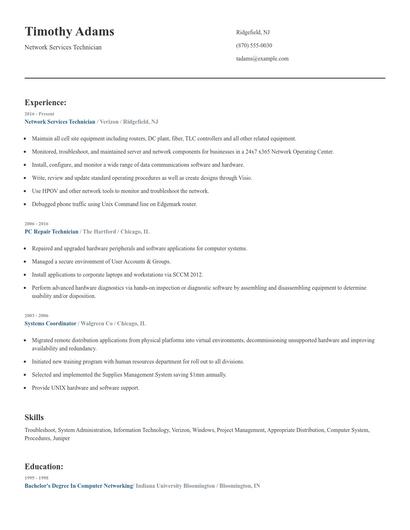
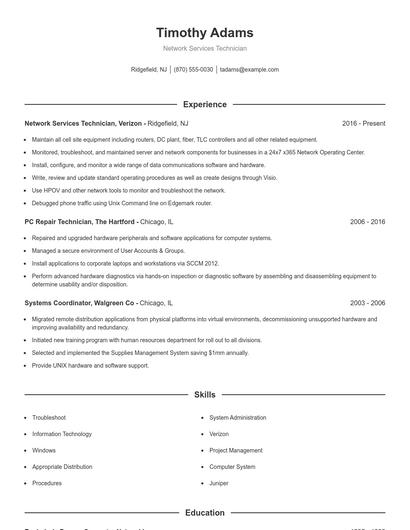
Build a professional network services technician resume in minutes. Our AI resume writing assistant will guide you through every step of the process, and you can choose from 10+ resume templates to create your network services technician resume.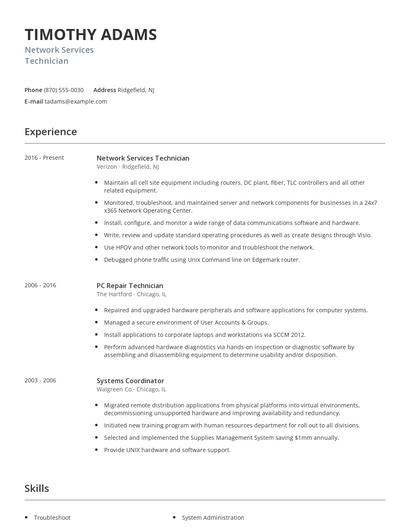


Compare different network services technicians
Network services technician vs. Technician support tier
A technician support tier focuses on providing technical support to clients or employees within a company. Typically working in a team setting, a technician support tier addresses technical problems and troubleshoots to identify the root of the issues and perform necessary corrective measures or repairs. Their responsibilities also revolve around responding to inquiries, answering calls and correspondence, conducting regular maintenance of systems and networks, maintaining records of all transactions, and supporting software and networks. Furthermore, it is essential to coordinate with all team members while adhering to the company's policies and regulations.
These skill sets are where the common ground ends though. The responsibilities of a network services technician are more likely to require skills like "customer satisfaction," "troubleshoot," "switches," and "telecommunication." On the other hand, a job as a technician support tier requires skills like "lan wan," "phone calls," "tier ii," and "lan." As you can see, what employees do in each career varies considerably.
Technician support tiers tend to make the most money working in the technology industry, where they earn an average salary of $62,098. In contrast, network services technicians make the biggest average salary, $51,791, in the education industry.On average, technician support tiers reach similar levels of education than network services technicians. Technician support tiers are 0.4% less likely to earn a Master's Degree and 0.5% less likely to graduate with a Doctoral Degree.Network services technician vs. Technical support technician
Technical support technicians are skilled professionals who resolve computer or information technology-related concerns. They may do installations, repairs, or maintenance activities of various applications or computer hardware. They are sometimes assigned specific issues or concerns to resolve so that they will not be bombarded with various issues. This means that they can now specialize in a specific family of concerns. Technical support technicians may provide on-site support, going directly to the person who needs help and doing what needs to be done or troubleshoot the problem in person. They may also be offsite and would usually be manning helpdesk hotlines. Offsite technical support technicians walk the caller through the steps they should do to fix the issues. As such, when a technical support technician is offsite, they are expected to be good communicators and will be able to provide clear instructions.
While some skills are similar in these professions, other skills aren't so similar. For example, resumes show us that network services technician responsibilities requires skills like "customer satisfaction," "noc," "troubleshoot," and "switches." But a technical support technician might use other skills in their typical duties, such as, "patients," "os," "inbound calls," and "software applications."
Technical support technicians may earn a lower salary than network services technicians, but technical support technicians earn the most pay in the finance industry with an average salary of $52,365. On the other hand, network services technicians receive higher pay in the education industry, where they earn an average salary of $51,791.technical support technicians earn similar levels of education than network services technicians in general. They're 0.7% more likely to graduate with a Master's Degree and 0.5% less likely to earn a Doctoral Degree.What technology do you think will become more important and prevalent for network services technicians in the next 3-5 years?
Ming Chow
Associate Teaching Professor, Tufts University
References:
1. cybersecurity
2. cybersecurity
Network services technician vs. Customer support technician
A customer support technician is responsible for resolving customer complaints with their network issues through remote communication, providing the customers with a step-by-step procedure to fix their systems. Customer support technicians assist the customers in setting up their programs and applications, guiding them with the instructional manuals, and responding to the inquiries and concerns they have. They also escalate high-level complaints to the immediate supervisor as needed while monitoring system solutions and creating technical tickets.
There are many key differences between these two careers, including some of the skills required to perform responsibilities within each role. For example, a network services technician is likely to be skilled in "noc," "troubleshoot," "desktop support," and "switches," while a typical customer support technician is skilled in "customer inquiries," "java," "post sales," and "debugging."
Customer support technicians earn the best pay in the technology industry, where they command an average salary of $50,042. Network services technicians earn the highest pay from the education industry, with an average salary of $51,791.When it comes to education, customer support technicians tend to earn similar degree levels compared to network services technicians. In fact, they're 1.6% more likely to earn a Master's Degree, and 0.5% more likely to graduate with a Doctoral Degree.Network services technician vs. Hardware technician
A hardware technician is typically in charge of providing technical support to clients or employees, ensuring efficiency and client satisfaction. In a company setting, a hardware technician is responsible for performing initial assessments on computer hardware, troubleshooting, diagnosing problems, and providing step by step solutions to solve the issues. They may also perform corrective repairs on problems and conduct regular maintenance checks to ensure the quality of equipment. Furthermore, as a hardware technician, it is essential to maintain an active communication line with staff for a smooth and efficient workflow.
Even though a few skill sets overlap between network services technicians and hardware technicians, there are some differences that are important to note. For one, a network services technician might have more use for skills like "customer satisfaction," "noc," "troubleshoot," and "telecommunication." Meanwhile, some responsibilities of hardware technicians require skills like "test equipment," "teleconferencing," "laptop computers," and "software applications. "
Hardware technicians enjoy the best pay in the technology industry, with an average salary of $48,180. For comparison, network services technicians earn the highest salary in the education industry.The average resume of hardware technicians showed that they earn similar levels of education compared to network services technicians. So much so that theyacirc;euro;trade;re 1.0% less likely to earn a Master's Degree and less likely to earn a Doctoral Degree by 0.6%.Types of network services technician
Updated January 8, 2025
