What does a performance tester do?
A performance tester is an industrial worker who identifies the stability, scalability, speed, and responsiveness of non-functional software in a given workload. The performance testers make sure that an application's critical components are performing well. They assess resource usage and other quality attributes, preparing it for production. Among the skills necessary to land this job are analytical, attention to detail, communication, and critical thinking.
Performance tester responsibilities
Here are examples of responsibilities from real performance tester resumes:
- Manage SharePoint inter-office documentation in relation to projects and internal processes.
- Used Linux and Unix commands to highly to check if every thong on the server is working fine.
- Perform configuration and troubleshooting of QA test environment through various modifications and upgrades.
- Update XML documents for new requirements for the user.
- Develop java web application scripts and execute in load runner.
- Implement a full transaction engine using XML messaging/dialog from scratch.
- Involve in JIRA bug tracking tool configuration and work flow creation.
- Identify the issues and submit them using issue tracking system (JIRA).
- Monitor metrics like errors, instance count, memory, CPU utilization etc.
- Involve in conducting stress test and volume test against the java application using LoadRunner.
- Perform code review of UNIX shell scripts to derive requirements, test conditions and identify defects.
- Used DynaTrace UEM and DynaTrace browser agent to determine end user response times inclusive of rendering.
- Design the performance test harness for execution on automate, performance, and endurance testing platforms.
- Used iOS simulator to make sure the app works on all devices and there no UI issues.
- Acquire a significant level of knowledge on the Linux file system (GPFS) and command line interaction.
Performance tester skills and personality traits
We calculated that 7% of Performance Testers are proficient in Test Results, Java, and Web Services. They’re also known for soft skills such as Analytical skills, Communication skills, and Problem-solving skills.
We break down the percentage of Performance Testers that have these skills listed on their resume here:
- Test Results, 7%
Provided recommendations to improve the performance of the application by communicating performance test results to all stakeholders.
- Java, 6%
Performed integration testing of Underwriting Desktop, Policy Fulfillment and IO Portal applications developed in Java.
- Web Services, 6%
Developed and debugged business components using Quality Center for Web Services.
- JMeter, 5%
Performed Load testing using JMETER.
- Test Data, 5%
Conduct brainstorming session to understand critical defects, perform root cause analysis, identify test data and plan regression-testing activity.
- Test Plan, 5%
Involved in analyzing system design specifications and developed test plans, scenarios and cases to cover overall quality assurance testing.
Common skills that a performance tester uses to do their job include "test results," "java," and "web services." You can find details on the most important performance tester responsibilities below.
Analytical skills. To carry out their duties, the most important skill for a performance tester to have is analytical skills. Their role and responsibilities require that "management analysts must be able to interpret information and use their findings to make proposals." Performance testers often use analytical skills in their day-to-day job, as shown by this real resume: "designed performance test scripts using load runner, ran stress test, analyzed the results. "
Communication skills. Another essential skill to perform performance tester duties is communication skills. Performance testers responsibilities require that "management analysts must be able to convey information clearly in both writing and speaking." Performance testers also use communication skills in their role according to a real resume snippet: "worked with jms (java messaging service) queues between various interfaces communication. "
Problem-solving skills. This is an important skill for performance testers to perform their duties. For an example of how performance tester responsibilities depend on this skill, consider that "management analysts must be able to think creatively to solve clients’ problems." This excerpt from a resume also shows how vital it is to everyday roles and responsibilities of a performance tester: "work java caps is a middleware product used for enterprise integration solution. ".
Time-management skills. For certain performance tester responsibilities to be completed, the job requires competence in "time-management skills." The day-to-day duties of a performance tester rely on this skill, as "management analysts often work under tight deadlines and must use their time efficiently to complete projects on schedule." For example, this snippet was taken directly from a resume about how this skill applies to what performance testers do: "develop load test plans to include acceptance criteria for business processes and transaction times. "
The three companies that hire the most performance testers are:
- Bank of America8 performance testers jobs
- Cognizant6 performance testers jobs
- Magna International3 performance testers jobs
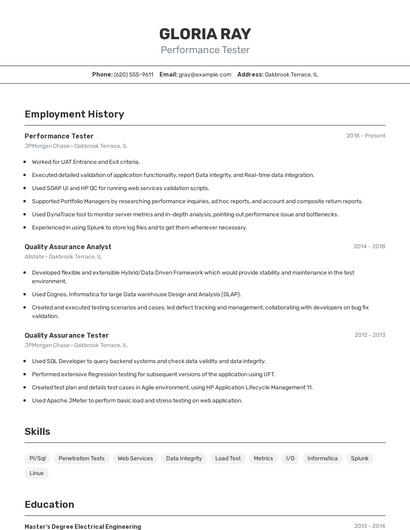
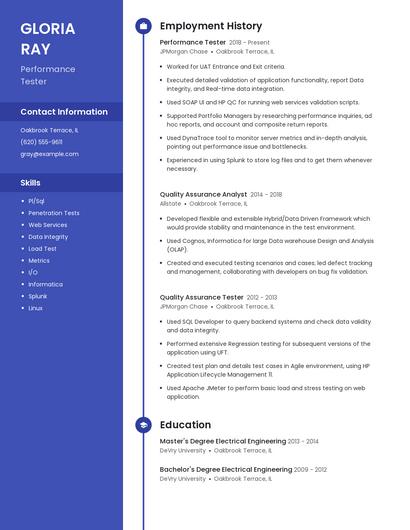
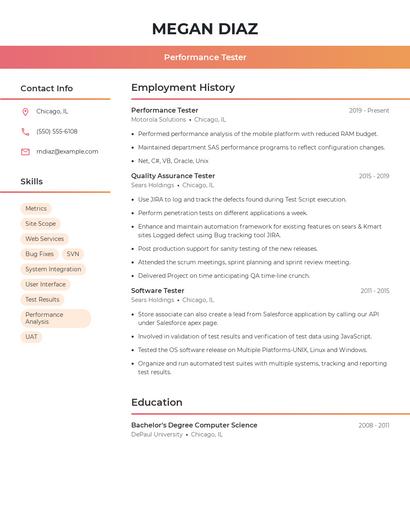
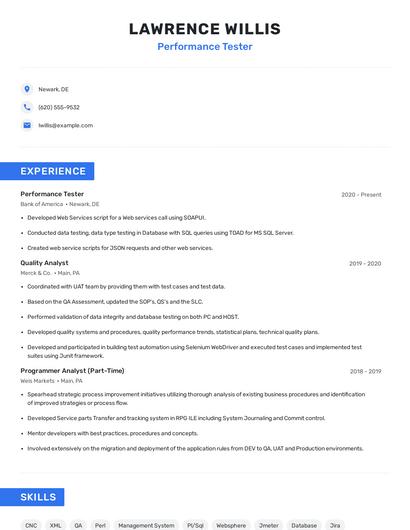
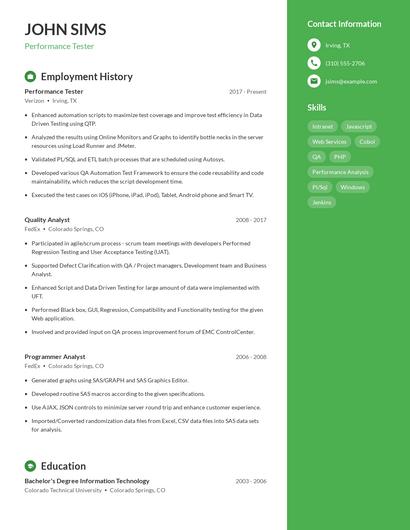
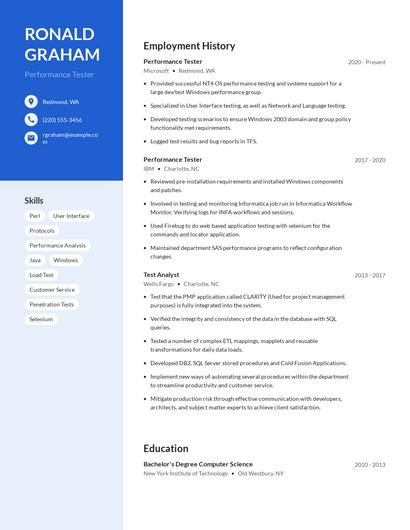
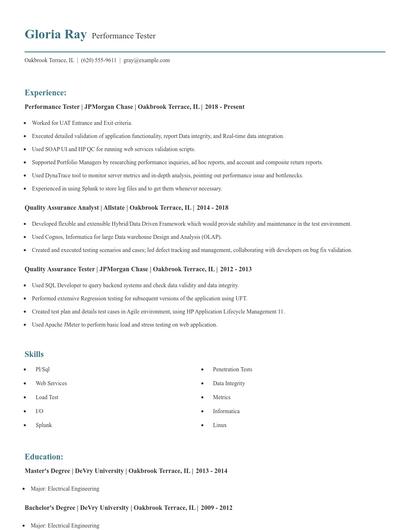
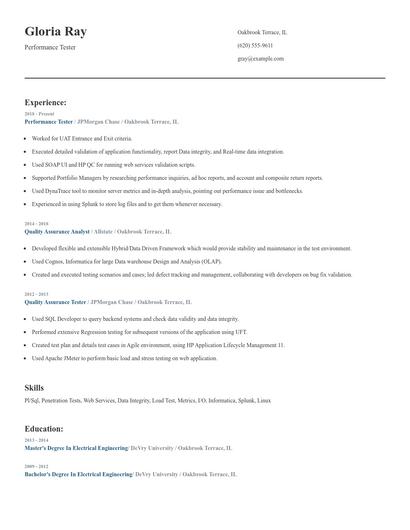
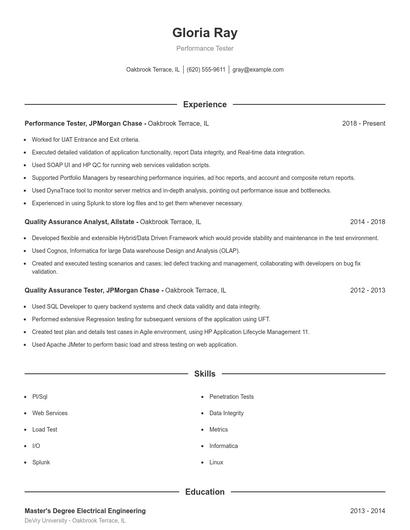
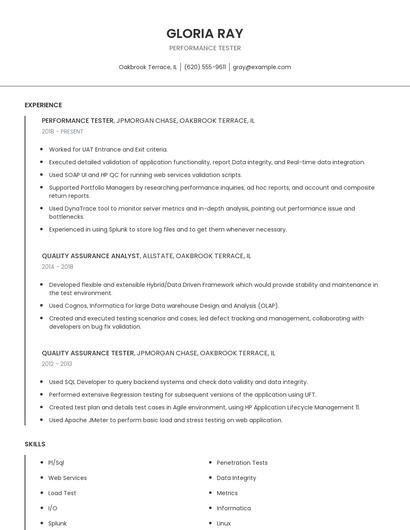
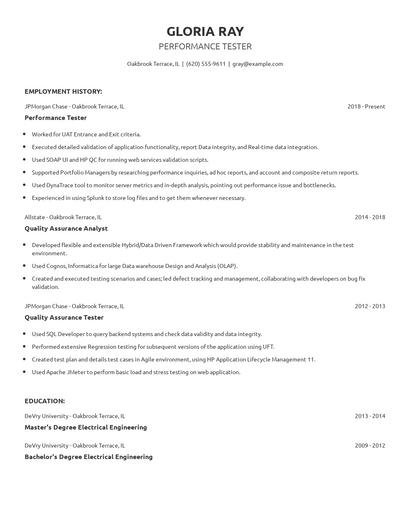
Choose from 10+ customizable performance tester resume templates
Build a professional performance tester resume in minutes. Our AI resume writing assistant will guide you through every step of the process, and you can choose from 10+ resume templates to create your performance tester resume.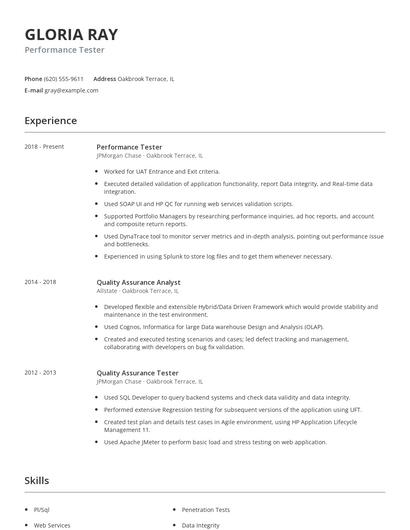
Compare different performance testers
Performance tester vs. Quality analyst
Pumpers are individuals who take responsibility for setting the pumping system controls for product maximization. Their job requires them to set density, concentration, rate, and pressure. They do the operation and maintenance of the auxiliary equipment pumping oil. It is their duty to set the wells so they will function based on the production schedules and switch the oil flow between tanks. They even install the pumping systems.
There are some key differences in the responsibilities of each position. For example, performance tester responsibilities require skills like "web services," "jmeter," "test plan," and "load test." Meanwhile a typical quality analyst has skills in areas such as "customer service," "patients," "data analysis," and "corrective action." This difference in skills reveals the differences in what each career does.
Quality analysts tend to make the most money working in the finance industry, where they earn an average salary of $77,710. In contrast, performance testers make the biggest average salary, $96,439, in the utilities industry.On average, quality analysts reach lower levels of education than performance testers. Quality analysts are 6.6% less likely to earn a Master's Degree and 0.5% more likely to graduate with a Doctoral Degree.Performance tester vs. Test analyst
The duties of a test analyst depend on one's line of work or industry of employment. In the information technology setting, a test analyst is responsible for testing computer software or hardware to ensure its quality before being released in the market. They participate in the development process to monitor the product specifications, review and analyze documentation, and create test systems, implementing them promptly and efficiently. As a test analyst, it is essential to produce progress reports, prepare presentations, and even give recommendations.
In addition to the difference in salary, there are some other key differences worth noting. For example, performance tester responsibilities are more likely to require skills like "jmeter," "load test," "test cases," and "performance test scenarios." Meanwhile, a test analyst has duties that require skills in areas such as "test scripts," "manual test cases," "status reports," and "test scenarios." These differences highlight just how different the day-to-day in each role looks.
On average, test analysts earn a lower salary than performance testers. Some industries support higher salaries in each profession. Interestingly enough, test analysts earn the most pay in the finance industry with an average salary of $74,197. Whereas performance testers have higher pay in the utilities industry, with an average salary of $96,439.In general, test analysts achieve similar levels of education than performance testers. They're 4.1% less likely to obtain a Master's Degree while being 0.5% less likely to earn a Doctoral Degree.Performance tester vs. Senior quality analyst
A senior quality assurance analyst specializes in inspecting and assessing the quality of software and systems in a company, ensuring efficiency and smooth workflow. Their responsibilities include developing specific test structures, coordinating with different departments to gather data, troubleshooting, and studying client complaints to prevent issues from happening again. They may also perform regular maintenance checks, recommending solutions as needed. Furthermore, as a senior quality assurance analyst, it is essential to lead the quality assurance efforts on systems, all while serving as a mentor and role model to junior analysts.
The required skills of the two careers differ considerably. For example, performance testers are more likely to have skills like "jmeter," "load test," "performance test scenarios," and "dynatrace." But a senior quality analyst is more likely to have skills like "data analysis," "test scripts," "status reports," and "patients."
Senior quality analysts make a very good living in the finance industry with an average annual salary of $93,397. On the other hand, performance testers are paid the highest salary in the utilities industry, with average annual pay of $96,439.When it comes to education, senior quality analysts tend to earn similar degree levels compared to performance testers. In fact, they're 2.1% more likely to earn a Master's Degree, and 0.1% more likely to graduate with a Doctoral Degree.Performance tester vs. Quality assurance analyst
Quality Administrators are responsible for managing the quality processes of an organization. Their duties include creating data collection processes, conducting data cleansing, tracks quality milestones, and develop training programs for internal teams. They undertake daily audits, work with the quality coordinator to determine root cause, and assist with feedback and complaints. Quality administrators also write daily reports for purchase orders that are overdue, open service jobs, quotations needing to follow up, unconfirmed hires, and processed sales orders.
Even though a few skill sets overlap between performance testers and quality assurance analysts, there are some differences that are important to note. For one, a performance tester might have more use for skills like "jmeter," "test plan," "load test," and "test cases." Meanwhile, some responsibilities of quality assurance analysts require skills like "manual test cases," "test scripts," "selenium webdriver," and "status reports. "
The retail industry tends to pay the highest salaries for quality assurance analysts, with average annual pay of $82,227. Comparatively, the highest performance tester annual salary comes from the utilities industry.quality assurance analysts reach lower levels of education compared to performance testers, in general. The difference is that they're 5.5% more likely to earn a Master's Degree, and 0.1% more likely to graduate with a Doctoral Degree.Types of performance tester
Updated January 8, 2025
