What does a polysomnograph technician do?
In the medical industry, a Polysomnograph Technician is a health professional who specializes in conducting tests and examinations to diagnose and treat different sleeping conditions, all while under the supervision of a physician or polysomnographic technologist. Their responsibilities include assisting patients by preparing them for the examinations, answering inquiries, and helping them understand the procedures, making them feel comfortable every step of the way. A Polysomnograph Technician reviews patient histories, monitors the patients' brain functions in their sleep, and records all observations and progress.
Polysomnograph technician responsibilities
Here are examples of responsibilities from real polysomnograph technician resumes:
- Perform CPAP desensitization clinics for patients before titration study.
- Attend field relate seminars and conventions to keep the lab up to date with the latest AASM standards.
- Use of electrophysiology methods such as EMG and evoke potentials to monitor the functional integrity of neural structures.
- Apply sensors/electrodes according to AASM standards, perform physiologic calibrations to assure proper signals and make adjustments as necessary.
- Administer and coordinate video and epilepsy monitoring units.
- Apply electrodes on pediatric and geriatric patients according to accept published standards.
- Abstract relevant information from patient's medical charts and/or obtains relevant medical history from patients.
- Perform ambulatory electroencephalogram and long term epilepsy monitoring on all patient populations from neonates to geriatrics including those with special needs.
- Review questionnaires to ensure suitability for studies, obtaining patient consent following HIPPA guidelines and company policy.
Polysomnograph technician skills and personality traits
We calculated that 15% of Polysomnograph Technicians are proficient in Patients, Polysomnographic Technologist, and Patient Care.
We break down the percentage of Polysomnograph Technicians that have these skills listed on their resume here:
- Patients, 15%
Abstracted relevant information from patient's medical charts and/or obtains relevant medical history from patients.
- Polysomnographic Technologist, 10%
Served as an Examiner for the Board of Registered Polysomnographic Technologists 1994-1998
- Patient Care, 8%
Provided comprehensive evaluation and treatment of sleep disorders, diagnostic and therapeutic interventions, comprehensive patient care and direct patient education.
- RPSGT, 6%
Received RPSGT credential while employed with Moses Cone Health System.
- Sleep Studies, 5%
Leveraged superior decision-making skills to monitor and record detailed technical notes during sleep studies.
- Sleep Disorders, 3%
Managed content creation and site development for Sleep Disorders Center website at http://www.parknicollet.com/methodist/sleep/
"patients," "polysomnographic technologist," and "patient care" are among the most common skills that polysomnograph technicians use at work. You can find even more polysomnograph technician responsibilities below, including:
The three companies that hire the most polysomnograph technicians are:
- Kaiser Permanente18 polysomnograph technicians jobs
- Novant Health11 polysomnograph technicians jobs
- Ascension Michigan11 polysomnograph technicians jobs
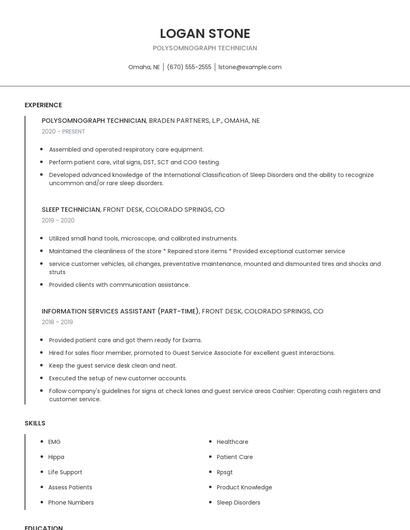
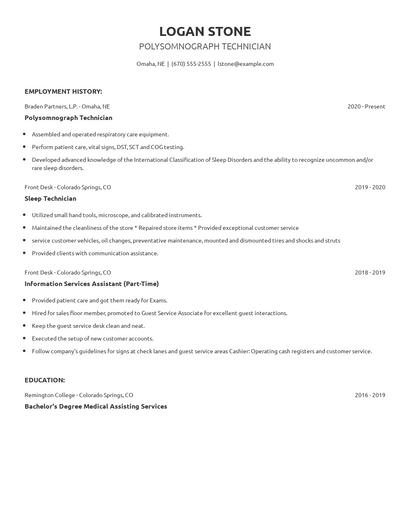
Choose from 10+ customizable polysomnograph technician resume templates
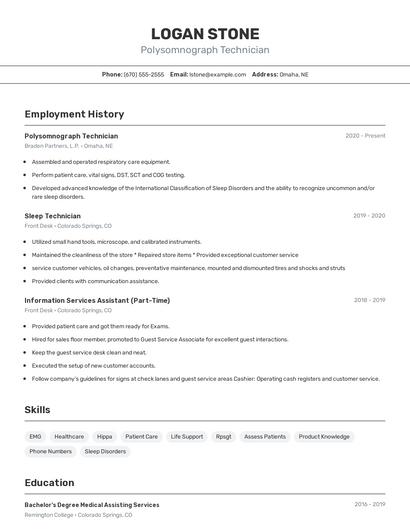
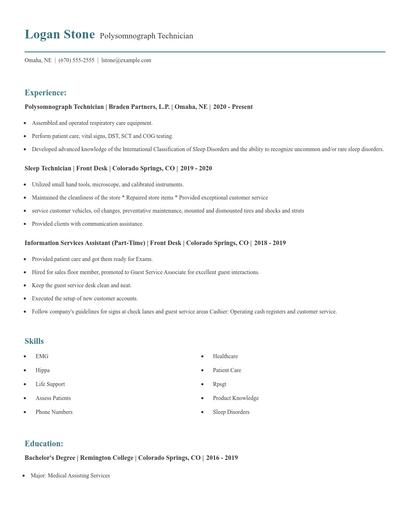
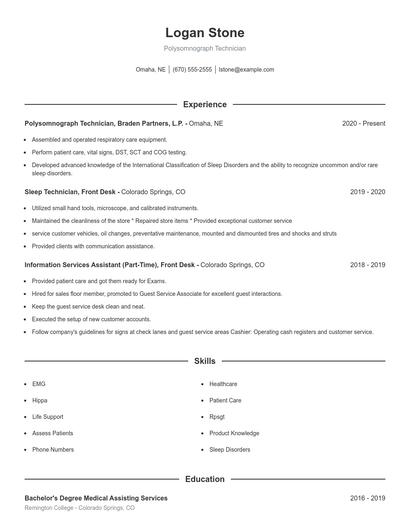
Build a professional polysomnograph technician resume in minutes. Our AI resume writing assistant will guide you through every step of the process, and you can choose from 10+ resume templates to create your polysomnograph technician resume.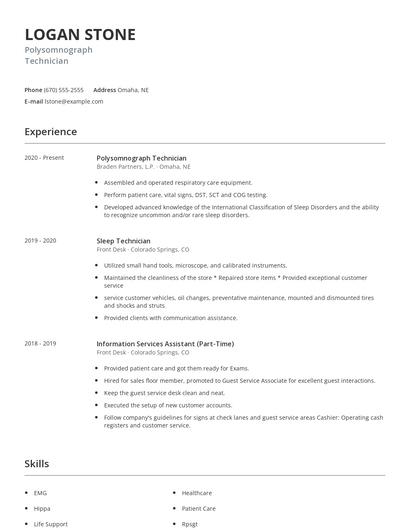



Compare different polysomnograph technicians
Polysomnograph technician vs. Perfusionist
A perfusionist is a healthcare expert who specializes in operating machinery that helps patients maintain blood flow during cardiac surgeries. As a member of a cardiothoracic surgical team, their duties also include monitoring the patient's vital signs, preparing cardiopulmonary bypass machines, meeting with team members before the surgery to identify the patient's needs, and developing strategies with the surgeons. Moreover, as a perfusionist, it is vital to maintain an active communication line with team members to ensure the surgery's success and the patients' safety.
These skill sets are where the common ground ends though. The responsibilities of a polysomnograph technician are more likely to require skills like "polysomnographic technologist," "rpsgt," "sleep studies," and "sleep disorders." On the other hand, a job as a perfusionist requires skills like "heart-lung machine," "ecmo," "life support," and "blood products." As you can see, what employees do in each career varies considerably.
Perfusionists tend to make the most money working in the health care industry, where they earn an average salary of $133,778. In contrast, polysomnograph technicians make the biggest average salary, $53,237, in the health care industry.On average, perfusionists reach higher levels of education than polysomnograph technicians. Perfusionists are 11.8% more likely to earn a Master's Degree and 1.6% less likely to graduate with a Doctoral Degree.Polysomnograph technician vs. Extracorporeal circulation specialist
In the medical industry, an EEG technician specializes in operating a non-invasive machine that helps medical experts to diagnose brain abnormalities. Also known as an electroencephalographic technician, their responsibilities include gathering and analyzing a patient's medical information, discussing the extent of procedures to patients, attaching device according to protocols, and assisting patients while helping them feel comfortable every step of the way. Moreover, an EEG technician is also responsible for maintaining supplies, arranging patient appointments, and submitting results to the physicians in a timely and efficient manner.
While some skills are similar in these professions, other skills aren't so similar. For example, resumes show us that polysomnograph technician responsibilities requires skills like "patients," "polysomnographic technologist," "rpsgt," and "sleep studies." But an extracorporeal circulation specialist might use other skills in their typical duties, such as, "library materials," "library services," "customer service," and "front desk."
In general, extracorporeal circulation specialists achieve similar levels of education than polysomnograph technicians. They're 0.7% more likely to obtain a Master's Degree while being 1.6% less likely to earn a Doctoral Degree.Polysomnograph technician vs. Renal dialysis technician
Some important key differences between the two careers include a few of the skills necessary to fulfill the responsibilities of each. Some examples from polysomnograph technician resumes include skills like "polysomnographic technologist," "rpsgt," "sleep studies," and "sleep disorders," whereas a renal dialysis technician is more likely to list skills in "direct supervision," "water systems," "blood samples," and "hemodialysis. "
Renal dialysis technicians typically earn similar educational levels compared to polysomnograph technicians. Specifically, they're 3.5% less likely to graduate with a Master's Degree, and 2.4% less likely to earn a Doctoral Degree.Polysomnograph technician vs. Eeg technician
Even though a few skill sets overlap between polysomnograph technicians and eeg technicians, there are some differences that are important to note. For one, a polysomnograph technician might have more use for skills like "polysomnographic technologist," "rpsgt," "sleep medicine," and "comprehensive evaluation." Meanwhile, some responsibilities of eeg technicians require skills like "healthcare," "neurodiagnostic," "eeg tech," and "epilepsy. "
Eeg technicians enjoy the best pay in the technology industry, with an average salary of $68,836. For comparison, polysomnograph technicians earn the highest salary in the health care industry.In general, eeg technicians hold similar degree levels compared to polysomnograph technicians. Eeg technicians are 1.3% more likely to earn their Master's Degree and 1.7% less likely to graduate with a Doctoral Degree.Types of polysomnograph technician
Updated January 8, 2025
