What does a preparator do?
Preparator responsibilities
Here are examples of responsibilities from real preparator resumes:
- Manage visual resource center, including acquisition, cataloging, budget management and other relevant issues.
- Assist in the creation and installation of MFA solo show
- Respond to all health and safety emergencies in the chemistry teaching labs.
- Assist in maintaining cleanliness of the several chemistry laboratories.
- Perform inventory, descriptive cataloging, and photography of archaeological and ethnographic object collections and preparation for display in digital environment.
- Develop the design of the online exhibit by coding in HTML, CSS and JavaScript.
- Degrease floors, warmers, ovens and steamers.
Preparator skills and personality traits
We calculated that 21% of Preparators are proficient in Exhibition Design, Hand Tools, and AV. They’re also known for soft skills such as Dexterity, Listening skills, and Physical strength.
We break down the percentage of Preparators that have these skills listed on their resume here:
- Exhibition Design, 21%
Visualize and execute exhibition design.
- Hand Tools, 14%
transfer and hang art using hand tools, power tools, scissor lifts and pallet jack.
- AV, 10%
Installed AV systems for students as necessary.
- Museum Exhibits, 7%
Design and installation of museum exhibits.
- Artifact, 6%
Designed and implemented comprehensive training programs focusing on artifact preservation and cleaning based on completed training course taken at Smithsonian.
- Museum Standards, 6%
Light artwork according to museum standards.
Most preparators use their skills in "exhibition design," "hand tools," and "av" to do their jobs. You can find more detail on essential preparator responsibilities here:
The three companies that hire the most preparators are:
- Silver Diner18 preparators jobs
- Rooms To Go12 preparators jobs
- CARE3 preparators jobs
Choose from 10+ customizable preparator resume templates
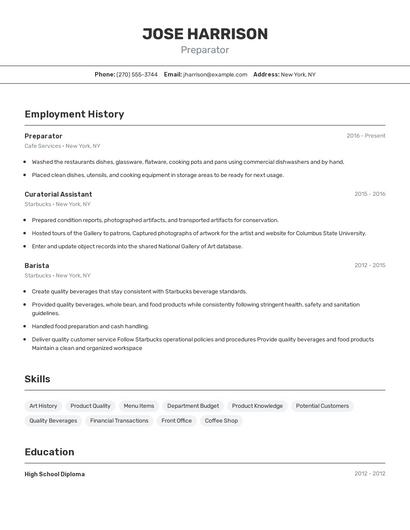
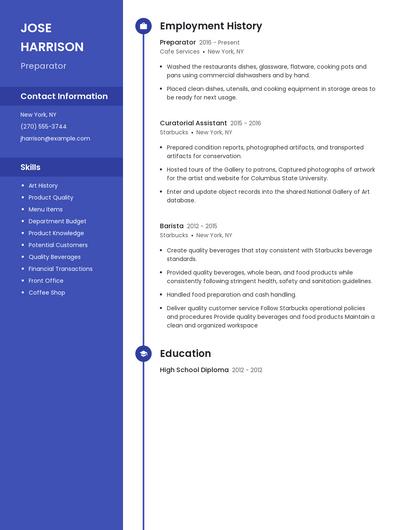
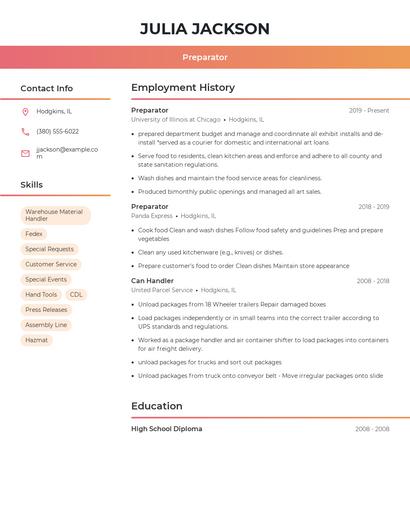
Build a professional preparator resume in minutes. Our AI resume writing assistant will guide you through every step of the process, and you can choose from 10+ resume templates to create your preparator resume.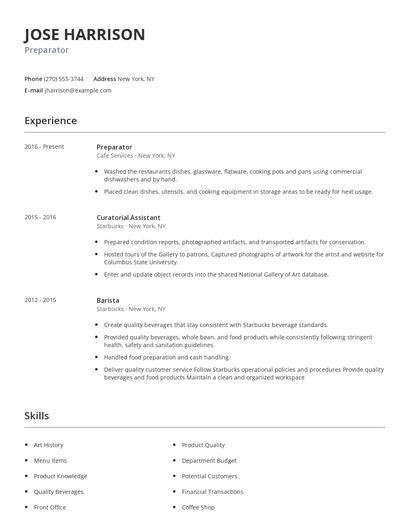
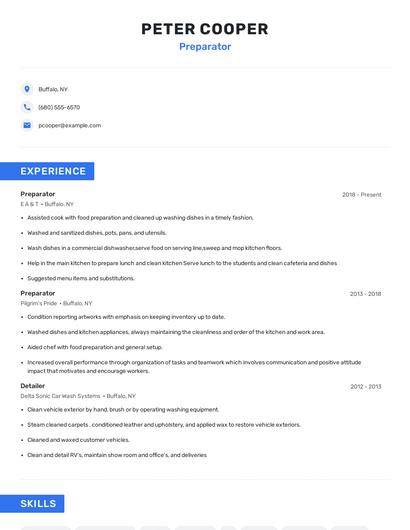
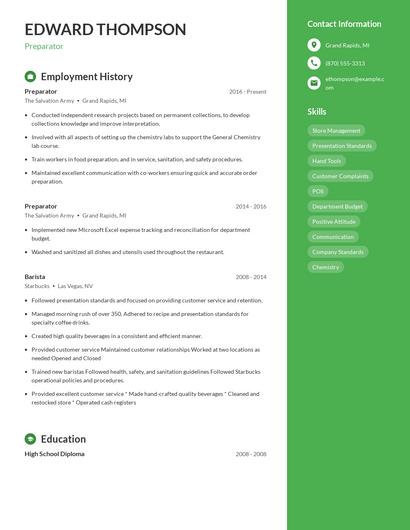
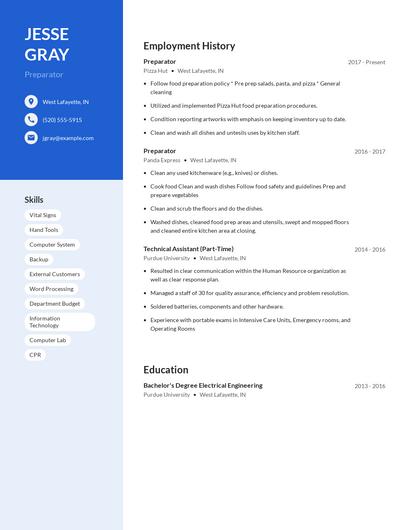
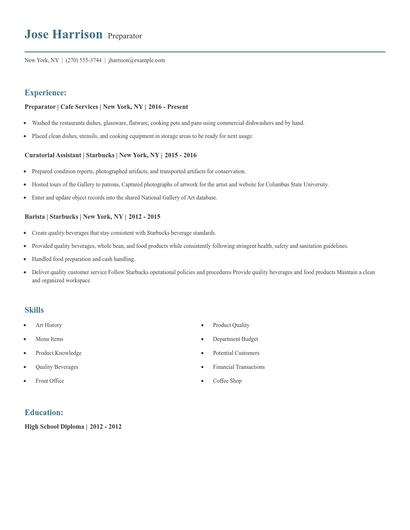
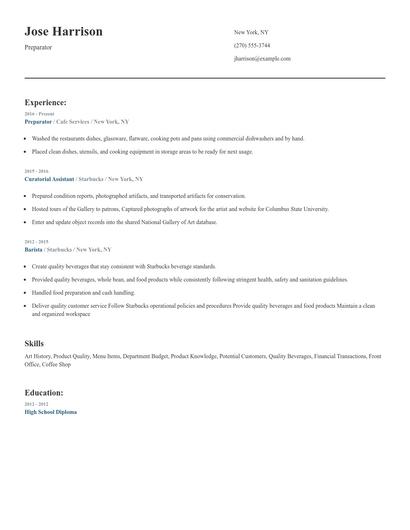
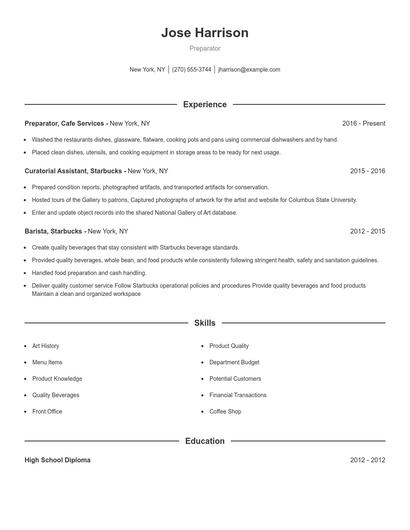
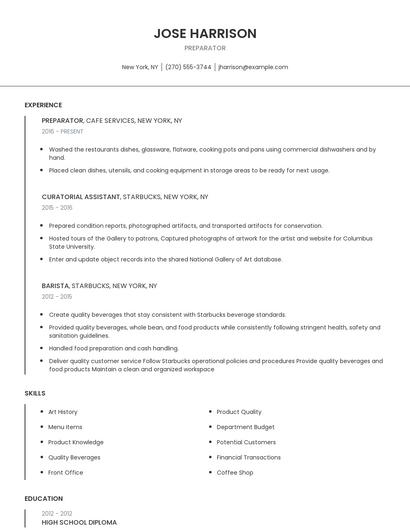
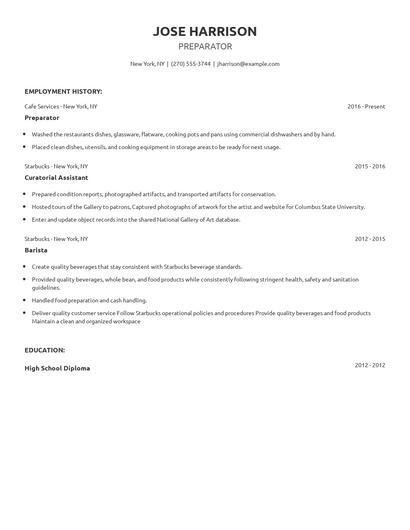
Compare different preparators
Preparator vs. Kitchen helper
Kitchen helpers perform various kitchen tasks in restaurants, schools, nursing homes, and hospitals. Their duties and responsibilities include assisting cooks in the preparation of meal ingredients, helping other staff with unloading food items from delivery trucks, and washing and drying the utensils, dishes, and cookware. Kitchen helpers are also responsible for removing and replacing garbage bags and storing ingredients and food supplies in compliance with food safety standards. The requirements for this position may include a high school diploma, a license in food handling, and knowledge of food safety standards.
There are some key differences in the responsibilities of each position. For example, preparator responsibilities require skills like "exhibition design," "hand tools," "av," and "museum exhibits." Meanwhile a typical kitchen helper has skills in areas such as "food handling," "food service," "wash dishes," and "cleanliness." This difference in skills reveals the differences in what each career does.
Kitchen helpers earn the highest salaries when working in the retail industry, with an average yearly salary of $27,239. On the other hand, preparators are paid more in the hospitality industry with an average salary of $56,708.kitchen helpers tend to reach lower levels of education than preparators. In fact, kitchen helpers are 12.9% less likely to graduate with a Master's Degree and 0.1% more likely to have a Doctoral Degree.Preparator vs. Seafood clerk
A seafood clerk is well-trained personnel who has a diverse knowledge of seafood and answers customer questions as well as advises them on the best product to buy depending on what they are looking for. They oversee almost all activities that take place between the time the product is ready for sale to the point where the customer is ready to purchase the product. Their duties and responsibilities include providing customer service and answering all questions related to the products in the market.
In addition to the difference in salary, there are some other key differences worth noting. For example, preparator responsibilities are more likely to require skills like "exhibition design," "hand tools," "av," and "museum exhibits." Meanwhile, a seafood clerk has duties that require skills in areas such as "food handling," "math," "basic math," and "pallets." These differences highlight just how different the day-to-day in each role looks.
On average, seafood clerks earn a lower salary than preparators. Some industries support higher salaries in each profession. Interestingly enough, seafood clerks earn the most pay in the retail industry with an average salary of $32,238. Whereas preparators have higher pay in the hospitality industry, with an average salary of $56,708.seafood clerks earn lower levels of education than preparators in general. They're 12.6% less likely to graduate with a Master's Degree and 0.1% more likely to earn a Doctoral Degree.Preparator vs. Kitchen aide
A deli clerk is responsible for providing healthy food recommendations to the customers, assisting them with their inquiries, and providing special offers. Deli clerks' duties include maintaining the highest sanitation procedures within the working area, updating the customers with the products' promotions, updating displays regularly, researching the latest market trends for product recommendations, and adhering to the company's safety standards and regulations. A deli clerk must have impeccable customer service and communication skills to ensure customer satisfaction while meeting the company's objectives and sales goals.
There are many key differences between these two careers, including some of the skills required to perform responsibilities within each role. For example, a preparator is likely to be skilled in "exhibition design," "hand tools," "av," and "museum exhibits," while a typical kitchen aide is skilled in "meal preparation," "cleanliness," "patients," and "food handling."
Kitchen aides make a very good living in the government industry with an average annual salary of $29,166. On the other hand, preparators are paid the highest salary in the hospitality industry, with average annual pay of $56,708.Most kitchen aides achieve a lower degree level compared to preparators. For example, they're 12.7% less likely to graduate with a Master's Degree, and 0.1% less likely to earn a Doctoral Degree.Preparator vs. Deli clerk
Even though a few skill sets overlap between preparators and deli clerks, there are some differences that are important to note. For one, a preparator might have more use for skills like "exhibition design," "hand tools," "av," and "museum exhibits." Meanwhile, some responsibilities of deli clerks require skills like "help support," "basic math," "excellent guest," and "slicers. "
In general, deli clerks earn the most working in the retail industry, with an average salary of $31,678. The highest-paying industry for a preparator is the hospitality industry.In general, deli clerks hold lower degree levels compared to preparators. Deli clerks are 12.7% less likely to earn their Master's Degree and 0.1% more likely to graduate with a Doctoral Degree.Types of preparator
Updated January 8, 2025
