What does a principal mechanical engineer do?
A principal mechanical engineer is responsible for managing and maintaining the company's machinery, designing equipment that would support the business functions and operations efficiently, and inspecting tools for production processes. Principal mechanical engineers assist the work of junior engineers in manufacturing operations and resolving issues and tickets. They also conduct quality check procedures for the outputs, identify areas of improvement, and identify opportunities that would help the business grow more revenues and increase the company's profitability.
Principal mechanical engineer responsibilities
Here are examples of responsibilities from real principal mechanical engineer resumes:
- Used SolidWorks to design implantable leads, anchors, introductory devices and other accessories.
- Manage and drive continuous improvement programs (CIP) of RF plasma ion immersion implanting equipment for the semiconductor industry.
- Provide mechanical design and sustaining engineering expertise to troubleshoot manufacturing defect trends and achieve a more robust and producible product.
- Used Matlab to compare results and gather data.
- Perform stress analysis and strength calculations using FEA and 1st principals.
- Used actual measurements to validate FEA model of complete fuel cell system.
- Work with in house manufacturing using Edgecam to develop tool paths from cad models.
- Design prototypes of noninvasive cardiologic and body fluid monitoring devices for the DOD and hospitals.
- Conduct failure investigations to determine root cause and corrective action (RCCA) for RF hardware.
- Complete major SolidWorks 3D-redesign project of an entire 12U (21"high) rack-mount card-cage chassis.
- Upgrade lathe and mill to cnc with surplus stepper motors, motor driver kits and freeware cnc program.
- Design UL list smoke detectors, fire notification appliances (horns, speakers, strobes) and fire alarm control panels.
- Design, develop, programme (PLC), implement & train personnel in the use of custom automate manufacturing equipment.
- Produce thermo-mechanical modeling/analysis of a solid-state diamond-cool laser using ANSYS code.
- Perform QA inspections during building construction to protect developer's ownership interest.
Principal mechanical engineer skills and personality traits
We calculated that 13% of Principal Mechanical Engineers are proficient in Mechanical Engineering, CAD, and Mechanical Design. They’re also known for soft skills such as Creativity, Listening skills, and Math skills.
We break down the percentage of Principal Mechanical Engineers that have these skills listed on their resume here:
- Mechanical Engineering, 13%
Complete mechanical engineering responsibility in developing a small seven-axis robot to be used in the assembly of power supply modules.
- CAD, 9%
Directed CAD database structure and management and implemented Pro/PDM Product Database Management computer software.
- Mechanical Design, 6%
Lead mechanical engineer responsible for mechanical designs and printed circuit board designs for space and military electronics.
- Creo, 5%
Developed a self-taught fundamental knowledge of Creo
- DOD, 5%
Received a letter of commendation for exceptional service from a classified DoD Program Office (2011).
- Solidworks, 5%
Perform structural design and analysis calculations through engineering formulas using governing codes, standards and SolidWorks Simulation.
"mechanical engineering," "cad," and "mechanical design" are among the most common skills that principal mechanical engineers use at work. You can find even more principal mechanical engineer responsibilities below, including:
Creativity. To carry out their duties, the most important skill for a principal mechanical engineer to have is creativity. Their role and responsibilities require that "mechanical engineers design and build complex pieces of equipment and machinery." Principal mechanical engineers often use creativity in their day-to-day job, as shown by this real resume: "implemented creative idea for a two pcb assembly with a plug and play integrated power connection scheme. "
Listening skills. Another soft skill that's essential for fulfilling principal mechanical engineer duties is listening skills. The role rewards competence in this skill because "mechanical engineers often work on projects with others, such as architects and computer scientists." According to a principal mechanical engineer resume, here's how principal mechanical engineers can utilize listening skills in their job responsibilities: "completed documentation for system designs and processes and presented and communicated specifications to engineering departments, peers, and upper management. "
Math skills. Another skill that relates to the job responsibilities of principal mechanical engineers is math skills. This skill is critical to many everyday principal mechanical engineer duties, as "mechanical engineers use the principles of calculus, statistics, and other advanced subjects in math for analysis, design, and troubleshooting in their work." This example from a resume shows how this skill is used: "developed cad automation methods for modeling turbine blade geometry. "
Mechanical skills. principal mechanical engineer responsibilities often require "mechanical skills." The duties that rely on this skill are shown by the fact that "mechanical skills allow engineers to apply basic engineering concepts and mechanical processes to the design of new devices and systems." This resume example shows what principal mechanical engineers do with mechanical skills on a typical day: "lead mechanical engineer for new laser, ir, and vis sensor product development under irad and crad. "
Problem-solving skills. A commonly-found skill in principal mechanical engineer job descriptions, "problem-solving skills" is essential to what principal mechanical engineers do. Principal mechanical engineer responsibilities rely on this skill because "mechanical engineers need good problem-solving skills to take scientific principles and discoveries and use them to design and build useful products." You can also see how principal mechanical engineer duties rely on problem-solving skills in this resume example: "optimized thermal solutions with cfd tools (flotherm) and wind tunnels. "
The three companies that hire the most principal mechanical engineers are:
- Northrop Grumman84 principal mechanical engineers jobs
- Microsoft24 principal mechanical engineers jobs
- Raytheon Technologies21 principal mechanical engineers jobs
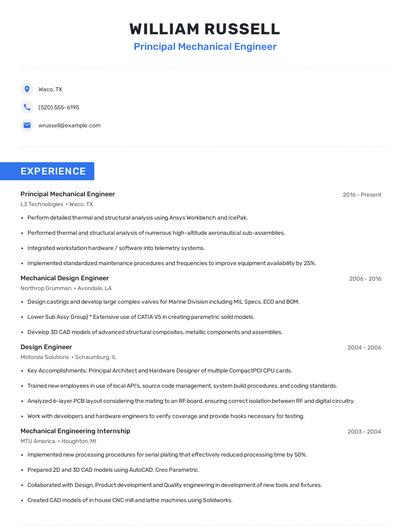
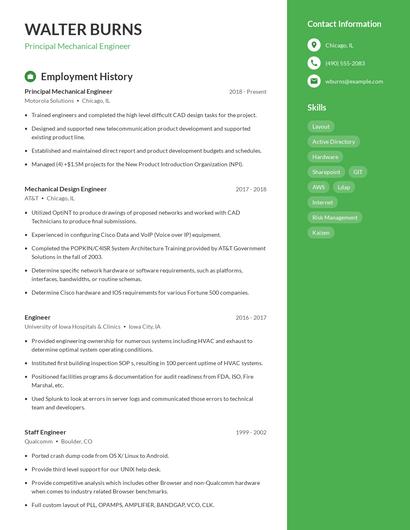
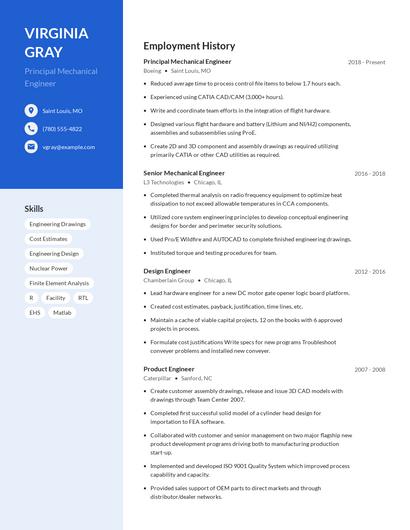
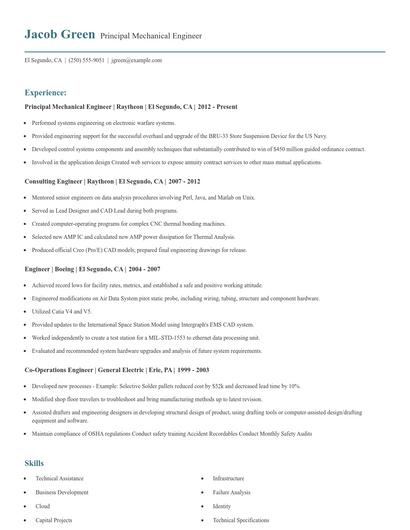
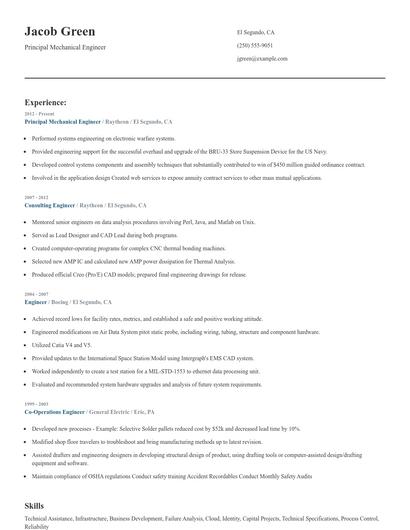
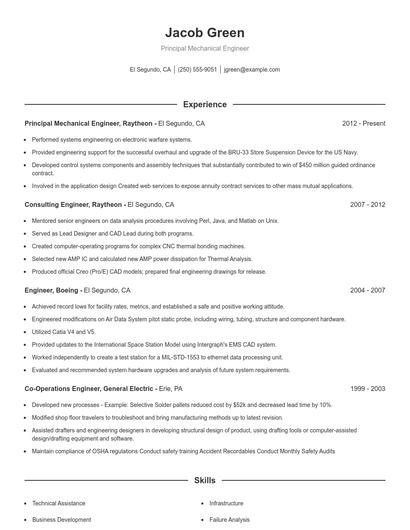
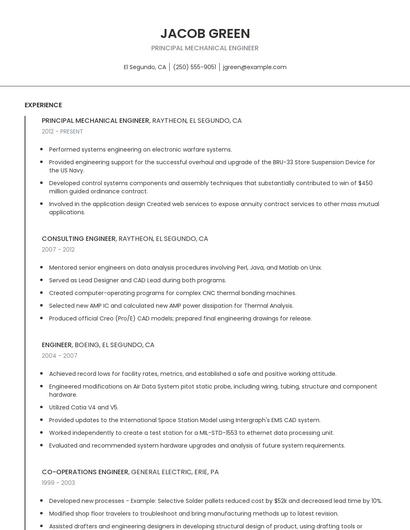
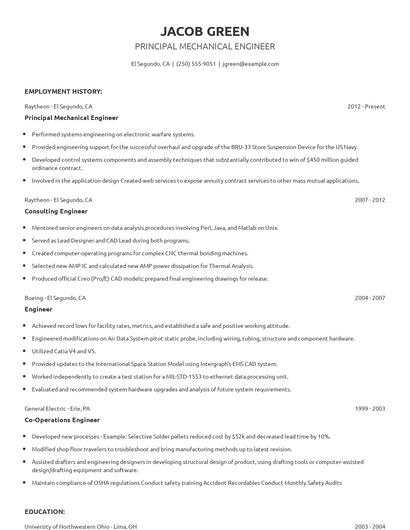
Choose from 10+ customizable principal mechanical engineer resume templates
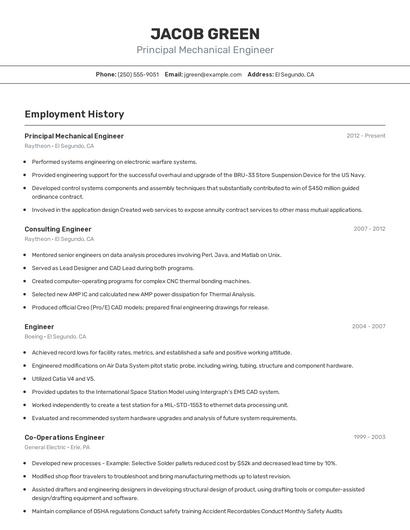
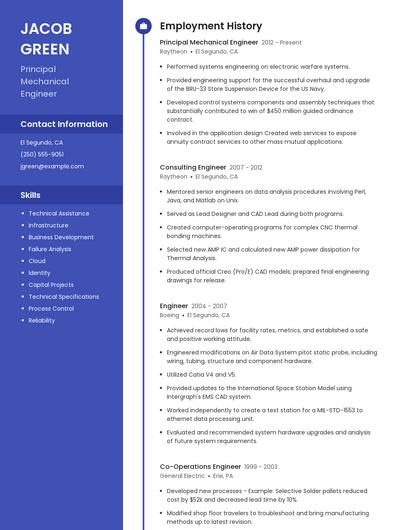
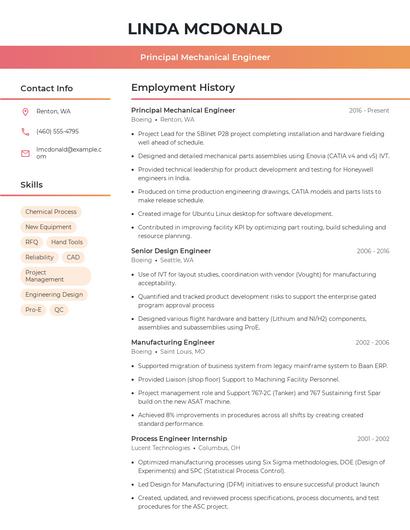
Build a professional principal mechanical engineer resume in minutes. Our AI resume writing assistant will guide you through every step of the process, and you can choose from 10+ resume templates to create your principal mechanical engineer resume.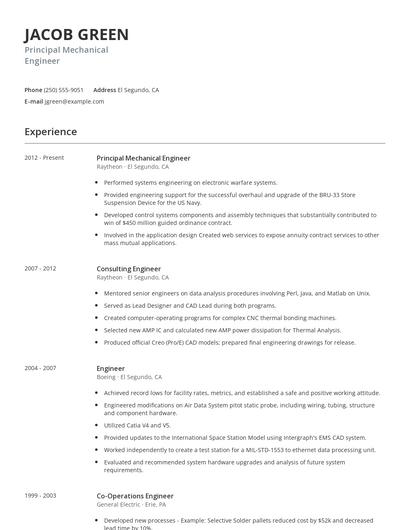
Compare different principal mechanical engineers
Principal mechanical engineer vs. Engineer
Engineers are highly trained professionals who determine the feasibility of various projects, usually related to the construction industry. They are considered experts in mathematics and science, two disciplines that they need to use in designing and coming up with plans for projects. They should also be well-versed in different construction or industrial materials, and they ensure that appropriate materials are used for the project. They also ensure that the projects meet the requirements of the groups that hired them. They create spaces that would both address the needs of the end-users and the industry standards. They also ensure that the projects they make would stand the test of time.
While similarities exist, there are also some differences between principal mechanical engineers and engineer. For instance, principal mechanical engineer responsibilities require skills such as "mechanical engineering," "mechanical design," "creo," and "dod." Whereas a engineer is skilled in "python," "cloud," "c++," and "c #." This is part of what separates the two careers.
Engineers earn the highest salaries when working in the automotive industry, with an average yearly salary of $97,672. On the other hand, principal mechanical engineers are paid more in the professional industry with an average salary of $111,820.engineers tend to reach similar levels of education than principal mechanical engineers. In fact, engineers are 4.9% less likely to graduate with a Master's Degree and 2.8% less likely to have a Doctoral Degree.Principal mechanical engineer vs. Lead design engineer
A Lead Design Engineer produces design solutions that can be purchased, installed, and commissioned effectively. They are also responsible for the cost-effectiviness and safety of new designs.
Each career also uses different skills, according to real principal mechanical engineer resumes. While principal mechanical engineer responsibilities can utilize skills like "mechanical engineering," "creo," "dod," and "mechanical systems," lead design engineers use skills like "system design," "matlab," "sigma," and "asic."
On average, lead design engineers earn a higher salary than principal mechanical engineers. Some industries support higher salaries in each profession. Interestingly enough, lead design engineers earn the most pay in the agriculture industry with an average salary of $112,898. Whereas principal mechanical engineers have higher pay in the professional industry, with an average salary of $111,820.lead design engineers earn similar levels of education than principal mechanical engineers in general. They're 4.7% less likely to graduate with a Master's Degree and 2.8% less likely to earn a Doctoral Degree.What technology do you think will become more important and prevalent for principal mechanical engineers in the next 3-5 years?
Dr. Sridhar Santhanam Ph.D.
Professor and Chair, Villanova University
Principal mechanical engineer vs. Staff engineer
Staff engineers are responsible for designing, developing, and inspecting various products, equipment, or structures. These professionals may perform varied duties depending on their specialization that includes overseeing the design and construction of buildings, bridges, sewer systems, and other infrastructure, estimating the financial costs of construction projects, and ensuring compliance with health and safety laws and regulations. Other duties include designing and developing machinery, tools, and engines, solving design problems, and building the manufacturing equipment needed to create their products.
The required skills of the two careers differ considerably. For example, principal mechanical engineers are more likely to have skills like "mechanical engineering," "mechanical design," "creo," and "dod." But a staff engineer is more likely to have skills like "java," "python," "architecture," and "software development."
Staff engineers make a very good living in the telecommunication industry with an average annual salary of $119,079. On the other hand, principal mechanical engineers are paid the highest salary in the professional industry, with average annual pay of $111,820.staff engineers typically earn similar educational levels compared to principal mechanical engineers. Specifically, they're 1.9% less likely to graduate with a Master's Degree, and 0.7% less likely to earn a Doctoral Degree.Principal mechanical engineer vs. Tool engineer
A tooling engineer is responsible for creating and adjusting tools or parts for cars, heavy equipment, and other products that need customized or personalized components. Your duties and responsibilities will include creating design blueprints, using computer-aided (CAD) software to develop two- and three-dimensional prints, and validating and evaluating products. As a tooling engineer, it is your responsibility to ensure compliance with operational standards such as the ISO 9000. You also have to provide technical assistance to manufacturing personnel and quality assurance.
Even though a few skill sets overlap between principal mechanical engineers and tool engineers, there are some differences that are important to note. For one, a principal mechanical engineer might have more use for skills like "mechanical engineering," "mechanical design," "creo," and "dod." Meanwhile, some responsibilities of tool engineers require skills like "python," "java," "linux," and "jenkins. "
Tool engineers enjoy the best pay in the technology industry, with an average salary of $94,406. For comparison, principal mechanical engineers earn the highest salary in the professional industry.In general, tool engineers hold lower degree levels compared to principal mechanical engineers. Tool engineers are 10.0% less likely to earn their Master's Degree and 3.8% less likely to graduate with a Doctoral Degree.Types of principal mechanical engineer
Updated January 8, 2025
