What does a process associate do?
Process Associates are responsible for maintaining, monitoring, and improving the production processes for manufacturing organizations. They are responsible for inspecting existing processes to guide system upgrades, servicing production equipment, maintaining supplies and inventory, and adhering to safety and quality regulations for production processes. Process associates also write production process reports and help to troubleshoot issues pertinent to processes. They must be detailed oriented and possess technical knowledge of mechanical processes. A goof process associate will maintain the smooth running to achieve cost reduction and production rate improvement.
Process associate responsibilities
Here are examples of responsibilities from real process associate resumes:
- Manage large scale MVS/ESA, VM & UNIX computer systems.
- Manage all aspects of the shipping dock, including TDR, truck arrival/departure scheduling, and associate dock assignments.
- Manage and operate departmental HPLC equipment.
- Manage distillation process to determine product specification compliance, and prepare unit for shutdown or turnaround process.
- Design layouts on the front-end using JavaScript, HTML, and CSS.
- Manufacture sterile commercial human blood therapeutics in an ISO 5 clean room within BSC per FDA requirements.
- Require great attention to detail, math skills, safety, cleanliness and ensuring ingredients are properly mix.
- Used calipers, micrometers, gauges, and OGP machines to monitor quality in production of stamp metal parts.
- Certify with organization as a server administrator in linux and windows operating servers.
- Used JavaScript for client-side validation.
- Process and monitor a UNIX application.
- Process print files using AS400 program.
- Encode checks in a numeric order.
- Conduct audits on all departments in FC.
- Operate Opex document capture and mail extraction machine.
Process associate skills and personality traits
We calculated that 17% of Process Associates are proficient in Patients, Customer Service, and Extraction. They’re also known for soft skills such as Computer skills, Integrity, and Detail oriented.
We break down the percentage of Process Associates that have these skills listed on their resume here:
- Patients, 17%
Contacted patients via telephone regarding delinquent balances; reviewed and referred accounts for outside collection activity.
- Customer Service, 9%
Provided customer service while ensuring products were continually stocked, replenished and merchandised while monitoring asset protection.
- Extraction, 8%
Operated an automated extraction machine.
- Business Process, 8%
Executed and documented audit procedures related to business process controls including automated application controls for 404 SOX and financial audit purposes.
- Data Entry, 8%
Position provided general support functions including documentation preparation and data entry of international trade transactions for a global logistics company.
- HR, 7%
Scheduled travel itinerary for HR specialists and scheduled their appointments.
"patients," "customer service," and "extraction" are among the most common skills that process associates use at work. You can find even more process associate responsibilities below, including:
Computer skills. One of the key soft skills for a process associate to have is computer skills. You can see how this relates to what process associates do because "bookkeeping, accounting, and auditing clerks need to be comfortable using computer spreadsheets and bookkeeping software." Additionally, a process associate resume shows how process associates use computer skills: "read and interpret insurance documents in order to perform data entry to a proprietary computer system. "
Integrity. Many process associate duties rely on integrity. "bookkeeping, accounting, and auditing clerks have control of an organization’s financial documentation, which they must use properly and keep confidential," so a process associate will need this skill often in their role. This resume example is just one of many ways process associate responsibilities rely on integrity: "repair trust, locate resources for problem resolution and design best option solutions. "
Detail oriented. process associates are also known for detail oriented, which are critical to their duties. You can see how this skill relates to process associate responsibilities, because "bookkeeping, accounting, and auditing clerks are responsible for producing accurate financial records." A process associate resume example shows how detail oriented is used in the workplace: "detailed numeric and alphanumeric data entry of all packages to identify appropriate destination. "
Math skills. process associate responsibilities often require "math skills." The duties that rely on this skill are shown by the fact that "bookkeeping, accounting, and auditing clerks deal with numbers daily and should be comfortable with basic arithmetic." This resume example shows what process associates do with math skills on a typical day: "required great attention to detail, math skills, safety, cleanliness and ensuring ingredients were properly mixed. "
The three companies that hire the most process associates are:
- Evoqua Water Technologies91 process associates jobs
- Conduent71 process associates jobs
- Black & Veatch50 process associates jobs
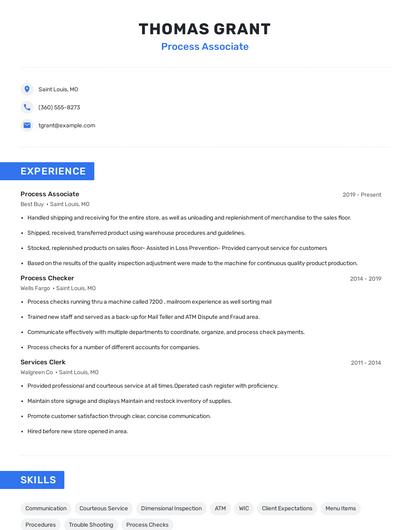
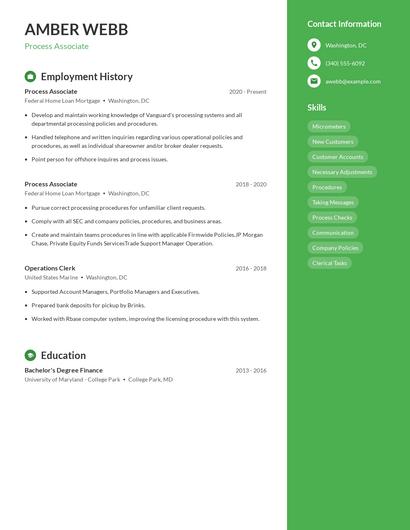
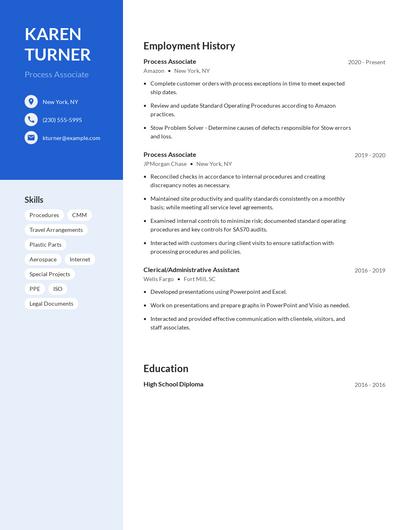
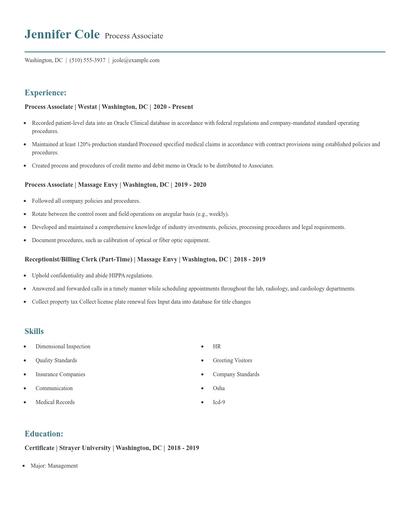
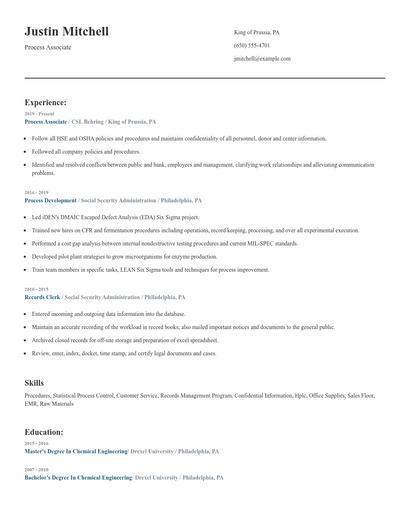
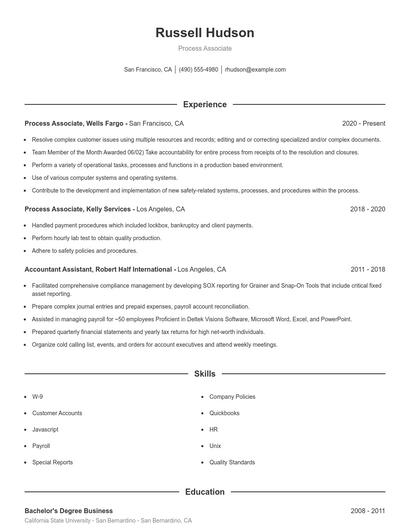
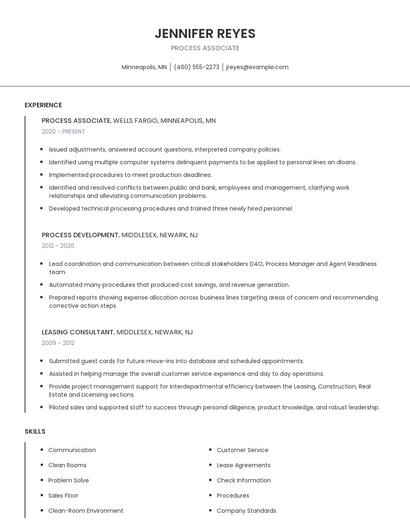
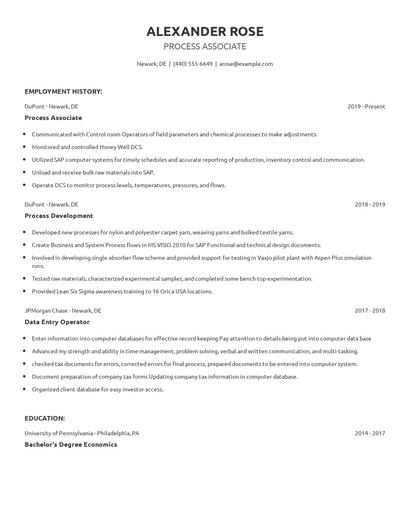
Choose from 10+ customizable process associate resume templates
Build a professional process associate resume in minutes. Our AI resume writing assistant will guide you through every step of the process, and you can choose from 10+ resume templates to create your process associate resume.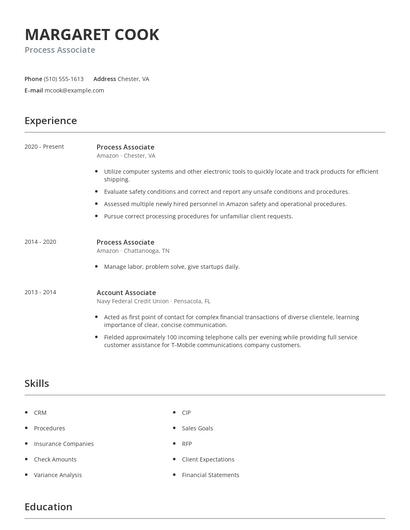
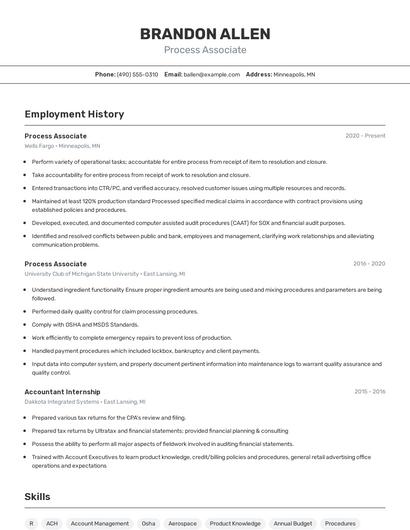
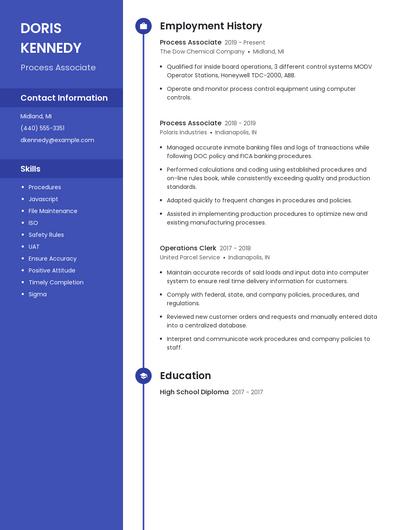
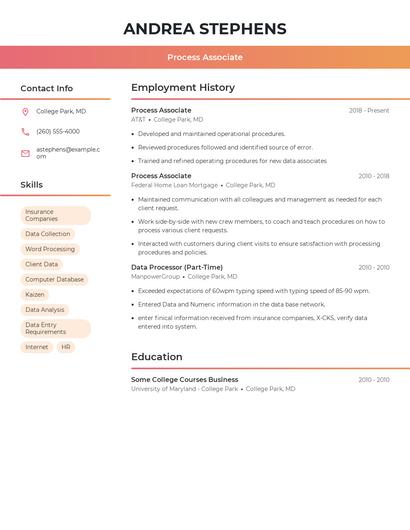
Compare different process associates
Process associate vs. Accountable clerk
The duties of an accountable clerk vary in one's industry of employment. Typically, their responsibilities revolve around overseeing the financial aspects of a company, including revenue and budget. They mostly process payments and income, ensuring accuracy in every detail and transaction. An accountable clerk may also have clerical tasks such as producing progress reports, answering calls and correspondence, coordinating with various department personnel, and maintaining a database of information. Should there be any issues, it is essential to report to a manager right away.
There are some key differences in the responsibilities of each position. For example, process associate responsibilities require skills like "patients," "extraction," "business process," and "sales floor." Meanwhile a typical accountable clerk has skills in areas such as "financial reports," "purchase orders," "process payroll," and "office equipment." This difference in skills reveals the differences in what each career does.
On average, accountable clerks reach similar levels of education than process associates. Accountable clerks are 4.8% less likely to earn a Master's Degree and 0.1% more likely to graduate with a Doctoral Degree.Process associate vs. Accounting clerk
Accounting clerks are employees assigned to manage administrative and clerical tasks in the accounting department. Accounting clerks handle office accounting records and ensure that files are properly labeled and stored. They validate records and check whether these are updated. They also sort through documents to ensure that they are in their proper storage bins. Aside from document handling, they also help with creating and validating financial statements and bookkeeping. As such, accounting clerks should have a strong background in accounting to manage their tasks better.
Each career also uses different skills, according to real process associate resumes. While process associate responsibilities can utilize skills like "patients," "extraction," "business process," and "sales floor," accounting clerks use skills like "purchase orders," "reconciliations," "vendor invoices," and "quickbooks."
Average education levels between the two professions vary. Accounting clerks tend to reach similar levels of education than process associates. In fact, they're 4.1% less likely to graduate with a Master's Degree and 0.1% less likely to earn a Doctoral Degree.Process associate vs. Bookkeeper
Bookkeepers are employees who are in charge of the company's general ledger. They are well-versed in basic accounting principles, and they apply these in their work. Bookkeepers manage the entry of items in the general ledger, assign items into their proper categories, and ensure that the entries are balanced. They also act as auditors by checking the accuracy and veracity of the receipts or vouchers in their possession before entering them into the system. Bookkeepers ensure that their files are up to date and free of errors.
There are many key differences between these two careers, including some of the skills required to perform responsibilities within each role. For example, a process associate is likely to be skilled in "patients," "extraction," "business process," and "sales floor," while a typical bookkeeper is skilled in "payroll tax returns," "reconciliations," "journal entries," and "general ledger accounts."
Bookkeepers typically earn similar educational levels compared to process associates. Specifically, they're 4.1% less likely to graduate with a Master's Degree, and 0.0% less likely to earn a Doctoral Degree.Process associate vs. Accounting internship
An accounting internship is a trainee who reports to an organization's accountant in order to learn about the accounting field, complete financial projects and files taxes, and financial reports. An intern should be a graduate of a Bachelor's or Master's in Accounting and should have an aptitude for mathematics and proficiency with computers. In order to prepare financial reports, an intern should possess knowledge with bookkeeping software. An intern must also know how to handle sensitive information with honesty and integrity.
Types of process associate
Updated January 8, 2025
