What does a process development director do?
The process development director is someone who creates and develops new manufacturing processes for the workplace. The goal of the process development director is to look into different methods of producing goods and services for the company. The aim is to be as efficient as possible and to avoid excess spending on inefficient practices. The process development director also works with management to assess current manufacturing processes and determine whether upgrades are necessary.
Process development director responsibilities
Here are examples of responsibilities from real process development director resumes:
- Manage electronics, software and mechanical engineers responsible for the development of the electromechanical system and disposable treatment catheters.
- Provide regulatory submissions for FDA, CMC section.
- Write and maintain unit policies per AORN and AAMI standards.
- Set up a new QC lab and library of standard products.
- Develop and conduct team building exercises to improve relations between the SPD departments and nursing.
- Develop process flow charts and trending database to analyze the efficiency of operations and streamline SPD departmental processes.
- Implement QC into manufacturing processes.
- Conduct development activities under ISO design control guidelines where applicable.
- Coordinate and execute protocol-driven studies and their statistical analysis to support GMP process changes.
- Provide oversight and direction on domestic and international projects impacting commercial markets, including conducting competitive assessments base on project results.
- Monitor and measure success and effectiveness of training and development initiatives via eLearning platform.
Process development director skills and personality traits
We calculated that 9% of Process Development Directors are proficient in Project Management, Lean Six Sigma, and Continuous Improvement. They’re also known for soft skills such as Business skills, Collaboration skills, and Instructional skills.
We break down the percentage of Process Development Directors that have these skills listed on their resume here:
- Project Management, 9%
Established and branded Corporate Enterprise Process Excellence Office encompassing Lean Six Sigma Process Improvement Methodology - DMAIC and Project Management governance.
- Lean Six Sigma, 8%
Author and Trainer of Lean Six Sigma Training Materials for Green, Black & Blue Belts (Project Sponsor) certification.
- Continuous Improvement, 7%
Coordinate with key functions to monitor critical KPI's/metrics, develop a project pipeline and promote an enterprise-focused continuous improvement culture.
- Process Improvement, 6%
Managed a staff of project managers and business analysts responsible for a portfolio of automation and technology-driven process improvement projects.
- GMP, 6%
Coordinated and executed protocol-driven studies and their statistical analysis to support GMP process changes.
- Sigma, 4%
Managed the day-to-day activities of eight (8) direct reports including Call Center Representatives and Six Sigma Black Belt Professionals.
Most process development directors use their skills in "project management," "lean six sigma," and "continuous improvement" to do their jobs. You can find more detail on essential process development director responsibilities here:
Business skills. To carry out their duties, the most important skill for a process development director to have is business skills. Their role and responsibilities require that "training and development managers must understand business operations in order to match training with business goals." Process development directors often use business skills in their day-to-day job, as shown by this real resume: "coordinated with department heads and executive management to define and document business processes to iso 9000 standards"
Collaboration skills. Another soft skill that's essential for fulfilling process development director duties is collaboration skills. The role rewards competence in this skill because "training and development managers need strong interpersonal skills because delivering training programs requires working in concert with staff, trainees, subject matter experts, and the organization’s leaders." According to a process development director resume, here's how process development directors can utilize collaboration skills in their job responsibilities: "restructured department, centralizing account oversight to facilitate collaboration, identify opportunities for account growth, and drive platform adoption. "
Instructional skills. This is an important skill for process development directors to perform their duties. For an example of how process development director responsibilities depend on this skill, consider that "training and development managers need to understand the fundamentals of teaching and lesson planning." This excerpt from a resume also shows how vital it is to everyday roles and responsibilities of a process development director: "established organizational policies and objectives, to include strategic direction, compliance, faculty development, and instructional design/delivery. ".
Leadership skills. A big part of what process development directors do relies on "leadership skills." You can see how essential it is to process development director responsibilities because "managers are often in charge of a staff and programs." Here's an example of how this skill is used from a resume that represents typical process development director tasks: "selected for membership to 3m sterilization leadership & advisory council for advanced knowledge in spd procedures. "
Communication skills. Another common skill required for process development director responsibilities is "communication skills." This skill comes up in the duties of process development directors all the time, as "training and development managers must clearly convey information to diverse audiences." An excerpt from a real process development director resume shows how this skill is central to what a process development director does: "managed a staff of 27 in computer operations, data communications, programming and technical support. "
The three companies that hire the most process development directors are:
- Estée Lauder6 process development directors jobs
- Grant Thornton4 process development directors jobs
- Visa3 process development directors jobs
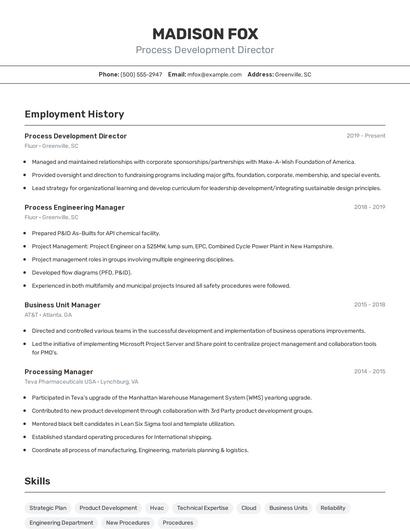
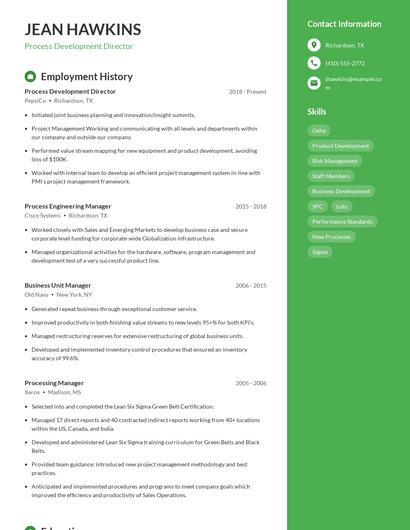
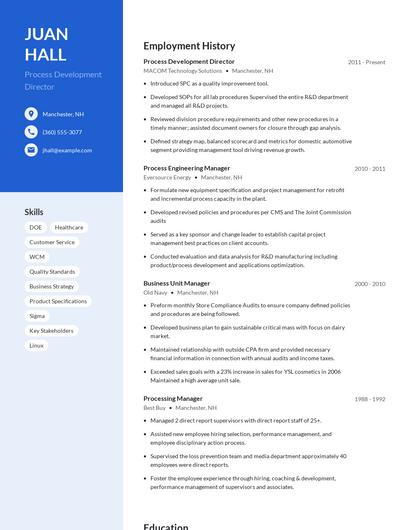
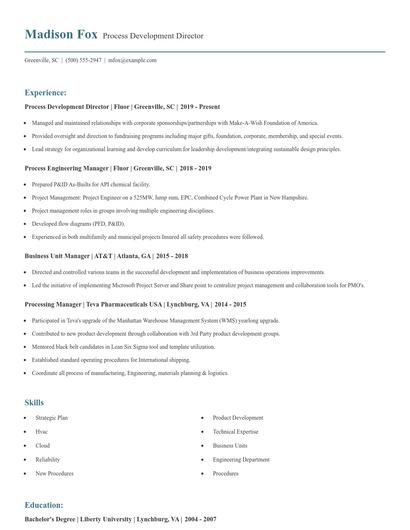
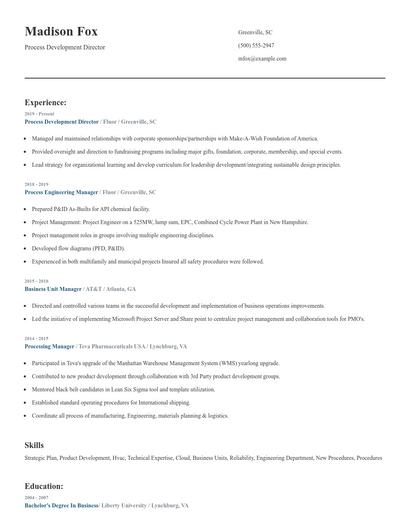
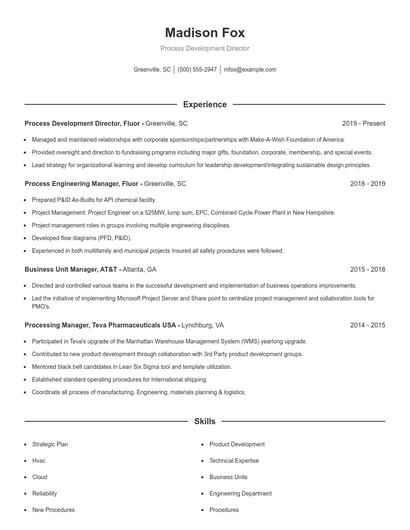
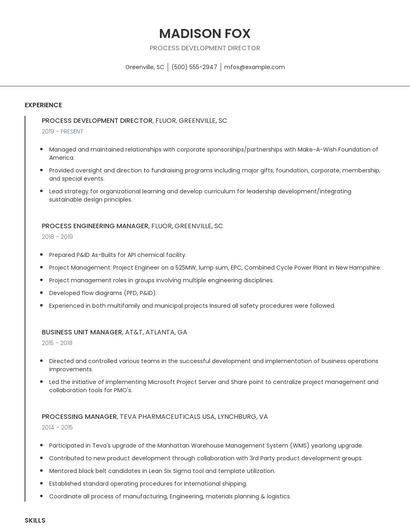
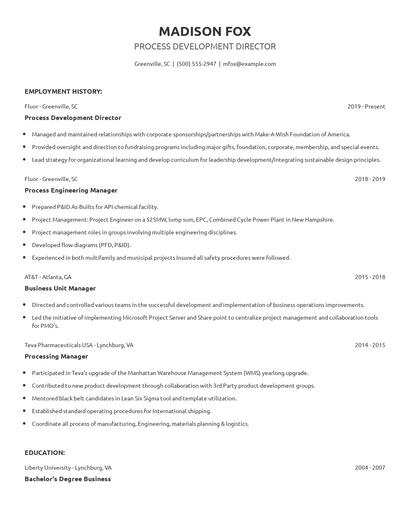
Choose from 10+ customizable process development director resume templates
Build a professional process development director resume in minutes. Our AI resume writing assistant will guide you through every step of the process, and you can choose from 10+ resume templates to create your process development director resume.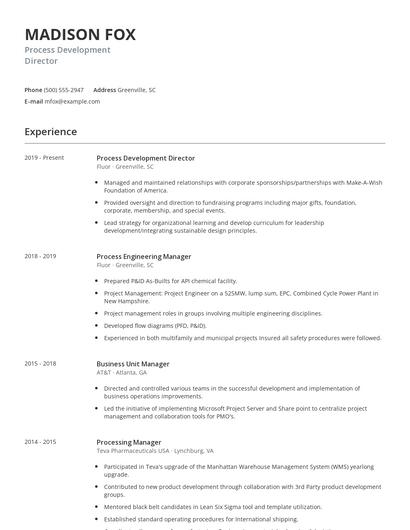


Compare different process development directors
Process development director vs. Educational manager
An educational manager is responsible for organizing educational strategies and managing learning resources, following the standard curriculum and guidelines. They coordinate with instructors and other educational institutions to develop teaching practices and adjust curriculum objectives as needed. Educational managers also handle department budgets, allocating adequate resources and materials to support students' learning and activities. An educational manager must have excellent knowledge of the teaching strategies, as well as educational disciplines, to handle concerns related to educational objectives.
There are some key differences in the responsibilities of each position. For example, process development director responsibilities require skills like "lean six sigma," "continuous improvement," "process improvement," and "gmp." Meanwhile a typical educational manager has skills in areas such as "patients," "education programs," "professional development," and "patient care." This difference in skills reveals the differences in what each career does.
Educational managers tend to make the most money working in the manufacturing industry, where they earn an average salary of $105,157. In contrast, process development directors make the biggest average salary, $163,422, in the professional industry.The education levels that educational managers earn slightly differ from process development directors. In particular, educational managers are 4.2% more likely to graduate with a Master's Degree than a process development director. Additionally, they're 5.5% less likely to earn a Doctoral Degree.Process development director vs. Hse manager
A health, safety, and environmental (HSE) manager is primarily in charge of spearheading and overseeing a company's health and safety programs. Their responsibilities typically revolve around coordinating with different departments to gather data, assessing existing programs and policies to identify areas needing improvement, implementing solutions on issues and concerns, developing strategies to execute programs, and creating new safety policies as necessary. Furthermore, as an HSE manager, it is essential to lead and encourage team members to reach goals, all while enforcing the company's policies and regulations.
While some skills are similar in these professions, other skills aren't so similar. For example, resumes show us that process development director responsibilities requires skills like "lean six sigma," "process improvement," "gmp," and "sigma." But an hse manager might use other skills in their typical duties, such as, "regulatory agencies," "osha," "environmental regulations," and "safety program."
Hse managers may earn a lower salary than process development directors, but hse managers earn the most pay in the construction industry with an average salary of $105,683. On the other hand, process development directors receive higher pay in the professional industry, where they earn an average salary of $163,422.hse managers earn similar levels of education than process development directors in general. They're 3.9% less likely to graduate with a Master's Degree and 5.5% less likely to earn a Doctoral Degree.Process development director vs. Regional training manager
A regional training manager focuses on improving and upskilling employees of a company located in different regions. The regional training manager works with employees, provides assessments, evaluations, and determinations on what areas need improvement and development. It is also the regional training manager's job to conduct inspections of employees for improvements in their skills after training. The regional training manager is needed to fine-tune the training method better to fit certain regions, especially concerning cultural, regional, and ethnic factors that need to be considered.
The required skills of the two careers differ considerably. For example, process development directors are more likely to have skills like "project management," "lean six sigma," "continuous improvement," and "process improvement." But a regional training manager is more likely to have skills like "customer service," "regional training," "training sessions," and "management training."
Regional training managers earn the best pay in the manufacturing industry, where they command an average salary of $63,426. Process development directors earn the highest pay from the professional industry, with an average salary of $163,422.Most regional training managers achieve a lower degree level compared to process development directors. For example, they're 6.0% less likely to graduate with a Master's Degree, and 6.5% less likely to earn a Doctoral Degree.Process development director vs. Training manager
A training manager is responsible for directing new staff with the tasks and training programs, leading the business to its growth and profitable development. Training managers' duties include supervising the staff's performance and improvement, facilitating knowledge assessment and developmental training, sharing strategic plans and techniques, creating effective training manuals, monitoring training expenses, and evaluating areas of improvement. A training manager must have excellent leadership and communication skills, as well as extensive experience on how to improve the team's performance and enhance their capabilities.
Types of process development director
Updated January 8, 2025
