What does a project production engineer do?
Project production engineer responsibilities
Here are examples of responsibilities from real project production engineer resumes:
- Lead work cells to become a team; Harmonize/unite/motivate assembly personnel using Kaizen approach.
- Coordinate materials management and inventory, personnel, OSHA standards and meeting manufacturing schedule commitments in an ISO certify facility.
- Plan and purchase network of engineering UNIX workstations.
- Develop UNIX shell script (batch files) to increase the productivity of the programmers.
- Input require information to develop item master within the MRP system.
- Assist with enclosure/packaging management while doing initial testing and overseeing PCB fabrication and assembly.
Project production engineer skills and personality traits
We calculated that 8% of Project Production Engineers are proficient in Production Processes, Capital Projects, and Production Management. They’re also known for soft skills such as Creativity, Listening skills, and Problem-solving skills.
We break down the percentage of Project Production Engineers that have these skills listed on their resume here:
- Production Processes, 8%
Charged to optimize production processes - managing 25-person team to improve performance while meeting all regulatory requirements.
- Capital Projects, 7%
Managed contract-engineering teams on capital projects.
- Production Management, 6%
Tasked as representative Shop Production Management Team member to weekly Senior-level Management Team production meetings.
- PLC, 6%
Optimized automation cycle reliability and production throughput through component redesign, process refinement, and PLC ladder logic troubleshooting and editing.
- Project Management, 6%
Coordinated/planned, scheduled and executed new equipment design and build along with the installation using Project Management skills.
- Cost Estimates, 6%
Major job functions included Developed Project Scopes and Cost Estimates Prepared Capital Funding Requests Managed Projects - Engineering and Construction Phases
Most project production engineers use their skills in "production processes," "capital projects," and "production management" to do their jobs. You can find more detail on essential project production engineer responsibilities here:
Creativity. One of the key soft skills for a project production engineer to have is creativity. You can see how this relates to what project production engineers do because "industrial engineers use creativity and ingenuity to design new production processes in many kinds of settings in order to reduce the use of material resources, time, or labor while accomplishing the same goal." Additionally, a project production engineer resume shows how project production engineers use creativity: "worked within the toyota production system to minimize inventory and perform continuous improvement through kaizen activities. "
Listening skills. Another essential skill to perform project production engineer duties is listening skills. Project production engineers responsibilities require that "these engineers often operate in teams, but they also must solicit feedback from customers, vendors, and production staff." Project production engineers also use listening skills in their role according to a real resume snippet: "communicated with shop workers assisting them to solve the issues of fabrication and assembly lines. "
Problem-solving skills. project production engineers are also known for problem-solving skills, which are critical to their duties. You can see how this skill relates to project production engineer responsibilities, because "in designing facilities for manufacturing and processes for providing services, these engineers deal with several issues at once, from workers’ safety to quality assurance." A project production engineer resume example shows how problem-solving skills is used in the workplace: "worked with cross-functional teams on continuous improvement, new product introduction, and resolution of production issues. "
Speaking skills. For certain project production engineer responsibilities to be completed, the job requires competence in "speaking skills." The day-to-day duties of a project production engineer rely on this skill, as "industrial engineers sometimes have to explain their instructions to production staff or technicians before they can make written instructions available." For example, this snippet was taken directly from a resume about how this skill applies to what project production engineers do: "represented the company as quality liaison during customer iso, and production audits (e.g. "
Writing skills. Another common skill required for project production engineer responsibilities is "writing skills." This skill comes up in the duties of project production engineers all the time, as "industrial engineers must prepare documentation for other engineers or scientists, or for future reference." An excerpt from a real project production engineer resume shows how this skill is central to what a project production engineer does: "assisted in writing and implementing iso 9002 documentation for the co2 division. "
Math skills. Lastly, "math skills" is an important element of what a project production engineer does. Project production engineer responsibilities require this skill because "industrial engineers use the principles of calculus, trigonometry, and other advanced topics in mathematics for analysis, design, and troubleshooting in their work." This resume example highlights how project production engineer duties rely on this skill: "patent us20140315705 and patent us20140315704) create mathematical models for process optimization and economic analysis. "
The three companies that hire the most project production engineers are:
- Rio Tinto1 project production engineers jobs
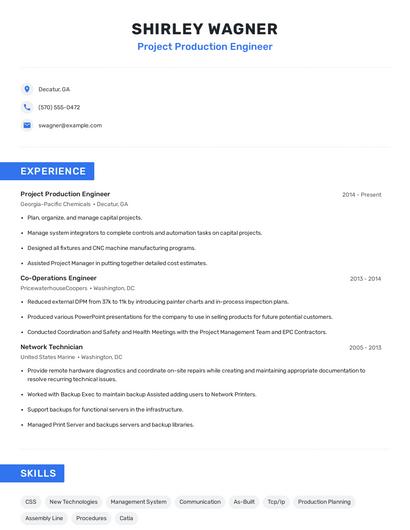
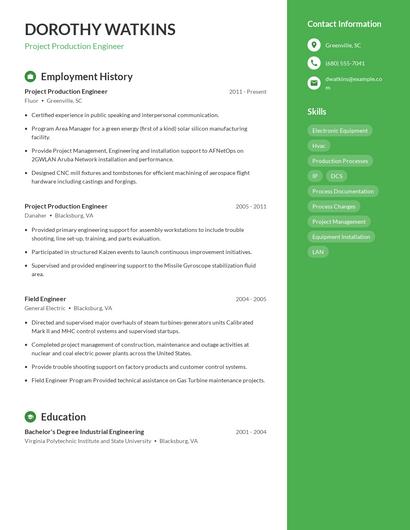
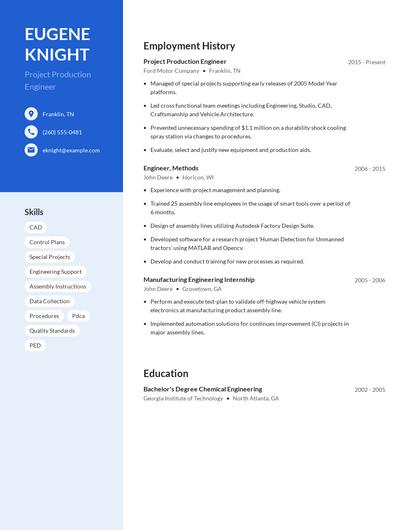
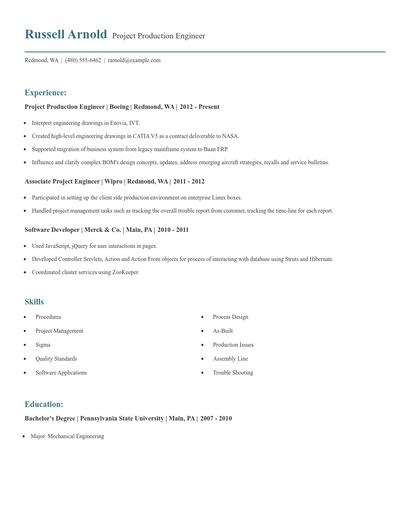
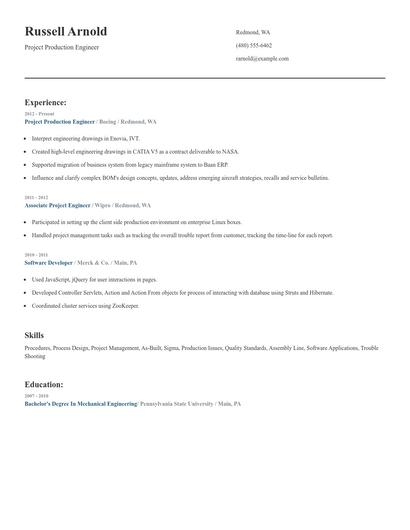
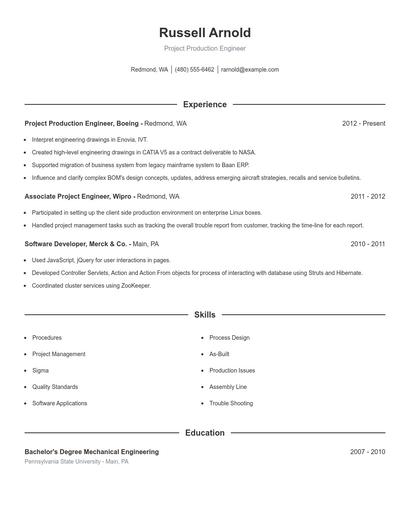
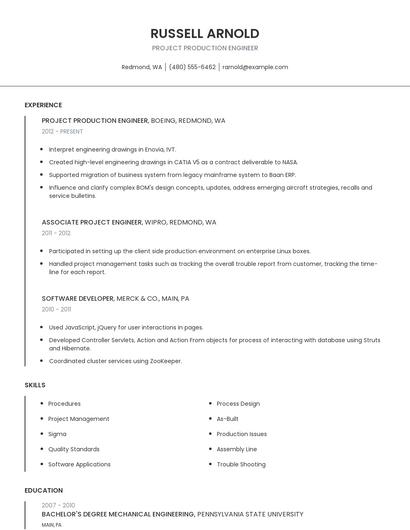
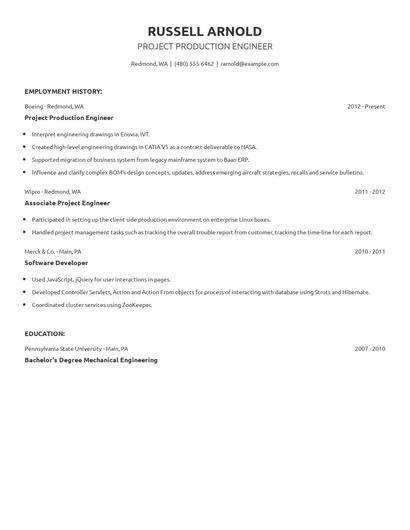
Choose from 10+ customizable project production engineer resume templates
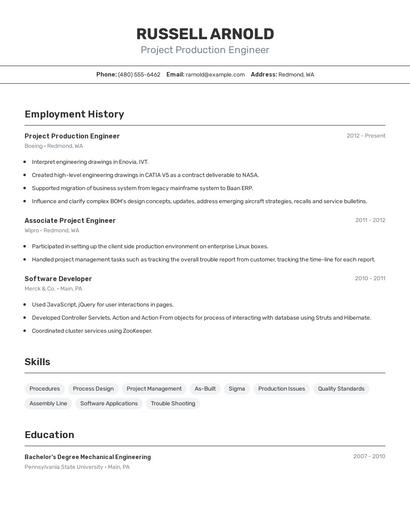
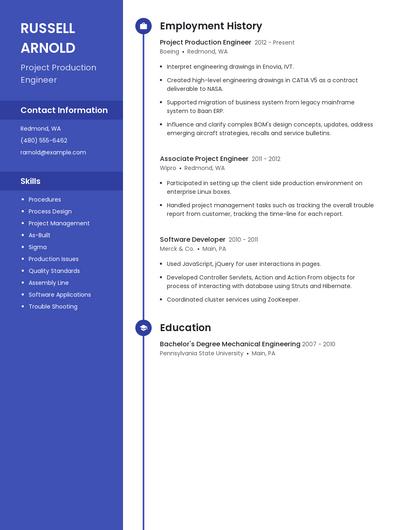
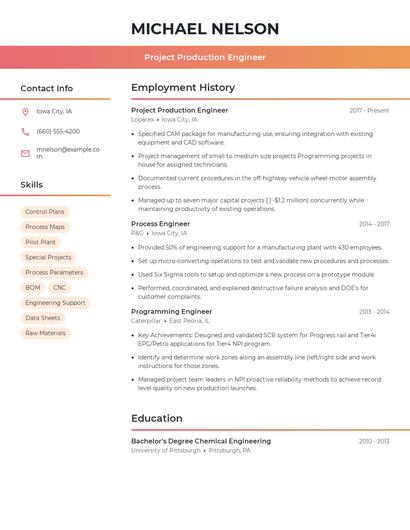
Build a professional project production engineer resume in minutes. Our AI resume writing assistant will guide you through every step of the process, and you can choose from 10+ resume templates to create your project production engineer resume.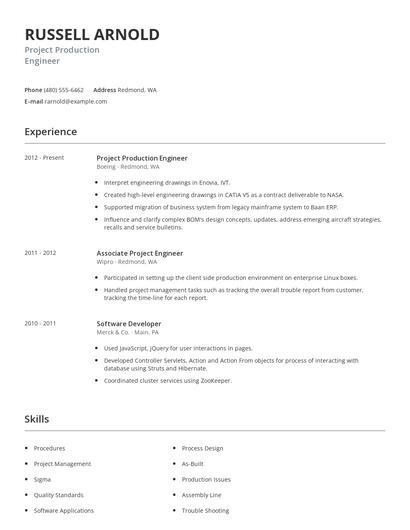
Compare different project production engineers
Project production engineer vs. Engineer
Engineers are highly trained professionals who determine the feasibility of various projects, usually related to the construction industry. They are considered experts in mathematics and science, two disciplines that they need to use in designing and coming up with plans for projects. They should also be well-versed in different construction or industrial materials, and they ensure that appropriate materials are used for the project. They also ensure that the projects meet the requirements of the groups that hired them. They create spaces that would both address the needs of the end-users and the industry standards. They also ensure that the projects they make would stand the test of time.
These skill sets are where the common ground ends though. The responsibilities of a project production engineer are more likely to require skills like "production processes," "capital projects," "production management," and "sigma." On the other hand, a job as an engineer requires skills like "python," "cloud," "c++," and "c #." As you can see, what employees do in each career varies considerably.
Engineers really shine in the automotive industry with an average salary of $97,672. Comparatively, project production engineers tend to make the most money in the technology industry with an average salary of $80,749.On average, engineers reach similar levels of education than project production engineers. Engineers are 2.7% more likely to earn a Master's Degree and 0.4% more likely to graduate with a Doctoral Degree.Project production engineer vs. Quality engineer
A quality engineer's responsibilities include ensuring that the manufacturing processes are efficient and accurate, documenting findings that would raise concerns, conducting quality tests while observing parameters, and implementing changes as necessary to meet the highest quality standards. Quality engineers need to have excellent problem-solving and observation skills to detect any irregularities and possible malfunctions. They also must be able to communicate effectively with the clients for feedbacks and corrective adjustments, address complaints, and immediately resolve any inconsistencies made.
While some skills are similar in these professions, other skills aren't so similar. For example, resumes show us that project production engineer responsibilities requires skills like "production processes," "capital projects," "production management," and "plc." But a quality engineer might use other skills in their typical duties, such as, "corrective action," "quality issues," "quality system," and "supplier quality."
Quality engineers earn a higher average salary than project production engineers. But quality engineers earn the highest pay in the technology industry, with an average salary of $84,890. Additionally, project production engineers earn the highest salaries in the technology with average pay of $80,749 annually.In general, quality engineers achieve similar levels of education than project production engineers. They're 2.7% more likely to obtain a Master's Degree while being 0.4% less likely to earn a Doctoral Degree.Project production engineer vs. Facility engineer
A facilities engineer specializes in managing and maintaining equipment and machinery in manufacturing plants or similar settings. Duties will revolve around conducting research and analysis through extensive data and blueprints, evaluating systems using various reports, handling issues, providing corrective measures, and performing regular inspections and maintenance. Furthermore, it is essential to implement all safety standards and regulations to ensure a safe and productive work environment for everyone.
Some important key differences between the two careers include a few of the skills necessary to fulfill the responsibilities of each. Some examples from project production engineer resumes include skills like "production processes," "production management," "sigma," and "process improvement," whereas a facility engineer is more likely to list skills in "hvac," "plumbing," "ladders," and "autocad. "
Facility engineers make a very good living in the energy industry with an average annual salary of $109,339. On the other hand, project production engineers are paid the highest salary in the technology industry, with average annual pay of $80,749.When it comes to education, facility engineers tend to earn similar degree levels compared to project production engineers. In fact, they're 1.1% less likely to earn a Master's Degree, and 0.4% less likely to graduate with a Doctoral Degree.Project production engineer vs. Plant engineer
A Plant Engineer is responsible for directing the smooth operation of the plant. They plan and coordinate activities concerned with the design, construction, modification, and maintenance of equipment and machinery in an industrial plant.
Even though a few skill sets overlap between project production engineers and plant engineers, there are some differences that are important to note. For one, a project production engineer might have more use for skills like "production processes," "capital projects," "production management," and "operator training." Meanwhile, some responsibilities of plant engineers require skills like "hvac," "plant operations," "plant maintenance," and "plumbing. "
The automotive industry tends to pay the highest salaries for plant engineers, with average annual pay of $99,347. Comparatively, the highest project production engineer annual salary comes from the technology industry.plant engineers reach similar levels of education compared to project production engineers, in general. The difference is that they're 0.0% more likely to earn a Master's Degree, and 0.2% less likely to graduate with a Doctoral Degree.Types of project production engineer
Updated January 8, 2025
