What does a property coordinator do?
Typically, a property coordinator maintains several properties for different owners. Property coordinators assist the property managers in the preparation of increased operating costs. They help the managers in the processing of insurance, rent, lease, tax, and any other billings to the tenants. It6 is part of their job to prepare and update reports concerning property management. Also, they take responsibility for the oversight, leadership, and standards of care of the properties.
Property coordinator responsibilities
Here are examples of responsibilities from real property coordinator resumes:
- Manage condominiums for individual investors; enforce lease requirements/community policies.
- Prepare correspondence with USPTO and foreign associates.
- Generate letters regarding receipts and notifications from the USPTO to clients.
- Work with owners and tenants to assist them with service requests or HOA violations.
- Prepare small claims court actions for evictions, unpaid rent, and damages when necessary.
- Keep accurate records of current space conditions including roof, HVAC, utilities and special circumstances.
- Provide detail and appropriate bids, per HUD specs, for work needing complete at a property.
- Complete inspection reports and request work orders for problems find at the properties and update the Yardi system.
- Represent property owners in tenant screening, leasing, maintenance of units, evictions, communication, etc.
- Update all tenant COI's and HVAC agreements with their prefer provider to maintain their contractual terms per the lease.
- Act as point of contact for tenants, owners, HOA's, home warranty companies, vendors and claims adjusters.
- Direct coordination for employee development/motivation, construction oversight, tenant retention programs, integrity training, and customer service training programs.
- Create PowerPoint presentations that are successfully used for student information and training presentations.
Property coordinator skills and personality traits
We calculated that 18% of Property Coordinators are proficient in Phone Calls, Tenant Relations, and Data Entry. They’re also known for soft skills such as Customer-service skills, Listening skills, and Communication skills.
We break down the percentage of Property Coordinators that have these skills listed on their resume here:
- Phone Calls, 18%
Answer and route phone calls from tenants and vendors and/or dispatch personnel based on immediate needs.
- Tenant Relations, 8%
Restructured tenant relations to enhance collaboration, increase customer involvement and highlight critical industry trends.
- Data Entry, 8%
Processed background checks for new residents and data entry of approved residential information.
- Maintenance Services, 8%
Coordinate with construction and maintenance services on building and grounds maintenance and all facility modifications.
- Vendor Invoices, 5%
Prepare property vacancy reports for reconciliation of monthly vendor invoices.
- Yardi, 5%
Completed inspection reports and request work orders for problems found at the properties and update the Yardi system.
Common skills that a property coordinator uses to do their job include "phone calls," "tenant relations," and "data entry." You can find details on the most important property coordinator responsibilities below.
Customer-service skills. To carry out their duties, the most important skill for a property coordinator to have is customer-service skills. Their role and responsibilities require that "property, real estate, and community association managers must provide excellent support to keep existing clients and expand their business with new ones." Property coordinators often use customer-service skills in their day-to-day job, as shown by this real resume: "assist with front desk duties when needed which includes guest check-in, blocking rooms, posting expenses, and answering phones. "
Listening skills. Another essential skill to perform property coordinator duties is listening skills. Property coordinators responsibilities require that "property, real estate, and community association managers pay attention to residents and proprietors in order to understand and meet their needs." Property coordinators also use listening skills in their role according to a real resume snippet: "listen to unit owners/tenants requests, address concerns and comments about the community, rules, hoa fees, etc. "
Communication skills. This is an important skill for property coordinators to perform their duties. For an example of how property coordinator responsibilities depend on this skill, consider that "property, real estate, and community association managers must understand contracts and must be able to clearly explain the materials and answer questions raised by residents, board members, or service providers." This excerpt from a resume also shows how vital it is to everyday roles and responsibilities of a property coordinator: "collect and maintain accurate information and communication using various reo platforms, systems, portals, and internal tracking system. ".
Interpersonal skills. For certain property coordinator responsibilities to be completed, the job requires competence in "interpersonal skills." The day-to-day duties of a property coordinator rely on this skill, as "property, real estate, and community association managers interact with different types of people every day." For example, this snippet was taken directly from a resume about how this skill applies to what property coordinators do: "maintained positive resident relations through my strong interpersonal relations skills. "
Organizational skills. Another common skill required for property coordinator responsibilities is "organizational skills." This skill comes up in the duties of property coordinators all the time, as "property, real estate, and community association managers must be able to plan, coordinate, and direct multiple contractors at the same time, often for multiple properties." An excerpt from a real property coordinator resume shows how this skill is central to what a property coordinator does: "developed organizational plans, processed financial invoices, balanced all financial deposit logs and processed payroll. "
Problem-solving skills. Lastly, "problem-solving skills" is an important element of what a property coordinator does. Property coordinator responsibilities require this skill because "property, real estate, and community association managers must be able to mediate disputes or legal issues between different groups of people, such as residents and board members." This resume example highlights how property coordinator duties rely on this skill: "resolved code violations issued by city municipalities and home owner associations. "
The three companies that hire the most property coordinators are:
- Marriott International7 property coordinators jobs
- BXP6 property coordinators jobs
- Hyatt Hotels5 property coordinators jobs
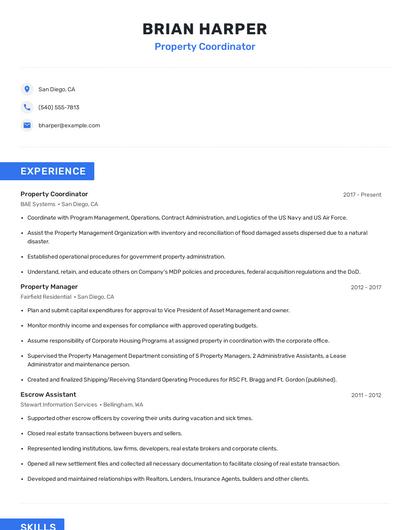
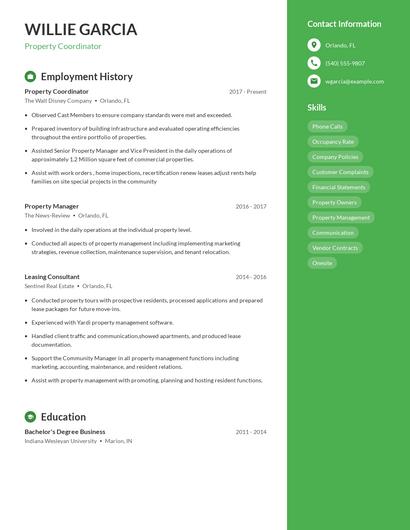
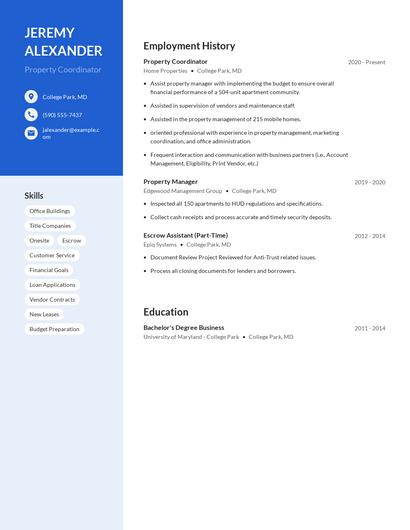
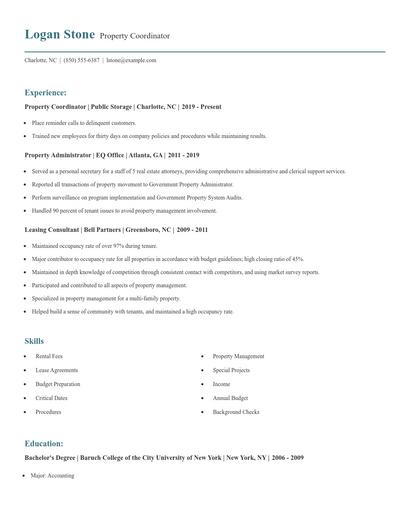
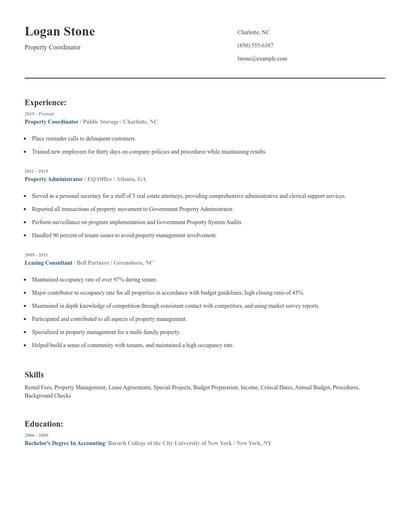
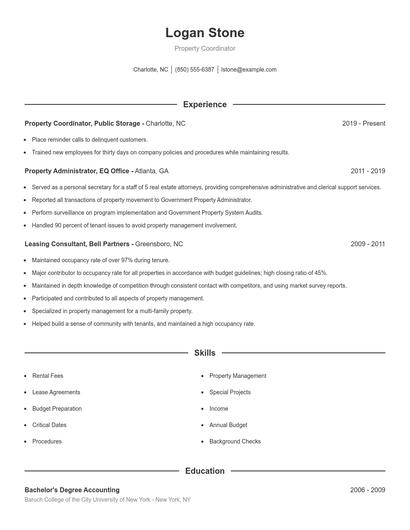
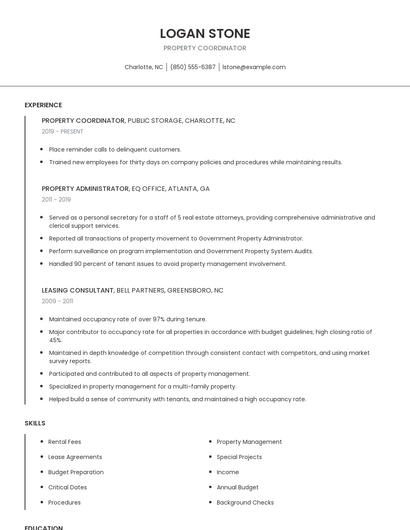
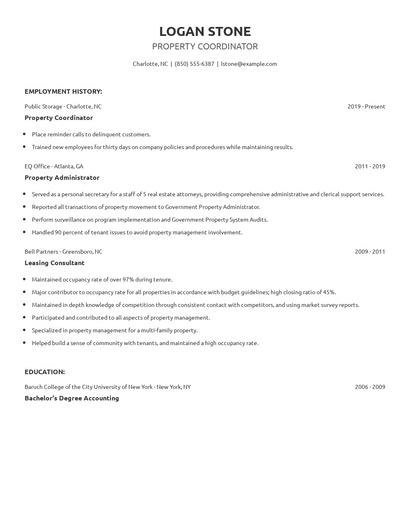
Choose from 10+ customizable property coordinator resume templates
Build a professional property coordinator resume in minutes. Our AI resume writing assistant will guide you through every step of the process, and you can choose from 10+ resume templates to create your property coordinator resume.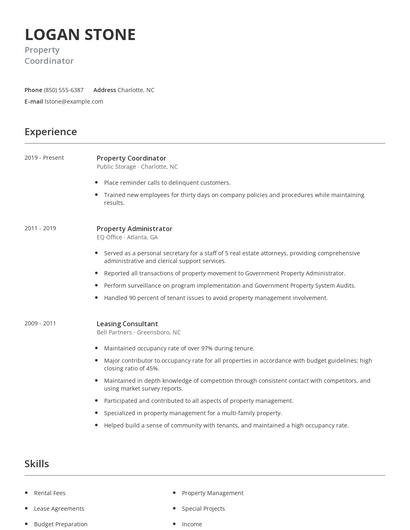
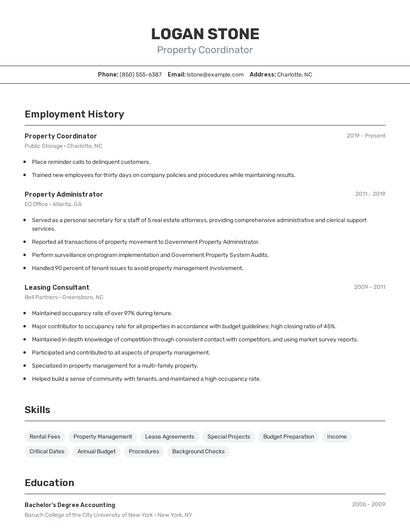
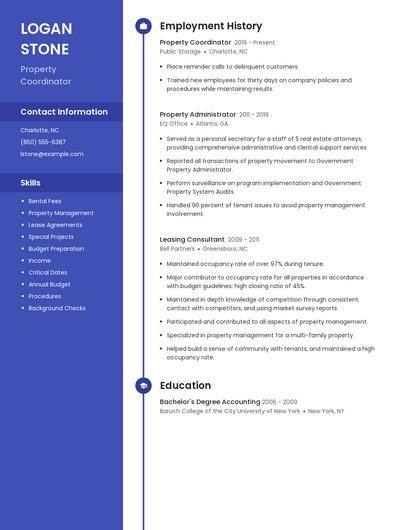
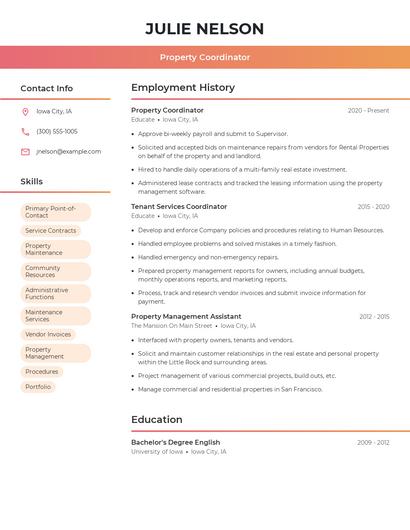
Compare different property coordinators
Property coordinator vs. Real estate manager
A Real Estate Manager manages the financial aspects of a property. They collect rent and prepare and maintain financial statements. Real Estate Managers also inform owners about occupancy rates, expiration dates of leases, and other issues.
These skill sets are where the common ground ends though. The responsibilities of a property coordinator are more likely to require skills like "phone calls," "data entry," "maintenance services," and "vendor invoices." On the other hand, a job as a real estate manager requires skills like "financial analysis," "property management," "project management," and "oversight." As you can see, what employees do in each career varies considerably.
Real estate managers really shine in the finance industry with an average salary of $85,510. Comparatively, property coordinators tend to make the most money in the professional industry with an average salary of $45,516.real estate managers tend to reach higher levels of education than property coordinators. In fact, real estate managers are 7.2% more likely to graduate with a Master's Degree and 1.9% more likely to have a Doctoral Degree.Property coordinator vs. Resident manager
A resident manager's role focuses on maintaining and supervising residential and rental properties, even hotels. Typically an in-house employee, it is a resident manager's responsibility to oversee all maintenance operations to ensure that the property is at optimal condition, assess staff's performance, prepare and manage budgets, and produce progress reports for the company or property owner. They mostly respond to inquiries from guests or tenants, even processing payments when necessary. Moreover, a resident manager may address issues and concerns, providing corrective measures while adhering to the policies and standards.
While some skills are similar in these professions, other skills aren't so similar. For example, resumes show us that property coordinator responsibilities requires skills like "phone calls," "data entry," "maintenance services," and "vendor invoices." But a resident manager might use other skills in their typical duties, such as, "resident care," "cpr," "medication administration," and "developmental disabilities."
On average, resident managers earn a higher salary than property coordinators. Some industries support higher salaries in each profession. Interestingly enough, resident managers earn the most pay in the internet industry with an average salary of $53,747. Whereas property coordinators have higher pay in the professional industry, with an average salary of $45,516.resident managers earn similar levels of education than property coordinators in general. They're 2.2% more likely to graduate with a Master's Degree and 1.9% less likely to earn a Doctoral Degree.Property coordinator vs. Leasing manager
A leasing manager is responsible for processing the lease requirements of multiple properties for potential renters and ensuring that all documents are filed accurately, following the standards of property management and clients' qualifications. Leasing managers develop marketing campaigns to advertise leasing properties through media relations and posting on social media platforms. They respond to the potential renters' inquiries and concerns, negotiate contract agreements, inspect the property's location for safety and security, and conduct regular reviews of monetary requirements.
Some important key differences between the two careers include a few of the skills necessary to fulfill the responsibilities of each. Some examples from property coordinator resumes include skills like "phone calls," "data entry," "maintenance services," and "vendor invoices," whereas a leasing manager is more likely to list skills in "customer service," "resident retention," "real estate," and "property management. "
Leasing managers earn the best pay in the finance industry, where they command an average salary of $52,986. Property coordinators earn the highest pay from the professional industry, with an average salary of $45,516.Most leasing managers achieve a similar degree level compared to property coordinators. For example, they're 0.7% less likely to graduate with a Master's Degree, and 0.2% less likely to earn a Doctoral Degree.Property coordinator vs. Communications manager
A communications manager is responsible for overseeing a company or organization's public relations by devising various strategies and finding new opportunities. They must craft and produce marketing materials such as campaigns, advertisements, newsletters, social media engagements, and press releases to shape and improve a brand or company. Furthermore, a communications manager must accomplish administrative tasks such as preparing reports and necessary documentation, reaching out to advertisers, leading communication letters, and coordinating with marketing personnel from other departments.
Types of property coordinator
Updated January 8, 2025
