What does a quality systems analyst do?
Quality Program Managers are professionals who oversee the quality-specific metrics of a company's project or activity. They manage the audit of the conduct of the different programs in the company. Quality Program Managers are considered experts on company standards, policies, and procedures. They use these metrics to assess the programs under them. Quality Program Managers ensure the consistency of all activities involved in the program. They check whether these programs work within their scope. They also check if the employees adhere to the guidelines and work plans.
Quality systems analyst responsibilities
Here are examples of responsibilities from real quality systems analyst resumes:
- Create and manage execution of PPAP protocols for verification of new production processes and equipment.
- Manage regression testing efforts to ensure completeness and provide adequate coverage of business critical functionality.
- Streamline development and QA process establish and manage test automation infrastructure that allow development and QA to work more efficiently.
- Collaborate with cross functional departments/teams to follow-up on and close open audit/inspection findings from notify ISO body and FDA.
- Enforce policies and procedures that would ensure that the system would withstand the scrutiny of an FDA or an ISO audit.
- Provide classroom procedure and GMP training.
- Assist in completion of audits by external auditors, including QMS registrar and customers.
- Understand and follow appropriate design control SDLC, quality validation processes and application processes.
- Aid users in various departments to make changes or corrections in their own teamsites within SharePoint.
- Conduct evaluations and audits of production personnel to ensure procedures are being follow in accordance with GMP compliance.
- Assist process owners in creating and revising procedures in the QMS, including forms, reports and standard work.
- Involve as a SME and SPOC throughout multiple releases and hot fixes in IFT and in RIT testing efforts.
- Perform acquisition planning efforts, risk assessment and management, vendor capability assessments, program/technical reviews, and ISO audits.
- Create prototypes/demos to reflect possible implementation scenarios for the given requirements and demonstrate them to the business users according to SDLC.
- Audited/Evaluat line product/process and report non-conformance and possible CAPA's.
Quality systems analyst skills and personality traits
We calculated that 10% of Quality Systems Analysts are proficient in Quality System, CAPA, and Management System. They’re also known for soft skills such as Analytical skills, Communication skills, and Creativity.
We break down the percentage of Quality Systems Analysts that have these skills listed on their resume here:
- Quality System, 10%
Prepared, presented and facilitated Management Review summaries and status of the quality system to Senior Management and Company.
- CAPA, 5%
Audited/evaluated line product/process and reported non-conformance and possible CAPA's.
- Management System, 5%
Created/developed and facilitated training for facilitators, production personnel and management team in support of Quality Management System and SPC implementation.
- Continuous Improvement, 5%
Report Analysis: Developed several macros to improve efficiency of report generation and rapid problem solving to support continuous improvement.
- Project Management, 5%
Reported Daily status and communicated impediments to lead and project management.
- FDA, 5%
Enforced policies and procedures that would ensure that the system would withstand the scrutiny of an FDA or an ISO audit.
Common skills that a quality systems analyst uses to do their job include "quality system," "capa," and "management system." You can find details on the most important quality systems analyst responsibilities below.
Analytical skills. The most essential soft skill for a quality systems analyst to carry out their responsibilities is analytical skills. This skill is important for the role because "analysts must interpret complex information from various sources and decide the best way to move forward on a project." Additionally, a quality systems analyst resume shows how their duties depend on analytical skills: "provided technical and analysis support to regulatory audits (fda and notified bodies). "
Communication skills. Many quality systems analyst duties rely on communication skills. "analysts work as a go-between with management and the it department and must explain complex issues in a way that both will understand.," so a quality systems analyst will need this skill often in their role. This resume example is just one of many ways quality systems analyst responsibilities rely on communication skills: "assisted in defining project scope, managing schedule, prepare release documentation and provide project status communication to management chain. "
Creativity. Another skill that relates to the job responsibilities of quality systems analysts is creativity. This skill is critical to many everyday quality systems analyst duties, as "because analysts are tasked with finding innovative solutions to computer problems, an ability to “think outside the box” is important." This example from a resume shows how this skill is used: "analyzed and developed software applications to support payroll, position control, budgeting, inventory control, and student information systems. "
The three companies that hire the most quality systems analysts are:
- Biolife Plasma Services27 quality systems analysts jobs
- BioLife Solutions10 quality systems analysts jobs
- INFICON9 quality systems analysts jobs
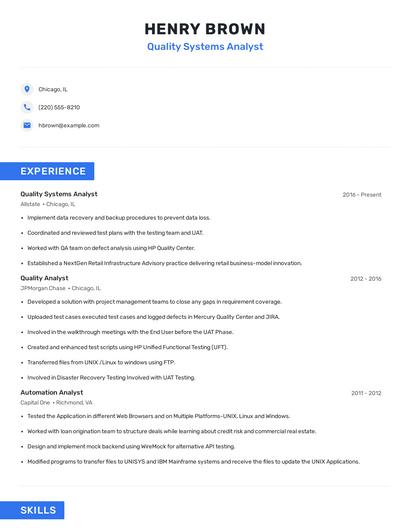
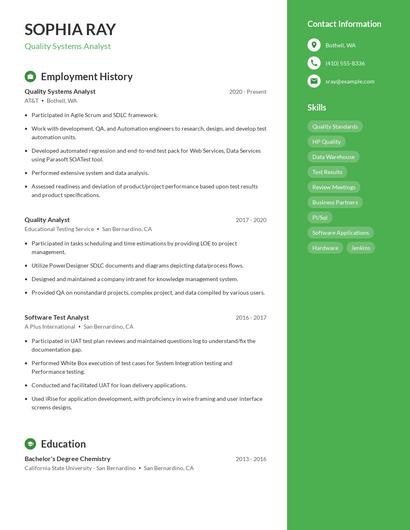
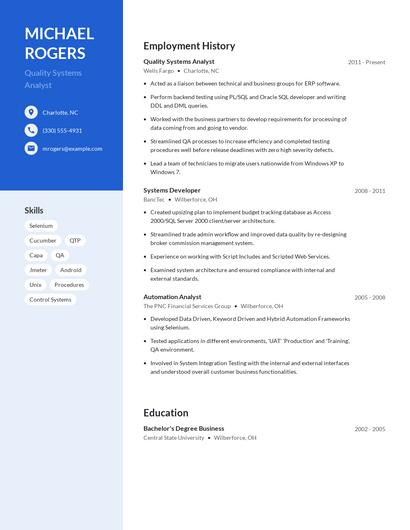
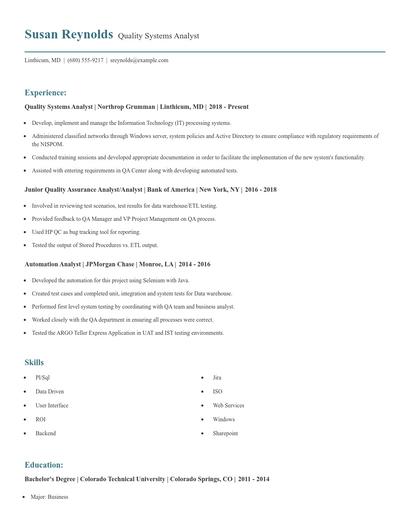
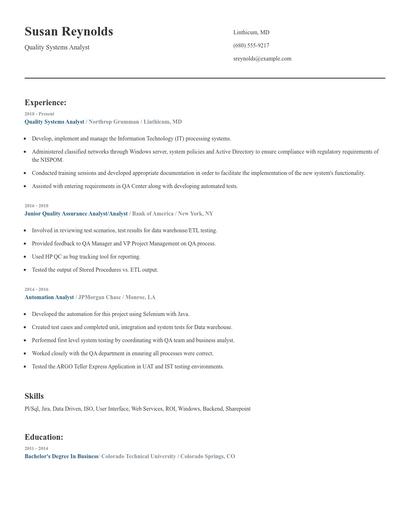
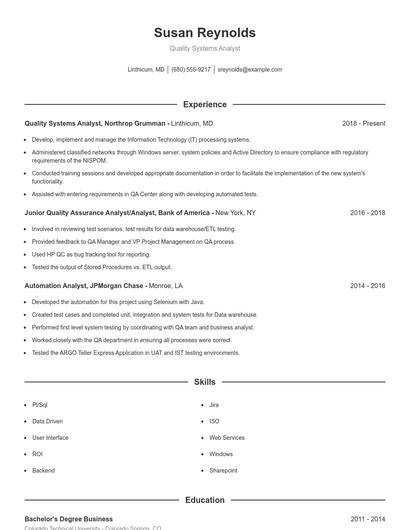
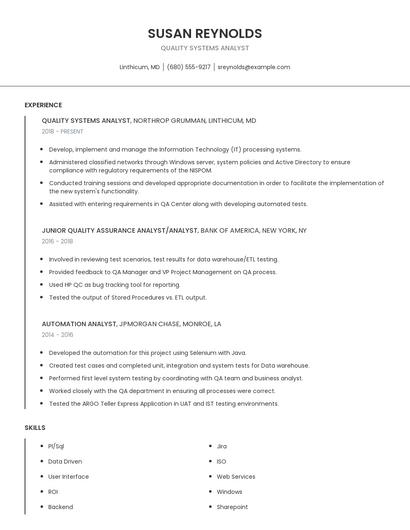
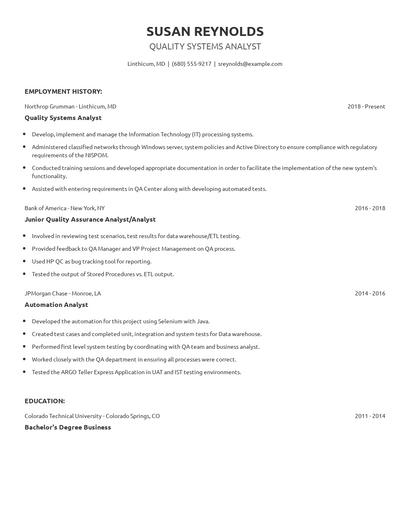
Choose from 10+ customizable quality systems analyst resume templates
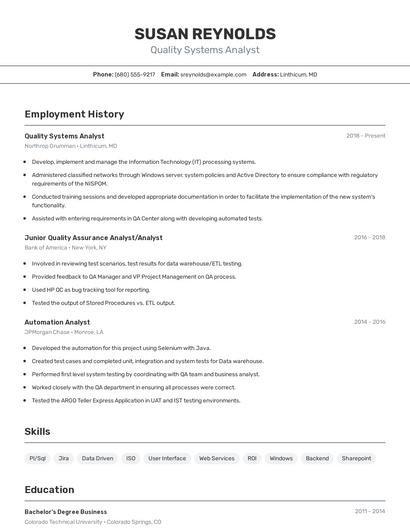
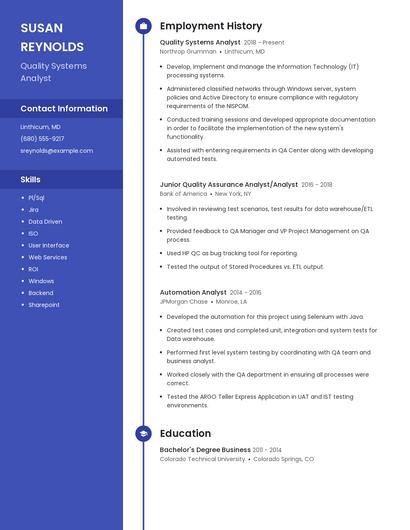
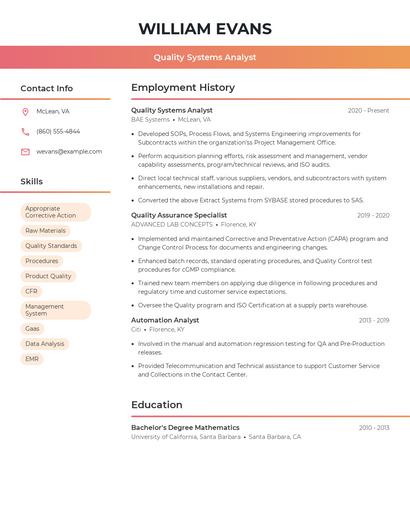
Build a professional quality systems analyst resume in minutes. Our AI resume writing assistant will guide you through every step of the process, and you can choose from 10+ resume templates to create your quality systems analyst resume.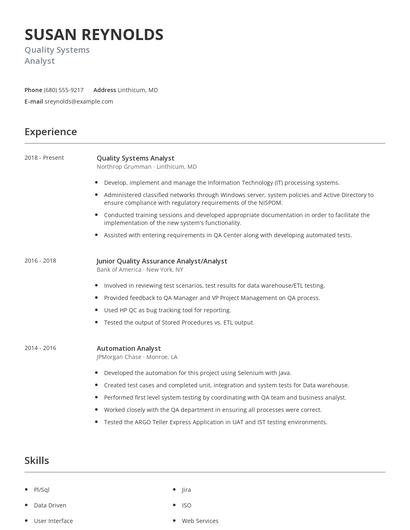
Compare different quality systems analysts
Quality systems analyst vs. Analyst lead
The duties of an analyst lead depend on one's line of work or industry of employment. Typically, their responsibilities revolve around performing research and analysis, coordinating with different departments to gather leads and data, reviewing findings, and producing reports and presentations for the stakeholders and other higher-ranking officials. Through the results, an analyst lead can provide advice, devise strategies for business optimization, spearhead the development of processes, identify strengths and weaknesses, and offer recommendations on areas in need of improvement. All of this is done while in adherence to the company's vision and mission.
These skill sets are where the common ground ends though. The responsibilities of a quality systems analyst are more likely to require skills like "quality system," "capa," "medical devices," and "continuous improvement." On the other hand, a job as an analyst lead requires skills like "analytics," "customer service," "excellent interpersonal," and "java." As you can see, what employees do in each career varies considerably.
Analyst leads tend to make the most money working in the finance industry, where they earn an average salary of $110,488. In contrast, quality systems analysts make the biggest average salary, $79,623, in the professional industry.On average, analyst leads reach higher levels of education than quality systems analysts. Analyst leads are 5.8% more likely to earn a Master's Degree and 0.1% more likely to graduate with a Doctoral Degree.Quality systems analyst vs. Business analyst/quality analyst
A business analyst/quality analyst is responsible for evaluating business outputs and operational processes to ensure that everything adheres to the quality standards and business regulations. Business analysts/quality analysts support senior management in determining solutions to improve the company's services and provide the highest satisfaction for the customers and clients. They also conduct data and statistical analysis by assessing the market trends to identify opportunities that would generate more revenue resources and increase profitability for the business.
In addition to the difference in salary, there are some other key differences worth noting. For example, quality systems analyst responsibilities are more likely to require skills like "quality system," "capa," "medical devices," and "management system." Meanwhile, a business analyst/quality analyst has duties that require skills in areas such as "microsoft visio," "business process," "scrum," and "powerpoint." These differences highlight just how different the day-to-day in each role looks.
Business analysts/quality analysts may earn a higher salary than quality systems analysts, but business analysts/quality analysts earn the most pay in the finance industry with an average salary of $94,836. On the other hand, quality systems analysts receive higher pay in the professional industry, where they earn an average salary of $79,623.business analysts/quality analysts earn higher levels of education than quality systems analysts in general. They're 11.8% more likely to graduate with a Master's Degree and 0.1% less likely to earn a Doctoral Degree.Quality systems analyst vs. Software analyst
A software analyst is responsible for creating and designing software programs and applications, as well as modifying existing ones for optimization according to business requirements. Software analysts work with the technical team to draw system codes, analyze programming languages, and ensure the stability and efficiency of software navigation by running multiple quality checks to the system. They inspect the application's performance, configure servers, and improve software infrastructure according to quality findings. A software analyst records resolution reports and provides progress updates, ensuring that the project adheres to budget limitations and set timetables.
There are many key differences between these two careers, including some of the skills required to perform responsibilities within each role. For example, a quality systems analyst is likely to be skilled in "quality system," "capa," "medical devices," and "continuous improvement," while a typical software analyst is skilled in "java," "c++," "software development," and "troubleshoot."
Software analysts make a very good living in the manufacturing industry with an average annual salary of $86,986. On the other hand, quality systems analysts are paid the highest salary in the professional industry, with average annual pay of $79,623.Most software analysts achieve a similar degree level compared to quality systems analysts. For example, they're 1.3% more likely to graduate with a Master's Degree, and 0.5% more likely to earn a Doctoral Degree.Quality systems analyst vs. Product analyst
A product analyst job utilizes data analysis software and notates trends in market research. Primarily, analysts project the costs of product development and marketing. They think of the possibilities for profit and sales and monitor the performance of products on the market to come up with a better product. Their responsibilities include company product evaluation, product understanding, and product rating reviews. Familiarity with Microsoft Office Suite, strong communication skills, and proficiency in database software is necessary for this job.
Types of quality systems analyst
Updated January 8, 2025
