What does a radio producer do?
Radio producer responsibilities
Here are examples of responsibilities from real radio producer resumes:
- Founded, host and manage one of the main radio programmes for Kairi Fm, a leading radio station in Dominica.
- Screen callers, create promos, edit sound, run board.
- Maintain organized list of programming that air, while ensuring that paid commercials run as scheduled.
- Collaborate with production to streamline and track internal booking calendars.
- Used information to compile competitive quarterly reviews using Microsoft PowerPoint.
Radio producer skills and personality traits
We calculated that 9% of Radio Producers are proficient in Adobe Audition, Conduct Interviews, and Radio Station. They’re also known for soft skills such as Communication skills, Creativity, and Leadership skills.
We break down the percentage of Radio Producers that have these skills listed on their resume here:
- Adobe Audition, 9%
Edited pre-recorded and live material using digital equipment (Adobe Audition 2.0 and 3.0) and comprehended with various technical procedures.
- Conduct Interviews, 8%
Conduct interviews with local arts organizations.
- Radio Station, 7%
Administered all the issues of the section and maintained close coordination with the Head of Radio Station for quality broadcast.
- Pro Tools, 7%
Utilized Pro Tools to edit recordings and manipulate sound effects for the show.
- Live Shows, 4%
Produce live shows, On-Air talent, Locate, record and edit audio (highlights, press conferences, etc.)
- Radio Program, 4%
Create advertisements to be consumed by listeners during commercial breaks throughout regularly scheduled radio programming.
Most radio producers use their skills in "adobe audition," "conduct interviews," and "radio station" to do their jobs. You can find more detail on essential radio producer responsibilities here:
Communication skills. To carry out their duties, the most important skill for a radio producer to have is communication skills. Their role and responsibilities require that "producers and directors must convey information and ideas clearly in order to coordinate many people to finish a production on time and within budget." Radio producers often use communication skills in their day-to-day job, as shown by this real resume: "key member of team providing tedx community events email marketing, data organization and communications management"
Creativity. Another soft skill that's essential for fulfilling radio producer duties is creativity. The role rewards competence in this skill because "because a script may be interpreted in different ways, directors must decide on their approach and on how to represent the script’s ideas for the production." According to a radio producer resume, here's how radio producers can utilize creativity in their job responsibilities: "cultivate and enhance proficiency and knowledge of the adobe creative suite, mainly adobe audition"
Leadership skills. radio producers are also known for leadership skills, which are critical to their duties. You can see how this skill relates to radio producer responsibilities, because "directors instruct actors and help them portray their characters in a believable manner." A radio producer resume example shows how leadership skills is used in the workplace: "selected and wrote all content and teases while taking leadership role in editorial process of daily news coverage. "
The three companies that hire the most radio producers are:
- iHeartMedia4 radio producers jobs
- SiriusXM2 radio producers jobs
- Bloomberg2 radio producers jobs
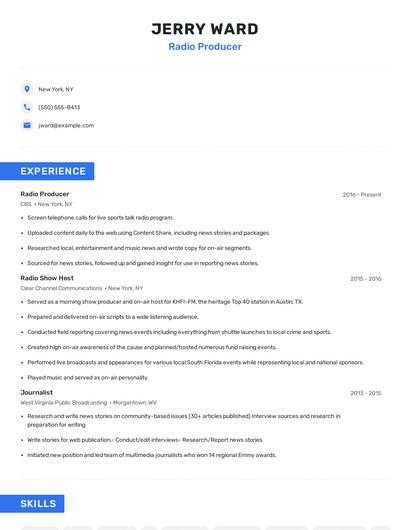
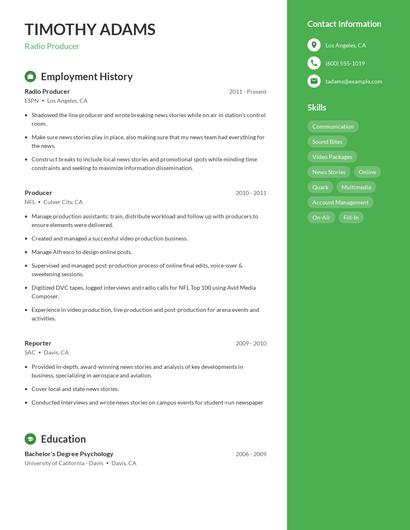
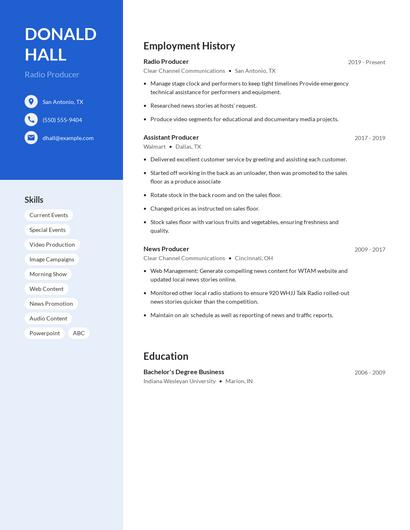
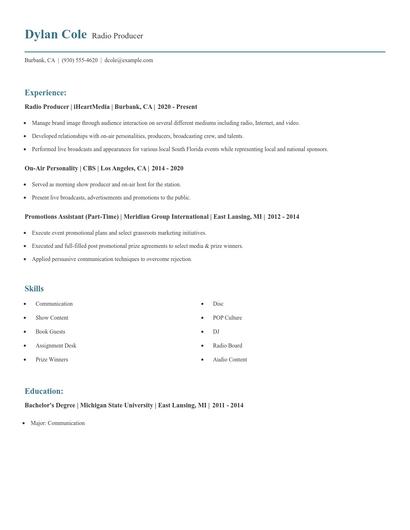
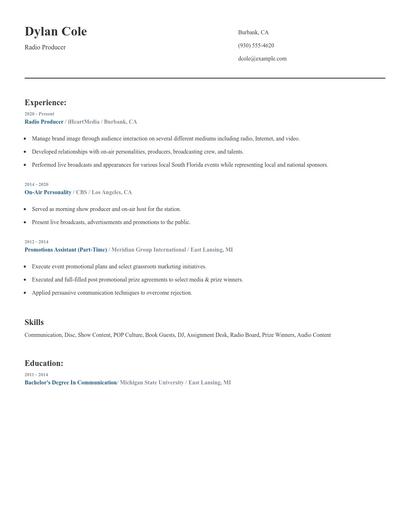
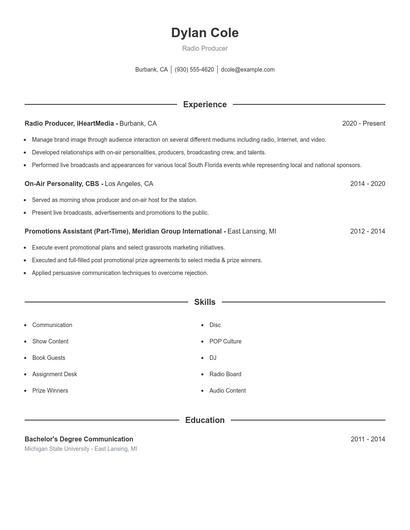
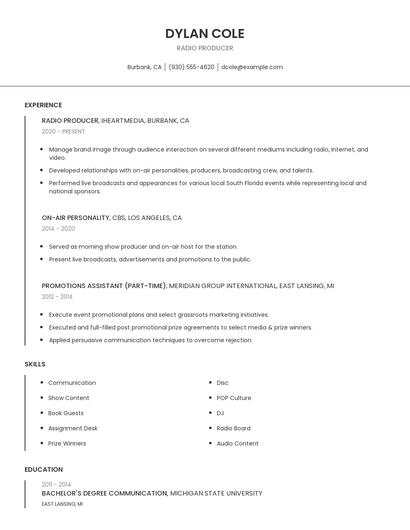
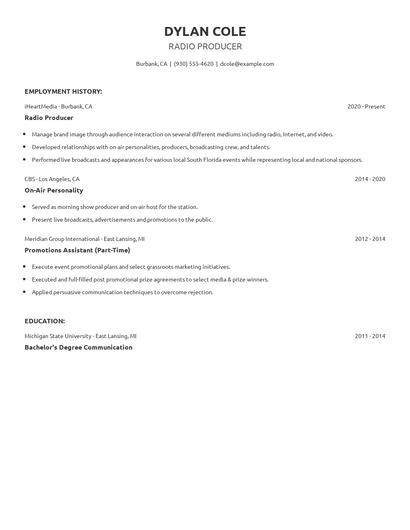
Choose from 10+ customizable radio producer resume templates
Build a professional radio producer resume in minutes. Our AI resume writing assistant will guide you through every step of the process, and you can choose from 10+ resume templates to create your radio producer resume.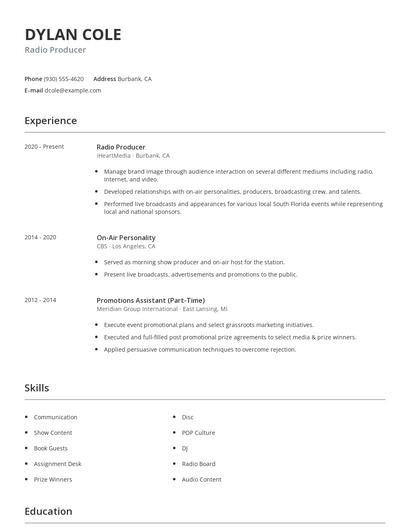
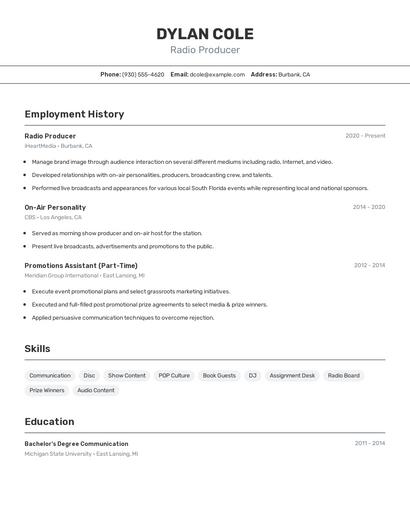
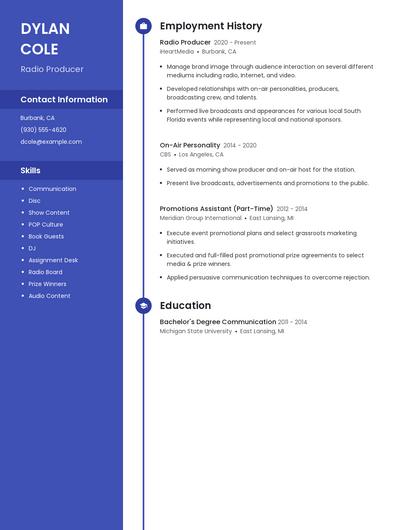
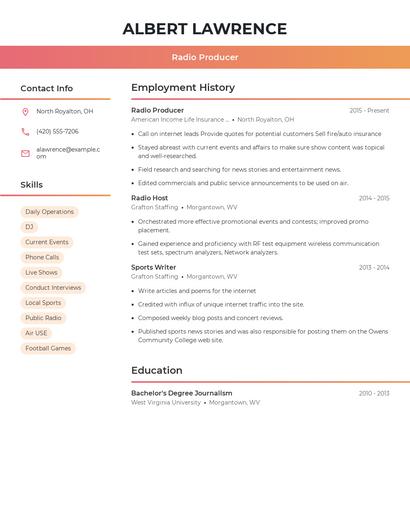
Compare different radio producers
Radio producer vs. Assistant stage manager
A stage manager is someone who oversees theatrical performances and all practical and technical aspects of rehearsals and shows, such as lighting cues, sound, prop usage, and costume changes. The core skills that stage managers should possess to accomplish their responsibilities include excellent attention to detail, the ability to multi-task and work under pressure, and strong leadership and problem-solving skills. They should be able to delegate tasks to staff. The job requires no formal education.
There are some key differences in the responsibilities of each position. For example, radio producer responsibilities require skills like "adobe audition," "conduct interviews," "radio station," and "pro tools." Meanwhile a typical assistant stage manager has skills in areas such as "live performances," "technical aspects," "costumes," and "stage management." This difference in skills reveals the differences in what each career does.
Assistant stage managers tend to reach similar levels of education than radio producers. In fact, assistant stage managers are 2.6% less likely to graduate with a Master's Degree and 1.3% less likely to have a Doctoral Degree.Radio producer vs. Stage manager
Producer interns require strong analytical, delegation, planning, time management, and prioritization skills, in addition to flexibility and the ability to work in fast-paced environments. Interns will need to set up rehearsals, transport musicians and instruments, plan and assist with recreational activities, and perform various other production tasks.
In addition to the difference in salary, there are some other key differences worth noting. For example, radio producer responsibilities are more likely to require skills like "adobe audition," "conduct interviews," "radio station," and "pro tools." Meanwhile, a stage manager has duties that require skills in areas such as "stage management," "audio equipment," "technical aspects," and "technical rehearsals." These differences highlight just how different the day-to-day in each role looks.
Stage managers earn similar levels of education than radio producers in general. They're 1.5% less likely to graduate with a Master's Degree and 1.3% less likely to earn a Doctoral Degree.Radio producer vs. Producer internship
A producer-director is responsible for ensuring that the production operations run smoothly, both in the business and creative side. The producer-director monitors the production staff's performance, as well as reviewing the output of delegated tasks, and manages promotional and marketing events. They also coordinate closely with the creative team to meet deadlines and maintain project deliverables within the budget goals. A producer-director must have excellent communication and organizational skills, especially on negotiating with sponsors to create the best experience for the audience.
Some important key differences between the two careers include a few of the skills necessary to fulfill the responsibilities of each. Some examples from radio producer resumes include skills like "pro tools," "radio program," "fcc," and "website content," whereas a producer internship is more likely to list skills in "video production," "audio clips," "video content," and "instagram. "
Most producer interns achieve a similar degree level compared to radio producers. For example, they're 2.6% less likely to graduate with a Master's Degree, and 1.3% less likely to earn a Doctoral Degree.Radio producer vs. Producer director
Types of radio producer
Updated January 8, 2025
