
Automatically apply for jobs with Zippia
Upload your resume to get started.
Receptionist/accounts receivable skills for your resume and career
15 receptionist/accounts receivable skills for your resume and career
1. Data Entry
Data entry means entering data into a company's system with the help of a keyboard. A person responsible for entering data may also be asked to verify the authenticity of the data being entered. A person doing data entry must pay great attention to tiny details.
- Hired temporarily for Data Entry Clerk and shortly offered a permanent position as Receptionist.
- Update policy information* Data entry* Accounting/ Reconcile commission statements* Filing* Process incoming and outgoing mail
2. Customer Service
Customer service is the process of offering assistance to all the current and potential customers -- answering questions, fixing problems, and providing excellent service. The main goal of customer service is to build a strong relationship with the customers so that they keep coming back for more business.
- Cultivated relationships and delivered excellent customer service by greeting guest and guiding them through the facility.
- Provided customer service anticipating customer needs, suggesting alternatives and solving problems.
3. Purchase Orders
- Worked with various departments to secure approvals for non-purchase order generated items.
- Process invoices for payment including purchase orders and back-up documentation.
4. Payroll
Payroll is the sum of all the compensation that an organization has to pay to employees at a specified time. Payroll is managed by the finance or HR department while small business owners may handle it themselves. Payroll isn't fixed as it varies every month due to sick leaves, overtime, etc.
- Prepared bi-weekly payroll utilizing ADP and reconciled to internal accounting system.
- Entered weekly payroll for approximately fifty employees.
5. Vendor Invoices
- Distributed vendor invoices to individual co-workers by vendor categories.
- Provided accounts payable responsibilities and handled vendor invoices.
6. Credit Card Payments
- Received, processed & deposited all checks via scanner; also credit card payments through Sage program.
- Posted charges and payments into computer system, processed credit card payments and completed deposits.
Choose from 10+ customizable receptionist/accounts receivable resume templates
Build a professional receptionist/accounts receivable resume in minutes. Our AI resume writing assistant will guide you through every step of the process, and you can choose from 10+ resume templates to create your receptionist/accounts receivable resume.7. Front Desk
- Handle medical front desk in computerized scheduling and verification of insurance benefits including main carriers and Medicaid.
- General receptionist and front desk responsibilities.
8. Scheduling Appointments
Scheduling appointments is the practice of finding a free slot with the person(s) you want to meet. The process of scheduling appointments involves finding mutually free time, negotiating follow-ups, sending reminders, and creating new appointments. Scheduling appointments is important to ensure that the timings of consecutive meetings do not clash with each other.
- Operated high-volume phone system and maintained daily direct and indirect client relations operations including assisting clients and scheduling appointments.
- Provide administrative assistance answering phones, filing paperwork, and scheduling appointments.
9. Bank Deposits
Any money that a customer chooses to leave with their bank account is a deposit. Deposits can vary in amounts and different banks have limits on the deposits their customers can have as a minimum. Banks charge customers for deposits especially when a teller is used by the customer to deposit money into their account.
- Balanced general accounting ledgers, Accounts Receivable/Payable and determined daily bank deposits in order to assure accurate financial records.
- Prepared bank deposits and reconciled accounts receivable ledger daily.
10. Multi-Line Phone System
- Answer Multi-Line Phone System Filing, Run Weekly Reports for Accounting Dept.
- Operated multi-line phone system Entered customer information into computer Balanced all accounts and completed check runs
11. Direct Calls
Direct calls are connections established with a previous customer or client, most likely a subscriber.
- Invoice, match payments to invoices, collection of unpaid invoices and answer telephone, direct calls, sell product.
- Answer telephone calls, screen and direct calls, provide information to callers, take and relay messages.
12. Customer Accounts
- Updated general ledger and printed financial statements, reconciled and updated customer accounts as needed.
- Research customer accounts for accounts receivable manager.
13. Accounts Receivables
- Answer incoming calls and transfer calls * Accounts Receivables - Enter EWA's for invoicing and mail out invoices to customers.
- Inventory control, accounts receivables, balance general ledger, weekly and monthly reporting to the bank.
14. Telephone Switchboard
- Operated telephone switchboard to answer screen or forward calls, providing information, taking messages.
- Operated telephone switchboard, answered, screened and forward calls to staff.
15. General Ledger
- Maintained detailed current aging of accounts and general ledger reconciliations.
- General ledger coding necessary to generate invoices to customers.
5 Receptionist/Accounts Receivable resume examples
Build a professional receptionist/accounts receivable resume in minutes. Browse through our resume examples to identify the best way to word your resume. Then choose from 5+ resume templates to create your receptionist/accounts receivable resume.

What skills help Receptionist/Accounts Receivables find jobs?
Tell us what job you are looking for, we’ll show you what skills employers want.
What skills stand out on receptionist/accounts receivable resumes?
Curtis Nicholls Ph.D.
Associate Professor of Accounting, Co-director of the Student Managed Investment Fund, Bucknell University
Data skills will also continue to become more prevalent across all business disciplines. Employers are looking for experience with large data sets, data visualization software (e.g. Tableau, PowerBI, Alteryx, etc.) and statistical analysis. Data has become a major currency, and employees' ability to utilize data for decision making will be critical to success in the employment marketplace.
Beyond the obvious, I think the pandemic has also shifted focus to skills surrounding resilience and motivation. I've heard employers during the pandemic express surprise at the disparity of responses to the pandemic: some employees made the pivot to remote work seamlessly, others required significantly more support. Skills that demonstrate resilience, such as group work, honors programs, etc. will become more important.
I would encourage job seekers to highlight skills learned during the pandemic. I would anticipate a regular interview question inquiring about how the job seeker used their extra time during the pandemic. The most common answers will likely include lots of Queen's Gambit and Tiger King, but employers will look for answers surrounding the development of new skills or acquired certifications. Imagine the employer's thoughts when you suggest that you used the extra time to pursue a lifelong dream such as learning to play the piano or guitar. If you missed the early pandemic window of opportunity, take advantage now!
This line of questions may precede a dangerous trend for employers to look for indications of mental strength. I find this possibility disheartening as we could see employers screening employees with mental health challenges at a time when the solidarity of a job could provide much needed structure.
What soft skills should all receptionist/accounts receivables possess?
Dr. Nicholas Robinson
Director of Accountancy, Eastern Illinois University
What hard/technical skills are most important for receptionist/accounts receivables?
Dr. Nicholas Robinson
Director of Accountancy, Eastern Illinois University
What technical skills for a receptionist/accounts receivable stand out to employers?
Jodi Olson
Assistant Accounting Professor, Winona State University
List of receptionist/accounts receivable skills to add to your resume
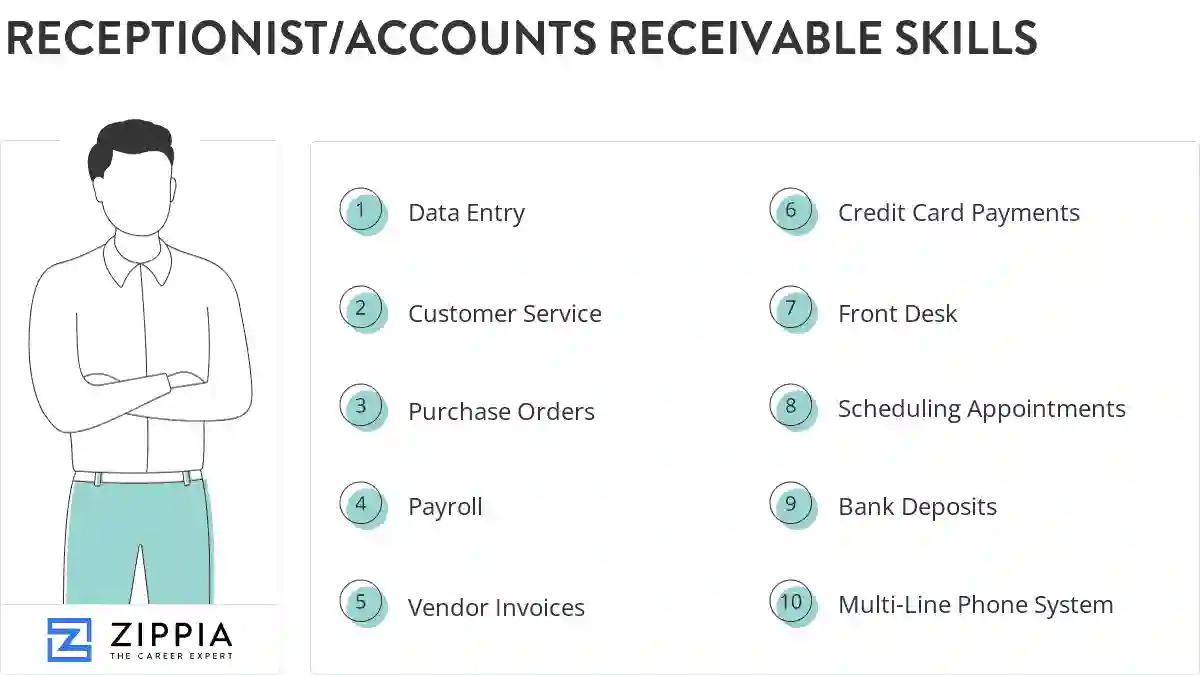
The most important skills for a receptionist/accounts receivable resume and required skills for a receptionist/accounts receivable to have include:
- Data Entry
- Customer Service
- Purchase Orders
- Payroll
- Vendor Invoices
- Credit Card Payments
- Front Desk
- Scheduling Appointments
- Bank Deposits
- Multi-Line Phone System
- Direct Calls
- Customer Accounts
- Accounts Receivables
- Telephone Switchboard
- General Ledger
- QuickBooks
- Computer System
- Accounts Payables
- Office Equipment
- Telephone Calls
- Vendor Statements
- Expense Reports
- Past Due Accounts
- Collection Calls
- Transferring Calls
- HR
- Process Invoices
- Credit Memos
- Payable Invoices
- Multi-Line Telephone System
- Clerical Support
- Check Runs
- Customer Payments
- Bank Statements
- Travel Arrangements
- PowerPoint
- Delinquent Accounts
- Administrative Tasks
- Sales Orders
- Medicaid
- Journal Entries
- Service Calls
- Fax Machines
- Financial Statements
- AS400
- ADP
- FedEx
- Customer Orders
- Customer Inquiries
- Balance Sheet
Updated January 8, 2025
