What does a research programmer do?
Research programmers are in charge of the overall programming activities on a vital project or various smaller projects that may include monitoring and directing the performance of assigned staff. They utilize research methods like digital modeling, simulation, programming, and database manipulation, as well as the evaluation of quantitative data. Also, they are responsible for determining and selecting project opportunities, managing coverage, and completing project commitments. Qualifications for the job may include a bachelor's degree in statistics, mathematics, economics, engineering, or computer science. Also, relevant professional experience is essential.
Research programmer responsibilities
Here are examples of responsibilities from real research programmer resumes:
- Implement a centralize configuration system for managing application settings, consisting of a desktop application with a WCF backend.
- Design front end applications in Java that interface with Linux base analysis systems.
- Lead software developer and architect of high speed data collection software on the Linux platform.
- Design and implement modular software system in C++ for general classification and regression analysis.
- Perform statistical analysis regression, correlation analysis, power spectra, principal components, box plots.
- Develop MFC and ATL GUI applications.
- Maintain and update NASA web sites.
- Use MPI API to retrieve data from distribute hard disks.
- Redesign and develop RTCA software in FORTRAN for DOD sponsor tests.
- Develop a groundwater flow model for contaminant transport with GIS support.
- Explore implementing CUDA GPU parallelism in a hybrid WENO-spectral hydrodynamic code written in FORTRAN.
- Innovate GUI formulating tool which setup system of equations for weight and volume output analyses.
- Port the entire core product from BeOS to Linux as BeOS have become an unsupport operating system.
- Integrate ASP.NET web parts into SharePoint services that are developed to the specific need of the client.
- Run edit checks and perform data validations, investigate and troubleshoot program and data errors using SAS and SPSS.
Research programmer skills and personality traits
We calculated that 16% of Research Programmers are proficient in Python, Research Projects, and Java. They’re also known for soft skills such as Troubleshooting skills, Analytical skills, and Detail oriented.
We break down the percentage of Research Programmers that have these skills listed on their resume here:
- Python, 16%
Programmed a basic software in Python language that parse a limited sample of tweets and categorize them under different topics.
- Research Projects, 7%
Conducted research projects in Mendelian genetics and decision models.
- Java, 7%
Developed and designed application-specific Java components.
- SAS, 5%
Experience in using SAS and SPSS to import/export data to external file formats like flat, Excel, Access files.
- Data Analysis, 4%
Developed a new data analysis technique which added a new dimension to data interpretation.
- Stata, 4%
Conducted researched projects in non-linear modeling and mass data importation via mathematical and statistical computer models (mainly STATA).
"python," "research projects," and "java" are among the most common skills that research programmers use at work. You can find even more research programmer responsibilities below, including:
Troubleshooting skills. One of the key soft skills for a research programmer to have is troubleshooting skills. You can see how this relates to what research programmers do because "an important part of a programmer’s job is to check the code for errors and fix any they find." Additionally, a research programmer resume shows how research programmers use troubleshooting skills: "provided troubleshooting assistance of pc software and hardware problems relating to the implementation of federal direct loan program. "
Analytical skills. Another soft skill that's essential for fulfilling research programmer duties is analytical skills. The role rewards competence in this skill because "computer programmers must understand complex instructions in order to create computer code." According to a research programmer resume, here's how research programmers can utilize analytical skills in their job responsibilities: "use mpi api to retrieve data from distributed hard disks. "
Detail oriented. research programmers are also known for detail oriented, which are critical to their duties. You can see how this skill relates to research programmer responsibilities, because "computer programmers must closely examine the code they write because a small mistake can affect the entire computer program." A research programmer resume example shows how detail oriented is used in the workplace: "designed frontend with in object oriented javascript framework like angular.js. "
The three companies that hire the most research programmers are:
- Carnegie Mellon University7 research programmers jobs
- RTI International Metals6 research programmers jobs
- University of Southern California6 research programmers jobs
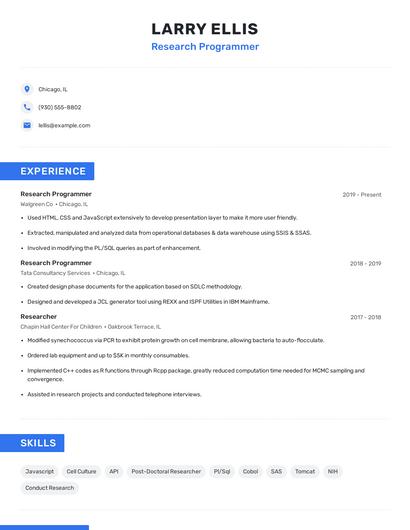
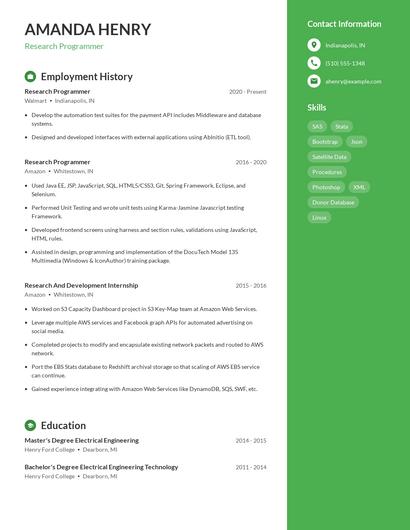
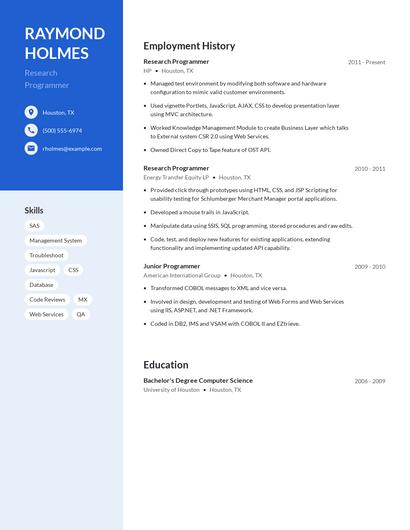
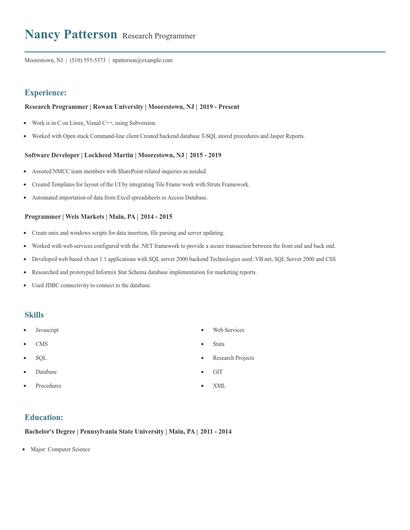
Choose from 10+ customizable research programmer resume templates
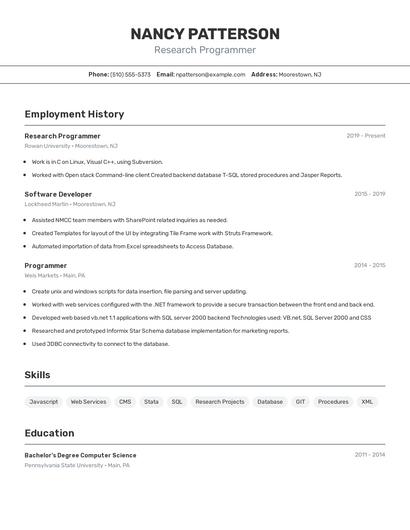
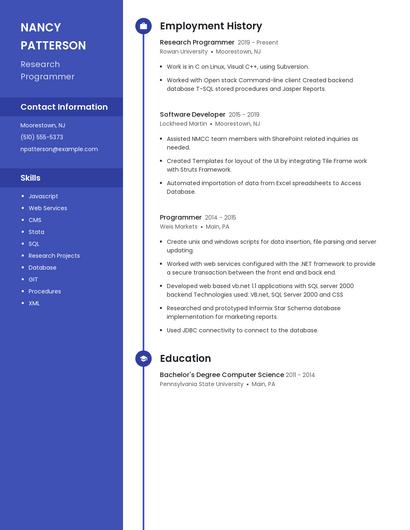
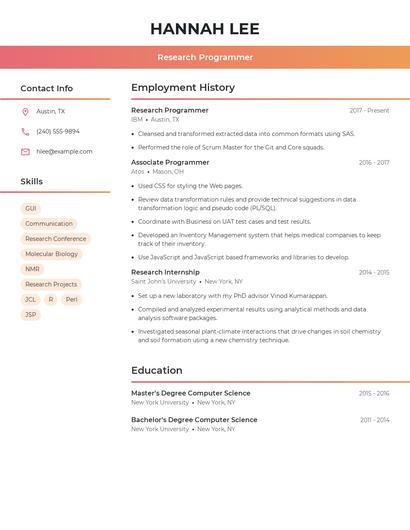
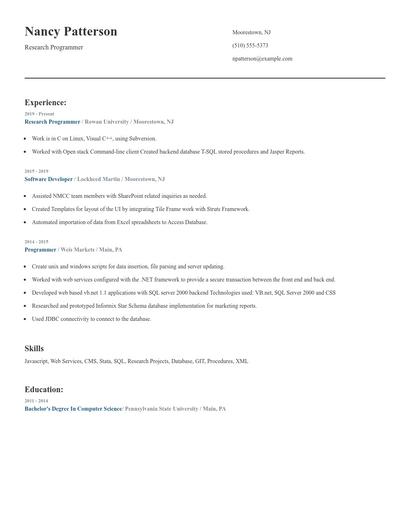
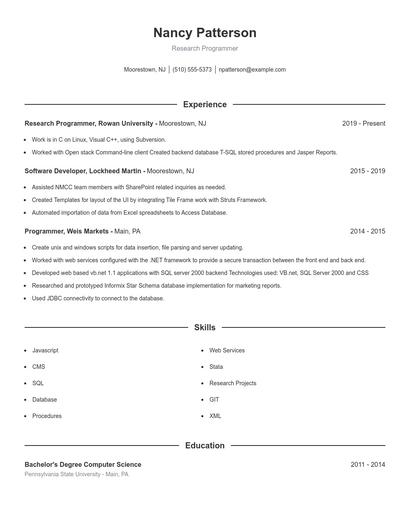
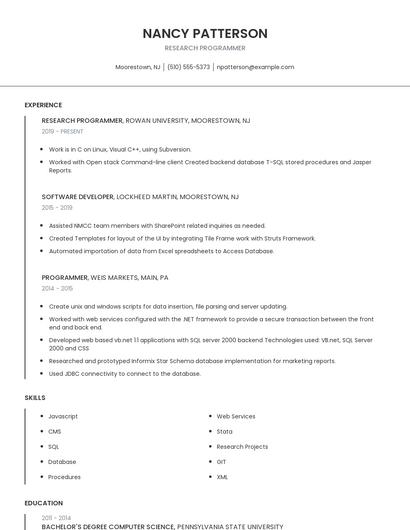
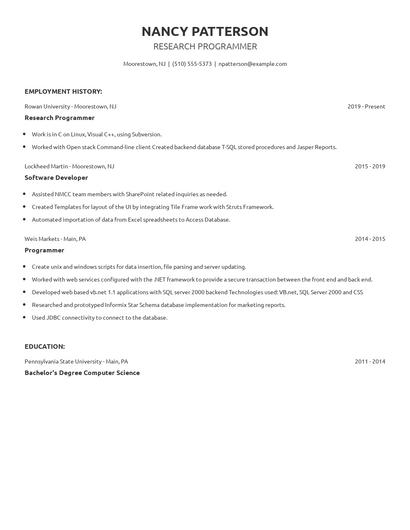
Build a professional research programmer resume in minutes. Our AI resume writing assistant will guide you through every step of the process, and you can choose from 10+ resume templates to create your research programmer resume.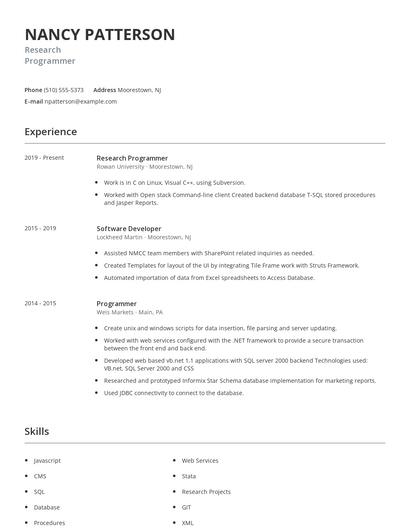
Compare different research programmers
Research programmer vs. Software design engineer
A software design engineer or SDE is part of a software development enterprise. Software design engineers determine the problems or issues and figure out how to establish programs to ease and automate the situations. They fabricate style sheets for the management of the individual aspects of huge engineering projects. It is their job to develop strategies for hardware architecture and software engineering. They also handle and mentor engineering interns for professional guidance.
There are some key differences in the responsibilities of each position. For example, research programmer responsibilities require skills like "research projects," "sas," "data analysis," and "stata." Meanwhile a typical software design engineer has skills in areas such as "software design," "git," "azure," and "database." This difference in skills reveals the differences in what each career does.
Software design engineers earn the highest salaries when working in the technology industry, with an average yearly salary of $108,183. On the other hand, research programmers are paid more in the professional industry with an average salary of $91,108.software design engineers tend to reach similar levels of education than research programmers. In fact, software design engineers are 3.3% less likely to graduate with a Master's Degree and 0.7% less likely to have a Doctoral Degree.Research programmer vs. Software engineering internship
A software engineer intern is responsible for assisting the technology department's operations, using their class knowledge on performing practical applications. Software engineer interns support software engineers on their processes, shadowing their daily tasks, and performing duties under mentors' supervision. They assess ideas, contribute to the development of new applications, and research current technology trends to help with product innovations. A software engineer intern must have excellent knowledge of the technology systems industry, programming languages, and learn efficiently through observations.
In addition to the difference in salary, there are some other key differences worth noting. For example, research programmer responsibilities are more likely to require skills like "research projects," "sas," "stata," and "extraction." Meanwhile, a software engineering internship has duties that require skills in areas such as "object oriented programming," "cloud," "emerging technologies," and "git." These differences highlight just how different the day-to-day in each role looks.
On average, software engineering interns earn a lower salary than research programmers. Some industries support higher salaries in each profession. Interestingly enough, software engineering interns earn the most pay in the technology industry with an average salary of $54,203. Whereas research programmers have higher pay in the professional industry, with an average salary of $91,108.software engineering interns earn similar levels of education than research programmers in general. They're 2.1% less likely to graduate with a Master's Degree and 0.7% less likely to earn a Doctoral Degree.Research programmer vs. Software engineer-consultant
A software engineer consultant develops and recommends strategies to optimize a company's software engineering operations. Their responsibilities revolve around conducting extensive research and analysis to find new opportunities, performing software evaluations and risk assessments, identifying the strengths and weaknesses of existing processes, and developing solutions against problem areas. Through the findings of their research, a software engineer consultant draws conclusions and recommendations that will help the company to reach their short and long-term goals and resolve issues or concerns.
Some important key differences between the two careers include a few of the skills necessary to fulfill the responsibilities of each. Some examples from research programmer resumes include skills like "research projects," "sas," "data analysis," and "stata," whereas a software engineer-consultant is more likely to list skills in "architecture," "scrum," "ui," and "database. "
Software engineers-consultant earn the best pay in the insurance industry, where they command an average salary of $118,185. Research programmers earn the highest pay from the professional industry, with an average salary of $91,108.When it comes to education, software engineers-consultant tend to earn similar degree levels compared to research programmers. In fact, they're 4.4% less likely to earn a Master's Degree, and 0.7% less likely to graduate with a Doctoral Degree.Research programmer vs. Principal software engineer
A Principal Software Engineer is responsible for the technical aspects of an organization's projects. They diagnose, document, and troubleshoot systems to resolve problems identified through testing, as well as implement strategies to improve integration and efficiency.
Types of research programmer
Updated January 8, 2025
