What does a robot technician do?
A robot technician is an individual who operates, configures, and tests robotic equipment as well as perform the first installation of the robot for industrial companies. Robot technicians are required to assist manufacturing, mechanical, and electronics engineers in all phases of robotic design, development, production, testing, and operations. They must provide preventive maintenance to robots to ensure that they are working properly. Robot technicians are also required to perform mechanical troubleshooting and repair to robotic equipment with preventive and corrective maintenance.
Robot technician responsibilities
Here are examples of responsibilities from real robot technician resumes:
- Evaluate the efficiency and reliability of industrial robotic systems, reprogramming or calibrating to achieve maximum quantity and quality.
- Bleed the lines, drain moisture filters (dryers).
- Program and operate CNC milling machine.
- Perform routine PMs on all equipment as scheduled.
- Design and fabricate replacement and new jigs and fixtures for fabrication and production areas.
- Install, program, troubleshoot and repair automate welding systems (MIG and spot/resistance).
- Experience in MIG and arc welding; know how to use a Plaz cutter and torch.
- Verify conformance of workpieces to specifications, using calipers, squares, rulers, and measuring tapes.
- Maintain robots, monitor PLC for line faults to keep production of BMW vehicles flowing through the plant.
- Position parts in jigs and fixtures on bench and floor, and clamp parts together along layout marks.
- Operate /maintained generators, steam boilers, compressors and dryers, water treating equipment, and mix chemicals.
- Perform setup, mastering, debugging, configure I/O, tool frame, user frame, touchups and repairs.
- Analyze, calibrate and replace capacitance level probes, pressure transmitters, temperature transmitters, and other measurement devices.
- Experience with industrial robots for welding with seam-tracking software, pick-and-place with vision control and CNC control laser cutting robots.
- Work safely with sharp edges and cutting tools through being attentive of hazards and utilizing the appropriate PPE for the task.
Robot technician skills and personality traits
We calculated that 20% of Robot Technicians are proficient in Preventative Maintenance, Continuous Improvement, and PLC. They’re also known for soft skills such as Interpersonal skills, Writing skills, and Mechanical skills.
We break down the percentage of Robot Technicians that have these skills listed on their resume here:
- Preventative Maintenance, 20%
Conduct repairs and preventative maintenance on robotic wafer handling and sorting equipment.
- Continuous Improvement, 15%
Project Manager for all continuous improvement and innovation projects.
- PLC, 10%
Programmed industrial PLC automation systems for various manufacturing and coating applications.
- General Maintenance, 8%
General maintenance of Amazon Kiva Robots.
- Robotic, 7%
Supervised and scheduled Robotic Technicians responsible for robot and automation maintenance for a 24/7 computer disc manufacturing operation.
- Technical Support, 6%
Support sales staff with technical support in the sale robotics, automation and welding equipment.
"preventative maintenance," "continuous improvement," and "plc" are among the most common skills that robot technicians use at work. You can find even more robot technician responsibilities below, including:
Writing skills. Another soft skill that's essential for fulfilling robot technician duties is writing skills. The role rewards competence in this skill because "electro-mechanical and mechatronics technologists and technicians must write clear, well-organized reports that describe onsite construction, testing results, and problems they found in carrying out designs." According to a robot technician resume, here's how robot technicians can utilize writing skills in their job responsibilities: "key player in designing and writing robotic programs for tig, plasma, and mig cells. "
Mechanical skills. This is an important skill for robot technicians to perform their duties. For an example of how robot technician responsibilities depend on this skill, consider that "electro-mechanical and mechatronics technologists and technicians must create components for industrial machinery or equipment." This excerpt from a resume also shows how vital it is to everyday roles and responsibilities of a robot technician: "performed electrical and mechanical troubleshooting of robots, weld guns, stud weld guns, pneumatic systems. ".
Detail oriented. robot technician responsibilities often require "detail oriented." The duties that rely on this skill are shown by the fact that "electro-mechanical and mechatronics technologists and technicians must take and record the precise measurements that engineers need." This resume example shows what robot technicians do with detail oriented on a typical day: "skilled in robotic telemetry/frequency calibration, robotic motion calibrations, electro-mechanical troubleshooting, failure analysis, and detailed work order reporting. "
Math skills. Another crucial skill for a robot technician to carry out their responsibilities is "math skills." A big part of what robot technicians relies on this skill, since "electro-mechanical and mechatronics technologists and technicians use mathematics for analysis, design, and troubleshooting in their tasks." How this skill relates to robot technician duties can be seen in an example from a robot technician resume snippet: "calculate dimensions and tolerances using knowledge of mathematics and instruments such as micrometers and vernier calipers. "
Dexterity. Another skill commonly found on robot technician job descriptions is "dexterity." It can come up quite often in robot technician duties, since "electro-mechanical and mechatronics technologists and technicians must be adept in using handtools and soldering irons on small circuitry and electronic parts to create electronic components." Here's an example from a resume of how this skill fits into day-to-day robot technician responsibilities: "maintain and troubleshoot dl1-1/2 (drop lifter 1 and 2) using plc and the operator panel. "
The three companies that hire the most robot technicians are:
- Jet Propulsion Laboratory6 robot technicians jobs
- Lippert Components4 robot technicians jobs
- Magna International3 robot technicians jobs
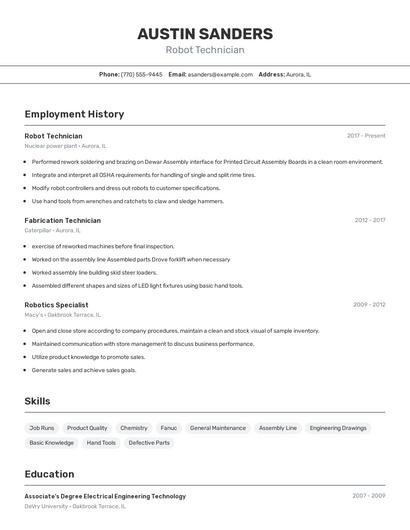
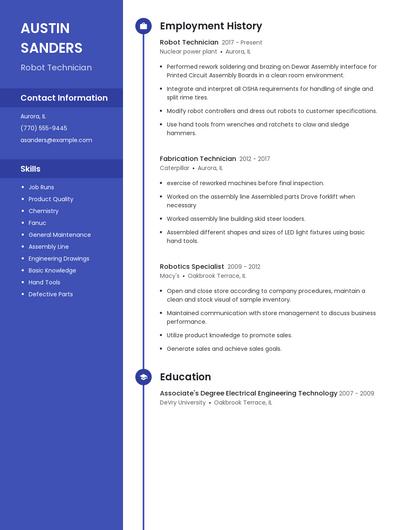
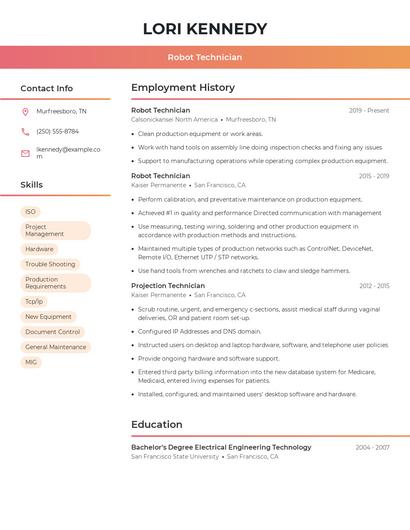
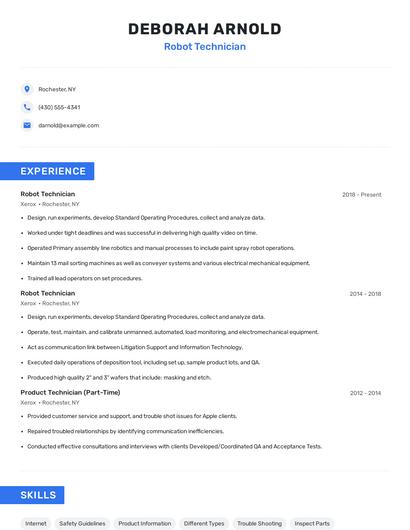
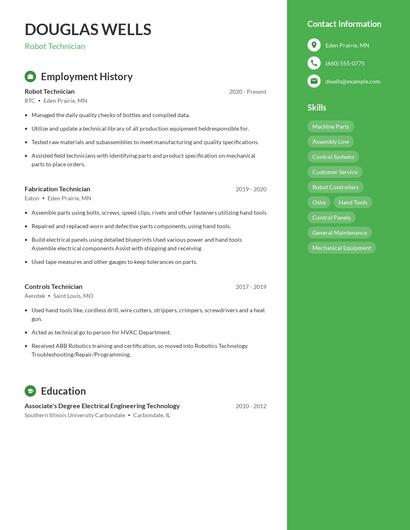
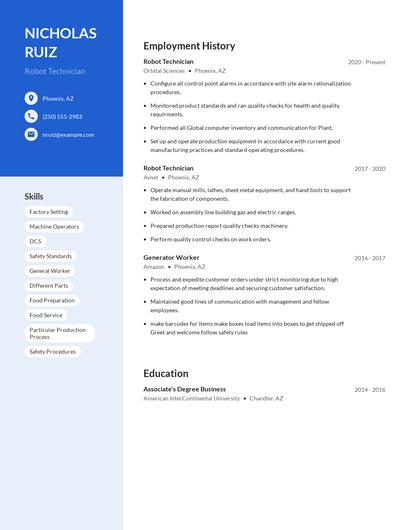
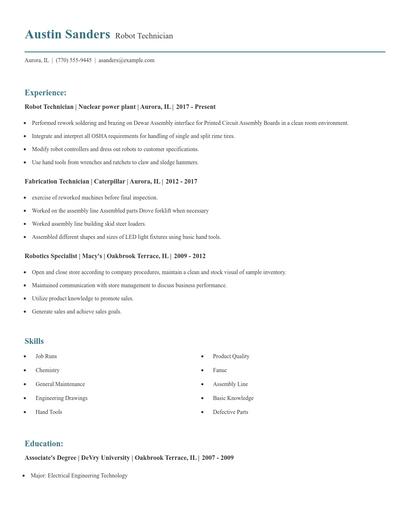
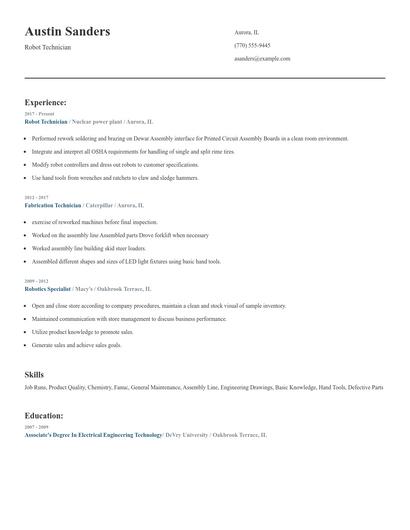
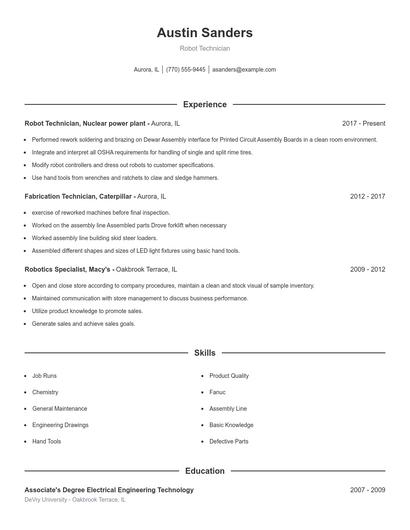
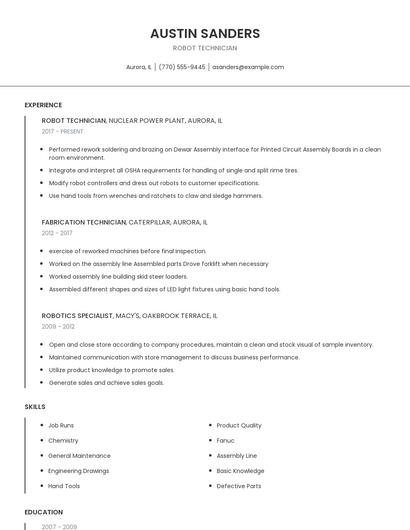
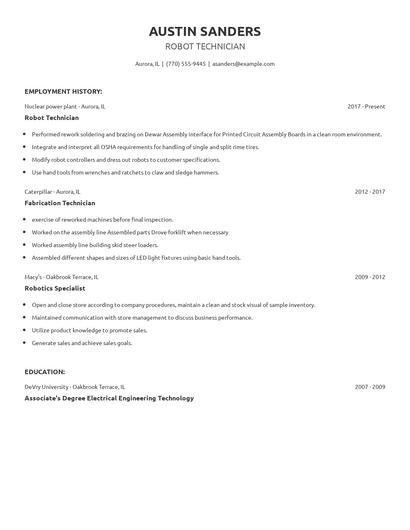
Choose from 10+ customizable robot technician resume templates
Build a professional robot technician resume in minutes. Our AI resume writing assistant will guide you through every step of the process, and you can choose from 10+ resume templates to create your robot technician resume.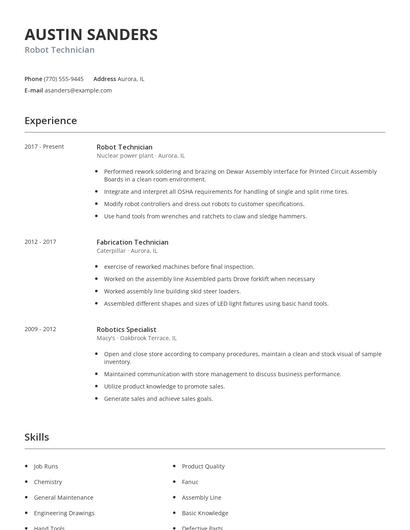
Compare different robot technicians
Robot technician vs. Electronics repair technician
An electronics repair technician assists in the design, development, testing, repair, and maintenance of electronic and electrical equipment and devices such as computers, navigational equipment, and communication equipment. Your duties will include configuring files on routers, hubs, switches, and internet controllers, installing new electronic systems and equipment, and running software tests and upgrading software. Additional duties include performing preventative maintenance, maintaining reports and manuals, training new technicians in problem prevention and troubleshooting, and removing and replacing faulty components and parts.
There are some key differences in the responsibilities of each position. For example, robot technician responsibilities require skills like "preventative maintenance," "continuous improvement," "general maintenance," and "robotic." Meanwhile a typical electronics repair technician has skills in areas such as "electronic devices," "electronic distance," "night vision equipment," and "oscilloscopes." This difference in skills reveals the differences in what each career does.
Electronics repair technicians really shine in the technology industry with an average salary of $50,672. Comparatively, robot technicians tend to make the most money in the automotive industry with an average salary of $67,365.The education levels that electronics repair technicians earn slightly differ from robot technicians. In particular, electronics repair technicians are 0.0% less likely to graduate with a Master's Degree than a robot technician. Additionally, they're 0.1% more likely to earn a Doctoral Degree.Robot technician vs. Robotics specialist
An Engineering Technician's duties vary according to the industry or company, whether mechanical, industrial, civil, agricultural, or more. However, most of the time, the responsibilities often revolve around resolving technical issues, working with and assisting Engineers in building, assembling, designing, gathering and testing data, and conducting more manual activities. Furthermore, Engineering Technicians can specialize and work in various fields after a certain training period, closely mentored or monitored by an engineer or someone with extensive expertise.
In addition to the difference in salary, there are some other key differences worth noting. For example, robot technician responsibilities are more likely to require skills like "preventative maintenance," "continuous improvement," "general maintenance," and "robotic." Meanwhile, a robotics specialist has duties that require skills in areas such as "computer software," "gi," "fanuc," and "troubleshoot." These differences highlight just how different the day-to-day in each role looks.
Average education levels between the two professions vary. Robotics specialists tend to reach similar levels of education than robot technicians. In fact, they're 2.7% more likely to graduate with a Master's Degree and 0.1% more likely to earn a Doctoral Degree.Robot technician vs. Engineering technician
The primary job of mechanical technicians is to help mechanical engineers design, develop, test, and manufacture mechanical devices such as machines and engines. They typically do varied tasks, including evaluating design sketches for new and changing tools, discussing changes with colleagues, and reviewing blueprints and instructions for projects. As a mechanical technician, you are also responsible for estimating equipment life, plant space, and labor costs. To become successful in this role, you need to have an associate degree in mechanical engineering technology, excellent communication skills, and mechanical skills.
The required skills of the two careers differ considerably. For example, robot technicians are more likely to have skills like "continuous improvement," "general maintenance," "robotic," and "maintenance procedures." But a engineering technician is more likely to have skills like "data collection," "test equipment," "asphalt," and "construction projects."
Engineering technicians make a very good living in the technology industry with an average annual salary of $76,126. On the other hand, robot technicians are paid the highest salary in the automotive industry, with average annual pay of $67,365.Most engineering technicians achieve a similar degree level compared to robot technicians. For example, they're 2.3% more likely to graduate with a Master's Degree, and 0.1% more likely to earn a Doctoral Degree.Robot technician vs. Mechanical technician
Types of robot technician
Updated January 8, 2025
