
Automatically apply for jobs with Zippia
Upload your resume to get started.
Security receptionist skills for your resume and career
15 security receptionist skills for your resume and career
1. Customer Service
Customer service is the process of offering assistance to all the current and potential customers -- answering questions, fixing problems, and providing excellent service. The main goal of customer service is to build a strong relationship with the customers so that they keep coming back for more business.
- Front desk reception area Answered and directed telephone calls Security duties Provide excellent customer service skills
- Provided customer service greeting employees and visitors, monitored daily operations of facility.
2. Direct Visitors
- Greet, identify and direct visitors, and arrange for escort as appropriate maintain visitor logs and related documentation.
- Served as the face of the organization; greet and direct visitors and employees as needed.
3. ID
- Schedule appointments for security identification badges, take photos with digital camera and process security ID badges for staff.
- Greeted and welcomed all employees, applicants and visitors daily Logged incoming/outgoing visitors and distributed visitor ID badges.
4. Visitor Badges
- Maintain security control by following company procedures; issuing visitor badges.
- Performed an end-of-the-day inventory of issued visitor badges.
5. HR
HR stands for human resources and is used to describe the set of people who work for a company or an organization. HR responsibilities revolve around updating employee records and carrying out management processes like planning, recruitment, evaluation, and selection processes. HR is a key contributor to any company or organization's growth as they are in charge of hiring the right employees, processing payrolls, conducting disciplinary actions, etc.
- Served as the primary resource for HR building, answered HR related questions and trained new employees on building procedures.
- Maintain HR I9 compliance collecting and entering appropriate documents into TALX database.
6. Phone Calls
Phone calls are a wireless or wired connection made over a telephone or a mobile phone between two people. Two parties are involved in a phone call, the caller and the receiver. A caller dials the number of the one he wants to call, and the recipient hears a bell or a tune to which he picks up the call. The call establishes a connection between them through which they can communicate. The voice is converted into signals and is transmitted through wired or wireless technology.
- Answered telephone calls and made emergency calls to police/fire department when any incident occurred.
- Answered telephone calls to take massages, answered questions, and provided information during non-business hours or when switchboard is closed.
7. Patrol
- Conducted campus patrol and enforced company policies.
- Operated company vehicle during patrol.
8. Data Entry
Data entry means entering data into a company's system with the help of a keyboard. A person responsible for entering data may also be asked to verify the authenticity of the data being entered. A person doing data entry must pay great attention to tiny details.
- Performed data entry services including input of customers and updated existing computerized files or documents.
- Completed data entry, collected applications and/or resumes maintained employees parking decal tracking system.
9. Client Facility
- Practice team building workplace practices to create balance and strengthen security detail at client facility.
- Uphold and employ client card access protocols amongst all personnel within client facility.
10. Emergency Situations
- Prepared incident reports in emergency situations while remaining responsive to law enforcement investigations.
- Directed and assisted in emergency situations.
11. Front-Desk Reception
- Operated front-desk switchboard with over one hundred extensions.
- Demonstrated proficiencies in telephone and front-desk reception within a high- volume environment.
12. Incident Reports
An Incident Report, in a medical facility such as hospitals and nursing homes, is a type of paperwork filled out immediately after and in the case of an incident of some sort, with the goal of describing the incident and its consequences, as well as the measurements taken after or during the incident, as well as any other information relevant to said incident. Such an incident might be a patient acting out or a patient being injured.
- Document all security department activity and generate incident reports as necessary.
- Constructed incident reports and maintained routine activity reports.
13. CCTV
- Coordinated emergency response procedures including evacuations Monitor Closed Circuit Television (CCTV) camera equipment.
- Performed various duties such as answering phone lines, monitoring CCTV equipment, and providing access control.
14. Telephone Calls
Telephone calls are a communication means through which a caller is connected to the called party. The call is done through a telecommunications device called a telephone. The caller can use a landline, mobile phone, or satellite phone to make the call.
- Monitored and answered telephone calls by taking messages, answering questions and providing information during business hours.
- Perform miscellaneous job-related duties such as answering telephone calls and providing information during non-business hours.
15. Security Cameras
- Maintained a safe work environment by operating security cameras, monitoring visitor access and conducting premise patrols.
- Monitor security cameras for resident safety and ensure all emergencies are handled promptly and appropriately.

What skills help Security Receptionists find jobs?
Tell us what job you are looking for, we’ll show you what skills employers want.
List of security receptionist skills to add to your resume
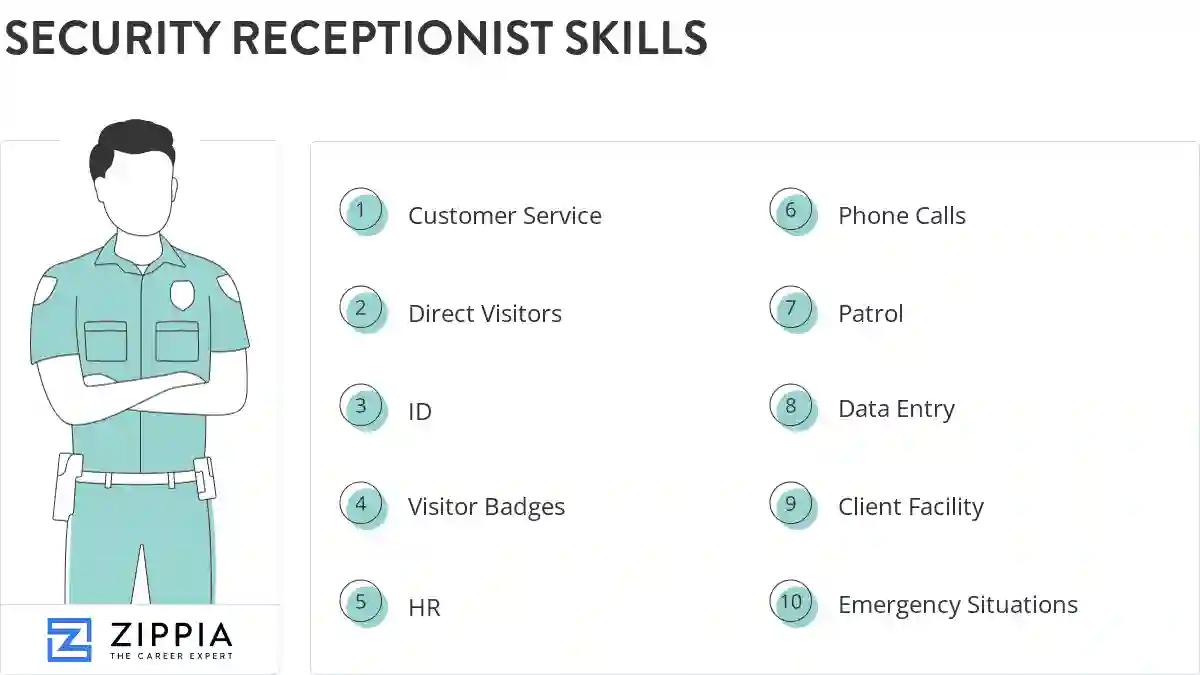
The most important skills for a security receptionist resume and required skills for a security receptionist to have include:
- Customer Service
- Direct Visitors
- ID
- Visitor Badges
- HR
- Phone Calls
- Patrol
- Data Entry
- Client Facility
- Emergency Situations
- Front-Desk Reception
- Incident Reports
- CCTV
- Telephone Calls
- Security Cameras
- Law Enforcement
- Security Systems
- Property Damage
- Administrative Tasks
- Greeting Visitors
- Transferring Calls
- CPR
- Security Procedures
- Security Issues
- Direct Calls
- Scheduling Appointments
- Multi-Line Phone System
- Security Rounds
- Medical Emergencies
- Emergency Calls
- Fire Alarms
- Alarm Systems
- AED
- Surveillance Cameras
- Word Processing
- Office Equipment
- Lenel
- Multi-Line Telephone System
- Surveillance Equipment
- Security Clearance
- PowerPoint
- Identification Card
- Telephone Switchboard
- Bomb Threats
- Security Badges
- Multi-Line Switchboard
Updated January 8, 2025
