What does a senior security & network engineer do?
A senior security and network engineer is an individual responsible for planning, designing, monitoring, and troubleshooting the network security system to improve organizational efficiency. The network security job is to safeguard a firm's computer networks and systems from threats such as cyber-attacks, intrusion, infiltration, and natural disasters. The job requirements for the main network security engineer position include a network engineer degree, experience in creating and maintaining security systems, and knowledge of computer forensic tools.
Senior security & network engineer responsibilities
Here are examples of responsibilities from real senior security & network engineer resumes:
- Manage external DNS for corporate domains and external ISP IP blocks.
- Configure, manage devices ASA 5520-40-80 site to site VPN and perimeter security.
- Configure and tune BGP attributes to achieve maximum efficiency and redundancy.
- Manage information technology security, including backups, firewalls, and routers.
- Analyze and test network protocols (Ethernet, TCP/IP) using Wireshark tool.
- Provide first-level support for the Linux and UNIX servers used to house the VDSS applications.
- Involve in the removal of EIGRP from all devices and making OSPF the primary routing protocol.
- Maintain network data centers, wiring closets, cabling, servers, consoles, switches, routers, etc.
- Upgrade of LAN connections, such as adding switches for redundancy, capacity planning, and stacking of switches.
- Implement firewall solutions including VPN connectivity.
- Used Wireshark for packet capturing.
- Shell scripting and job scheduling for Unix databases.
- Experience in configuring virtual machines on Linux server platforms.
- Create and maintain SQL accounts and set database permissions.
- Involve in troubleshooting of DNS, DHCP and other IP conflict problems.
Senior security & network engineer skills and personality traits
We calculated that 10% of Senior Security & Network Engineers are proficient in Network Security, Cisco Asa, and Switches. They’re also known for soft skills such as Communication skills, Analytical skills, and Problem-solving skills.
We break down the percentage of Senior Security & Network Engineers that have these skills listed on their resume here:
- Network Security, 10%
Job duties include support for large-scale managed network security infrastructure consisting of customer-premises Linux-based Rampart firewalls and intrusion detection systems.
- Cisco Asa, 6%
Configure Cisco ASA5520 firewall cluster for disaster recovery location.
- Switches, 5%
Manage and support NetApp, Dell, QNAP and EMC storage arrays, utilizing Cisco 9124 fabric switches for fiber zoning.
- Network Infrastructure, 3%
Design and implemented network infrastructure and configured all the network Infrastructure devices including Network Printers and Registers.
- BGP, 3%
Configured and tuned BGP attributes to achieve maximum efficiency and redundancy.
- ASA, 3%
Recommended various lacking best practices for ASA Firewalls for improving efficiency and better resource utilization for production networks.
"network security," "cisco asa," and "switches" are among the most common skills that senior security & network engineers use at work. You can find even more senior security & network engineer responsibilities below, including:
Communication skills. One of the key soft skills for a senior security & network engineer to have is communication skills. You can see how this relates to what senior security & network engineers do because "administrators must describe problems and their solutions to non-it workers." Additionally, a senior security & network engineer resume shows how senior security & network engineers use communication skills: "utilize wireshark for open source packaging; network troubleshooting, and communication protocol. "
Analytical skills. Another essential skill to perform senior security & network engineer duties is analytical skills. Senior security & network engineers responsibilities require that "administrators need to evaluate networks and systems to make sure that they perform reliably and to anticipate new requirements as customers’ needs change." Senior security & network engineers also use analytical skills in their role according to a real resume snippet: "designed and implemented redundant sprint datalink cellular backup solution using jbm electronics and cisco ios routers. "
Problem-solving skills. senior security & network engineers are also known for problem-solving skills, which are critical to their duties. You can see how this skill relates to senior security & network engineer responsibilities, because "administrators must quickly resolve problems that arise with computer networks." A senior security & network engineer resume example shows how problem-solving skills is used in the workplace: "deployed a large-scale hsrp solution to improve the uptime of collocation customers, in the event a core router became unreachable. "
The three companies that hire the most senior security & network engineers are:
- CDW4 senior security & network engineers jobs
- Sirius Federal
4 senior security & network engineers jobs
- Fannie Mae Northeastern Region
4 senior security & network engineers jobs
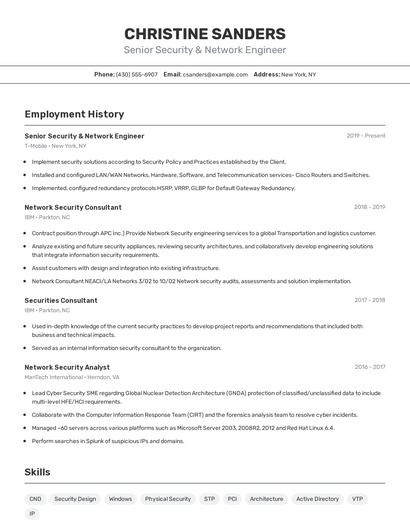
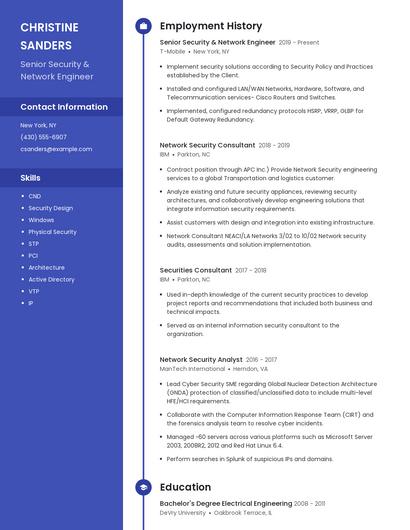
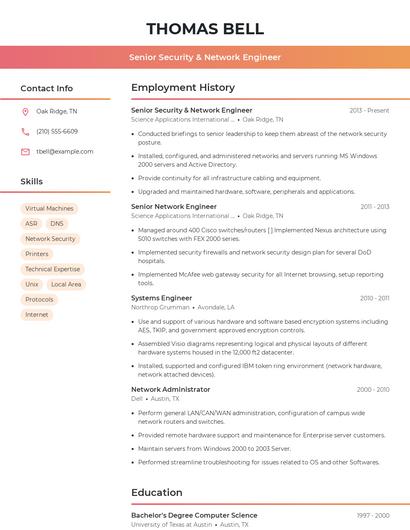
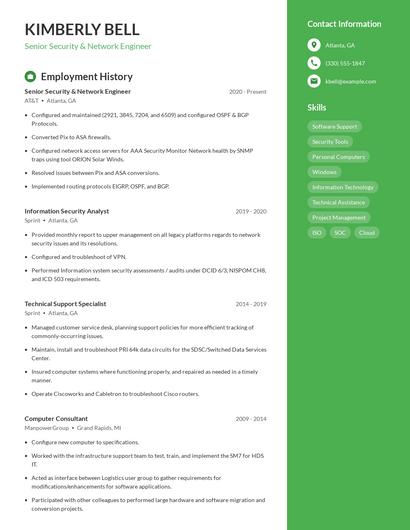
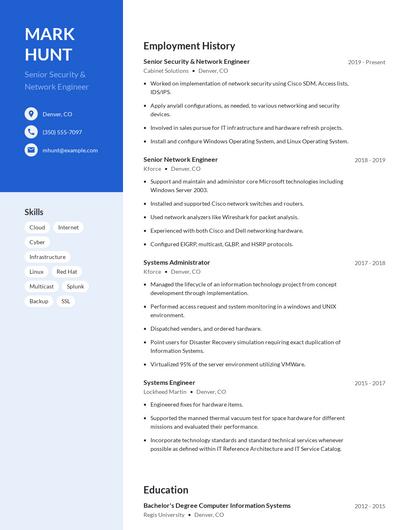
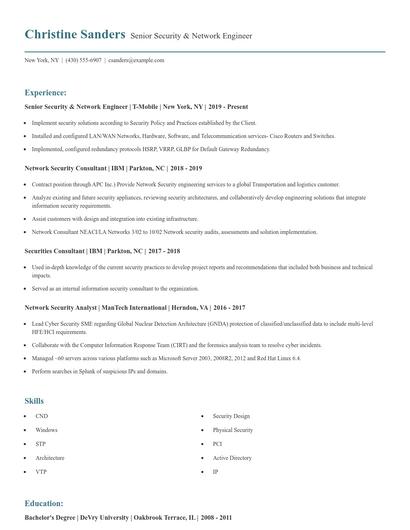
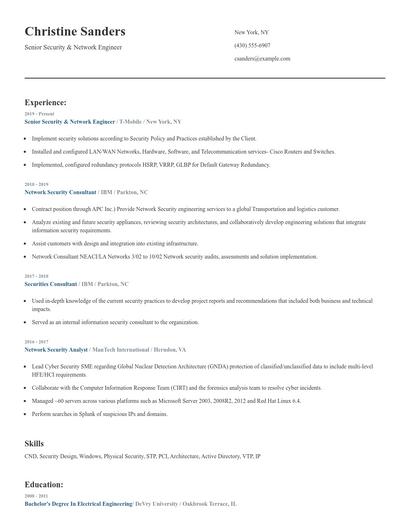
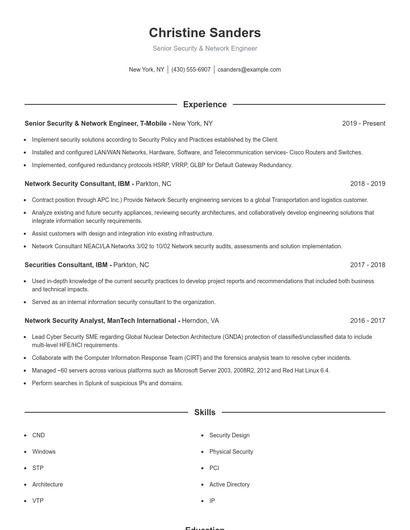
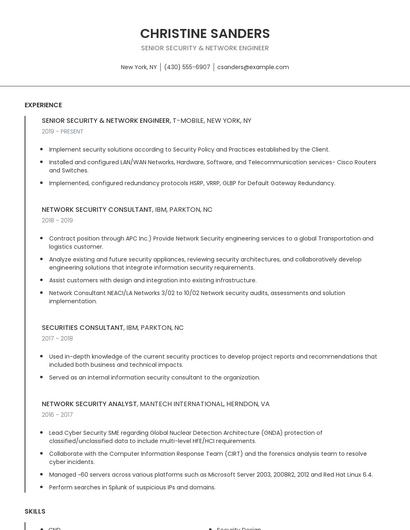
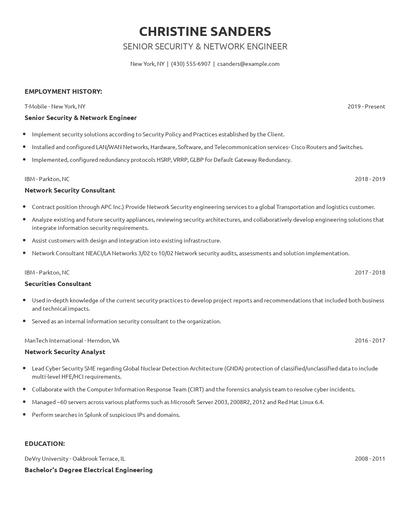
Choose from 10+ customizable senior security & network engineer resume templates
Build a professional senior security & network engineer resume in minutes. Our AI resume writing assistant will guide you through every step of the process, and you can choose from 10+ resume templates to create your senior security & network engineer resume.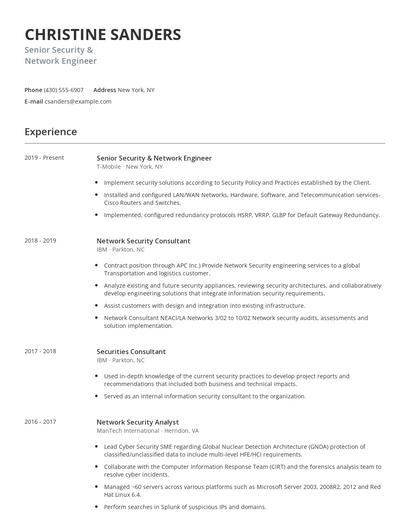

Compare different senior security & network engineers
Senior security & network engineer vs. Information technology administrator
An Information Technology (IT) administrator is an individual responsible for managing the day-to-day operation of an organization's IT systems and ensuring that the systems are running effectively. IT administrators must conduct consistent analyses of the computer system and install updates when needed. They are required to assess the organization's security programs and run the system for viruses and spyware. IT administrators also extend support to the organization's end-users and train them on desktop applications.
There are some key differences in the responsibilities of each position. For example, senior security & network engineer responsibilities require skills like "bgp," "asa," "windows," and "ospf." Meanwhile a typical information technology administrator has skills in areas such as "customer service," "database," "windows server," and "pc." This difference in skills reveals the differences in what each career does.
Information technology administrators tend to make the most money working in the finance industry, where they earn an average salary of $93,678. In contrast, senior security & network engineers make the biggest average salary, $127,265, in the internet industry.The education levels that information technology administrators earn slightly differ from senior security & network engineers. In particular, information technology administrators are 8.9% less likely to graduate with a Master's Degree than a senior security & network engineer. Additionally, they're 0.1% less likely to earn a Doctoral Degree.Senior security & network engineer vs. Administrator
Administrators are administrative professionals who oversee the whole office or department. They manage office activities and supervise administrative functions in the office. They work the office calendar and oversee the appointment-setting process. They coordinate office events and ensure that all preparations are made and that there are no conflicting schedules. They also maintain a database of external providers of various office needs. Administrators also oversee office supplies and prepare purchase requisitions. They also manage janitorial services and other functions that are related to the maintenance of the physical office space. Administrators ensure that all fixtures and equipment in the office are functioning well and have no problems.
While some skills are similar in these professions, other skills aren't so similar. For example, resumes show us that senior security & network engineer responsibilities requires skills like "network security," "cisco asa," "switches," and "tcp ip." But an administrator might use other skills in their typical duties, such as, "customer service," "data entry," "payroll," and "financial reports."
Administrators earn a lower average salary than senior security & network engineers. But administrators earn the highest pay in the manufacturing industry, with an average salary of $78,798. Additionally, senior security & network engineers earn the highest salaries in the internet with average pay of $127,265 annually.administrators earn similar levels of education than senior security & network engineers in general. They're 4.0% less likely to graduate with a Master's Degree and 0.1% more likely to earn a Doctoral Degree.Senior security & network engineer vs. Systems administrator
Systems administrators are employees who oversee information technology infrastructures in the office. They are skilled information technology professionals who are knowledgeable about the company's network systems and other technology-related infrastructures. They are responsible for installing, configuring, or updating network systems, software, and hardware. They also monitor the different systems and troubleshoot any issues that users may encounter. Systems administrators manage the access of users, ensure the security of the network, and address any challenges that users may have. They conduct repairs and routine maintenance to ensure that the systems in place are in the best shape.
There are many key differences between these two careers, including some of the skills required to perform responsibilities within each role. For example, a senior security & network engineer is likely to be skilled in "network security," "bgp," "asa," and "windows," while a typical systems administrator is skilled in "windows server," "database," "powershell," and "os."
Systems administrators make a very good living in the technology industry with an average annual salary of $86,962. On the other hand, senior security & network engineers are paid the highest salary in the internet industry, with average annual pay of $127,265.Most systems administrators achieve a lower degree level compared to senior security & network engineers. For example, they're 7.4% less likely to graduate with a Master's Degree, and 0.1% less likely to earn a Doctoral Degree.Senior security & network engineer vs. System technician
A system technician is an individual responsible for supporting users with issues related to the computer system. System technicians conduct appropriate diagnostics on computer issues and must be able to explain technical issues to clients or team members. They should carry out tests on the system so that they can generate error reports to identify and fix any computer system problems. System technicians also can write and maintain computer programs and work with computers and electronics, including circuit boards, computer hardware and software, and computer processors.
Even though a few skill sets overlap between senior security & network engineers and system technicians, there are some differences that are important to note. For one, a senior security & network engineer might have more use for skills like "network security," "cisco asa," "tcp ip," and "network infrastructure." Meanwhile, some responsibilities of system technicians require skills like "customer service," "hand tools," "preventative maintenance," and "control systems. "
The government industry tends to pay the highest salaries for system technicians, with average annual pay of $58,665. Comparatively, the highest senior security & network engineer annual salary comes from the internet industry.system technicians reach lower levels of education compared to senior security & network engineers, in general. The difference is that they're 12.7% more likely to earn a Master's Degree, and 0.3% less likely to graduate with a Doctoral Degree.Types of senior security & network engineer
Updated January 8, 2025
