What does a service center analyst do?
The job of a service center analyst is to help users resolve computer software and hardware problems. You will perform a variety of tasks that typically include responding to inquiries from users, assessing and troubleshooting IT equipment issues, and working closely with other IT staff to assist with other tasks that are outside your expertise or knowledge. In addition, you will train and support service desk personnel, keep employee and customer information confidential, and maintain records of hardware and software issues.
Service center analyst responsibilities
Here are examples of responsibilities from real service center analyst resumes:
- Used Microsoft SMS to manage software distribution and lookup hardware and software information.
- Manage customer expectations through use of negotiation, persuasion, diplomacy and clear communication.
- Switch IP traffic globally between datacenters.
- Perform and maintain daily backups for Novell and NT servers.
- Execute daily operations of HP-Unix, Novell servers and GroupWise.
- Hire as a computer operator with little UNIX experience, and advance to supervisory position.
- Answer, troubleshoot, and resolve user issues, or dispatch problem and service requests as necessary.
- Identify, troubleshoot and resolve server connectivity that impacts the end users ability to connect to a network.
- Serve as subject matter expert on wireless PDAs and Washington point person for PDA encryption project (mSecure).
- Improve SharePoint security by proposing and implementing improve security access controls & policies.
- Collaborate with retail and sale department on presentation warranty policy, and update information on SharePoint.
- Provide administration and troubleshooting for a large Citrix environment with a wide variety of conditions and applications.
- Assist patients by explaining necessary preparations, reviewing charts after discharge and determining eligibility for medication at government's expense.
- Support users who utilize VMWARE.
- Identify and resolve various LAN, connectivity, and desktop relate issues.
Service center analyst skills and personality traits
We calculated that 17% of Service Center Analysts are proficient in Customer Service, Computer System, and Data Entry. They’re also known for soft skills such as Customer-service skills, Listening skills, and Problem-solving skills.
We break down the percentage of Service Center Analysts that have these skills listed on their resume here:
- Customer Service, 17%
Completed a high volume of support activities over 7,400 service interactions annually while providing excellent customer service and escalation when needed.
- Computer System, 13%
Enter freight shipment information into the computer system Comply with all applicable laws/regulations, as well as, company policies/procedures.
- Data Entry, 13%
Perform administrative/clerical functions including maintaining files, copying, imaging, answering phones, data entry, sorting/distributing mail and/or packages.
- COD, 9%
Reconcile cash and checks collected, prepare deposits and prepare COD check remittance to customers, as required.
- Problem Resolution, 7%
Team Reduced significant number of reported issues spanning multiple clients by recommending alternate approaches and fixes to problem resolution.
- Delivery Appointments, 7%
Verify freight history and verify timely receipt to adhere to delivery appointments.
Common skills that a service center analyst uses to do their job include "customer service," "computer system," and "data entry." You can find details on the most important service center analyst responsibilities below.
Customer-service skills. To carry out their duties, the most important skill for a service center analyst to have is customer-service skills. Their role and responsibilities require that "computer support specialists must be patient and sympathetic." Service center analysts often use customer-service skills in their day-to-day job, as shown by this real resume: "contacted application support to resolve system issues and ensure customer satisfaction. "
Listening skills. Another essential skill to perform service center analyst duties is listening skills. Service center analysts responsibilities require that "support workers must be able to understand the problems that their customers are describing and know when to ask questions to clarify the situation." Service center analysts also use listening skills in their role according to a real resume snippet: "performed administrative/clerical operations assisted with logistics during city operations communicated with sales, operations, and other service centers"
Problem-solving skills. Another skill that relates to the job responsibilities of service center analysts is problem-solving skills. This skill is critical to many everyday service center analyst duties, as "support workers must identify both simple and complex computer problems, analyze them, and solve them." This example from a resume shows how this skill is used: "diagnosed and resolved hardware issues for desktop, laptop, and mobile devices. "
Speaking skills. For certain service center analyst responsibilities to be completed, the job requires competence in "speaking skills." The day-to-day duties of a service center analyst rely on this skill, as "support workers must describe the solutions to computer problems in a way that a nontechnical person can understand." For example, this snippet was taken directly from a resume about how this skill applies to what service center analysts do: "addressed, resolved and logged incident requests via remedy ticketing system. "
Writing skills. A commonly-found skill in service center analyst job descriptions, "writing skills" is essential to what service center analysts do. Service center analyst responsibilities rely on this skill because "strong writing skills are useful for preparing instructions and email responses for employees and customers, as well as for real-time web chat interactions." You can also see how service center analyst duties rely on writing skills in this resume example: "involved in writing the unix shell scripts. "
The three companies that hire the most service center analysts are:
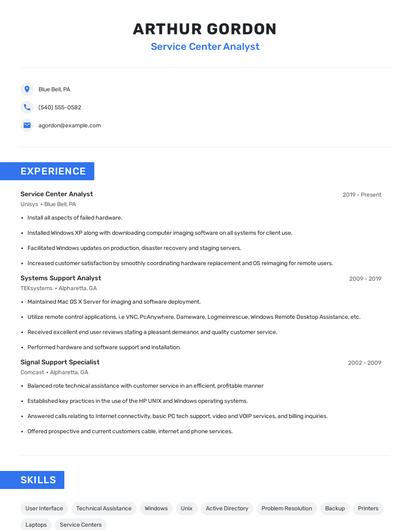
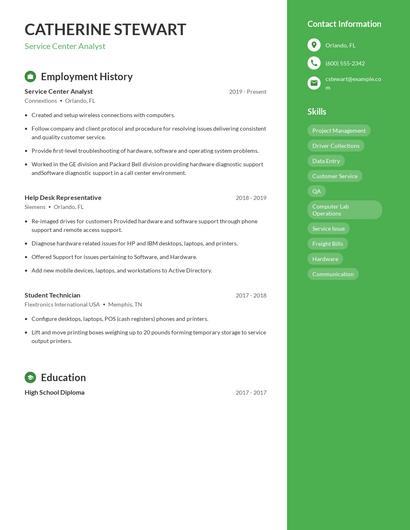
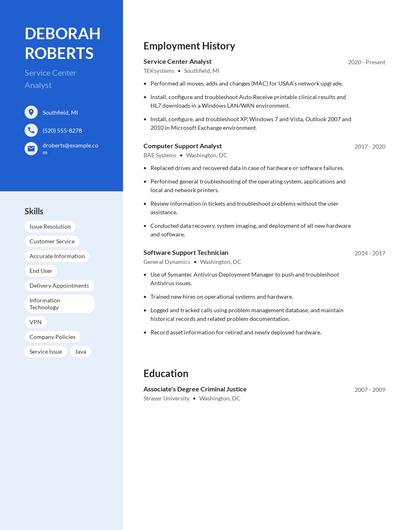
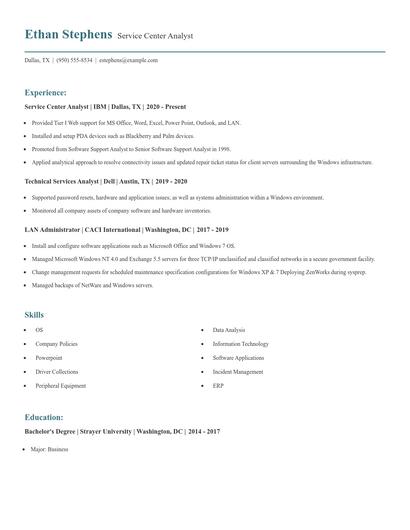
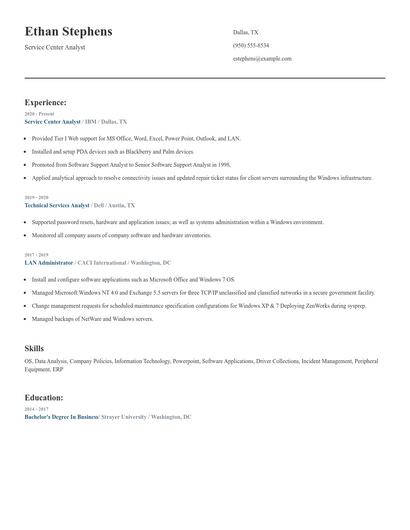
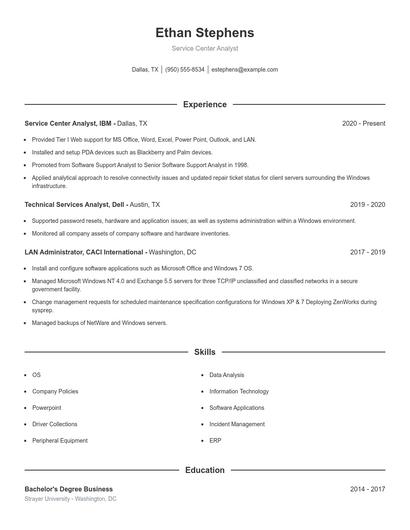
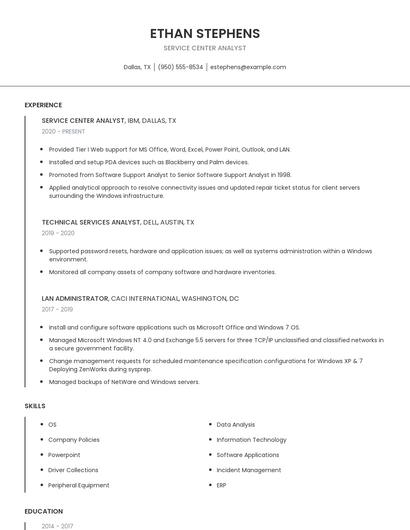
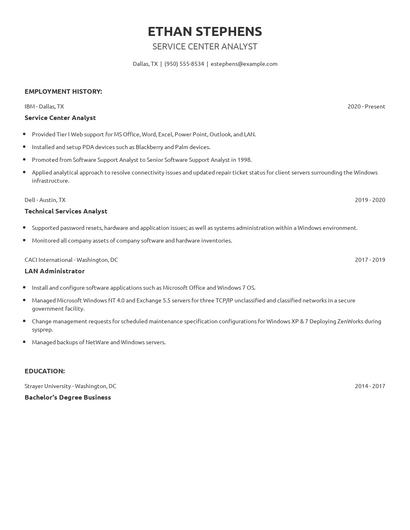
Choose from 10+ customizable service center analyst resume templates
Build a professional service center analyst resume in minutes. Our AI resume writing assistant will guide you through every step of the process, and you can choose from 10+ resume templates to create your service center analyst resume.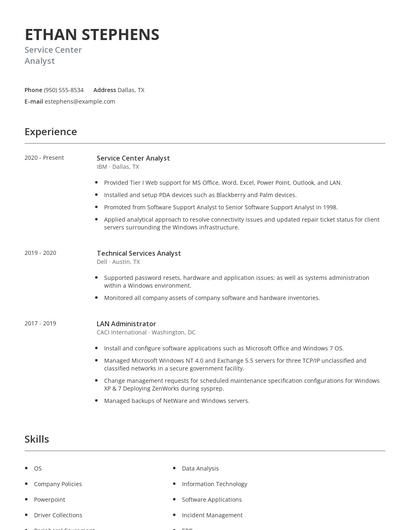
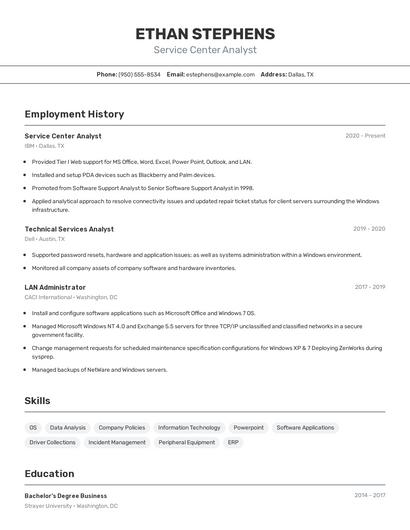
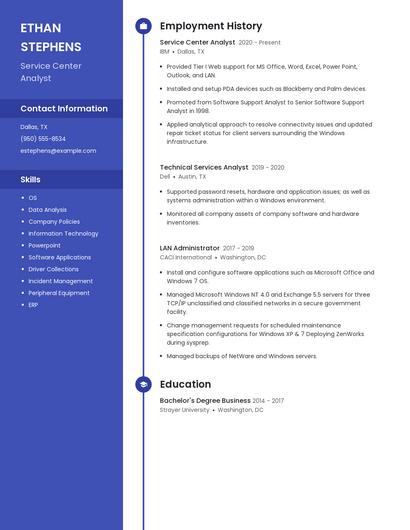
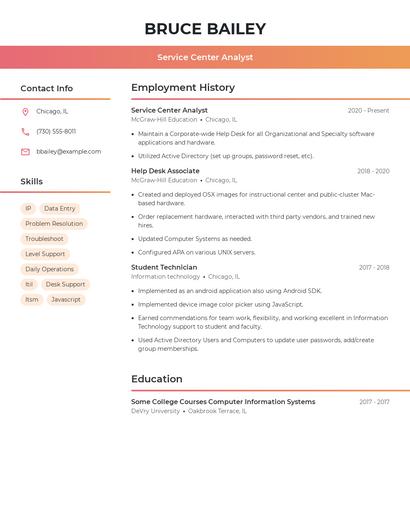
Compare different service center analysts
Service center analyst vs. Information technology technician
An information technology technician, also known as an IT technician, is responsible for ensuring that all computer systems in a company or organization are running smoothly and efficiently. Their duties primarily revolve around installing and maintaining systems, including software and hardware, and resolving any issues. They also provide technical support such as troubleshooting, navigation, and even system upgrades. Furthermore, an information technology technician can choose whether to work for a company or independently.
There are some key differences in the responsibilities of each position. For example, service center analyst responsibilities require skills like "data entry," "processing documentation," "cod," and "problem resolution." Meanwhile a typical information technology technician has skills in areas such as "desk support," "network printers," "switches," and "linux." This difference in skills reveals the differences in what each career does.
Information technology technicians earn the highest salaries when working in the finance industry, with an average yearly salary of $66,881. On the other hand, service center analysts are paid more in the technology industry with an average salary of $53,246.The education levels that information technology technicians earn slightly differ from service center analysts. In particular, information technology technicians are 1.7% less likely to graduate with a Master's Degree than a service center analyst. Additionally, they're 0.4% less likely to earn a Doctoral Degree.Service center analyst vs. Information technology/support technician
An information technology (IT) support technician is an individual who is responsible for providing support and troubleshoots software and hardware problems faced by customers. As for larger organizations that have their own IT department, technicians must work together internally with their IT staff members. IT support technicians are involved in inspecting and resolving minor local area network and wireless network issues, which include TCP/IP, DHCP, and VPN. They are also required to obtain an associate's degree in computer science or related field.
In addition to the difference in salary, there are some other key differences worth noting. For example, service center analyst responsibilities are more likely to require skills like "data entry," "processing documentation," "cod," and "problem resolution." Meanwhile, an information technology/support technician has duties that require skills in areas such as "desk support," "phone calls," "remote desktop," and "network printers." These differences highlight just how different the day-to-day in each role looks.
Information technology/support technicians may earn a lower salary than service center analysts, but information technology/support technicians earn the most pay in the technology industry with an average salary of $53,210. On the other hand, service center analysts receive higher pay in the technology industry, where they earn an average salary of $53,246.Average education levels between the two professions vary. Information technology/support technicians tend to reach similar levels of education than service center analysts. In fact, they're 1.1% less likely to graduate with a Master's Degree and 0.4% less likely to earn a Doctoral Degree.Service center analyst vs. Systems support
A systems support agent is responsible for resolving system applications and network issues, performing technical configuration, and upgrading systems infrastructure. A systems support representative conducts regular maintenance and diagnostic tests on the computer applications to ensure its optimal performance and efficiency to support business operations and avoid delays in deliverables. They also assist the technology team in designing backup systems and improve existing networks according to business requirements and specifications. They write resolution reports for reference to prevent the reoccurrence of system malfunction and inconsistencies.
There are many key differences between these two careers, including some of the skills required to perform responsibilities within each role. For example, a service center analyst is likely to be skilled in "data entry," "processing documentation," "cod," and "delivery appointments," while a typical systems support is skilled in "pc," "provides technical support," "desktop support," and "end user support."
Systems supports earn the highest salary when working in the professional industry, where they receive an average salary of $72,760. Comparatively, service center analysts have the highest earning potential in the technology industry, with an average salary of $53,246.When it comes to education, systems supports tend to earn similar degree levels compared to service center analysts. In fact, they're 1.7% more likely to earn a Master's Degree, and 0.3% more likely to graduate with a Doctoral Degree.Service center analyst vs. Desk support technician
A desktop support technician is responsible for assisting end-users with their network issues, grant authorization requests, and create user accounts. Desktop support technicians maintain the safety and security of networks, preventing unauthorized access and illegal dissemination of database information. They also handle the software configurations and upgrading the network infrastructure to avoid system downtimes and operational delays. A desktop support technician must have excellent communication and technical skills to monitor systems performance and enhance network navigation.
Types of service center analyst
Updated January 8, 2025
