What does a survey analyst do?
Survey analyst responsibilities
Here are examples of responsibilities from real survey analyst resumes:
- Help develop and handle both on and offsite SEO solutions as well as managing local campaigns and international SEO efforts.
- Collect and process statistical data on substance abuse using SAS.
- Maintain project repository and create PowerPoint presentations.
- Present information to staff using a Microsoft PowerPoint document.
- Develop SAS programs to display geographic maps and interpret multivariate analyses.
- Assist management with evaluation of restructuring alternatives, procurement of financing, negotiations with multiple constituencies and issuance of new securities.
- Develop and debug application programs for the disability/health care line of business utilizing COBOL.
Survey analyst skills and personality traits
We calculated that 12% of Survey Analysts are proficient in Analyze Data, Survey Design, and Survey Instruments. They’re also known for soft skills such as Detail oriented, Problem-solving skills, and Analytical skills.
We break down the percentage of Survey Analysts that have these skills listed on their resume here:
- Analyze Data, 12%
Collect and analyze data to support real estate development project in intern role.
- Survey Design, 12%
Approved survey design, supplemental questions and fielding letters submitted by CAHPS vendors.
- Survey Instruments, 12%
Perform quality assurance functions related to survey instruments including compliance with privacy requirements/regulations and reviewing documents for completeness.
- Stata, 9%
Used STATA and SPSS in the analysis of Excel-managed datasets.
- SAS, 8%
Interpreted and analyzed statistical data using SAS computer programs providing valuable insight toward the development of banking clients marketing efforts.
- Research Projects, 7%
Gathered data on various marketing research projects and conducted participant interviews to further supplement the data.
"analyze data," "survey design," and "survey instruments" are among the most common skills that survey analysts use at work. You can find even more survey analyst responsibilities below, including:
Detail oriented. The most essential soft skill for a survey analyst to carry out their responsibilities is detail oriented. This skill is important for the role because "survey researchers must pay attention to details, because survey results depend on collecting, analyzing, and reporting the data accurately." Additionally, a survey analyst resume shows how their duties depend on detail oriented: "perform highly detailed and extensive pricing surveys, real estate and hardship analyses independently on-site in over 35 countries. "
Problem-solving skills. Another soft skill that's essential for fulfilling survey analyst duties is problem-solving skills. The role rewards competence in this skill because "survey researchers need problem-solving skills when identifying survey design issues, adjusting survey questions, and interpreting survey results." According to a survey analyst resume, here's how survey analysts can utilize problem-solving skills in their job responsibilities: "developed adaptive automated solutions for leading telecom client as a part of fixed asset managementengagement using vba macros and ms excel. "
Analytical skills. survey analysts are also known for analytical skills, which are critical to their duties. You can see how this skill relates to survey analyst responsibilities, because "survey researchers must be able to apply statistical techniques to large amounts of data and interpret the results correctly." A survey analyst resume example shows how analytical skills is used in the workplace: "analyzed and interpreted legal descriptions, aerial imagery, plat tract maps and courthouse records. "
Communication skills. survey analyst responsibilities often require "communication skills." The duties that rely on this skill are shown by the fact that "survey researchers need strong communication skills when conducting surveys and interpreting and presenting results to clients." This resume example shows what survey analysts do with communication skills on a typical day: "created web-based, market research surveys of electronic-communication vendorsanalyzed survey data and generated insights of the e-communications market"
The three companies that hire the most survey analysts are:
- Kimley-Horn8 survey analysts jobs
- Gallagher1 survey analysts jobs
- EXL1 survey analysts jobs
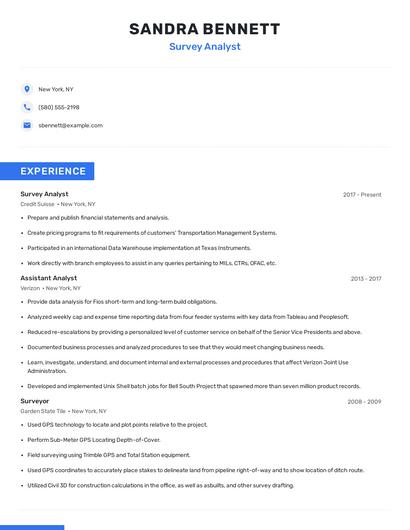
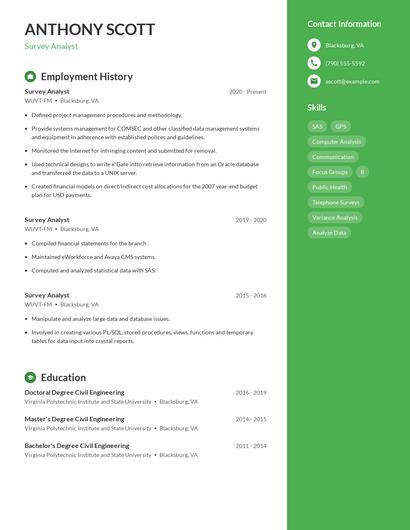
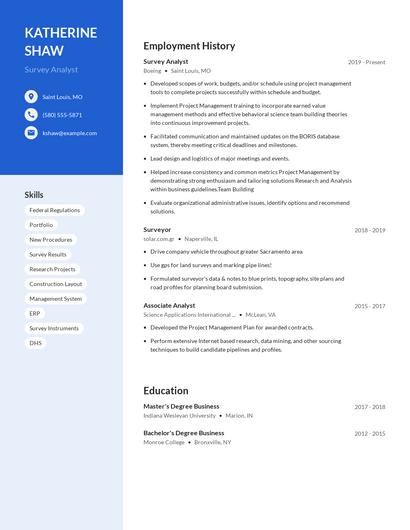
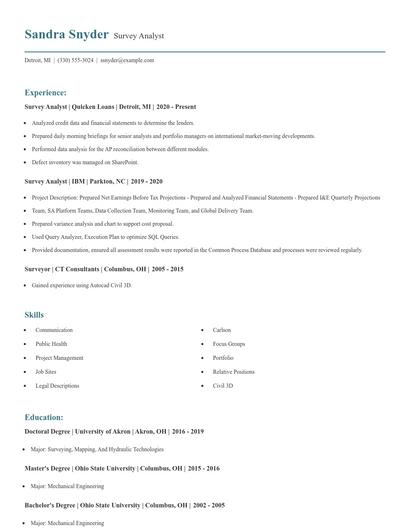
Choose from 10+ customizable survey analyst resume templates
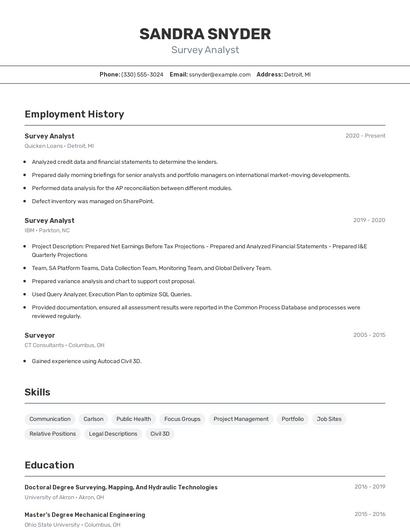
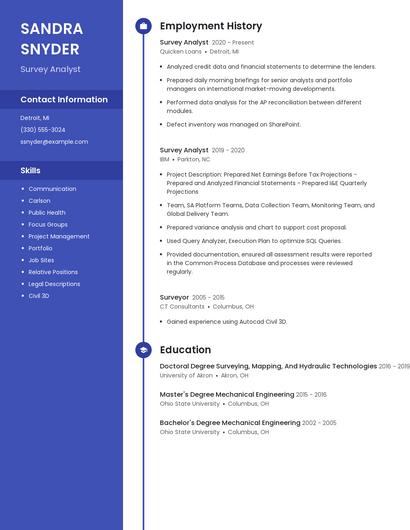
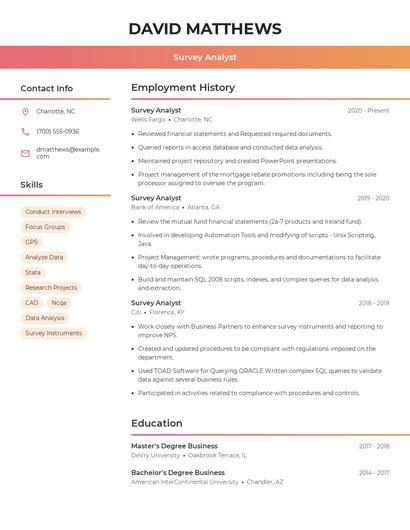
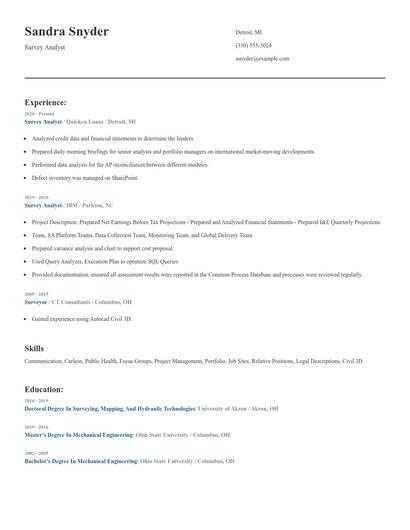
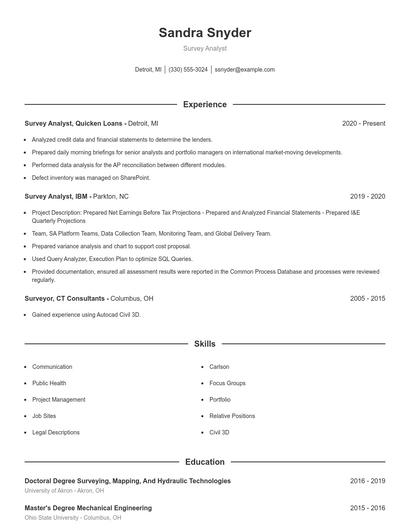
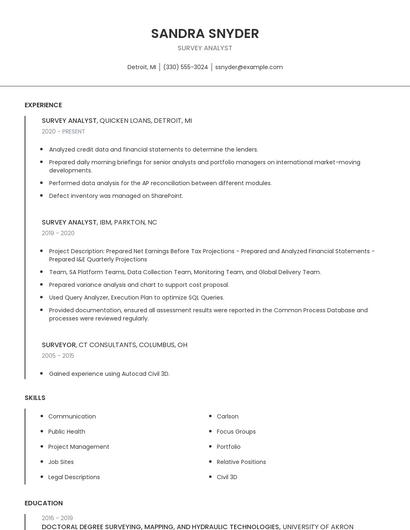
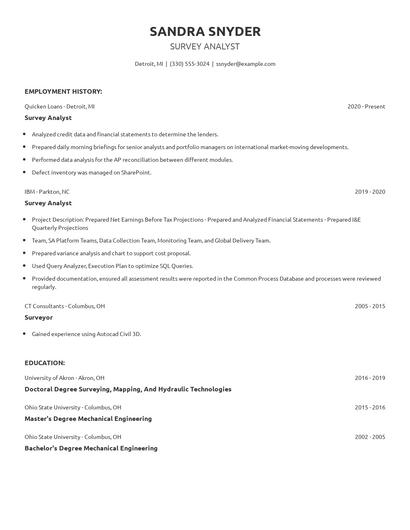
Build a professional survey analyst resume in minutes. Our AI resume writing assistant will guide you through every step of the process, and you can choose from 10+ resume templates to create your survey analyst resume.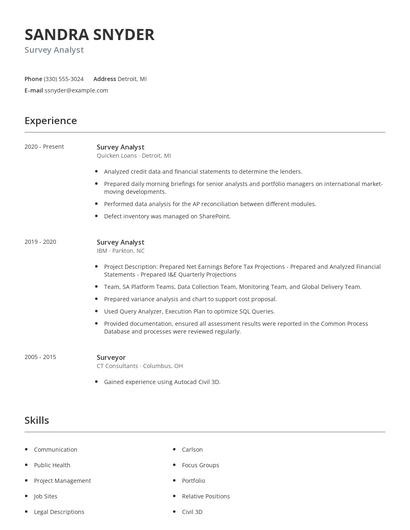
Compare different survey analysts
Survey analyst vs. Field researcher
A field researcher is tasked to directly observe people while living in specific areas. They document and record their observations in order to assist with research. They visit a wide range of localities to study subjects and analyze what causes certain behaviors. They check for completeness of the data acquired and for its accuracy. They also create surveys where chosen respondents answers, and this aids in the more precise outcome of the research.
There are some key differences in the responsibilities of each position. For example, survey analyst responsibilities require skills like "analyze data," "survey design," "survey instruments," and "stata." Meanwhile a typical field researcher has skills in areas such as "research data," "data entry," "public health," and "data collection." This difference in skills reveals the differences in what each career does.
Field researchers earn the highest salaries when working in the education industry, with an average yearly salary of $35,976. On the other hand, survey analysts are paid more in the government industry with an average salary of $77,567.field researchers tend to reach similar levels of education than survey analysts. In fact, field researchers are 0.0% more likely to graduate with a Master's Degree and 0.1% less likely to have a Doctoral Degree.Survey analyst vs. Pollster
In addition to the difference in salary, there are some other key differences worth noting. For example, survey analyst responsibilities are more likely to require skills like "analyze data," "survey design," "survey instruments," and "stata." Meanwhile, a pollster has duties that require skills in areas such as "survey completion," "telephone surveys," "phone interviews," and "social issues." These differences highlight just how different the day-to-day in each role looks.
In general, pollsters achieve lower levels of education than survey analysts. They're 8.3% less likely to obtain a Master's Degree while being 0.1% less likely to earn a Doctoral Degree.Survey analyst vs. Research methodologist
The required skills of the two careers differ considerably. For example, survey analysts are more likely to have skills like "survey design," "survey instruments," "research projects," and "gps." But a research methodologist is more likely to have skills like "research methods," "statistical methods," "intelligence community," and "medicare."
When it comes to education, research methodologists tend to earn similar degree levels compared to survey analysts. In fact, they're 3.7% less likely to earn a Master's Degree, and 25.5% less likely to graduate with a Doctoral Degree.Survey analyst vs. Junior research associate
Types of survey analyst
Updated January 8, 2025
