What does a switch engineer do?
Switch engineer responsibilities
Here are examples of responsibilities from real switch engineer resumes:
- Manage Alcatel and Telecom Egypt technical teams.
- Manage all aspects of DS3 and DS1 connectivity between various equipment and vendors.
- Implement the latest Avaya VoIP technology that lead to cost reduction and improve VoIP features.
- Manage mobile switch for 20-cell CDMA test overlie of Sprint/APC commercial GSM network in Washington D.C.
- Manage, solve and coordinate daily operational support issues for 600 banks and 2400 workstations worldwide.
- Assist RF engineers to ensure the best possible network performance.
- Provide site review and upgrade all phones from Avaya to Cisco and Linux software.
- Perform RF optimization for all platforms including: CDMA, WiMAX, and LTE reducing daily blocks and drops.
- Track negative performance statistics and KPI's to identify chronic system issues for switches and cell sites and respond accordingly.
- Perform switch and DACS translations.
- Perform dacs expansions and loop back testing.
- Involve in the pre-installation activities of ALCATEL E10 exchanges.
- Assist test engineering with test fixture debugging and maintenance.
- Utilize Wireshark to capture data traffic & analyze issues.
- Generate and distribute monthly SLA reports to managers and customers.
Switch engineer skills and personality traits
We calculated that 14% of Switch Engineers are proficient in Switches, MSC, and Software Upgrades. They’re also known for soft skills such as Color vision, Customer-service skills, and Dexterity.
We break down the percentage of Switch Engineers that have these skills listed on their resume here:
- Switches, 14%
Performed troubleshooting and preventive maintenance of switches.
- MSC, 5%
Analyzed data gathered from the MSC (OM) Operational Measurements to determine problems and assist in the resolutions.
- Software Upgrades, 4%
Participated in major software upgrades and correction introduced to the switching system for repair of major faults as well as upgrades.
- VoIP, 4%
Connected and monitored VOIP web powered agents remotely.
- Trouble Tickets, 3%
Facilitate trouble ticket resolution by coordinating support for vendors and field personnel.
- T1, 3%
Performed data 2G data transcript preparation for site integration and channel additions, and T1 provisioning/testing, along with performance monitoring.
Common skills that a switch engineer uses to do their job include "switches," "msc," and "software upgrades." You can find details on the most important switch engineer responsibilities below.
Analytical skills. While "analytical skills" is last on this skills list, don't underestimate its importance to switch engineer responsibilities. Much of what a switch engineer does relies on this skill, seeing as "administrators need to evaluate networks and systems to make sure that they perform reliably and to anticipate new requirements as customers’ needs change." Here is a resume example of how this skill is used in the everyday duties of switch engineers: "verified ss7 continuity by performing icot tests and watching ss7 messaging through inet (ss7 protocol analyzer). "
The three companies that hire the most switch engineers are:
- ICONMA2 switch engineers jobs
- Altice USA1 switch engineers jobs
- Cisco1 switch engineers jobs
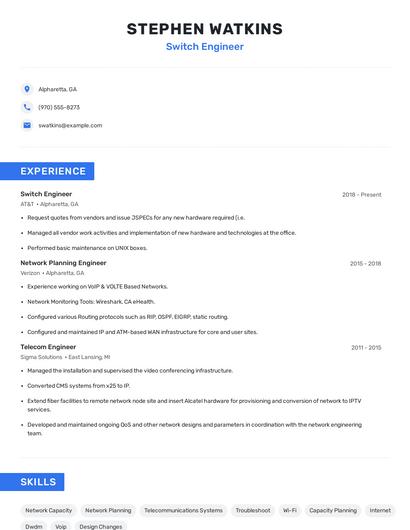
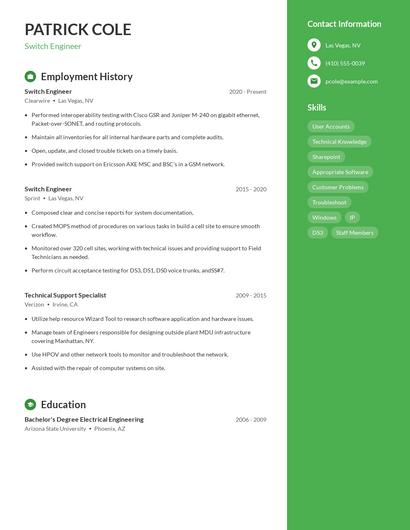
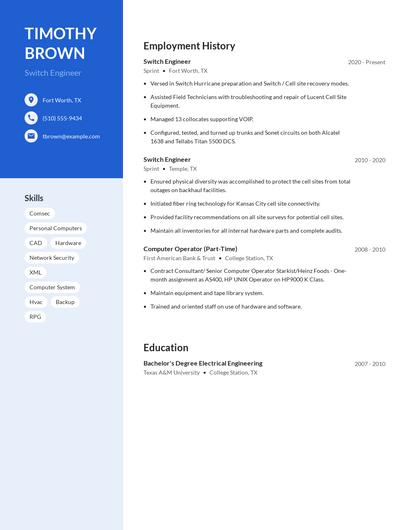
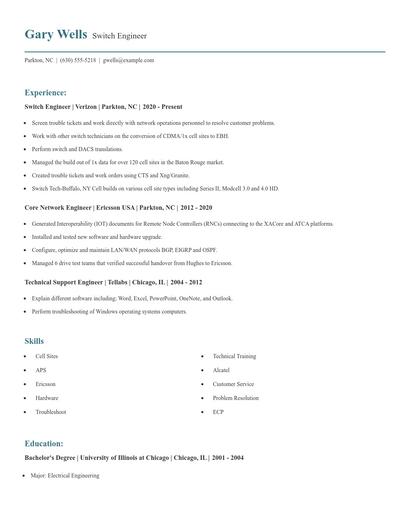
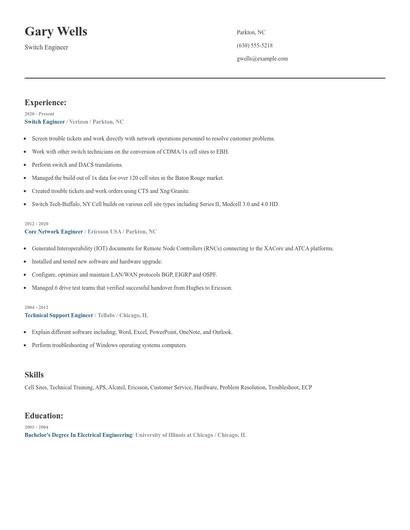
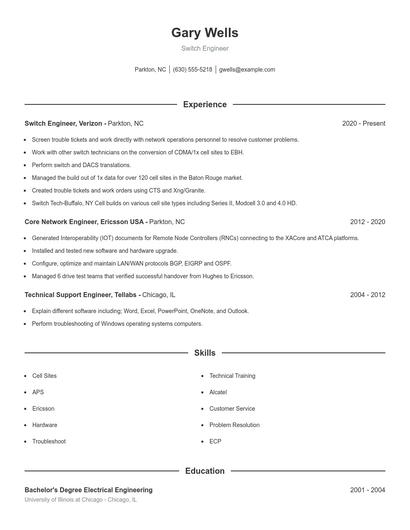
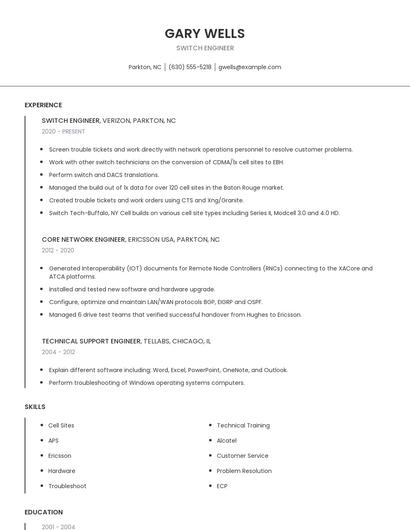
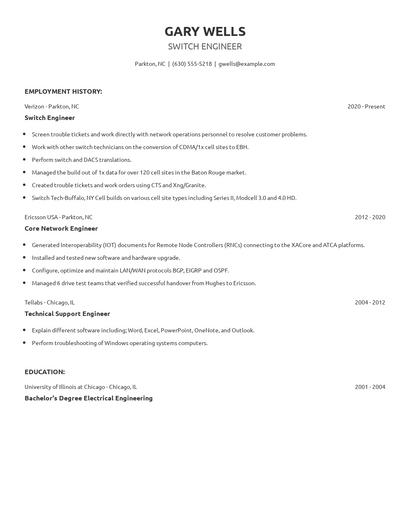
Choose from 10+ customizable switch engineer resume templates
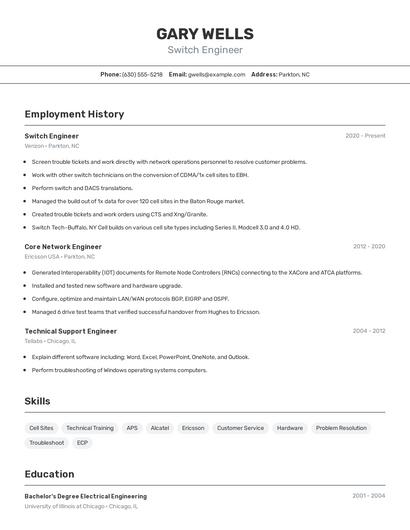
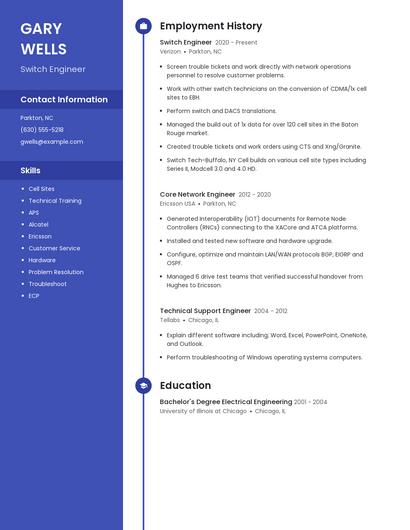
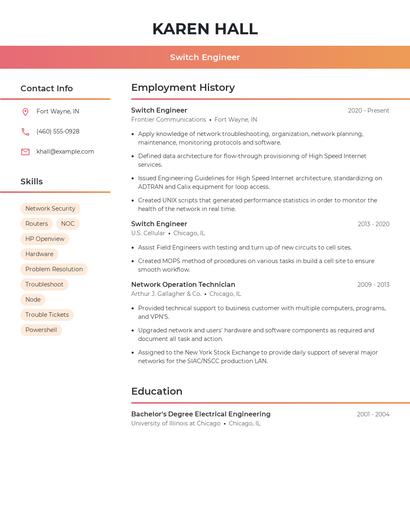
Build a professional switch engineer resume in minutes. Our AI resume writing assistant will guide you through every step of the process, and you can choose from 10+ resume templates to create your switch engineer resume.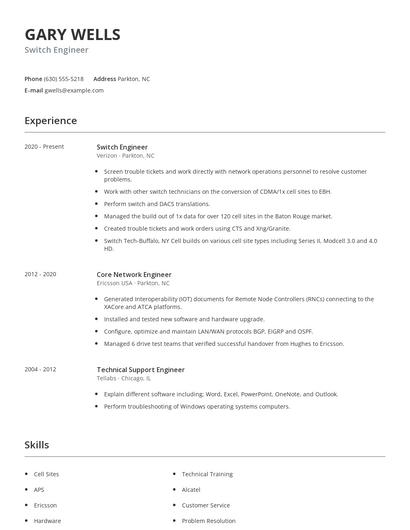
Compare different switch engineers
Switch engineer vs. Administrator
Administrators are administrative professionals who oversee the whole office or department. They manage office activities and supervise administrative functions in the office. They work the office calendar and oversee the appointment-setting process. They coordinate office events and ensure that all preparations are made and that there are no conflicting schedules. They also maintain a database of external providers of various office needs. Administrators also oversee office supplies and prepare purchase requisitions. They also manage janitorial services and other functions that are related to the maintenance of the physical office space. Administrators ensure that all fixtures and equipment in the office are functioning well and have no problems.
These skill sets are where the common ground ends though. The responsibilities of a switch engineer are more likely to require skills like "lan wan," "switches," "msc," and "software upgrades." On the other hand, a job as an administrator requires skills like "customer service," "data entry," "troubleshoot," and "payroll." As you can see, what employees do in each career varies considerably.
Administrators earn the highest salaries when working in the manufacturing industry, with an average yearly salary of $78,798. On the other hand, switch engineers are paid more in the telecommunication industry with an average salary of $99,003.administrators tend to reach similar levels of education than switch engineers. In fact, administrators are 3.1% more likely to graduate with a Master's Degree and 0.9% more likely to have a Doctoral Degree.Switch engineer vs. Information technology administrator
An Information Technology (IT) administrator is an individual responsible for managing the day-to-day operation of an organization's IT systems and ensuring that the systems are running effectively. IT administrators must conduct consistent analyses of the computer system and install updates when needed. They are required to assess the organization's security programs and run the system for viruses and spyware. IT administrators also extend support to the organization's end-users and train them on desktop applications.
While some skills are similar in these professions, other skills aren't so similar. For example, resumes show us that switch engineer responsibilities requires skills like "msc," "trouble tickets," "t1," and "noc." But an information technology administrator might use other skills in their typical duties, such as, "customer service," "troubleshoot," "linux," and "database."
Information technology administrators may earn a lower salary than switch engineers, but information technology administrators earn the most pay in the finance industry with an average salary of $93,678. On the other hand, switch engineers receive higher pay in the telecommunication industry, where they earn an average salary of $99,003.Average education levels between the two professions vary. Information technology administrators tend to reach similar levels of education than switch engineers. In fact, they're 1.7% less likely to graduate with a Master's Degree and 0.9% more likely to earn a Doctoral Degree.Switch engineer vs. Network administrator
A network administrator is responsible for managing an organization's computer systems, ensuring its smooth operations and highest efficiency. Network administrators' duties include inspecting network malfunctions, troubleshooting unresponsive programs, improving system processes, analyzing client's specifications, upgrading existing applications, coordinating with the technology department, and creating a report of network issues resolutions. A network administrator should display a strong command of programming languages. Extensive knowledge in the technology industry and analytical and problem-solving skills to manage network problems immediately is also necessary.
The required skills of the two careers differ considerably. For example, switch engineers are more likely to have skills like "msc," "software upgrades," "trouble tickets," and "noc." But a network administrator is more likely to have skills like "windows server," "troubleshoot," "network hardware," and "routers."
Network administrators earn the best pay in the finance industry, where they command an average salary of $74,936. Switch engineers earn the highest pay from the telecommunication industry, with an average salary of $99,003.Most network administrators achieve a similar degree level compared to switch engineers. For example, they're 1.9% less likely to graduate with a Master's Degree, and 0.1% less likely to earn a Doctoral Degree.Switch engineer vs. Systems administrator
Systems administrators are employees who oversee information technology infrastructures in the office. They are skilled information technology professionals who are knowledgeable about the company's network systems and other technology-related infrastructures. They are responsible for installing, configuring, or updating network systems, software, and hardware. They also monitor the different systems and troubleshoot any issues that users may encounter. Systems administrators manage the access of users, ensure the security of the network, and address any challenges that users may have. They conduct repairs and routine maintenance to ensure that the systems in place are in the best shape.
Even though a few skill sets overlap between switch engineers and systems administrators, there are some differences that are important to note. For one, a switch engineer might have more use for skills like "msc," "software upgrades," "t1," and "noc." Meanwhile, some responsibilities of systems administrators require skills like "linux," "troubleshoot," "windows server," and "database. "
In general, systems administrators earn the most working in the technology industry, with an average salary of $86,962. The highest-paying industry for a switch engineer is the telecommunication industry.The average resume of systems administrators showed that they earn similar levels of education compared to switch engineers. So much so that theyacirc;euro;trade;re 0.3% less likely to earn a Master's Degree and more likely to earn a Doctoral Degree by 0.1%.Types of switch engineer
Updated January 8, 2025
