What does a systems engineer and team lead do?
Systems engineer and team lead responsibilities
Here are examples of responsibilities from real systems engineer and team lead resumes:
- Perform file and operating system backups utilizing TSM and manage SAN storage through EMC attach systems.
- Recruit to establish and manage Virtualization\Storage\Backup environments.
- Used liveupgrade / SVM / VxVM for OS mirroring solutions.
- Deploy new staging and production environments from rack mounting to OS configuration.
- Operate on UNIX platform to verify and validate communication for external segments.
- Perform software development bug fixing using Java, XML, HTML, and SQL.
- Position require in depth understanding of the UNIX operating system and the ability to monitor and troubleshoot network connectivity.
- Deploy several SAN technologies including Dell/EqualLogic.
- Perform troubleshooting analysis of switches, workstations and associate systems.
- Provide both logical and physical diagrams highlighting suggest architecture for web-base applications.
- Develop embedded Linux application and driver for remote upgrade of field equipment.
- Define SOA governance requirements and recommend security standards for ESB authentication and fine-grain role-based authorization.
- Create and maintain a split horizon DNS configuration for service availability and ease of administration access.
- Translate customer needs into product design requirements utilizing technology standards to define system architecture and product features.
- Develop proprietary distribute authentication and DNS system which dramatically improve network performance virtually eliminating all authentication-relate support problems.
Systems engineer and team lead skills and personality traits
We calculated that 9% of Systems Engineers And Team Lead are proficient in Architecture, Project Management, and Java. They’re also known for soft skills such as Creativity, Detail oriented, and Interpersonal skills.
We break down the percentage of Systems Engineers And Team Lead that have these skills listed on their resume here:
- Architecture, 9%
Provide both logical and physical diagrams highlighting suggested architecture for web-based applications.
- Project Management, 6%
Project Management -Voice, data, telecommunications, network installations, implementation, documentation and technical support.
- Java, 6%
Created a daily build and validation process for an enterprise E-Commerce java product.
- System Engineering, 6%
Reviewed and developed System Engineering documents for existing and new interfaces.
- Windows Server, 6%
Installed Microsoft critical/secured patches for all windows NT/Windows servers.
- DOD, 4%
Work with BIMA government on various engineering tasks regarding the Operations of the DoD ABIS.
"architecture," "project management," and "java" are among the most common skills that systems engineers and team lead use at work. You can find even more systems engineer and team lead responsibilities below, including:
Analytical skills. For certain systems engineer and team lead responsibilities to be completed, the job requires competence in "analytical skills." The day-to-day duties of a systems engineer and team lead rely on this skill, as "administrators need to evaluate networks and systems to make sure that they perform reliably and to anticipate new requirements as customers’ needs change." For example, this snippet was taken directly from a resume about how this skill applies to what systems engineers and team lead do: "performed scheduled java software builds and oracle database updates. "
Communication skills. Another crucial skill for a systems engineer and team lead to carry out their responsibilities is "communication skills." A big part of what systems engineers and team lead relies on this skill, since "administrators must describe problems and their solutions to non-it workers." How this skill relates to systems engineer and team lead duties can be seen in an example from a systems engineer and team lead resume snippet: "created and maintained a sharepoint site for improved communications and collaboration between engineers. "
Problem-solving skills. Lastly, "problem-solving skills" is an important element of what a systems engineer and team lead does. Systems engineer and team lead responsibilities require this skill because "administrators must quickly resolve problems that arise with computer networks." This resume example highlights how systems engineer and team lead duties rely on this skill: "tasked with assisting a natural workgroup in the development of a java security solution. "
The three companies that hire the most systems engineer and team leads are:
- Raytheon Technologies11 systems engineers and team lead jobs
- Bank of America4 systems engineers and team lead jobs
- Forrester3 systems engineers and team lead jobs
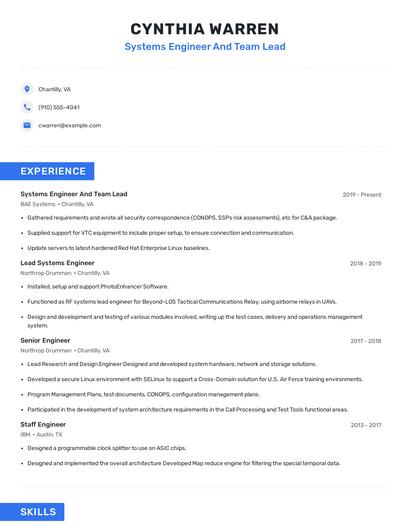
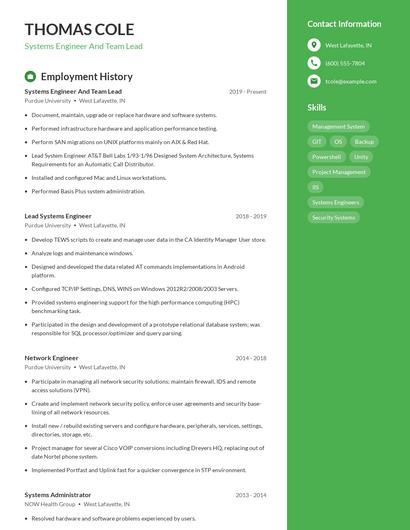
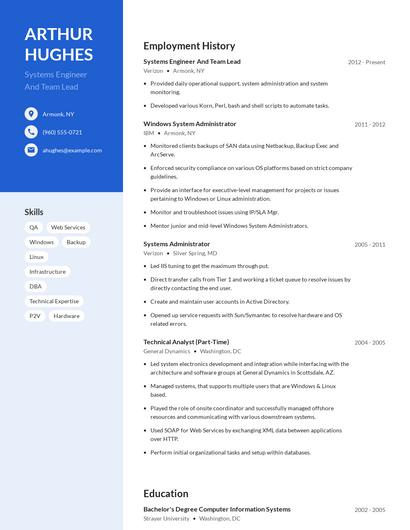
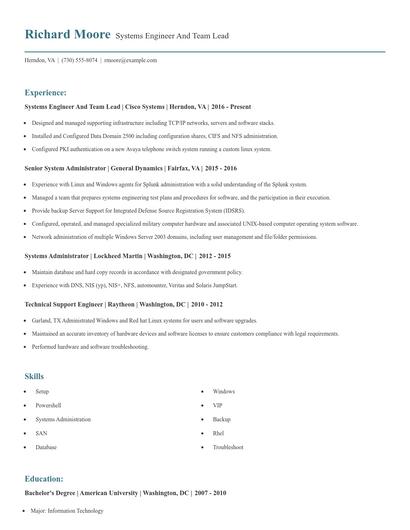
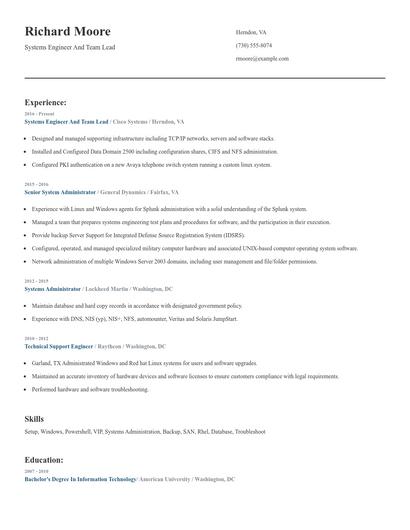
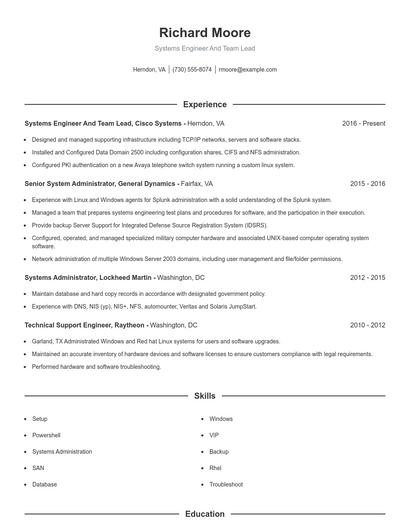
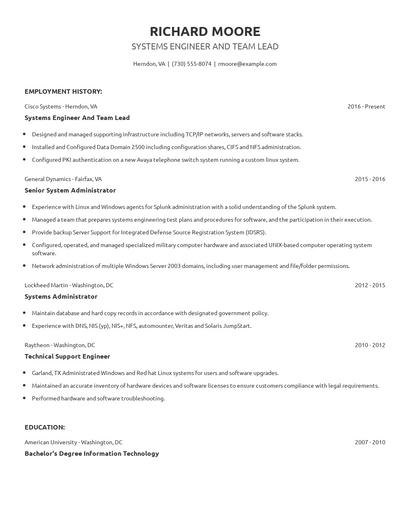
Choose from 10+ customizable systems engineer and team lead resume templates
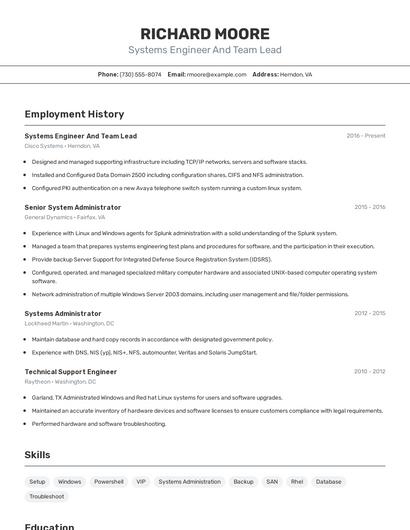
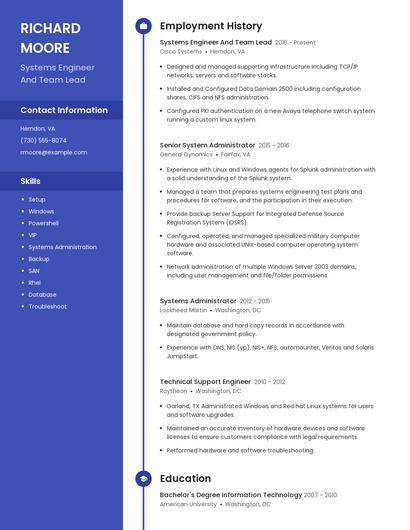
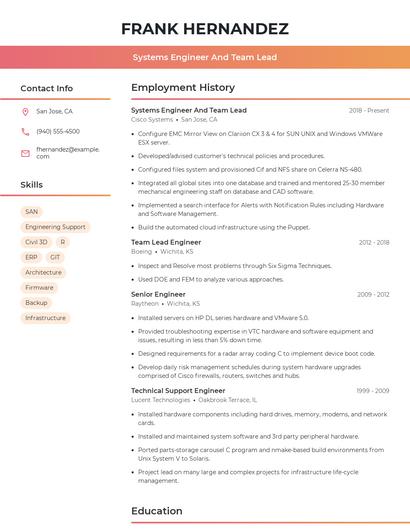
Build a professional systems engineer and team lead resume in minutes. Our AI resume writing assistant will guide you through every step of the process, and you can choose from 10+ resume templates to create your systems engineer and team lead resume.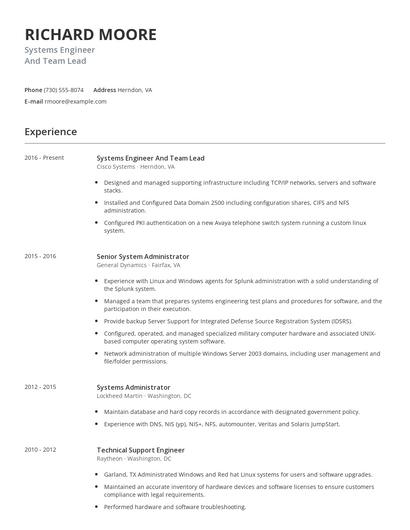

Compare different systems engineers and team lead
Systems engineer and team lead vs. Network engineer
A network engineer is responsible for managing a network system, monitoring its performance, and upgrading its features to optimize performance and boost efficiency. Network engineers also create new systems, designing them based on clients' specifications and business needs. They also check network defects, perform troubleshooting, improve data security systems, and install security updates. A network engineer must have excellent knowledge of the technology industry, as well as a broad understanding of system codes, programming languages, and network configurations.
These skill sets are where the common ground ends though. The responsibilities of a systems engineer and team lead are more likely to require skills like "architecture," "project management," "system engineering," and "dod." On the other hand, a job as a network engineer requires skills like "switches," "troubleshoot," "bgp," and "ospf." As you can see, what employees do in each career varies considerably.
Network engineers tend to make the most money working in the technology industry, where they earn an average salary of $90,927. In contrast, systems engineers and team lead make the biggest average salary, $112,615, in the retail industry.network engineers tend to reach lower levels of education than systems engineers and team lead. In fact, network engineers are 5.1% less likely to graduate with a Master's Degree and 0.5% less likely to have a Doctoral Degree.Systems engineer and team lead vs. Management engineer
A management engineer specializes in designing and developing systems to optimize business or establishment procedures. Their duties typically revolve around coordinating with various departments to obtain necessary data, conducting observations and inspections to determine the strengths and weaknesses of existing processes, executing maintenance checks to ensure the efficiency of services, and performing research and analysis to come up with the ideal solutions. Furthermore, as a management engineer, it is essential to adhere to the company's policies and regulations when making decisions or recommending new systems.
While some skills are similar in these professions, other skills aren't so similar. For example, resumes show us that systems engineer and team lead responsibilities requires skills like "architecture," "system engineering," "network infrastructure," and "system design." But a management engineer might use other skills in their typical duties, such as, "infrastructure," "azure," "ldap," and "customer service."
Management engineers earn a lower average salary than systems engineers and team lead. But management engineers earn the highest pay in the technology industry, with an average salary of $102,884. Additionally, systems engineers and team lead earn the highest salaries in the retail with average pay of $112,615 annually.Average education levels between the two professions vary. Management engineers tend to reach similar levels of education than systems engineers and team lead. In fact, they're 1.6% more likely to graduate with a Master's Degree and 0.5% more likely to earn a Doctoral Degree.Systems engineer and team lead vs. Team lead engineer
A team leads engineer is in charge of spearheading and overseeing the efforts of an engineering team, ensuring efficiency and smooth workflow. Although the duties may depend on one's industry of employment, it typically includes designing and developing systems according to project requirements, setting objectives and construction guidelines, delegating tasks, managing budgets and schedules, and monitoring the workflow, performing corrective measures as needed. Furthermore, as a team leads engineer, it is essential to encourage the workforce to reach goals, all while enforcing the company's safety standards and regulations.
Some important key differences between the two careers include a few of the skills necessary to fulfill the responsibilities of each. Some examples from systems engineer and team lead resumes include skills like "system engineering," "windows server," "dod," and "network infrastructure," whereas a team lead engineer is more likely to list skills in "python," "c #," "infrastructure," and "windows. "
Team lead engineers make a very good living in the technology industry with an average annual salary of $117,918. On the other hand, systems engineers and team lead are paid the highest salary in the retail industry, with average annual pay of $112,615.Most team lead engineers achieve a similar degree level compared to systems engineers and team lead. For example, they're 0.4% less likely to graduate with a Master's Degree, and 0.2% less likely to earn a Doctoral Degree.Systems engineer and team lead vs. Computer engineer
A computer engineer is someone who examines, designs, and manages computer hardware and software systems. He/She or she helps in solving issues or any concerns that may occur with the computer's hardware and software as well as assists in the innovation of computer technology. Computer engineers are responsible for computer hardware design, development, research, and test computer systems. They examine components like circuit boards, processors, memory devices, routers, and networks. While, those working with the computer software are in charge of the development, design, and administration of software programs.
Types of systems engineer and team lead
Updated January 8, 2025
