What does a systems engineer/systems administrator do?
The aspiring person always wants to be a System Engineer. System Engineer or Administrator is an interdisciplinary turf of engineering-based management which is concerned with the system and design update. In the multi-dimensional computer world, System Engineer plays the main role.
Systems engineer/systems administrator responsibilities
Here are examples of responsibilities from real systems engineer/systems administrator resumes:
- Manage phone system voice over TCP/IP NBX 3com switch.
- Manage and administer Microsoft IIS application server for mission essential applications.
- Manage PC and equipment inventory, monitor network performance, evaluate and integrate new technology.
- Coordinate FileNet and EMC system configuration changes, manage disk storage consumption, allocate/mask storage, and document system configurations/changes.
- Verify and correct communication problems using protocols; TCP/IP, SNA, DDM, DNS, FTP.
- Perform code deployments for WMB and Java from the Unix/Linux command line.
- Configure support information for application teams to receive page and email alerts by modifying Perl scripts.
- Deploy programs, security updates and computer and users settings domain wide through GPO's and SCCM.
- Work with adding DNS entries to their DNS servers for virtual servers that are being create for certain projects.
- Assign static IP addresses using DHCP manager, set up outlook, image PCs and set up telnet sessions.
- Determine requirements and complete installations and upgrades of hardware, software, operating platforms, SAN, and network devices.
- Prepare budgets for branch offices, which encompass all computer equipment, routers, hubs and switches need for initial installation.
- Automate tasks using PowerShell scripting.
- Develop environment for JAVA applications.
- Design and deliver technical SAN solutions.
Systems engineer/systems administrator skills and personality traits
We calculated that 7% of Systems Engineers/Systems Administrator are proficient in Windows Server, Troubleshoot, and AWS. They’re also known for soft skills such as Multitasking skills, Analytical skills, and Communication skills.
We break down the percentage of Systems Engineers/Systems Administrator that have these skills listed on their resume here:
- Windows Server, 7%
Deploy, manage, and administer Windows Server Environment (Server 2003, 2008R2 and Windows Server 2012 R2).
- Troubleshoot, 6%
Provide Administration, Support and Troubleshoot in a Linux/Unix technical environment.
- AWS, 4%
Experienced in providing system administration support for over 100 instances hosted in AWS Commercial cloud.
- Database, 4%
Lead administrator, consulted and rebuilt/migrated/implemented/supported database servers, Exchange SharePoint installation, Active Directory, Router, and internal DNS.
- SAN, 4%
Designed and delivered technical SAN solutions.
- PowerShell, 3%
Automated tasks using PowerShell scripting.
Most systems engineers/systems administrator use their skills in "windows server," "troubleshoot," and "aws" to do their jobs. You can find more detail on essential systems engineer/systems administrator responsibilities here:
Multitasking skills. The most essential soft skill for a systems engineer/systems administrator to carry out their responsibilities is multitasking skills. This skill is important for the role because "administrators may have to work on many problems and tasks at the same time." Additionally, a systems engineer/systems administrator resume shows how their duties depend on multitasking skills: "organized work flow while multitasking, critical thinking and solved technical issues troubleshooted and resolved network connectivity issues. "
Analytical skills. Another essential skill to perform systems engineer/systems administrator duties is analytical skills. Systems engineers/systems administrator responsibilities require that "administrators need to evaluate networks and systems to make sure that they perform reliably and to anticipate new requirements as customers’ needs change." Systems engineers/systems administrator also use analytical skills in their role according to a real resume snippet: "administered hyper-v server virtual machines for creation and consolidation of data center. "
Communication skills. systems engineers/systems administrator are also known for communication skills, which are critical to their duties. You can see how this skill relates to systems engineer/systems administrator responsibilities, because "administrators must describe problems and their solutions to non-it workers." A systems engineer/systems administrator resume example shows how communication skills is used in the workplace: "implemented netapp san storage dr solution at national water and sewerage corporation, and uganda communications commission (ucc). "
Problem-solving skills. For certain systems engineer/systems administrator responsibilities to be completed, the job requires competence in "problem-solving skills." The day-to-day duties of a systems engineer/systems administrator rely on this skill, as "administrators must quickly resolve problems that arise with computer networks." For example, this snippet was taken directly from a resume about how this skill applies to what systems engineers/systems administrator do: "provided best practice guidance on setting up and maintaining a solid patching solution using sccm. "
See the full list of systems engineer/systems administrator skills
The three companies that hire the most systems engineer/systems administrators are:
- General Dynamics Mission Systems
181 systems engineers/systems administrator jobs
- General Dynamics141 systems engineers/systems administrator jobs
- CACI International6 systems engineers/systems administrator jobs
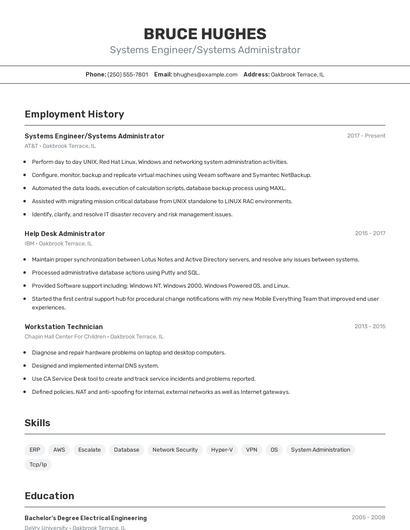
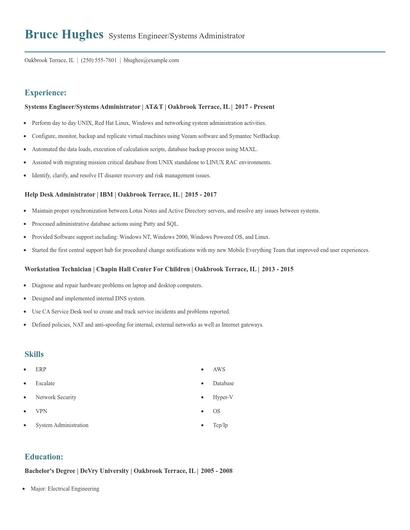
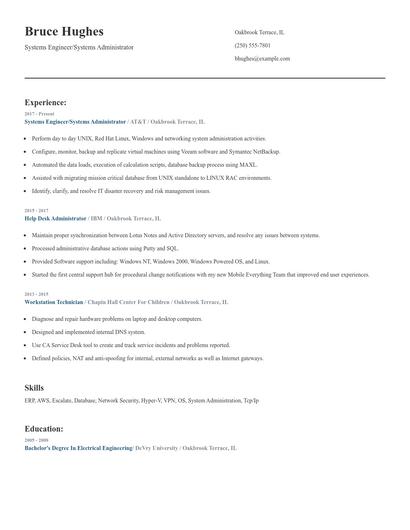
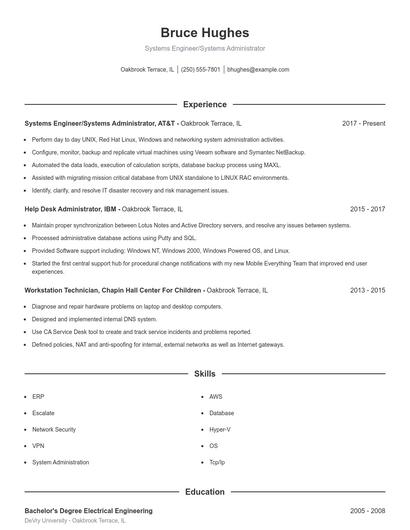
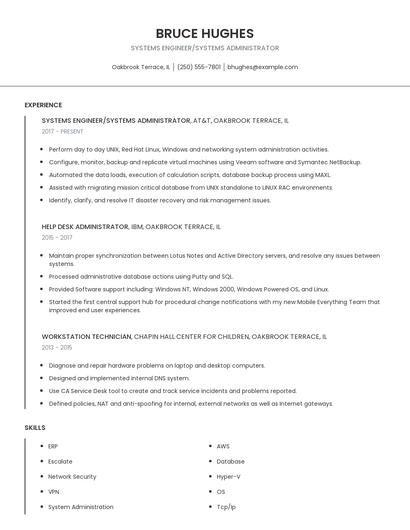
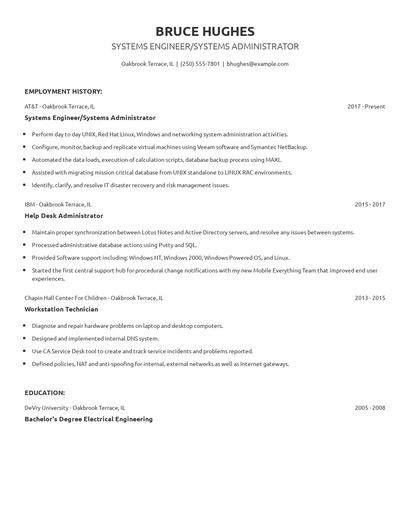
Choose from 10+ customizable systems engineer/systems administrator resume templates
Build a professional systems engineer/systems administrator resume in minutes. Our AI resume writing assistant will guide you through every step of the process, and you can choose from 10+ resume templates to create your systems engineer/systems administrator resume.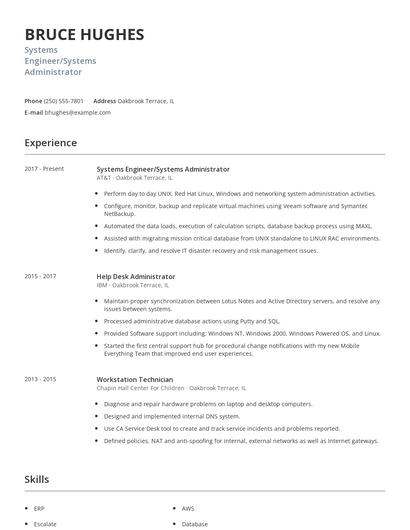


Compare different systems engineers/systems administrator
Systems engineer/systems administrator vs. Systems integration engineer
A systems integration engineer is responsible for evaluating the efficiency and performance of the control systems to support business operations and requirements. Systems integration engineers develop technical solutions from business initiatives that would maximize a team's productivity and increase target performance. They also handle the upgrades of network infrastructure and system configuration and resolve technical failures as soon as they arise. A systems integration engineer must have excellent communication and technical skills, especially in providing recommendations to improve the network's capability and prevent downtimes.
While similarities exist, there are also some differences between systems engineers/systems administrator and systems integration engineer. For instance, systems engineer/systems administrator responsibilities require skills such as "aws," "powershell," "system administration," and "desktop." Whereas a systems integration engineer is skilled in "python," "architecture," "system integration," and "c++." This is part of what separates the two careers.
Systems integration engineers earn the highest salaries when working in the professional industry, with an average yearly salary of $105,674. On the other hand, systems engineers/systems administrator are paid more in the technology industry with an average salary of $101,673.systems integration engineers tend to reach higher levels of education than systems engineers/systems administrator. In fact, systems integration engineers are 5.8% more likely to graduate with a Master's Degree and 0.6% more likely to have a Doctoral Degree.Systems engineer/systems administrator vs. Technical systems engineer
Technical Systems Engineers are responsible for maintaining the integrity of the infrastructure or systems network. They build, maintain, and repair all the systems and network infrastructure of the organization. They troubleshoot problems and find the best possible solution to address such problems. They also ensure that those problems will be resolved and would never be encountered again. Technical Systems Engineers also help out in information technology or network infrastructure projects of other departments. They provide expertise on the systems-related aspects of the project. They help guide project teams on the feasibility and the success factors of the project.
While some skills are similar in these professions, other skills aren't so similar. For example, resumes show us that systems engineer/systems administrator responsibilities requires skills like "aws," "desktop," "configuration management," and "virtual machines." But a technical systems engineer might use other skills in their typical duties, such as, "cloud," "linux," "vmware," and "project management."
Technical systems engineers earn a higher average salary than systems engineers/systems administrator. But technical systems engineers earn the highest pay in the finance industry, with an average salary of $116,420. Additionally, systems engineers/systems administrator earn the highest salaries in the technology with average pay of $101,673 annually.In general, technical systems engineers achieve similar levels of education than systems engineers/systems administrator. They're 1.0% more likely to obtain a Master's Degree while being 0.6% more likely to earn a Doctoral Degree.Systems engineer/systems administrator vs. Software systems engineer
A software systems engineer is responsible for designing and creating software systems applications and programs according to clients' specifications or business' needs. They work to improve the features of existing applications to boost efficiency and optimal performance. Software systems engineers manage systems configuration and structural development to develop high-quality outputs and deliverables. They also run multiple diagnostic tests to ensure smooth navigations and server transitions and identify efficient technical solutions. A software systems engineer assists the end-users with application issues, performing troubleshooting operations, and creating resolution reports for reference.
Some important key differences between the two careers include a few of the skills necessary to fulfill the responsibilities of each. Some examples from systems engineer/systems administrator resumes include skills like "windows server," "troubleshoot," "aws," and "powershell," whereas a software systems engineer is more likely to list skills in "c #," "python," "software development," and "architecture. "
Software systems engineers earn the highest salary when working in the start-up industry, where they receive an average salary of $125,769. Comparatively, systems engineers/systems administrator have the highest earning potential in the technology industry, with an average salary of $101,673.software systems engineers typically earn higher educational levels compared to systems engineers/systems administrator. Specifically, they're 6.1% more likely to graduate with a Master's Degree, and 0.5% more likely to earn a Doctoral Degree.Systems engineer/systems administrator vs. Lan administrator
LAN administrators are responsible for maintaining the local area network of an organization. These administrators manage the server that connects an organization's network to computers and equipment that need them. They install, configure, and troubleshoot the local area network or LAN in a corporate office. It is part of their job to ensure that the internet is available for everyone who uses computers to perform their roles. They also evaluate and recommend the computers, hardware and software, and the equipment needed to create a hack-proof server.
Types of systems engineer/systems administrator
Updated January 8, 2025
